Reonomy review: what the ownership data and the $400-a-month entry price buy
 By Jan Suski. I go deep on every review, checking every number against its source and digging up details other coverage misses, a habit from six years of SEO and link building for tech companies. Bylines at Brand24 and Senuto. How the scoring works.
· Prefer this source on Google
Best for
Commercial brokers, investors and lenders who need to unwind an LLC back to a named owner and reach them by phone, email or mail.
Not for
Anyone who needs lease comps, which Reonomy doesn't collect, and buyers in Poland, where both checkout buttons returned an access-denied page.
What it costs
Plans start at $400 a month and annual billing saves 30%. Annual includes 1,000 exports a month; bulk feeds and the API are quoted by sales.
- Owner
- Altus Group Limited (TSX: AIF), deal announced November 11, 2021
- Acquisition price
- $201.5 million: $198.5 million cash plus $3 million in Altus shares
- Financials at the deal
- $18.3 million trailing revenue and a $16.9 million adjusted EBITDA loss, 12 months to September 30, 2021
- Current branding
- Sold and supported as "Reonomy, an Altus Group business"
- Parent company status
- Strategic review confirmed August 2025, ended November 2025 with Altus staying independent; non-core Analytics divestments planned through 2026
- Properties covered
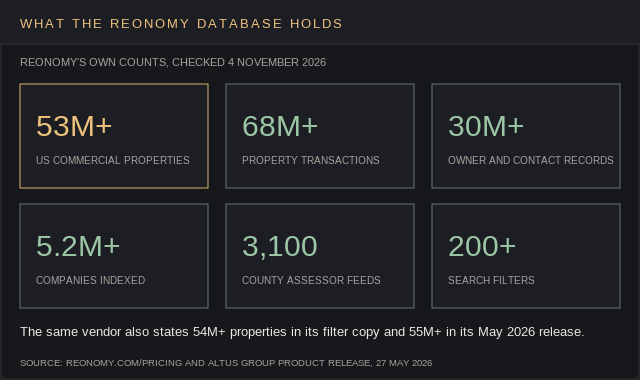
- 53 million-plus U.S. commercial properties
- Transactions covered
- 68 million-plus property transactions
- Companies indexed
- 5.2 million-plus
- Owner and contact records
- 30 million-plus
- Search filters
- 200-plus criteria, applied to a filter universe Reonomy puts at 54 million-plus properties
- Public-record integrations
- Direct feeds from all 3,100 U.S. county assessors and every Secretary of State, plus census data
- Data partnerships
- Cotality and ICE, named directly by Reonomy
- Entry price
- Plans start at $400/month, per the pricing page's meta description
- Monthly plan
- No price on the card; cancel or upgrade anytime; 1,000-export packs sold as an add-on
- Annual plan
- 30% below Monthly, 1,000 exports/month included
- 3-month plan
- Announced May 27, 2026 alongside Monthly and Annual
- Free trial
- One day (24 hours), no payment details, U.S. only
- Bulk data feed / API pricing
- Not published; sales-negotiated only
- Checkout from Poland
- Both Buy now buttons returned "Access denied, Error 16" on November 4, 2026
- Capterra
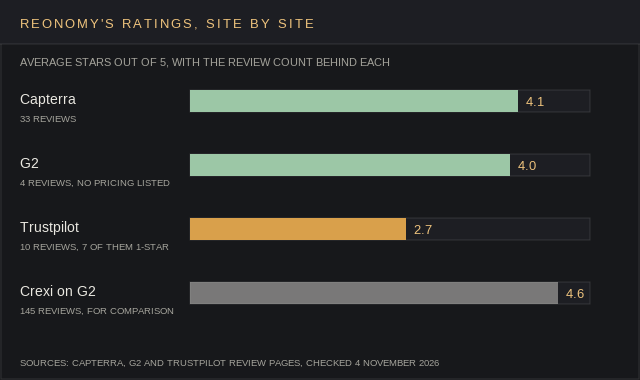
- 4.1/5 across 33 reviews (Ease of use 4.3, Customer service 4.1)
- G2
- 4.0/5 across 4 reviews; no pricing listed
- Trustpilot
- 2.7/5 across 10 reviews, 7 of them 1-star
- Comparable-sales gap
- One appraiser reports roughly 80% of properties in his markets carry no linked comparable sale
- Rural data thinness
- Capterra and G2 reviewers report ownership data thins outside major metros
- Post-cancellation billing
- Two Capterra reviewers, filed 14 months apart, each report a charge after confirmed cancellation
Alternatives to Reonomy
Cherre
Not forA broker who needs one owner's phone number today, which is the job Reonomy is built for.
Cotality
Not forBrokers chasing the person behind an LLC, since that layer is what Reonomy adds on top of Cotality's records.
Pairs well with Reonomy
Which Reonomy figures are the company's own numbers
The 53 million-plus properties, 68 million-plus transactions, 30 million-plus owner and contact records, 5.2 million-plus companies and 200-plus filters are Reonomy's own counts, and its pages state the property total three ways (53M+, 54M+ and 55M+). The $400 starting rate appears only in the pricing page's meta description. Checked 4 November 2026.
Reonomy is a commercial real estate data and property intelligence platform built around one question: who owns this building, and how do you reach them? Altus Group, the Toronto-listed real estate software company, bought Reonomy for $201.5 million in November 2021 and has run it as a standalone product line since.
The platform pairs public records, county assessor filings and machine learning to unwind LLCs and trusts back to a named owner, then hands a broker or investor a phone number, an email address and a mailing address to go with it.
This review covers what the 53 million-property database contains, what it costs under Reonomy's own May 2026 self-serve pricing, and where the ownership and contact data breaks down according to the 33 Capterra reviewers and four G2 reviewers who paid for it. It also covers the billing complaints that recur on Capterra and Trustpilot, since they shape if an annual commitment is a fair trade for the data.
It's built for real estate professionals such as commercial brokers, investors, lenders and appraisers who need to source off market properties or track down a decision-maker hiding behind a holding company. It's a weaker fit for anyone who also needs lease comps, since Reonomy doesn't collect them at all.
Reonomy spent most of its life as a demo-gated, sales-led product. On May 27, 2026, Altus announced self-serve Monthly, 3-month and Annual plans, and the pricing page now carries a "Buy now" button on its Monthly and Annual cards. That timing matters: 19 of the 25 reviews on Capterra's first page were posted between September 9 and September 18, 2020, nearly six years before self-serve checkout existed.
↑ FACT SHEETWhat Reonomy's ownership data and public records cover
The core product is a search engine over 53 million-plus U.S. commercial properties, built from assessor records pulled directly from all 3,100 U.S. counties and every Secretary of State, plus census data. That's the part of the pitch that used to mean building a list from scratch, stitching property data together from disparate data sources by hand, county by county, across an industry where no single public database covers the country.
Our ranking of real estate data providers lines Reonomy up against the other national commercial property datasets.
Reonomy also names two data partnerships directly: Cotality (the rebranded CoreLogic) and ICE, on top of data from other third party providers it doesn't name. A search returns building characteristics like square footage, asset class, year built, lot size and zoning.
That pairs with a full transaction history and sales history across 68 million-plus records, covering sales, debt, liens and refinances, handing buyers that detailed information down to the parcel level. A Capterra reviewer in marketing notes that users "can see when a loan is coming due," which is the mortgage-maturity signal lenders and debt brokers buy it for.
The search itself runs on over 200 advanced search filters, by Reonomy's own count. The property counts don't agree with each other, though: the same pricing page says 53 million-plus in its headline counter and 54 million-plus in its filter copy, and Altus's May 2026 release says 55 million-plus.
Live access to that same data comes through an API built for custom workflows, delivering up to 1 million properties per request, priced through a sales conversation separately from the web app.
Finding the human behind a shell LLC by hand is a needle in a haystack, and the ownership layer is the part Reonomy leads with. Machine learning algorithms, what Reonomy and Altus both market as artificial intelligence, parse recorded deeds, LLC filings, trust documents and other ownership records to connect a corporate name back to an individual signer, then map the ownership portfolios that same signer controls across every parcel those property owners hold.
Reonomy's own pricing page says its machine learning "unwinds shell entities, holding companies, and trust structures," and ranks phone, email and mailing contact information by reliability so users call the likeliest responders first.
"What I like most about this software is it's ease of use in finding the business owner and the mailing address. I also like the fact that I can look up other businesses that are owned by the same business owner and see what their portfolio consists of."
Admin assistant/researcher, real estate, Capterra review, September 18, 2020
↑ FACT SHEETReonomy cost: pricing plans, the free trial, and what's still quote-only
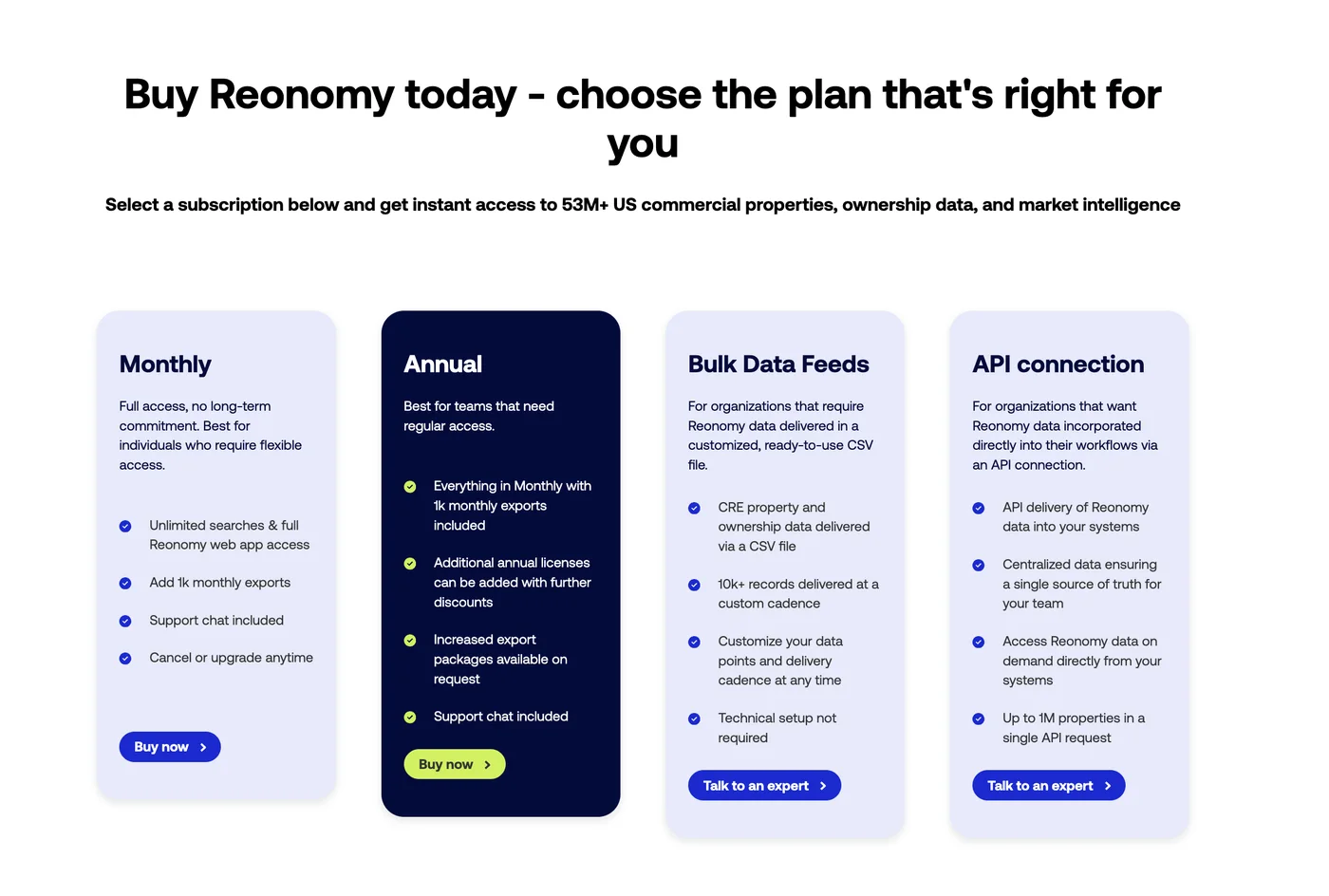
Altus's May 2026 release lists three subscription plans: Monthly, a 3-month term and Annual. The reonomy.com pricing page today shows Monthly and Annual cards next to Bulk Data Feeds and an API connection, and neither subscription card prints a price.
A buyer has to read between the lines: the only dollar figure on the website sits in its meta description, which says plans "start at $400/mo," and the FAQ says annual billing saves 30%. If $400 is the annual seat, that 30% puts month-to-month near $571, about $2,057 more per seat across a year.
The annual subscription folds 1,000 exports a month into the seat, while Monthly users add export packs on top. Pricing is per user, and the company says larger commercial real estate teams can negotiate discounts.
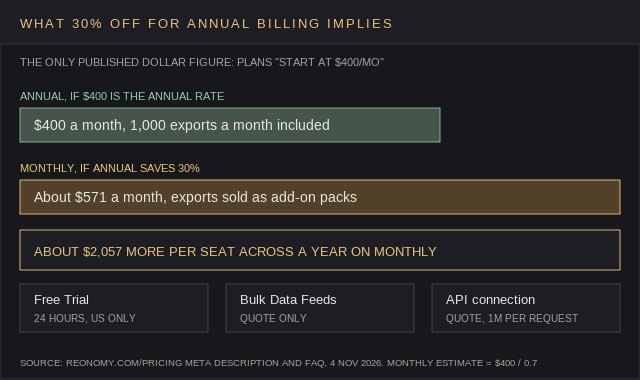
The trial period runs one day: 24 hours of full access from activation, no payment details, U.S. only. CRE professionals fill in role, company size and property types, and accept Reonomy's Master Subscription Agreement before the clock starts. That's enough to check ownership data and owner contact information in a market you know, mostly for lead generation, and a race against time for testing a full prospecting cycle.
What happened when I clicked Buy now from Poland
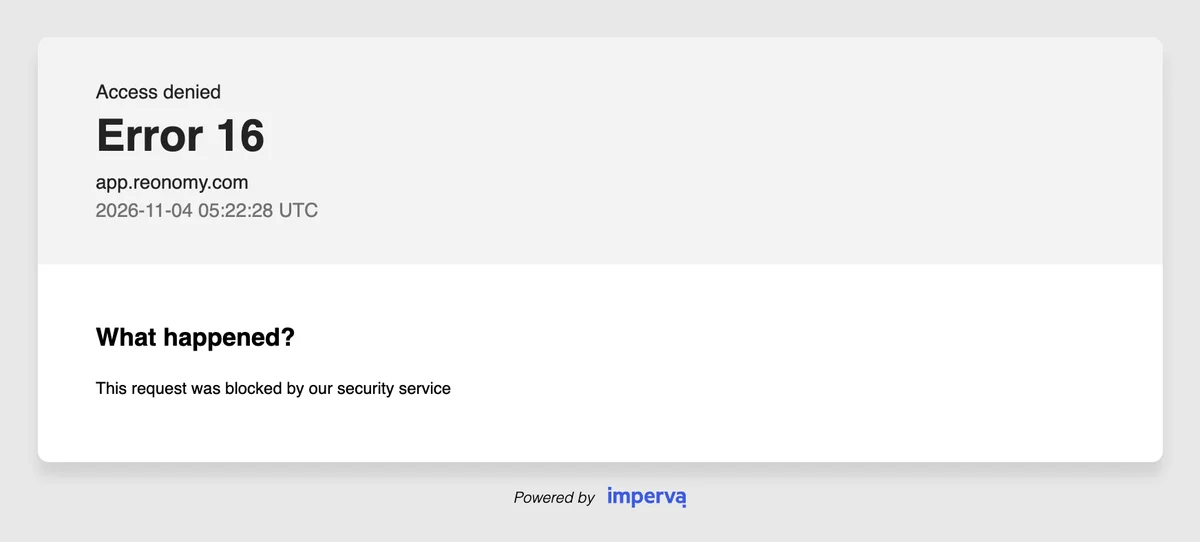
I tested the self-serve route myself on November 4, 2026. From Poland, where I'm based, I clicked the "Buy now" button on the Monthly card and then the one on the Annual card. Both sent me to app.reonomy.com, and both stopped on the same page: "Access denied, Error 16," with "This request was blocked by our security service" underneath and an Imperva footer.
The two timestamps read 05:22:28 and 05:22:41 UTC. So I, a buyer in Poland, could not purchase the self-serve plan. A geo-block is the most likely cause, since the free trial is already limited to U.S. users. A security rule tripping on my network would produce the same page, and from the outside I can't tell the two apart.
Either way, it's a poor first impression for a product sold as self-serve. The checkout button was the whole point of the May 2026 change, and on my first try it led to an error page.
What still isn't published anywhere on Reonomy's website is bulk data feed and API connection pricing, along with other services like larger export packages, all routed through a sales conversation.
A cheaper "individual" tier near $49 a month still circulates on older third-party pricing roundups. Reonomy's own pricing page lists exactly four options today, Monthly, Annual, Bulk Data Feeds and API connection, and the only number it publishes is the $400-a-month starting rate. Our Reonomy pricing report tracks the plan terms and export limits in more detail.
Search demand barely moved when the self-serve plans went live. DataForSEO's Google Ads data, pulled November 4, 2026, puts U.S. searches for "reonomy pricing" at 320 a month in January and February 2026 and 210 a month from May through July, against 1,900 a month for "reonomy login" and 6,600 for the brand name itself.
Reviewers who bought before the May 2026 self-serve plans had a harder time judging value against price. "For what you get, the price could/should be better," wrote an investor in a Capterra review from September 2020.
A manager who rated it 1 out of 5 in a Capterra review from March 2023 put a figure on the complaint: "really bad experience for $500.00." A broker on Trustpilot wrote in June 2022 that he was quoted $4,400 to get started and went looking for cheaper alternatives.
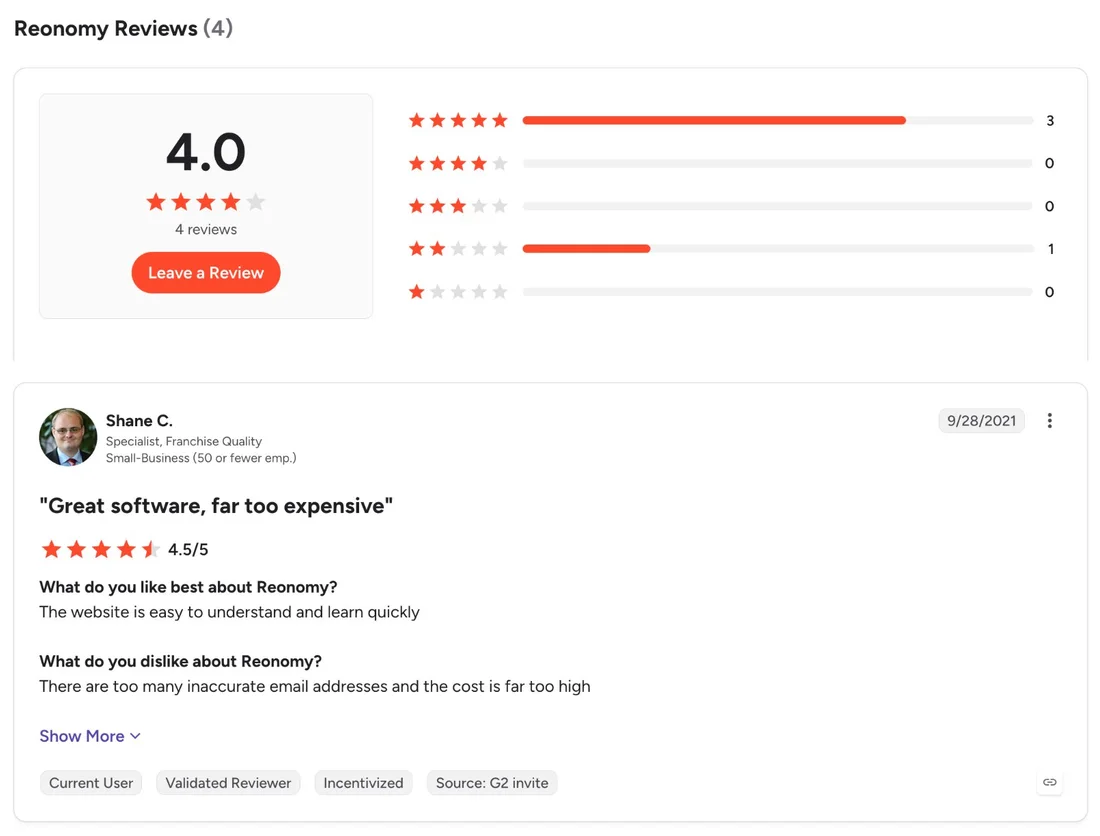
G2 shows no price for Reonomy; its pricing panel reads "Pricing details for this product isn't currently available." The cost complaint shows up there as well. Shane C., a franchise-quality specialist at a small business, titled his September 2021 review "Great software, far too expensive" and still gave it 4.5 out of 5.
"There are too many inaccurate email addresses and the cost is far too high"
Shane C., Specialist, Franchise Quality, small business, G2 review (incentivized), September 28, 2021
↑ FACT SHEETWhere the ownership and transaction data breaks down
The largest documented gap sits in comparable sales. One reviewer, a commercial appraiser who has used the platform for one to three years, put a number on it directly:
"We find that 80% of the properties in your system do not have a link to 'comparable sales' of similar property types, or comparable sales in the mapped location. We could add several hundred comparable sales, from our files, but see no way to upload that kind of information [...]."
President and CEO, real estate, Capterra review, September 10, 2020
Classification errors are par for the course when the source is a county assessor. A loan clerk who writes evaluations for religious facilities said the property type "isn't always categorized correctly," and blamed "the way the assessor reports the property."
Geography drives the ownership-accuracy gap. A managing director at a commercial brokerage split it cleanly between metro and non-metro markets:
"Certain states that don't contain large cities, the ownership information is not always accurate. However, the Tri-state, Chicago, Florida, California etc all of that information is 100% Accurate."
Managing director, commercial real estate, Capterra review, September 16, 2020
An investor, in a Capterra review from September 2020, put the failure rate in his own markets at "80% of the time not accurate," adding that missing or wrong owner data meant "a real hard time actually getting to the owners with the contact info on Reonomy."
G2, with only four reviews, carries the same rural caveat. Becky J., a small-business user who gave Reonomy 5 out of 5 under the title "I use it every day!", still flagged it:
"Since Reonomy goes by addresses, it's sometimes hard to find the property name. Also, in the more rural areas, there is not always a lot of information because the county doesn't have that much information."
Becky J., small business, G2 review (incentivized), April 1, 2021
Vacant land searches drew the sharpest complaint on file: a commercial realtor, also in a Capterra review from September 2020, rated the land-search feature "95% inaccurate" and said properties that the likelihood-to-sell score, the platform's predictive analytics feature, flagged as high were routinely ones already developed.
An analyst added that it is "a bit slow to update the sales of the property," so the sales history and transaction history behind recent ownership changes can lag.
We counted the complaint themes across the 25 reviews on Capterra's first page (sorted by most helpful, checked November 4, 2026). Fifteen name data accuracy or coverage in their cons, six name price, three ask for CRM or team features and two describe being charged after cancelling.
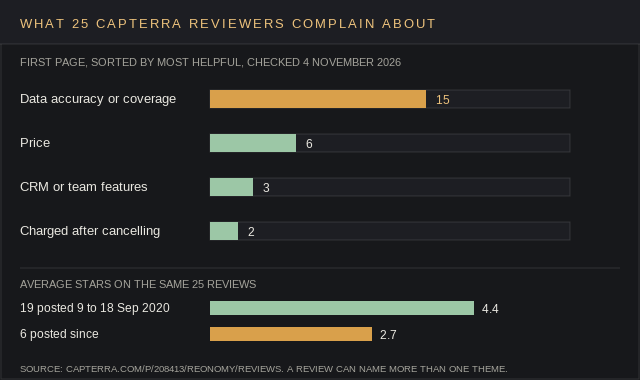
The devil's in the details. Reviewers who put their own number on accuracy range from "80% of the time not accurate" to "99% reliable," with "about 50/50," "over 85% accurate" and "95% accurate" in between. The 19 reviews posted between September 9 and 18, 2020 average 4.4 stars, while the six posted since average 2.7.
↑ FACT SHEETCancellation and the billing complaints behind the review scores
A 1-star and a 2-star review on Capterra, filed 14 months apart, describe the same pattern: a cancellation followed by a charge anyway.
"After canceling my subscription well in advance of the notice period and receiving multiple confirmations that my account would NOT renew, Reonomy still continued to charge my card without authorization[,] to the tune of over $1,000. This is not a billing error. This is predatory and unethical behavior."
Developer, real estate, Capterra review, April 2025
An independent contractor filed a near-identical complaint 14 months later, in a Capterra review from June 2026: "I canceled my membership at the end of one month and they charged me for another month. Plus the bad contract info." The same review's cons list adds "Numerous bounced emails and phone numbers that were no longer in service."
Trustpilot shows the same complaint at a higher rate. Reonomy's Trustpilot page holds 10 reviews at a 2.7 TrustScore, and 7 of the 10 are 1-star. Billing and auto-renewal is the most common theme: reviewers describe 12-month contracts that renew automatically and charges after cancelling, and one says they were threatened with collections over a disputed renewal in September 2024.
None of the reviews on that first page carries a reply from the company. For anyone signing an annual contract, that's a red flag worth weighing before the first invoice.
What users praise
The strongest praise on file comes from independent brokers who built a full deal pipeline on the platform alone.
"100% of my listings were sourced using Reonomy. Cold calling takes a lot of time and work and it's really not the most fun part of my business, but Reonomy makes it as bearable as possible and drives my firm's success."
Broker/Owner, real estate, Capterra review, September 9, 2020
Users also praise the learning curve. A managing director wrote in September 2020 that "it takes about 20 minutes to learn the whole program," so a new hire can hit the ground running.
A commercial sales associate wrote that finding the right owner information had been the biggest problem, and that they "closed deals with it." A broker the same month called it a "Team friendly tool that helps us track conversations, database strategies and really focus on property locations," and a marketing reviewer said a requested owner-portfolio feature shipped "within 4 months."
The team-side complaints land elsewhere. A general manager wrote that "there is no good way to keep track of leads or any type of CRM capability," and a principal listed "Lack of features to collaborate as teams" and "Lack of integration with our CRM." That gap costs more in day-to-day operations for a commercial real estate team splitting the work than it does for a solo user, and 3 of the 25 first-page Capterra reviews raise those concerns.
On G2, the only 2-star review, from an enterprise commercial-division associate in May 2019, singles out the export function.
↑ FACT SHEETOwnership: Altus Group's 2021 acquisition and what it changed
Altus Group announced the deal on November 11, 2021, with closing set for the next day: $201.5 million on a cash-free, debt-free basis, split as $198.5 million cash and $3 million in Altus common shares issued to Reonomy employees. At the time, Reonomy's trailing twelve-month revenue to September 30, 2021 stood at $18.3 million, against an adjusted EBITDA loss of $16.9 million.
That's a price of about 11 times trailing revenue for a company still losing nearly a dollar for every dollar it billed.
The parent has changed more than the product since. Altus confirmed a strategic review in August 2025 after media reports of a possible sale. On November 6, 2025, CEO Jim Hannon left and former CEO Mike Gordon came back as executive chair, and the company said the review ended with a decision to stay independent as a pure-play CRE data and analytics platform.
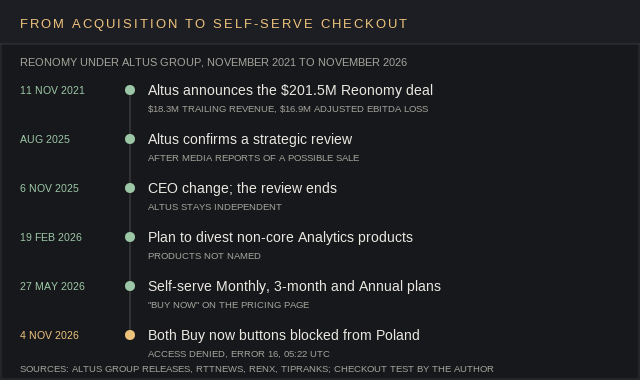
Altus's fiscal 2025 results, released February 19, 2026, say it plans to divest non-core Analytics products throughout the year without naming them. The jury's still out on which products go, so a buyer signing an annual Reonomy contract is buying from a parent company still pruning its line.
The most visible change for a buyer arrived in May 2026 with self-serve checkout, four and a half years after the deal closed. Nearly everything the platform's 33 Capterra reviewers say about price was written under the old sales-led model.
Reonomy vs the alternatives
Reonomy competes on ownership resolution, property intelligence and market analysis. Lease data and listings depth belong to other vendors, and five names come up most often against it.
Cherre takes a different approach: it connects data from outside vendors into one hub, and its platform resolves more than four billion entities, by its own count. RealPage completed its acquisition of Cherre on July 14, 2026, on undisclosed terms, billing the combination as an AI-powered intelligence platform.
Cherre suits a data team stitching several vendors into one pipeline, and Reonomy suits a broker who needs one owner's phone number today. Cherre publishes no rate card, and every quote is built on the buyer's needs and data volume. Read the full Cherre review.
Cotality, the company formerly known as CoreLogic, is one of Reonomy's own named data partners, and also sells its own property records covering residential and commercial parcels. A buyer already paying for Cotality's feed will find much of Reonomy's base data familiar, so the case for adding Reonomy rests on its LLC-piercing ownership layer. Cotality publishes no rate card either, and sells to lenders, insurers and large enterprises. See the Cotality review.
CoStar is the commercial real estate lease and comps database most Reonomy buyers weigh it against, and the name draws 110,000 U.S. Google searches a month against 6,600 for "reonomy," per DataForSEO. Our CoStar pricing report breaks down what a seat costs.
Several Capterra reviewers who evaluated both ranked Reonomy above it, one on price and one on interface. An analyst, in a Capterra review from July 2021, wrote "for the money this is a great software and has many features compared to Propertyshark or Co-Star." A broker's associate, in a Capterra review from September 2020, called the interface "superior to CoStar in my opinion."
A vice president added that "The pricing compared to similar products, was a major factor in our decision to purchase." Neither reviewer disputed CoStar's data depth.
CompStak crowdsources lease comps from more than 40,000 brokers, appraisers and researchers, by its own count, capturing lease-level tenant detail that Reonomy's public-record model can't reach, since lease terms rarely sit in a county filing. Reonomy carries some occupant and tenant data from the same public filings, but it runs thinner than CompStak's crowdsourced, lease-level detail.
Reonomy's sales-comp coverage overlaps with CompStak's, and CompStak now markets a Knowledge Graph that it says unmasks ownership structures, so the ownership gap between the two is one to keep an eye on. CompStak's comparison page states that Reonomy does not include lease comps. A brokerage negotiating leases needs CompStak, and a team sourcing off-market deals from an owner list is Reonomy's core buyer.
Crexi runs a commercial property listings marketplace and carries a stronger G2 rating than Reonomy: 4.6/5 across 145 reviews against Reonomy's 4.0/5 across 4. Crexi's marketplace reach helps a seller listing a property, and Reonomy's contact data helps a buyer working from an owner list they already built.
A handful of other names turn up in searches for Reonomy alternatives that don't hold up as direct competitors. PropertyRadar covers commercial and residential ownership data too, and its current pricing runs $119 to $599 a month on monthly billing across its Solo, Team and Business plans. The $50-a-month figure older roundups still repeat is out of date.
BatchData sells property and owner data mostly to a residential and skip-tracing audience. Its pricing page starts the Property Data Growth plan at $1,000 a month for 100,000 records, which makes it a bulk contact-data add-on for teams that already know their targets.
Entrata, a property management suite, and QuantLens both surface in generic "Reonomy alternatives" lists on review sites, and neither offers ownership resolution for a commercial broker's workflow. A broker shopping them for owner lookups is barking up the wrong tree.
For the wider field, our real estate intelligence platforms ranking, the ATTOM Data pricing report and our real estate statistics report cover the vendors and market numbers this review leaves out. The real estate industry guide explains where ownership data sits in an investor's research stack.
Verdict
Reonomy is for a broker, investor or lender who needs to find the owner behind a commercial property and get a working phone number or email for them, at a database scale (53 million-plus properties) that few standalone tools match. The May 2026 self-serve plans removed part of the pre-purchase friction: a buyer can now start a seat without a demo, though the pricing page still prints only a $400-a-month starting figure.
From Poland, both of my checkout attempts on November 4, 2026 ended on an access-denied page.
It's a poor fit for anyone whose workflow depends on lease comps, since that data doesn't exist in the product at any price. It's also a poor match for a buyer who can't tolerate an annual commitment without a documented, fast exit.
Two Capterra reviewers describe being billed after cancelling, 7 of 10 Trustpilot reviewers gave it 1 star with auto-renewal the most common complaint, and the parent company is still divesting products. Put any cancellation request in writing and keep the confirmation.
Buyers in major metros, where reviewers rate ownership data as "100% Accurate," get the clearest return. Buyers working smaller or rural markets should budget time to verify Reonomy's property owners and contact records against a second source before treating them as final, since accuracy complaints cluster there specifically.