Reonomy pricing in 2026: plans, exports, API costs and what buyers report
 By Jan Suski. I go deep on every review, checking every number against its source and digging up details other coverage misses, a habit from six years of SEO and link building for tech companies. Bylines at Surfer, Brand24, and Senuto. How the scoring works.
The numbers Reonomy plans, data products and ownership, checked 6 October 2026
An Annual seat costs the same as 8.4 Monthly payments, because a 30% saving on 12 payments leaves 8.4 of them.
A Monthly seat ships with zero exports, so anyone pulling owner lists pays for an export pack on top of the seat.
Altus paid 11 times Reonomy's trailing revenue in 2021, and the subscription line is how it earns that back.
Reonomy sells two self-serve subscriptions, Monthly and Annual, and its pricing page prints no dollar figure for either. The one number it publishes is a ratio: annual billing saves 30% against monthly. Bulk data feeds and the API connection go through sales. That's the Reonomy pricing model as it stood when we checked the page on 6 October 2026.
This report covers what each tier gates, what Altus Group paid for the company, what the published structure lets you calculate, and what users on Capterra, G2 and Wall Street Oasis say they paid or fought over. It's written for CRE brokers, investors, lenders and property managers sizing a seat before the sales call, and for teams pricing the API against a bulk feed.
The figures matter because Reonomy's own pages disagree with each other on the size of the database, and the checkout itself sits behind a bot wall. A buyer has to read between the lines of the plan cards to know what a year costs.
How Reonomy pricing works in 2026
Reonomy charges per user. The FAQ on the pricing page says pricing is "typically structured on a per-user (seat-based) model," with discounts for larger teams based on team size, use case and level of engagement. Two subscriptions can be bought online. Two more go through sales.
The buy-online route is new. On 27 May 2026 Altus Group posted a product release announcing that customers could create an account and pick a subscription "with no sales or customer success team involvement required." Straight from the horse's mouth, that release listed three options: Annual, 3-month and Monthly.
The page we checked on 6 October 2026 lists two of them. The middle term dropped off the page under the radar, with no release explaining it. Both Buy now buttons route to app.reonomy.com, which returned an Incapsula bot-protection block page to our browser, so any figure the checkout shows sits one click past a wall.
Reonomy subscriptions and data products, one by one
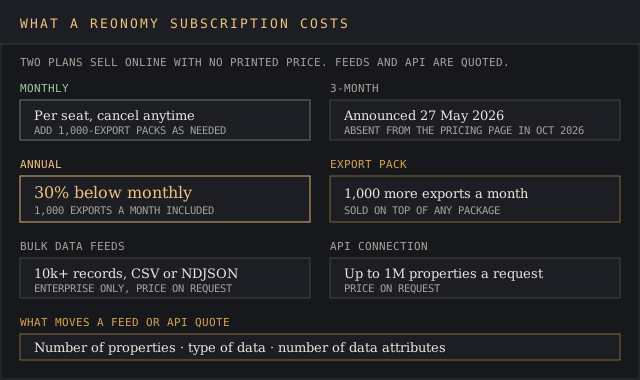
| Option | How you buy | Exports | Commitment | Price shown online |
|---|---|---|---|---|
| Monthly | Online checkout | 0 included, 1,000-export packs added | Cancel or upgrade anytime | No dollar figure |
| 3-month | Announced 27 May 2026 | Not stated | One quarter | Not listed |
| Annual | Online checkout | 1,000 monthly included | 12 months | 30% below Monthly |
| Bulk data feeds | Sales | 10k+ records a delivery | Enterprise customers only | Quote |
| API connection | Sales | Up to 1M properties a request | Contract | Quote |
Every cell comes from Reonomy's pricing page, read on 6 October 2026, and from Altus Group's product release of 27 May 2026. Reonomy prints no dollar figure for any option, and the table carries no Vendr figures.
Monthly
Monthly gives unlimited searches, full web app access and support chat, and you can cancel or upgrade anytime. It's pitched at individuals who want flexible access.
The card says "Add 1k monthly exports," which means the export allowance is an add-on. Exports are what feed a direct mail marketing campaign or a call list, so a broker who only researches ownership on screen can live with that and one who mails 500 owners monthly can't.
Quarterly term
Altus described the quarterly option in May 2026 as "a better price with a commitment that suits your pace." It sat between Monthly and Annual. As of 6 October 2026 it's missing from the pricing page, so ask the sales rep if it still exists before you sign a full-year term.
Annual
Annual includes everything in Monthly plus 1,000 monthly exports, which is 12,000 a year. Extra annual licenses come "with further discounts," and bigger export packages are available on request.
This is the tier the 30% saving applies to, and it is designed for teams that need regular access. If you'll use it for three quarters of the year or more, bite the bullet and take the annual term, since 8.4 Monthly payments buy the full year.
Bulk data feeds
The feed delivers building and ownership records as files of 10k+ records on a cadence you set. Reonomy's API documentation says feeds come as CSV or NDJSON, run weekly, monthly or quarterly, take 1 to 2 hours to process and up to 12, and are "available to enterprise customers only." The same page names the three factors behind the charge: the number of properties, the type of data and the number of data attributes.
API connection
The API puts Reonomy records straight into your own system, with up to 1M properties in a single request. Altus's Reonomy solution page lists search, entity resolution and live data integration as API uses. The price is a conversation with sales.
Teams comparing delivery options across vendors can line this up against the real estate data providers ranking, which lists each provider's delivery method, from ATTOM's bulk files to Cherre's warehouse connectors.
What each tier gates: exports, seats and data
Every subscription gets the same records. The May 2026 release says all subscriptions include all ownership records, "LLC-piercing entity resolution" and the full set of properties and contact details. What changes between tiers is the export allowance and the seat count, and the devil's in the details on both.
The features inside each seat, as the vendor lists them:
- 53M+ commercial properties, 68M+ property transactions, 5.2M+ companies and 30M+ owners and contact records.
- Direct integrations with all 3,100 county assessors, Secretary of State filings and census data, plus partnerships with Cotality and ICE.
- Full transaction history covering sales, debt, liens and refinances, with occupant data and ownership records.
- 200+ search criteria for building target lists by asset class, year built, lot size and square footage.
- A Likely to Sell indicator, launched 28 May 2020, that scores each property's chance of selling within 2 years from 30+ years of sales data.
Reonomy is primarily an owner lookup tool. Reonomy's pricing page says its machine learning unwinds shell entities to reach the decision-maker behind the LLC on the deed. Finding that person by hand is a needle in a haystack, and the search is what the seat fee pays for.
A September 2026 release reworked the knowledge graph behind company matching. That release warned API and bulk customers to expect larger delta files while identifiers changed.
Why the checkout hides the dollar figure
The pricing page's marketing headline reads "Buy Reonomy today," and its Buy now buttons point to a sign-up flow on a separate domain behind Incapsula bot protection. Comparison sites list no rate: GetApp's Reonomy listing shows "No pricing info."
Quote-only pricing is par for the course in CRE data: CoStar and Yardi both route visitors to a demo request. Reonomy's pricing page carries "Buy Online" in its title and lists every plan with no dollar figure. Other vendors' rate cards sit in our market intelligence platform report.
There's a free trial. The trial page restricts it to "qualified U.S.-based commercial real estate professionals and commercial service providers" and gives access to search, ownership records and contact information. Use the trial to count how many owners in your market you'd export, since the export allowance is the cost most teams miss.
Hidden costs: renewals, cancellations and export packs
Three costs sit outside the seat price. Export packs, at 1,000 monthly exports each, are sold on top of any package. Extra annual licenses carry their own discount. And cancellation is where the written complaints cluster.
Billing after cancellation is the red flag in the public reviews. A developer on Capterra, rating Reonomy 1 out of 5 on 28 April 2025 after 1 to 2 years of use, wrote:
"Even when following the cancellation policies to a tee, they will continue to bill and make it your new part time job to send dozens of emails and phone calls attempting to refund payments they were never authorized to bill in the first place."
Ryan H., Developer, self-employed, Capterra, 28 April 2025
Altus Group replied the next day that its team was investigating the billing issue. A second reviewer reported the same pattern in 2026. An independent contractor rated it 2 out of 5 on 1 Jun 2026 after under half a year of use:
"Very poor. I canceled my membership at the end of one month and they charged me for another month. Plus the bad contract info."
Chip P., Independent contractor, Capterra, 1 June 2026
Put the cancellation date and method in writing before you pay, and keep the confirmation. On a Monthly seat, that's how you cut your losses after one bad billing cycle without paying for a second.
What users say about the price
The platform holds 4.1 out of 5 from 33 reviews on Capterra and 4.0 from 4 on G2. The price comments split two ways: users who picked it because it cost less than CoStar, and users who paid and found the contact records thin. A vice president who chose it over CoStar told Capterra in September 2020: "The pricing compared to similar products, was a major factor in our decision to purchase."
The cost complaints are specific. A director of operations at a construction firm, reviewing on Capterra on 11 October 2022, listed one con: "Requires an annual commitment at a high cost". An advisor and CPA, in September 2020, opened the cons with "The cost and limited exports." On G2, a franchise quality specialist at a small business titled a 28 September 2021 review "Great software, far too expensive" and wrote:
"There are too many inaccurate email addresses and the cost is far too high"
Shane C., Specialist, Franchise Quality, small business, G2, 28 September 2021
One research manager put a number on it. Rating it 1 out of 5 on 16 March 2023 after under half a year, the reviewer wrote:
"really bad experience for $500.00 I promise you that i can find more accurate information by my own more work but accurate."
franchesca M., Manager, Research, Capterra, 16 March 2023
Contact accuracy drives the value judgement. A real estate vice president focused on retail told Capterra in September 2020 about often using Whitepages or Nuwber for contact information "and I shouldn't have to at the premium I'm paying."
A principal wrote that the contact info is "not perfect but a good starting point," adding that their team runs skip tracing software after identifying an owner, which puts a second subscription on the budget. Skip tracing platforms bill separately. Our data enrichment tools ranking covers the contact-append products teams pair with ownership records.
Who owns Reonomy: Altus Group and the $201.5 million deal
Reonomy was acquired by Altus Group for US$201.5 million on a cash-free, debt-free basis. Altus announced the deal on 11 November 2021 and expected it to close the next day, paying US$198.5 million in cash and US$3.0 million in shares to Reonomy employees.
The release disclosed numbers a budget can use. Reonomy earned US$18.3 million over the year to 30 September 2021, forecast US$21 million of annual recurring revenue by year end, ran an adjusted EBITDA loss of US$16.9 million and employed about 115 people at the time of the deal. By November 2019 it had raised $128 million, including a $60 million Series D led by Georgian Partners that month, per Commercial Observer.
Since it was acquired by Altus Group, the product has sat beside ARGUS, the appraisal and cash-flow software Altus calls "industry-standard" and says is used in 100+ countries and taught at 200+ universities, per its ARGUS Enterprise page. Appraisers who already license ARGUS are buying from the same parent company, which gives them a bundle to ask about.
Keep an eye on the parent. Altus confirmed on 13 August 2025 a strategic review covering "acquisitions, divestitures, and a sale or merger of the Company."
Altus then sold its Canadian appraisals business to Newmark on 17 February 2026 and its development advisory business on 4 August 2026, a sale that moved about 335 development advisory employees to Newmark. The data business stayed in the analytics line, and the site footer still reads "An Altus Group Business." Ask how the contract handles a change of control.
Coverage claims, counted
The database size depends on which marketing page you read. The pricing page headline says 53M+, the body text on the same page says 54M+, the Altus solution page says 54M+, and the May 2026 release says 55m+. In 2021 the acquisition release counted 52 million tax parcels and 38 million commercial properties.
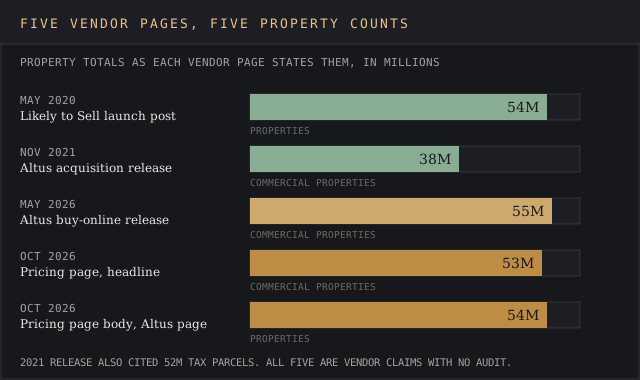
The spread comes from what gets counted. A tax parcel, a commercial property and a property are three different units, and the 2020 Likely to Sell post used 54 million before the 2021 release used 38 million commercial properties.
For a buyer the useful test is narrower: run your own target market in the trial and count the hits. Reviewers flag the gaps by geography, with an appraiser on Capterra reporting no comparable sales for industrial and retail in Fort Worth.
Compare Reonomy with CoStar, Yardi Matrix and ATTOM
Of the four platforms below, only one prints an entry price. Every price cell below comes from the vendor's own page or filing.
| Product | Published entry price | Billing unit | Scale the vendor states |
|---|---|---|---|
| Reonomy | No dollar figure, Annual 30% below Monthly | Per user seat, monthly or annual | 53M+ commercial properties, 30M+ owners and contact records |
| ATTOM Property Navigator | $499 a year, Professional | 1 user, annual only | 150+ million properties, 200 reports and 2,000 monthly exports |
| Yardi Matrix | Demo request, no rate card | Subscription | 8 asset classes, 6.6 million vacant land parcels |
| CoStar | Demo request, no rate card | Subscription | $1,259 million product revenue in 2025 |
Every price cell is the vendor's own list price or sales route, read on 6 October 2026, and the CoStar revenue figure comes from CoStar Group's full-year 2025 results. Vendr has no Reonomy page, so no cell carries a Vendr figure.
CoStar works at a different order of scale. The CoStar product booked $1,259 million of revenue in 2025, per CoStar Group's results, against Reonomy's last disclosed US$18.3 million, a drop in the bucket by comparison. CoStar sells listings, lease comps and market analytics. The CoStar lawsuit report covers the antitrust cases brokers have filed over that position.
Yardi Matrix covers multifamily, office, industrial, self storage, student housing, affordable housing, SFR and BTR, and vacant land. A Wall Street Oasis managing director put the ownership gap this way in 2018:
"at the end of the day, what you want is to be able to pierce the corporate veil and get to an actual company or person who owns the property and get their contact info, either a phone number or an email address, or both."
gotmike, Real Estate, Managing Director, Wall Street Oasis, 2018
That's the job it's made for. In the same thread a first-year analyst wrote, "I have it, rarely use it," listing Yardi, CoStar, the property appraiser and a people-search site as the sources. Teams that need warehouse-native integration across several feeds can look at Cherre. Product detail beyond price lives on the Reonomy review page.
How to negotiate a Reonomy quote
The vendor FAQ admits the discount levers: team size, use case and level of engagement. The sales process for feeds and the API starts at a "Talk to an expert" form, and a seat customer can enter the same queue. Once you've had the trial, the ball is in your court. Bring these questions:
- Price the seat online first, then ask sales to beat it with a multi-seat annual quote that includes extra annual licenses at the "further discounts" the Annual card mentions.
- Ask for the export allowance in writing. 1,000 monthly exports is the Annual default, and a team mailing more owners than that pays for packs.
- Ask if the quarterly term announced on 27 May 2026 is still sold, since it gives you a cheaper exit than Monthly.
- Get the cancellation notice window and method in the order form, given the billing complaints on Capterra, and pay by credit card so a disputed charge has a route back.
- For bulk feeds, cut the attribute count. Feeds are priced by properties, data type and number of attributes, so dropping unused fields lowers the price.
What to budget
Budget in units the vendor publishes. A year on Annual equals 8.4 Monthly payments, so anyone staying past the eighth payment saves by committing. Add one export pack per 1,000 monthly exports beyond the Annual allowance, and add a skip tracing or enrichment tool if your team calls owners, since three reviewers quoted here found contact details short.
For marketing teams running owner outreach at scale, and for brokers with a marketing budget tied to listings, the exports cap the campaign size before the seat price does. For an investor screening deals in one metro, the Monthly seat with no export pack covers the research. Our guide to real estate market intelligence for investors walks through which data layers a deal screen needs.
Frequently asked questions
How much does Reonomy cost per month?
Monthly is a per-seat subscription bought online, and the pricing page lists its terms without a dollar figure. The seat comes with exports sold as 1,000-export add-on packs, and Annual costs 30% less than 12 Monthly payments.
What does Reonomy do?
Reonomy, acquired by Altus Group in 2021, is a commercial real estate data platform that resolves LLCs and trusts to the people who own the building and supplies their contact details. It tracks 53M+ US commercial properties and 68M+ transactions, including debt, for brokers, investors, lenders, developers and appraisers working leads and research.
What are some good alternatives to Reonomy?
CoStar for verified comps and leasing data, Yardi Matrix for multifamily and self storage market data, ATTOM Property Navigator at a published $499 a year, and Cherre for warehouse integration. Our real estate market intelligence guide and property market intelligence page map the categories.
What is the best real estate data software?
It depends on the layer you need. CoStar leads on comps, Reonomy on ownership resolution and Yardi on multifamily operating data. The ranking of real estate data providers sorts 10 of them by use case.
How much does real estate software cost?
Published entry points run from ATTOM Property Navigator at $499 a year for one user, and most CRE data platforms quote. For market context, see our real estate statistics report and the retail real estate market report.
How much does real estate CRM software cost?
A Capterra reviewer called Reonomy "solely a research product" with no way to track leads, so a CRM tool is its own line item. Our CRM software cost report prices 11 vendors per seat, from $0 to $550.
Bottom line
Reonomy publishes the structure of its price and keeps any dollar figure off its pricing page. That structure tells you plenty: Annual pays for itself after 8.4 Monthly payments, Monthly comes with zero exports, and bulk feeds and the API scale with record count and attribute count.
Altus Group paid US$201.5 million for a business earning US$18.3 million a year, and it sells Reonomy per seat to brokers, investors, lenders and appraisers who need the owner behind the LLC. Price the trial, write the export allowance and cancellation terms into the order form, and choose Annual only if you'll still be using it by the ninth billing cycle.
Where each Reonomy figure was read, and the seat price Altus never prints
Plan terms, the 30% Annual saving, export allowances, API and feed limits and the 53M+ headline come from reonomy.com/pricing, read on 6 October 2026, along with the free-trial terms at reonomy.com/free-trial and the Likely to Sell post dated 28 May 2020. Bulk feed formats, cadence and pricing factors come from Reonomy's API documentation at api.reonomy.com.
Ownership and deal figures come from altusgroup.com: the acquisition release of 11 November 2021, the buy-online product release of 27 May 2026, the knowledge-graph release of September 2026, the Reonomy solution and ARGUS Enterprise pages, the strategic-review statement of 13 August 2025, and the Newmark sale releases of 17 February 2026 and 4 August 2026.
Funding history comes from commercialobserver.com, November 2019. User quotes come from Capterra reviews dated September 2020 to June 2026, a G2 review dated 28 September 2021 and a Wall Street Oasis thread from 2018. The "No pricing info" line is GetApp's Reonomy listing. Competitor figures come from attomdata.com, yardimatrix.com and investors.costargroup.com. All URLs accessed 6 October 2026.
Reonomy prints no dollar figure for any seat, export pack, bulk feed or API contract on its own pages, and Vendr has no Reonomy page, so no tracked contract value exists for this report to cite.