Real Estate Intelligence Platforms: 9 Ranked for 2026
 By Jan Suski. I go deep on every review, checking every number against its source and digging up details other coverage misses, a habit from six years of SEO and link building for tech companies. Bylines at Brand24 and Senuto. How the scoring works.
· Prefer this source on Google
Quick comparison of real estate intelligence platforms
The coverage column mixes units on purpose: a comps platform counts markets, a records platform counts parcels, and a rental platform counts listings. The criteria below put them on a level playing field.
| # | Provider | Coverage the vendor publishes | Entry price | Best fit |
|---|---|---|---|---|
| 1 | CoStar | 7.3M+ properties, 20M+ lease & sale comps | Vendr median $15,360/yr* | Commercial brokers and investors who need verified comps |
| 2 | CompStak | 105 US markets, 40,000+ contributors | $0 on Exchange (comps for credits) | Brokers and appraisers who trade lease comps |
| 3 | Reonomy | 53M+ US commercial properties | From $400/mo | Deal sourcing and owner lookup behind LLCs |
| 4 | HouseCanary | Nationwide residential AVM and forecasts | $19/mo or $190/yr | Residential investors and lenders pricing single-family homes |
| 5 | Placer.ai | Panel of tens of millions of devices | Free limited plan, paid quoted | Retail landlords underwriting on visits |
| 6 | ARGUS Enterprise | Used in 100+ countries | Quoted, asset-based tiers | Valuation and cash flow modelling teams |
| 7 | Dealpath | 300+ firms, $10T+ in transactions | Quoted, five-user minimum | Institutional acquisitions teams |
| 8 | Crexi Intelligence | Listings marketplace activity | Quoted | Brokers who list on Crexi and want buyer leads |
| 9 | AirDNA | 15M+ STR listings, 120,000+ markets | $0 Free, $79/mo Research | Short-term rental investors and hosts |
The median marked * is an anonymised buyer-reported contract value published by Vendr. Everything else is the price the vendor publishes itself.
Where these figures come from
Coverage counts are each vendor’s own published figure, read on 16 October 2026 and linked in that platform’s entry below. CoStar publishes no rate card, so its row carries Vendr’s anonymised buyer median. Placer.ai, ARGUS Enterprise, Dealpath and Crexi print no paid price, and CompStak prints none for Enterprise, so those rows name the pricing model and no figure.
This page ranks the platforms that analyse, forecast and score. Raw feeds and APIs sold by the record (ATTOM, BatchData, Bright Data) belong to our real estate data providers ranking, which tests fill rates and delivery formats. Four names sit on both lists because they do both jobs.
A real estate intelligence platform turns property data, comps, foot traffic and ownership records into a decision a buyer can defend at an investment committee. The nine ranked here sell that output to brokers, lenders, investors, appraisers and short-term rental hosts, and their entry prices run from $19 a month to a Vendr median of $15,360 a year.
It's written for the person signing the contract. Every price links to the vendor's own page or to Vendr's anonymised buyer data, every quote links to the review or thread it came from, and every figure was checked on 16 October 2026.
Why now: the category consolidated hard this year. RealPage completed its purchase of Cherre in July 2026, Clear Capital bought the computer vision company Restb.ai in May, and Altus Group now owns both Reonomy and ARGUS. A contract signed today may renew under a different owner, so read between the lines of any multi-year term.
Evaluation criteria for real estate intelligence platforms
Five criteria decide the shortlist, and the ranking below applies them in this order. Each one is a test a buyer can run in an afternoon and get a yes, a no or a number.
Published coverage count
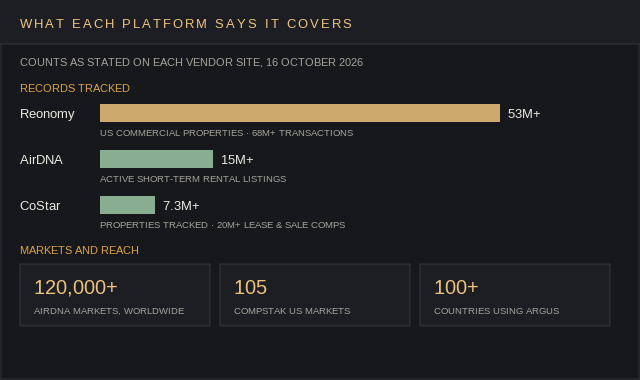
The vendor states how many properties, comps, markets or listings it covers, on its own site, in a unit you can check against your footprint. CoStar's 7.3M+ properties and AirDNA's 120,000+ markets pass. "Nationwide" with no count earns half credit, and a demo-only answer earns none.
Entry price visible before a demo
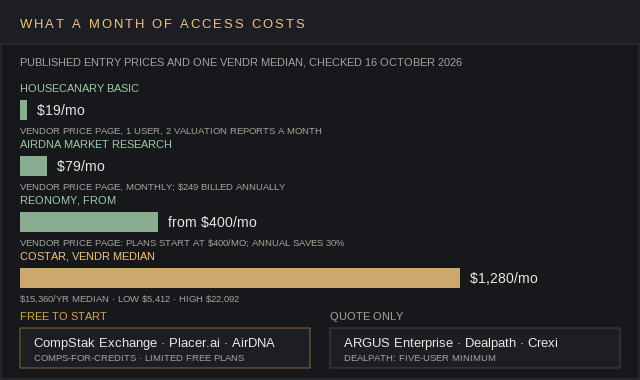
A published plan price, a free tier, or a Vendr median a buyer can read without booking a call. HouseCanary's $19 Basic plan and AirDNA's free plan pass outright, and a "contact sales" button with no number fails. Vendr's header median counts when the sentence calls it anonymised buyer data.
Exit terms in writing
A monthly option, cancel-anytime language, or a stated contract minimum. Reonomy's Monthly plan says "Cancel or upgrade anytime." Dealpath's plans page says plans "typically include a minimum of five users," and implementation "typically takes 6-8 weeks." A buyer can hold a vendor to both sentences, and talk is cheap on a demo call.
Delivery with a documented limit
An API, feed or export with a stated cap or per-call price. Reonomy's API returns up to 1M properties in a single request, and HouseCanary prints a per-call price for every endpoint tier. Integrating a platform into a warehouse or an underwriting model depends on this number.
Independent user evidence
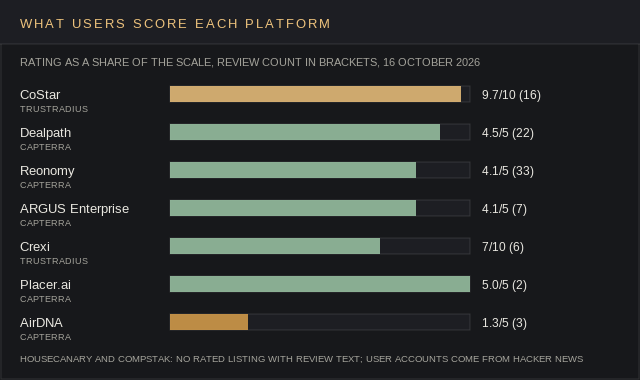
A rating and review count on Capterra, TrustRadius or G2, plus at least one public user account a buyer can read in full. The quality of that evidence varies by a factor of ten: Reonomy carries 33 Capterra reviews and AirDNA carries three. Cherre, Green Street and Moody's CRE have no public user reviews to cite, which is why they sit in the unranked section below the list.
Nine platforms cleared enough of these five tests to rank. The category has more vendors, but a ranking that can't show a user's own words for an entry is guessing about how it holds up after the contract starts.
Real estate intelligence platforms, ranked
CoStar
Best fit
Commercial brokers, lenders and investors who need verified lease and sale comps across every major US property type.
CoStar's own product page counts 7.3M+ properties tracked, 20M+ lease & sale comps and 8.3M+ commercial tenants, built over more than 37 years by what it calls the largest research team in commercial real estate.
It sells to 181,000+ subscribers, so the comps a lender reads are the same comps the borrower's broker reads. A shared set of comparable properties across both sides of a deal is what the seat price buys. Our CoStar pricing report traces seat rates through public city contracts.
Key features
- 20M+ lease and sale comps, filterable by market, property type and date
- 8.3M+ commercial tenants tracked for tenant-rep and leasing work
- Market overview and forecast views, which the TrustRadius reviewer below uses for rents and cap rates
- CoStar Real Estate Manager for lease administration and accounting
- CoStar news and alerts on tracked properties
Pricing
CoStar quotes every seat. Vendr's anonymised buyer data puts the median contract at $15,360 a year, with a low of $5,412 and a high of $22,092. That's about $1,280 a month at the median, before extra markets, which costs an arm and a leg next to HouseCanary's $19 plan.
Pros
- The largest published comp count here, 20M+ lease and sale records
- One shared dataset across lenders, appraisers and brokers on the same deal
- 37+ years of history for trend analysis on a submarket
Cons
- No published price; the Vendr range spans $5,412 to $22,092
- Seats and markets drive the quote, per the public contracts in our pricing report
- Self-storage and property financials are thin, per the review below
A TrustRadius reviewer, an executive in finance and accounting at an 11 to 50 person firm with eight years on the product, described the workflow in July 2026:
"We use it to look at market supply and demand, determine market rents, get a handle of average expenses at comps and look at sales prices and cap rates to verify investment exit assumptions."
TrustRadius, Verified User, 22 July 2026. The same reviewer listed "breakout self-storage data" and "property financials" as cons.
A Hacker News commenter put the market position more bluntly in January 2020: "The leader is CoStar, they have the most complete and accurate data." (jimkri, Hacker News)
Why it’s ranked #1. CoStar publishes 7.3M+ properties and 20M+ comps and scores 9.7 out of 10 across 16 TrustRadius ratings, while CompStak publishes 105 markets and no rated review base, so CoStar wins on coverage and user evidence.
CompStak
Best fit
Commercial brokers, appraisers and researchers who hold lease comps and want to trade them for the comps they're missing.
CompStak crowdsources its data: 40,000+ CRE professionals at brokerage and appraisal firms submit comps, and its free Exchange works on one rule, "Submit the comps you have to get the comps you need, all for free." Lease, sale, loan and property data cover 105 US markets, and the multifamily layer is powered by RealPage.
Credits earned on Exchange never expire, though CompStak removes them for incorrect submissions or data copied from another provider, so the free Exchange comes with strings attached. Underwriters, valuers and analysts buy the same dataset through CompStak Enterprise, which adds analytics across all 105 markets.
Key features
- Exchange: comps for credits, free for brokers, appraisers and researchers
- Deal Radar (beta) inside Exchange
- Enterprise delivery by API, data feed and a custom MCP server
- CompStak One Connect and Agent Connect for underwriting teams
- Analytics across 105 US markets, with a native Dealpath integration
Pricing
Exchange costs $0 for contributors. Enterprise access is quoted after a demo, and the site prints no figure.
Pros
- A $0 entry point for anyone with comps to contribute
- Credits never expire, so a slow quarter costs nothing
- Lease-level detail from the brokers who negotiated the deals
Cons
- Coverage depends on what contributors submit in each market
- Enterprise pricing is unpublished
- No rated review base on Capterra to check against
A Hacker News commenter described the access model in February 2020, and the scarcity point is the trade-off a buyer accepts:
"they appear to prop up the overall scarcity by only granting access of existing data to users who provide new data."
jb775, Hacker News, 20 February 2020
Why it’s ranked #2. CompStak's $0 Exchange beats Reonomy's from-$400-a-month entry price, and 40,000+ contributing brokers supply its lease comps, but it trails CoStar's 20M+ published comps and 9.7 TrustRadius score.
Reonomy
Best fit
Brokers, lenders and acquisitions teams sourcing off-market deals who need the owner behind the LLC.
Reonomy, "an Altus Group Business," covers 53M+ US commercial properties, 68M+ property transactions, 5.2M+ companies and 30M+ owners and contact records. It pulls from all 3,100 county assessors, Secretary of State filings and census data, plus exclusive partnerships with Cotality and ICE, and filters that universe by 200+ criteria. Without that owner resolution, the person behind an LLC is a needle in a haystack.
Its machine learning model, the Likely to Sell indicator, scores each property's chance of selling within two years from sales, tax, debt and ownership history, trained on more than 30 years of sales data. That's lead generation built on public records, ranked by probability. Our Reonomy pricing report covers the Altus deal and the seat math.
Key features
- Owner and entity resolution across 30M+ owner and contact records
- Likely to Sell score, a two-year sale probability per property
- Property details, debt, liens and full transaction history
- API delivery of up to 1M properties in a single request
- Bulk CSV feeds of 10k+ records at a custom cadence
Pricing
The pricing page's own description says plans start at $400/mo, and its FAQ says annual billing saves 30% against monthly. The page body shows the Monthly and Annual cards without a dollar figure, and pricing is per seat. Bulk feeds and the API are quoted.
Pros
- 53M+ properties, the widest commercial record count here
- Monthly plan with "Cancel or upgrade anytime"
- Documented 1M-property API ceiling for warehouse loads
Cons
- Contact data bounces, per several Capterra reviewers
- Billing complaints after cancellation on Capterra in 2025 and 2026
- Bulk feeds, the API and extra exports are all priced on request
The billing complaint recurs, and it's the con a monthly buyer should watch:
"Very poor. I canceled my membership at the end of one month and they charged me for another month. Plus the bad contract info."
Chip P., independent contractor, real estate, Capterra, 1 June 2026
The same reviewer listed "Numerous bounced emails and phone numbers that were no longer in service." An analyst rating it 4 out of 5 in July 2021 saw it the other way: "For the money this is a great software and has many features compared to Propertyshark or Co-Star. I really love the ownership information." (paul O., Capterra)
Why it’s ranked #3. Reonomy's 53M+ properties and 1M-property API limit beat HouseCanary on commercial coverage and delivery, and its 33 Capterra reviews average 4.1, but CompStak's $0 Exchange undercuts its $400 entry price.
HouseCanary
Best fit
Residential investors, lenders and agents pricing single-family homes with an automated valuation model.
HouseCanary sells AVM-driven property valuations, rental forecasts and portfolio monitoring for residential real estate, and it publishes every plan price. Basic costs $19 a month or $190 a year for one user and two custom valuation reports a month; Teams costs $199 a month or $1,990 a year for 10 active users and 40 reports.
The Pro plan adds portfolio monitoring for 25 properties, which is predictive analytics applied to homes a fund already owns. Extra monitored properties cost $0.45 a month each on Pro and $0.35 on Teams, so a 1,000-home book prices out before a sales call. In a nutshell, the bill is the property count times the rate.
Key features
- CanaryAI assistant on every plan, Basic included
- AVM PDF reports: 15 a month on Pro, 40 on Teams
- Portfolio monitoring for 25 (Pro) or 50 (Teams) properties
- Property Analytics API from $0.30 to $4 per successful call by tier
- Configurable SSO and SOC 2 reports on request on Teams
Pricing
$19, $79 and $199 a month for Basic, Pro and Teams, or $190, $790 and $1,990 a year, with yearly billing saving 17%. Plans auto-renew until canceled. Enterprise is custom, with "negotiable minimums."
Pros
- The lowest published entry price here, $19 a month
- Per-call API prices printed for three endpoint tiers
- Monitoring priced per property, so a portfolio budget is a multiplication
Cons
- Residential only, with no commercial comps
- No AVM accuracy figure on the pricing page
- Both monthly and yearly plans auto-renew
Speed is the pro users cite. A Hacker News commenter comparing feeds in August 2021:
"Zillow’s data lags 3-4 weeks while HouseCanary’s is about as real time as you can get."
iknowSFR, Hacker News, 16 August 2021
Price was the reply in the same thread: "Wow that's expensive. I wonder if HouseCanary offers data limited to specific zip codes for less." (ineedasername, Hacker News). The $19 Basic plan is the answer that exists now.
Why it’s ranked #4. HouseCanary's $19 entry plan and per-call API prices beat Placer.ai's quote-only paid tiers on price visibility, but Reonomy's 53M+ properties and 33 rated reviews give buyers more to check.
Placer.ai
Best fit
Retail and mixed-use landlords, brokers and site selectors who underwrite on visits.
Placer.ai estimates foot traffic from a panel of tens of millions of mobile devices, stripped of personal identifiers, then aggregated and extrapolated with machine learning to any location in the US. It shows data only for places with more than 50 unique devices, which is the threshold to ask about on a small strip center.
Visit counts answer a question property records can't: how many people walk in, from where, and where they go next. Our Placer.ai pricing report collects the public order forms, and the location intelligence platforms ranking compares it with GIS-first tools.
Key features
- Visit counts and trends per property, chain and venue
- Trade area and visitor demographics
- Unlimited property, chain and industry analysis on paid plans
- API and data feeds for warehouse delivery
- A dedicated customer success manager on every paid subscription
Pricing
The pricing page offers a free sign-up, which it calls "just a small display of the full platform," and quotes every paid subscription by form. It sells individual seat and enterprise-wide licenses and doesn't sell one-time reports.
Pros
- A free plan for testing the panel on a known property
- Behavioural data no records-based platform here offers
- Unlimited dashboard access once paid
Cons
- Paid pricing is quoted only
- Locations under 50 unique devices show nothing
- Store-level gaps take time to fill, per the review below
A real estate marketing coordinator on Capterra named the gap that matters when a deal comes down to the wire:
"Not all of the data has been input for all centers or stores, so sometimes you have to request data be researched."
Alisha W., marketing coordinator, real estate, Capterra, 1 March 2021. She added that store requests take longer and "You will probably not receive that information by your deadline."
A parks and recreation director rated it 5 out of 5 in March 2025 and still wrote "Cost was the only factor that was a con. It is expensive but worth the cost." (Lori F., Capterra)
Why it’s ranked #5. Placer.ai's free plan and stated 50-device display threshold beat ARGUS Enterprise on entry price and method disclosure, but HouseCanary prints a $19 paid tier and per-call API prices where Placer.ai quotes.
ARGUS Enterprise
Best fit
Valuation, asset management and underwriting teams that model cash flows lease by lease.
ARGUS Enterprise is the Altus Group modelling software that firms in 100+ countries use for discounted cash flow analysis and property valuations. Every tiered, asset-based ARGUS Intelligence Platform subscription includes ARGUS Enterprise, and ARGUS Assist adds AI-powered chat to query, update and analyse a model.
It's the format appraisers and lenders expect a model in. One director on Capterra called it "the de facto software for the real estate industry," which is the reason a buyer's lender asks for the file. New analysts take months to know the ropes, per the review below.
Key features
- Lease-by-lease cash flow modelling and DCF valuation
- ARGUS Assist, an AI chat over the model
- ARGUS Intelligence Platform subscriptions, priced by assets held
- Web interfaces for ARGUS Enterprise Cloud
- Exports to Excel for downstream analysis
Pricing
Altus says pricing is "flexible, tiered and scales with your business" and prints no figure. Tiers are asset-based.
Pros
- The model format counterparties expect, in 100+ countries
- AI chat built into the model with ARGUS Assist
- Budgeting and valuation in one file, per users
Cons
- Capterra ease-of-use score of 3.6 from 7 reviews
- Forced move from legacy DCF to SaaS, per a 2021 review
- No published price
The longest review on Capterra covers both sides:
"Switch to SaaS vs. "owned" software and lack of support for legacy DCF. Expensive software for small businesses/individuals."
Matthew M., director, real estate, Capterra, 17 July 2021. He also wrote that "it takes months of heavy use to achieve fluency."
An asset manager rating it 5 out of 5 said "It has a lot of functionality and creates synergy between cash flow/budgeting and understanding building values." (Stacey S., Capterra, July 2018)
Why it’s ranked #6. ARGUS Enterprise is used in 100+ countries with no stated seat minimum, which beats Dealpath's five-user floor and 6-8 week setup, but Placer.ai offers a free plan where ARGUS prints no price.
Dealpath
Best fit
Institutional acquisitions and development teams of five or more running an investment committee pipeline.
Dealpath is deal management software with an intelligence layer on top: AI-powered data ingestion captures incoming deals, and a comparables database, market tracking and dashboards sit on the same pipeline. The company says it's trusted by 300+ firms, powering $10T+ in transactions.
Its value as intelligence comes from the deals a firm passed on. Dealpath's own FAQ says firms gain most when they evaluate more deals, "either to pursue or amass market intelligence," because every screened deal stays in the firm's proprietary database.
Key features
- AI-powered data ingestion for incoming deals
- Comparables database, analytics, reporting and dashboards
- Integrations with Esri, Google Maps, CompStak, Box, Dropbox and Okta SSO
- Open API and sandbox environments on Enterprise
- SOC 2 Type 2 security
Pricing
Quoted. The plans page lists Professional and Enterprise, says plans "typically include a minimum of five users," and puts implementation at 6-8 weeks with a dedicated customer success manager.
Pros
- 4.5 out of 5 across 22 Capterra reviews
- Named integrations, including a CompStak comps feed
- Investor reporting and IC memos built from deal data
Cons
- Five-user minimum rules out a solo buyer
- Billing can start before setup ends, per a 2025 review
- API speed complaints from a technical user
The critical review lands on setup cost, a bitter pill to swallow for a firm already paying:
"Setting up this interface takes a long time. And it happen on our dime not dealpaths as they start billing even before the system is setup."
Sarah G., vice president, commercial real estate, Capterra, 9 December 2025
A construction lender's associate described the upside in October 2023: "We structure our pipeline meetings directly from the reporting dashboards and are starting to work on creating investment committee memos directly from Dealpath inputs." (Brian H., Capterra)
Why it’s ranked #7. Dealpath's 4.5 average across 22 Capterra reviews and its named CompStak and Esri integrations beat Crexi's 7 out of 10 TrustRadius score, but its five-user minimum puts it behind ARGUS Enterprise on exit terms.
Crexi Intelligence
Best fit
Commercial brokers who already list on Crexi and want buyer demand and owner leads from the same account.
Crexi runs a commercial listings marketplace and sells intelligence built on the activity flowing through it, chiefly lead information on the buyers who engage with a listing. TrustRadius scores Crexi 7 out of 10 across 6 ratings, and its users praise lead generation and map search.
The intelligence product depends on listing traffic, so its buyer signals are strongest on assets marketed through Crexi itself. For off-market owner research, listing-based signals miss the mark, and Reonomy's 53M+ property records go further.
Key features
- Lead generation from listing views and requests
- Map search, which TrustRadius users list as a pro
- Owner research on properties, the use case in the 2026 review below
- Pro tiers with lead contact details
Pricing
Quoted. A TrustRadius reviewer describes a one-year contract for the Pro tier that unlocks lead contact details.
Pros
- Buyer demand signals tied to real listing activity
- Lead generation users rate as its strongest feature
- One account for listing, marketing and research
Cons
- Owner data accuracy complaints on TrustRadius in 2026
- Full lead access costs more than LoopNet, per a Capterra reviewer
- No published price
A realtor rating it 2 out of 10 in September 2026 started with the data:
"It was good for a while, until I began to realize that most of the data was either antiquated or completely wrong."
Nicholas Koch, realtor, Koch Home Collective, TrustRadius, 8 September 2026
On Capterra, a director of marketing who ran both platforms wrote that full lead access "is actually more than what it cost through Loopnet, which is their direct competitor and they’re actually larger." (Mandie Y., Capterra, 22 May 2025). A founder at Triad Real Estate Partners rated it 10 out of 10 in August 2026: "We have had success on the platform finding and identifying new Buyers for the assets we are selling." (Sean Lyons, TrustRadius, 20 August 2026)
Why it’s ranked #8. Crexi's 7 out of 10 TrustRadius score from 6 ratings beats AirDNA's 1.3 out of 5 on Capterra, but Dealpath's 22 reviews averaging 4.5 and its named integrations put it a rank higher.
AirDNA
Best fit
Short-term rental investors and hosts screening markets and properties by expected revenue.
AirDNA tracks 15M+ active short-term rental listings across 120,000+ markets, with history back to 2014, and every plan, Free included, carries global coverage. Its Rentalizer estimates a property's revenue, and the Research plan adds future demand data, comparable sets and five Rentalizer Agent Reports.
AirDNA's own FAQ claims its revenue estimates "have consistently matched Airbnb's actual figures with 95% to 99% accuracy." Treat that as the vendor's claim and test it on a listing you own before you buy a property on it.
Key features
- Rentalizer revenue calculator, limited on Free
- Future demand data and historical market insights on Research
- Browse for-sale properties with revenue estimates
- Adapt dynamic pricing at $20 a month per listing
- Property Manager plan with 25 Rentalizer Agent Reports and revenue forecasts
Pricing
Free costs $0 forever. Market Research showed at $79 a month, or $21 a month billed $249 annually, on the rendered pricing page on 16 October 2026, and annual billing "saves up to 73%." Property Manager plans for 6+ properties are quoted.
Pros
- A permanent free plan with worldwide market coverage
- Published monthly and annual prices
- Cancel any time and keep access to the end of the paid period
Cons
- 1.3 out of 5 from 3 Capterra reviews
- Accuracy complaints from a host on Capterra
- Short-term rentals only
The Capterra reviews are few, and they call a spade a spade:
"The data is too inaccurate to be of any use whatsoever"
Robert B., owner, hospitality, Capterra, 24 July 2024
A Hacker News user who had run both tools in June 2023 came down the other way: "I've also used both AllTheRooms and AirDNA and AirDNA appears much more accurate (YMMV)." (mbesto, Hacker News)
Why it’s ranked #9. AirDNA publishes 15M+ listings and a $79 monthly price, yet its 1.3 out of 5 Capterra average across 3 reviews trails Crexi's 7 out of 10, and its coverage stops at short-term rentals.
Other real estate intelligence platforms worth a look
Four strong platforms didn't rank because no public user review exists to test them against, and one is a pure data feed. They stay under the radar on review sites, yet each still belongs on a shortlist for the right buyer.
- Cherre resolves "more than four billion entities and four trillion dollars in real assets," per RealPage's announcement of 14 July 2026 that it had completed the acquisition. Its site lists 150+ data and application partnerships and 200+ data lakes and warehouses connected. Our Cherre review covers the data integration model.
- Green Street covers 384 US, 30 pan-European, 10 Canadian and 10 Australian markets across about 20 sectors, with 40 years of data, five-year forecasts and an AVM Pro model. Its monthly Commercial Property Price Index tracks property values for institutional investors.
- Moody's CRE forecasts more than 400 metro areas for apartment, retail, office, industrial and hotel, with 10-year forecasts and monthly updates delivered by API.
- Cotality claims access to 99.9% of the US housing market, and its SpatialRecord product maps public record data through parcel polygons inside GIS tools, giving "a visual map of potential acquisition targets," per Cotality's smart campus guide. Our Cotality review has the detail.
- PropStream sells residential investor data from $99 a month for Essentials, with 25,000 monthly saves and exports and over 160 million public records, plus a 7-day trial with 50 free leads. G2 and Capterra list no reviews for it.
Pricing across real estate intelligence platforms
Published prices in this category run from $0 to a $22,092 CoStar contract, the high end of Vendr's anonymised buyer data. CoStar's $15,360 median would buy about 81 years of HouseCanary Basic at $190 a year.
Six of the nine ranked platforms don't publicly print a paid price, which is par for the course in the commercial real estate market. Three free entry points exist, and each caps what it shows: AirDNA Free costs $0 forever with a limited Rentalizer, Placer.ai's free sign-up is "just a small display of the full platform," and CompStak Exchange trades comps for credits.
Annual billing is where the published prices drop furthest. Reonomy's FAQ puts the annual saving at 30%, a figure Altus repeated in its 27 May 2026 product release. HouseCanary's yearly plans save 17%. AirDNA's Market Research costs $948 over twelve monthly payments of $79 and $249 billed annually, a 73.7% gap that matches AirDNA's "saves up to 73%" line.
Costs outside the plan price
The devil's in the details on usage. HouseCanary's Pro plan monitors 25 properties, and a fund with 1,000 homes to manage adds 975 more at $0.45 each, effectively $438.75 a month on top of the $79 plan. Its API costs $0.30 to $0.50 a call for basic endpoints and $2.50 to $4 for premium ones, and extra AVM PDFs cost $10, $9 or $7 depending on plan.
Exports are the second meter. Reonomy's Monthly plan gives unlimited searches and sells 1k monthly exports as an add-on, while Annual includes them.
Where real estate intelligence data comes from
Six collection methods sit behind the insights on this page, and each one fails in its own way.
Public records are the widest net. Reonomy pulls from all 3,100 county assessors, Secretary of State filings and census data, plus a partnership with Cotality and another with ICE. The contact layer is where Reonomy's reviewers report trouble, including the bounced emails quoted in its entry.
Contributed comps come straight from the horse's mouth: the 40,000+ brokers and appraisers who contribute to CompStak negotiated or valued the deals they submit. CompStak polices quality by removing credits for incorrect submissions or data copied from another provider, per its help centre.
Research teams are the oldest method here. CoStar has built its 7.3M+ property records over more than 37 years, which gives a submarket analysis decades of market data to test trends against.
Device panels measure visit patterns. Placer.ai extrapolates visits from tens of millions of mobile devices with machine learning and hides any location under 50 unique devices.
Listing activity is the fifth source: AirDNA reads 15M+ short-term rental listings around the world, and Crexi turns the views and requests on its own marketplace into leads on buyers. Residential agents already price homes from MLS comps, and HouseCanary sells them and their lenders an AVM value to set beside the MLS figure.
Restb.ai, a Barcelona computer vision company, processes more than 2 billion property photos monthly for more than 1 million real estate agents. A firm's own deal flow is the sixth source, and it's the one Dealpath sells: every deal screened and passed on stays in the firm's database for the next comparison.
Refresh speed differs by method, and it decides how current valuations are on the day of a bid. Green Street publishes its Commercial Property Price Index monthly alongside forecasts for 10 markets in Australia and 384 in the US, so its price trends update 12 times a year, and Moody's monthly forecast updates arrive via API or its Data Buffet interface.
How AI and machine learning work inside these platforms
Artificial intelligence capabilities show up in five jobs across the ranked platforms: scoring sellers, valuing property, reading photos, ingesting documents and answering questions about a model.
Seller scoring has the longest public record. Reonomy announced its Likely to Sell indicator in May 2020, a machine learning model running over more than 30 years of sales data on 54M+ properties that returns each property's chance of selling within two years. That turns lead generation into a ranked list of likely sellers, and a broker identifying targets can act on the top of it.
Valuations are where accuracy claims live. HouseCanary's automated valuation model prices single-family homes, and AirDNA says its revenue estimates matched Airbnb's actual figures "with 95% to 99% accuracy." Neither number is a substitute for 20 closed deals of your own run through the same AI models.
Computer vision is the category's newest buy. Clear Capital, based in Reno, Nevada, announced on 12 May 2026 that it had acquired Restb.ai, with terms undisclosed.
Document processing and chat round out the advanced analytics on offer. Dealpath's AI-powered data ingestion captures incoming deals as structured data, ARGUS Assist answers questions about a cash flow model and HouseCanary puts its CanaryAI assistant on every plan. The jury's still out on chat assistants, so check each answer against the model or record behind it before it reaches an investment committee memo.
Real estate intelligence for development, land and campus projects
Teams that develop land need two layers a comps database doesn't carry: demographics and parcels. Placer.ai's trade area and visitor demographics show who already visits a site, and Moody's CRE covers more than 400 metro areas across apartment, retail, office, industrial and hotel, with 10-year forecasts and scenarios for each. A team expanding into new regions can compare metros on one forecast method.
Land work runs on maps. Cotality's SpatialRecord places public record data on parcel polygons inside GIS tools, which it describes as "a visual map of potential acquisition targets," per its smart campus guide. The same guide pitches foot traffic data for siting off-campus student housing.
Cotality calls repurposing underused space "One of the most significant trends in 2026," and a campus planner expanding housing or research projects needs the parcel and traffic layers together.
Common mistakes when buying a real estate intelligence platform
Buying a records platform for a comps job is the most common mismatch of capabilities, and it's barking up the wrong tree. Reonomy's 53M+ records answer who owns a building, what debt sits on it and when it last sold. Lease rents come from CoStar's 20M+ comps or from CompStak's contributing brokers.
Taking an accuracy claim on faith is the second, and the error flows straight into loan, insurance and bid pricing. AirDNA's 95% to 99% claim sits next to a 1.3 out of 5 Capterra average built on a handful of reviews, three in total, and HouseCanary's pricing page prints no AVM accuracy figure at all. Run 20 properties with known sale prices or rents through the trial and compute the error yourself, which gives an investment committee a confidence figure it can check.
Skimming the renewal terms costs real money. HouseCanary's monthly and yearly plans both auto-renew until canceled, and Capterra reviewers of both Reonomy and AirDNA describe charges after canceling. An AirDNA manager wrote in May 2025: "I canceled my subscription a year ago and they somehow reactivated it and changed me again." (Askhat Y., Capterra)
Keep an eye on the renewal date, get the cancellation route written into the order form, and ask in writing when billing starts relative to setup.
Ignoring who owns the vendor is the last. Altus Group owns both Reonomy and ARGUS, and RealPage, with 42,000+ customers, owns Cherre and powers CompStak's multifamily data. Buying two of those products from one parent puts all your eggs in one basket at renewal, a poor negotiating strategy when one company prices both contracts.
How to run a trial of a real estate intelligence platform
A trial should end in three measured outcomes: a fill rate, an error rate and a monthly cost at your real usage.
- Build a test list of 50 properties you know cold: sale price, owner, current rent and last transaction date. Your own closed deals are the ground truth every vendor gets scored against.
- Start on the free and trial tiers: AirDNA Free and its 30-day Adapt trial, Placer.ai's free sign-up, CompStak Exchange, and PropStream's 7-day trial with 50 free leads.
- Count how many of the 50 each platform returns with a value, and compute the gap between its valuations and your known prices on every match.
- Log the search patterns your team runs for a week, then price seats, exports and monitored properties at that scale.
- Before integrating anything, make the API deliver a sample against its stated limit: 1M properties per request at Reonomy, or a priced batch of HouseCanary calls.
- Get exit terms and cancellation processes in writing and check the Vendr median before setting a negotiating strategy; CoStar's sits at $15,360 a year.
Any efficiency gain from Dealpath waits behind its 6-8 week implementation, and a wrong pick forces two months of setup before the team is back to square one with a second vendor.
Real estate intelligence platform FAQ
Which AI platform is best for real estate?
It depends on which real estate decisions the platform supports. Reonomy's machine learning Likely to Sell score suits commercial deal sourcing, HouseCanary's AVM and CanaryAI assistant suit agents and lenders running residential valuations from $19 a month, and ARGUS Assist adds artificial intelligence chat inside the cash flow model lenders ask for. CoStar takes the overall win on this page for its 20M+ comps.
Bottom line
CoStar wins for commercial brokers, lenders and investors who need comps the other side of the table will accept, and its 20M+ records justify the $15,360 median for teams that use them daily. CompStak is the pick for brokers and appraisers with comps to trade, and Reonomy is the pick for deal sourcing behind LLCs on a monthly plan.
Residential buyers should start with HouseCanary's $19 plan, retail landlords with Placer.ai's free tier, and short-term rental investors with AirDNA Free before paying $79. ARGUS Enterprise and Dealpath belong to institutional teams with a model to build and five seats to fill, and Crexi suits brokers already listing on it. A comps platform paired with an owner-records platform gives a commercial team the best of both worlds.