ATTOM Data pricing: $499 a year for reports, a sales quote for the data
 By Jan Suski. I go deep on every review, checking every number against its source and digging up details other coverage misses, a habit from six years of SEO and link building for tech companies. Bylines at Surfer, Brand24, and Senuto. How the scoring works.
The numbers ATTOM Data list prices, trial limits and coverage, checked 6 October 2026
The only list price ATTOM publishes is $499 a year for one Property Navigator seat, and every API, bulk and cloud contract goes through sales.
Billing on the API runs per property returned, so the page size on a search call sets the invoice more than the call count does.
Four property counts between 150 million and 160 million appear on the vendor's own pages, so a contract should name the figure it prices.
ATTOM Data Solutions publishes one list price. It's $499 a year for a single seat on Property Navigator Professional, the company's self-serve property report tool. The Property Data API, bulk file licensing and the Snowflake and Databricks shares all route to a sales rep.
The closest thing the company prints to an API rate card is a worked example in its own help center, and that example gets its arithmetic wrong by a factor of ten. This report covers what each product costs, what each meter counts, where the free trials stop, and which of the vendor's own pages contradict each other. Every figure links to the page it came from, read on 6 October 2026.
It's written for three buyers: a developer sizing an API budget, an investor weighing a $499 seat, and a data team pricing a bulk license against the field on our real estate data providers ranking. The quote depends on inputs the buyer controls, so a buyer who understands the meter before the sales call can zero in on the cheapest configuration that still answers the question.
How much ATTOM Data costs, product by product
The company sells one data warehouse through five doors, and only one of them has a price tag on it.
| Product | Published price | What the meter counts | Free access |
|---|---|---|---|
| Property Navigator Professional | $499 a year | 1 user, 200 reports and 2,000 list exports a month | 7-day trial |
| Property Navigator Enterprise | Custom pricing | Unlimited users, custom report and list quotas | Free trial, per the pricing FAQ |
| Property Data API | Quoted by sales | API Reports, one per property returned | 30-day key, typically 1,000 lifetime hits |
| Bulk data licensing | Quoted by sales | Datasets, states and fields in the file | Sample .csv file per dataset |
| Cloud delivery | Quoted by sales | Snowflake or Databricks shares ATTOM maintains | Contact form |
| MCP Server and AI agents | Quoted by sales | Listed as solution types on the sales form | Contact form |
Every price is ATTOM's own published list price, read on attomdata.com on 6 October 2026, annualised where stated. "Quoted by sales" marks a product with no public rate.
Navigator's pricing page is the only complete fee schedule the company publishes, and Navigator is the only door a buyer can open with a credit card. The pricing FAQ lists Visa, MasterCard, Discover, AMEX and debit cards for Professional and invoice billing for Enterprise.
ATTOM Data Solutions plan tiers for Property Navigator
Property Navigator is the company's browser tool for property reports, comparables and prospect lists. Both plans open on "full access to nationwide property & comparables data", and the feature table on the Navigator pricing page shows the data rows ticked identically in both columns.
Professional, $499 a year
Professional covers one user, 200 property and comparable reports a month, and 2,000 data list exports a month. The page states nationwide access to 150 million+ residential and commercial properties, plus foreclosure, pre-foreclosure, sales and mortgage search, flood data, the property AVM, the Rental AVM, phone numbers and premium New York data.
Billing is annual only. The FAQ's answer to "Do you offer monthly subscription?" is "No, we do not offer monthly subscription at this time." At $499, that's $41.58 a month, or about $0.21 a report if a user pulls all 2,400 reports the year allows.
The overage line is the one place the page goes vague. For a Professional user exporting records beyond the monthly quota, the page prints no figure and says only that "the system will offer to process your exports for an additional low cost". Extra users get requested from the account dashboard, also with no price attached. For anyone planning to export past 2,000 records a month, that unpriced line is a small red flag.
Cancellation is simple: an annual subscription can be cancelled at any time and the account stays active until the end of the billing cycle.
Enterprise, custom pricing
Enterprise is quoted, and its column on the feature table adds five things to Professional:
- Unlimited user seats, against one on Professional
- Custom report quotas and custom list quotas
- White label
- SSO and CRM integration
- Development support
So the Enterprise premium buys seats, branding and integration work, while the lion's share of the data, from AVMs to flood and foreclosure records, already sits in the $499 plan.
How ATTOM API pricing works
ATTOM API pricing has no public rate card. The developer platform FAQ answers "How much does API access cost?" by pointing new developers at "a free API key or our start-up plan" and telling larger users to call about enterprise options. The same page describes ATTOM's coverage as "complete premium data on every property and neighborhood in the country".
The help center article on API pricing routes pricing, trial extensions and upgrades to Data Customer Care, which hands them to sales.
The meter itself is documented. The Cloud Help article on API Reports says the API "is priced based on the number of API Reports produced, not the number of calls made", and each property in a response counts as one report. A call to an AVM endpoint returning values for 1,000 properties is 1,000 API Reports.
Paging is the cost control. A call returns at most 1,000 API Reports by default, and the vendor invoices only the reports it returns, so a search matching 10,000 properties costs 2,000 reports if the application stops after two pages. When a month's reports pass the contracted quota, the excess gets invoiced at the same unit cost as the quota.
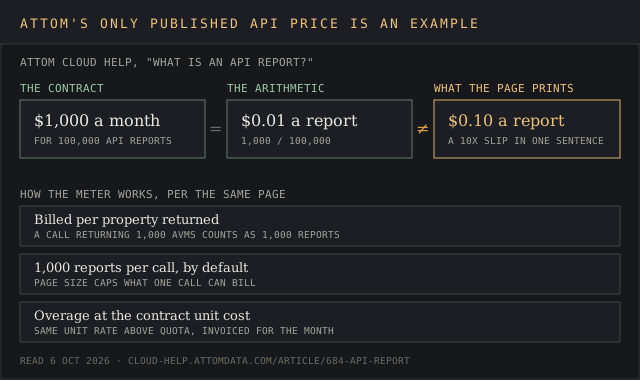
That worked example is the only API price on attomdata.com: "If you are paying $1,000 per month for $100,000 API Reports ($0.10 per API Report), then additional API Reports will be charged ar $0.10 per API Report." Divide $1,000 by 100,000 and the unit cost is $0.01. Either the quota is 10,000 reports or the rate is a cent, and the page gives no way to tell which. It's the same class of first-party slip our software pricing errors report logged across eight vendors.
The free trial key and its two meters
The trial is 30 days. The API FAQ on ATTOM's API product page says to "Sign up for a free 30-day trial to receive an API key", review endpoints and make sample calls.
The help center's article on usage limit alerts describes a lifetime cap "common on free trial accounts, typically 1,000 total hits". Once it's spent, calls get blocked, sometimes with HTTP 401 Unauthorized errors, and technical support can't raise it. Only sales and account management can extend a trial, so a key used for load testing can be dead in the water inside a day.
Read between the lines and the trial and the contract run on different meters. The usage-limit article says "Every individual API request is counted", while billing counts API Reports. One search returning 1,000 properties spends one of a trial's 1,000 hits, and 1,000 reports of a paid quota. Paid plans can also carry per-minute, per-day and per-month limits, with daily limits resetting at midnight.
Bulk data licensing and cloud delivery costs
Bulk is the license for storing data. The developer bulk page gives three reasons a buyer needs it, and the third carries the cost: needing to store data "for more than 24 hours (per API caching limit)". An API contract lets an application cache the data for a day, so any product that keeps records longer is shopping for a bulk license.
How bulk files are delivered
The mechanics are spelled out. Deliveries come as full files or custom match-and-append files over FTP, in .csv format, weekly, monthly, quarterly or annually depending on the data set.
Bulk data comes state by state or nationwide with no difference in the data available, buyers can take only the fields their use case needs, and custom solutions get built through match and append. The page adds that the company has "a set of permitted use cases", and the devil's in the details there, since that list sets what a buyer may do with the file and enters the quote as usage rights.
Bulk datasets with free sample files
Each bulk dataset on that page has a sample file and a data dictionary. The schools file covers 127,000 schools and attendance zones, updated quarterly. Home sale trends carry 2 years of median and average prices, updated monthly. Boundaries come in 10 types, in shapefiles and WKT. The community file holds nearly 400 neighborhood data points, updated annually, and the transit file covers 3,400 cities. The attomdata.com bulk page adds a headline claim and no price.
Snowflake and Databricks cloud shares
The cloud delivery page covers the other route: a Snowflake share, and curated datasets in a Databricks workspace through Delta Sharing, with ATTOM maintaining and updating the data. It lists both behind a contact button.
What drives an ATTOM Data quote
The sales form shows what the company asks before quoting. The developer platform form collects five inputs:
- Data coverage area: national, one or more states, or counties, cities and ZIP codes
- Solution type: 14 options, from MCP Server, API and ATTOM Nexus to bulk file licensing, cloud delivery, match and append, and Property Navigator
- Volume: a yes or no on more than 75,000 API calls a month, the nearest thing to a published API tier boundary
- Use case: 16 options, among them underwriting, lead generation, appraisal and valuation, and portfolio monitoring
- Industry: 25 options, from mortgage and insurance to real estate investors and REITs
Delivery cadence is the sixth lever, and the form leaves it for the call. The vendor bills the API as "Real Time, Fully Integrated" on its API product page and sells the bulk file on a weekly-to-annual schedule, and neither page prices the gap between them. Settle the refresh rate in writing before the quote.
Display rights are the seventh. The developer FAQ answers "Can I display your data on my commercial website?" with "Yes (for the most part)" and a pointer to the terms of use.
The ATTOM Data coverage figure behind the price
The company states its coverage four ways. The homepage says 160M+ US properties, as do the API product page and the bulk licensing page. The Navigator pricing page says 150 million+, and the developer platform says "150 million records". Estated.com, which the company bought in August 2022, says 160+ million, 155 million and 158+ million on a single page.
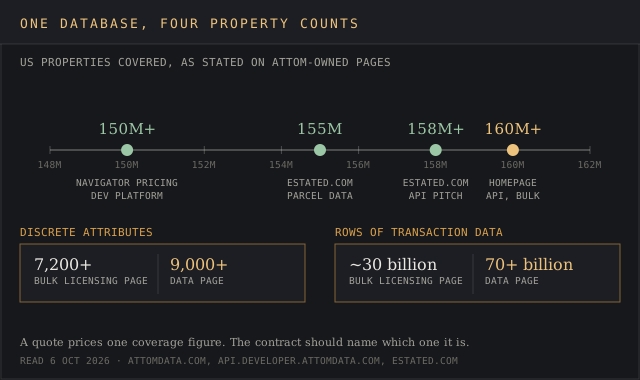
The attribute and row counts split the same way. The data page claims over 9,000 discrete data attributes and more than 70 billion rows, covering 99 percent of the population across more than 3,000 counties. The bulk licensing page says more than 7,200 attributes and nearly 30 billion rows. Same warehouse, a 40-billion-row gap between two pages of one site.
How complete the ownership field is in the counties a buyer cares about is a separate measure from every count above. Ask which figure the contract covers, then pull the sample file and measure fill rate on the fields you'll pay for.
Rental AVM and valuation data inside the price
Valuation products are part of what the money buys. The Rental AVM, per its Cloud Help article, "Estimates the likely rental value of a property based upon rental listings in the immediate area for comparable properties", using the techniques behind the company's property AVM. The article states the model is proprietary to ATTOM.
The table carries an estimated rental value, a minimum and a maximum for each property, keyed to the ATTOM ID with a valuation date, and holds about 72 million rows. The model runs once a month and loads into ATTOM Cloud between the 28th and 31st. That article was last updated on 26 July 2023, so treat the row count as a 2023 figure.
Price-wise, the Rental AVM and the property AVM both sit inside the $499 Navigator seat. On the API, the same values cost one API Report per property, so a rent-roll check across 1,000 doors spends 1,000 reports.
What ATTOM buyers pay in practice
Procurement data on this vendor is thin. Vendr's marketplace page for ATTOM Data Solutions carries a company description, citing "more than 155 million U.S. properties", and one product entry, with no purchase count or median contract value on the page as of 6 October 2026. That keeps the company's contract values under the radar of Vendr's tracked-purchase data.
The help-center example is the only contract-sized number left. Taken at face value, $1,000 a month is $12,000 a year for a 100,000-report quota. BatchData's published Growth tier uses the same two numbers, $1,000 a month for 100,000 records, which works out to the one cent a record that the help-center arithmetic produces.
How to negotiate an ATTOM contract
Page size and overage
Most of the bargaining power comes from the vendor's own documentation. Start with the page size. Billing counts reports returned, so an application that requests 1,000 records per call when it needs 50 is paying for 950 it throws away; write the default page size your product uses into the scope.
Ask for a volume break above quota. The standard term bills overage at the quota's unit cost, so a contract that runs hot every month pays list rate on every extra report. A lower overage rate, or a quota that steps up automatically, is the cheapest concession to win before signature.
Trial terms
Get trial terms in writing before load testing. A 1,000-hit lifetime cap covers every test request, support can't lift it, and only sales can, so ask for the extension at the first call. Easier said than done once the key has already returned 401s.
Storage, coverage and use rights
Settle storage up front. If the product keeps records past the 24-hour caching limit, price the bulk license or cloud share in the same negotiation, since a second contract signed later starts from list. And name the coverage figure, the refresh cadence and the fields in the order form, leaving no stone unturned on fill rate in your counties.
Last, ask for the complete list of permitted use cases in writing. The bulk page mentions the list without printing it, and a use the list doesn't name is a renegotiation waiting to happen.
ATTOM Data pricing against the alternatives
Four competitors publish rate cards, which makes them the yardstick for an ATTOM quote.
| Vendor and entry tier | List price | Included volume | Unit cost at entry | Free access |
|---|---|---|---|---|
| ATTOM Property Navigator Professional | $499 a year | 200 reports a month | About $0.21 a report | 7-day trial |
| ATTOM API | Quoted | Contracted API Report quota | Overage at the contract rate | 30-day key, about 1,000 hits |
| RentCast API Foundation | $74 a month | 1,000 requests a month | $0.074 a request, $0.06 overage | Developer plan at $0, 50 requests a month |
| RealEstateAPI Starter | $599 a month | 30,000 credits a month | $0.02 a record | Free trial; pay-as-you-go at $0.10 a record |
| BatchData Growth | $1,000 a month | 100,000 records a month | $0.01 a record | Sales call |
| PropStream Essentials | $99 a month | 50 free leads in the trial | Seat price | 7-day trial |
Every price is the vendor's own published list price, read on each vendor's pricing page on 6 October 2026, annualised where stated.
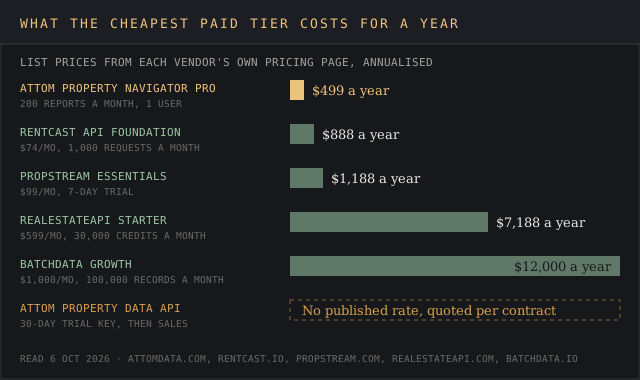
The ladder cuts both ways. At $499, Navigator undercuts every annualised entry tier above it, including RentCast's $888 and PropStream's $1,188. Annualised, RealEstateAPI's Starter runs $7,188 and BatchData's Growth $12,000. On the API side, ATTOM's API is the only one in the table a developer can't price without a call, while RealEstateAPI publishes a $0.10 pay-as-you-go rate and RentCast a $0 developer tier.
CoStar, Cotality and Cherre publish no rate card either; quote-only pricing is par for the course at the enterprise end. Commercial buyers researching building owners can compare the Reonomy review. Our BatchData review and the ATTOM review cover the data each one delivers, and the data providers guide covers where property records sit among the other data categories.
Who ATTOM's pricing fits
Navigator fits a solo investor or agent pulling fewer than 200 reports a month who wants foreclosure search, comps and AVMs in one seat.
The API fits product teams with an engineer, a defined page size and a use case that never stores data past a day. Bulk and cloud fit data teams building on the file, the buyers our property market intelligence guide describes. Teams that need monthly billing or a self-serve API key on a card can hit the ground running with RentCast or RealEstateAPI.
Commercial brokers work from a different shortlist with CoStar on it, and the CoStar lawsuits moving through federal court in 2026 are part of the licensing picture there. Buyers sizing the residential market itself can start from our real estate statistics for 2026 or the retail real estate market report.
What to budget for ATTOM Data
Investor and developer budgets
A solo investor budgets $499 a year plus tax for one Navigator seat, with any export overage unpriced until the system offers it. That's a drop in the bucket next to an API contract. A developer prototype costs $0 for 30 days, and roughly 1,000 calls, before a sales conversation becomes mandatory.
Production API and bulk budgets
A production API contract has no list price. The help-center example implies $12,000 a year for a 100,000-report quota, and overage bills at the contract's unit rate. Bulk and cloud contracts add engineering time: the vendor ships records, and turning a complete national file into a product is the buyer's job, a cost that lands on the buyer's own payroll. Teams mapping that spend inside a wider real estate market intelligence investor strategy should count both lines.
Frequently asked questions
How much is ATTOM?
ATTOM pricing starts at $499 a year for one Property Navigator Professional user, billed annually with a 7-day free trial. Enterprise Navigator, the API, bulk licensing and cloud delivery are quoted by the company's sales team.
Is ATTOM API free?
For 30 days. The free trial key typically carries a lifetime cap of 1,000 hits, and continued access after that needs a paid plan through sales.
Is there a free property data API available?
The ATTOM trial key is free for 30 days. RentCast publishes a permanent Developer plan at $0 with 50 requests a month, and RealEstateAPI offers a free trial on each of its paid tiers.
Who owns ATTOM?
Private equity firm Lovell Minnick Partners acquired ATTOM Data Solutions in January 2019 for an undisclosed sum, National Mortgage Professional reported.
Who is ATTOM Data?
ATTOM Data Solutions is an Irvine, California property data company, originally known as RealtyTrac and founded in 1996. It also publishes the Housing News Report, and the HNR newsletter signup is free.
What kind of data does ATTOM provide?
Property characteristics such as square footage, lot size and zoning, plus ownership, tax and assessment records, sales and mortgage history, foreclosures, AVMs, boundaries, schools, neighborhood demographics and hazard risk. ATTOM's endpoint list on estated.com groups them into 10 families.
What does ATTOM mean in real estate?
ATTOM is the company name of a data vendor, renamed from RealtyTrac, whose records feed listing sites, lenders, insurers and property investors.
What are ATTOM's main competitors?
Cotality and CoStar at the enterprise end, Cherre for data integration, and BatchData, RealEstateAPI and RentCast among the published-price APIs.
How accurate is ATTOM data?
ATTOM publishes no accuracy rate or fill-rate percentage for its records. The way to measure it is a sample file in your own counties: check fill rate on ownership, sale price and AVM fields before signing.
Bottom line
ATTOM's one published price is $499 a year for a single Navigator seat. Every data contract, from the API to a Snowflake share, is quoted, and the one API example the company prints is off by a factor of ten.
Buy the API knowing that page size sets the invoice, that the trial's 1,000 hits are counted differently from a paid quota, and that storing data past 24 hours needs a separate license. Then make the contract name the coverage figure, because the vendor's own pages offer four.
Which ATTOM pages each number was read from, and the rate cards nobody prints
The $499 Navigator price, its quotas, trial, billing and overage terms come from ATTOM's Property Navigator pricing page and FAQ at attomdata.com. The API meter, the 1,000-report page size, the overage rule, the worked $1,000 example and the Rental AVM specification come from ATTOM's Cloud Help articles at cloud-help.attomdata.com; the Rental AVM article was last updated 26 July 2023.
Trial caps, usage-limit alerts and the pricing-routing article come from support.attomdata.com. The sales-form inputs, the API FAQ, the 24-hour caching limit and the bulk dataset list come from ATTOM's developer platform at api.developer.attomdata.com.
Coverage, attribute and row counts are read off attomdata.com's homepage, data, API, bulk licensing and cloud delivery pages, and off estated.com. The Estated acquisition date comes from Inman's report at inman.com, published 16 August 2022, and the January 2019 ownership change from National Mortgage Professional at nationalmortgageprofessional.com.
Competitor rate cards come from rentcast.io, realestateapi.com, batchdata.io and propstream.com, and the procurement check from vendr.com. Every URL was accessed 6 October 2026.
ATTOM publishes no rate card for the Property Data API, bulk licensing or cloud delivery, and no price for Navigator export overage or extra seats. Vendr's ATTOM page shows no purchase count and no contract value. CoStar, Cotality and Cherre publish no list price at all.