Mixpanel vs PostHog: Pricing at 5M Events, Session Replay and Feature Flags (2026)
 By Jan Suski. I go deep on every review, checking every number against its source and digging up details other coverage misses, a habit from six years of SEO and link building for tech companies. Bylines at Surfer, Brand24, and Senuto. How the scoring works.
| WHAT EACH ONE DOES | POSTHOG | MIXPANEL |
|---|---|---|
| Core job | All-in-one dev platform | Product analytics |
| Billing unit | Anon + identified rates | One rate per event |
| Free replays a month | 5K web + 2.5K mobile | 10K replays |
| Replay console logs | Yes + perf metrics | Yes, since Apr 2026 |
| Feature flags, free | 1M requests/mo | 10 active flags |
| Error tracking | 100K exceptions free | No native product |
| Data warehouse | Built in, 1M rows free | Connectors only |
| Self-hosting | MIT, unsupported | Cloud only |
| Skip it if | Every user is identified | You need error tracking |
| WHAT YOU GET | POSTHOG | MIXPANEL |
|---|---|---|
| Cost at 5M events/mo | $153 anon, $560 ident | $438 yr, $613 mo |
| Annual discount | Via sales, unpublished | Public, $7,848/yr at 20M |
| Billing cap | Per-product limit | No billing limit |
| Self-serve ceiling | Unlimited, pay-as-you-go | 20M events/mo |
| HIPAA BAA | Boost, $250/mo | Enterprise only |
| SAML SSO | Scale, $750/mo | Growth plan |
| Startup offer | $50K credits, 12 mo | Year free, 1B events |
| Last funding | $75M Series E, 2025 | $200M Series C, 2021 |
| G2 rating | 4.5 from 1,055 | 4.5 from 1,376 |
StrongerWeakerNo edge
Thirty-one further documented limits sit behind the button below: both vendors’ per-unit price ladders, quotas, API rate limits, retention windows and Mixpanel’s add-on percentages.
Test scenario: 5 million events a month, priced once with every event anonymous and once with every event identified (person profiles), against Mixpanel’s Growth tier on annual and monthly billing.
PostHog figures: anonymous tiers from posthog.com/product-analytics/pricing; identified totals from the table on posthog.com/blog/posthog-vs-mixpanel (28 Jan 2026), which reproduce exactly from the identified rates on posthog.com/blog/analytics-pricing ($0.000248/event 1-2M, $0.000104 2-15M, $0.0000655 15-50M). Mixpanel figures: Growth tier table on mixpanel.com/pricing. All read 17 October 2026.
| PostHog | WHAT IT DOCUMENTS |
|---|---|
| Anonymous event tiers | $0.00005 (1-2M), $0.0000343 (2-15M), $0.0000295 (15-50M), $0.0000218 (50-100M), $0.000015 (100-250M), $0.000009 (250M+) |
| Identified event tiers | $0.000248 (1-2M), $0.000104 (2-15M), $0.0000655 (15-50M), $0.0000364 (50-100M), $0.0000187 (100-250M), $0.00001 (250M+) |
| Web replay price | $0.005 (5-15k), $0.0035 (15-50k), $0.002 (50-150k), $0.0017 (150-500k), $0.0015 (500k+) |
| Mobile replay price | 2,500 free, then $0.01 (2.5-15k) down to $0.003 (500k+), billed separately from web |
| Flag request price | $0.0001 (1-2M), $0.000045 (2-10M), $0.000025 (10-50M), $0.00001 (50M+) |
| Warehouse rows | 1M a month free, then from $0.000015/row; historical syncs free |
| Surveys | 1,500 responses a month free |
| LLM analytics | 100,000 events a month free |
| Logs | 10 GB free, 14-day default retention, custom retention $0.05/GB-month |
| Event retention | 1 year Free, 7 years paid |
| Projects | 1 Free, 6 pay-as-you-go, unlimited with Boost |
| Support | Community on Free, email on paid, Slack above $2k/month |
| API rate limits | Analytics endpoints 240/min and 1,200/hr; query 2,400/hr; flag local evaluation 600/min |
| Capture endpoint | No request-level rate limit |
| Billing start | One month after signup, monthly invoices, card via Stripe |
| Onboarding call | $80 for 30 minutes |
| Mixpanel | WHAT IT DOCUMENTS |
|---|---|
| Growth ladder (annual) | 1.5M $100/mo, 3M $270, 10M $840, 15M $1,230, 20M $1,635 |
| Overage, 1M plan | $0.00028 per event, billed at start of next month |
| Usage alerts | Emails at 85%, 100%, 110%, 120%, 200%, 300%, 400% of plan |
| MTU plan | Enterprise only, from $20,000/year, sold through sales |
| Experiments | 1,000 MEU Free; 5,000 included, up to 100,000 Growth |
| Saved reports | 5 per seat Free, unlimited Growth |
| Alerts | None Free, 5 per project Growth, unlimited Enterprise |
| Group Analytics | Add-on, 40% of calculated overage |
| Data Pipelines | Add-on, 20% of calculated overage; 30-day trial, daily-only |
| Warehouse Connector limits | ~30K events+updates/sec; API-triggered syncs 5/hour |
| Ingestion API | 2GB uncompressed JSON/minute, ~30,000 events/second |
| Query API | 5 concurrent queries, 60/hour |
| Data residency | US, EU or India* |
| Compliance certs | SOC 2 Type II, ISO 27001, ISO 27701 |
| Custom data retention policy | Enterprise only |
*A marked figure is one the vendor states two ways on its own domain. Mixpanel’s pricing page labels its residency row “US or EU”, while its India Data Residency docs describe a third region for storing and processing customer data in India, opened on request through an account manager. The row carries all three because the docs page names the process a buyer follows to get the India region.
Where the per-event rates, replay quotas and both vendors’ attack pages came from
Prices come from posthog.com/pricing, posthog.com/product-analytics/pricing, posthog.com/session-replay/pricing, posthog.com/feature-flags/pricing and mixpanel.com/pricing, read 17 October 2026; PostHog’s identified-event rates are the ones on posthog.com/blog/analytics-pricing, which reproduce the totals in PostHog’s January 2026 comparison table.
Quotas, limits and changelog dates trace to docs.mixpanel.com (pricing, warehouse connectors, pipelines, reference/rate-limits, privacy/in-residency) and posthog.com/docs/api, plus posthog.com/platform-packages and mixpanel.com/legal/security-overview. Vendor claims are quoted from posthog.com/blog/posthog-vs-mixpanel (28 Jan 2026) and mixpanel.com/compare/posthog (undated). G2 counts are G2’s own.
Three more figures are stated two ways on a single vendor’s domain.
- PostHog’s docs call anonymous events “up to 4x cheaper” than identified ones, and its comparison page says “up to 80% less”, which works out to 5x. The page above publishes the calculator totals: $153 against $560 at 5M events.
- PostHog’s history page dates its Series D to June 2025 and its Series E to October 2025 in one section, and to March and July 2025 in its press kit. The decision block uses the Series E announcement post, dated 29 September 2025.
- Mixpanel’s pricing page sells Enterprise replay retention at 7 to 365 days, and its session replay docs say 7 to 360. The replay table above carries the pricing-page figure.
Neither vendor publishes PostHog’s annual discount figures, dollar prices for Mixpanel’s add-ons, crawlable uptime percentages, the scope of Mixpanel’s November 2025 incident, or a support tier for self-hosted PostHog.
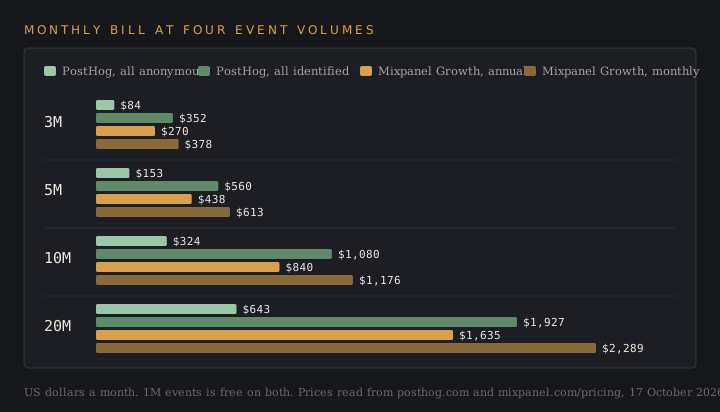
PostHog is the cheaper pick for most teams with anonymous traffic under 20 million monthly events, and Mixpanel is the cheaper pick for one specific buyer: a team that identifies every user and pays annually. At 5 million events a month, PostHog bills $153 if those events are anonymous and $560 if every one is identified. Mixpanel bills $438 a month on annual billing and $613 on monthly billing, whatever the event type.
That split decides more PostHog vs Mixpanel purchases than any feature table. This page prices both product analytics platforms at four event volumes, then covers session replay, feature flags, the data warehouse, self-hosting, security and who each one suits. Every price was read off mixpanel.com and posthog.com on 17 October 2026.
Among product analytics tools, PostHog and Mixpanel sit at two ends: an all-in-one platform for engineers and a focused analytics product for product teams. The pick matters because both bill per event, so a wrong one shows up on every invoice: at 20M identified events the gap between PostHog and annual Mixpanel is $292 a month, or $3,504 a year.
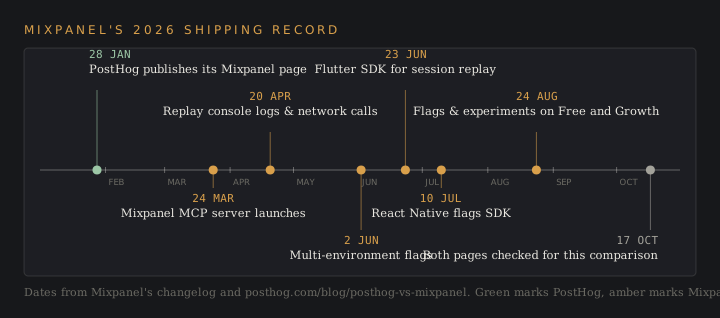
This page is written for product managers, engineering teams and founders who've narrowed a shortlist of analytics tools to these two. Both vendors publish a page attacking the other, and several claims on PostHog's January 2026 page went stale after Mixpanel shipped console logs in April and opened feature flags to its Free plan in August. A comparison that's even six months old is now wrong on three rows.
↑ COMPARISONPostHog vs Mixpanel pricing at 3M, 5M, 10M and 20M monthly events
PostHog and Mixpanel both publish public pricing. Both run usage based pricing anchored on monthly event volume and give away the first 1,000,000 events every month. The difference is what counts as an event. Mixpanel's event based pricing charges one rate per event. PostHog charges a base rate for anonymous events and a much higher rate for identified ones, the events tied to a person profile.
| Monthly events | PostHog, all anonymous | PostHog, all identified | Mixpanel Growth, annual | Mixpanel Growth, monthly |
|---|---|---|---|---|
| 1M | $0 | $0 | $0 | $0 |
| 3M | $84 | $352 | $270 | $378 |
| 5M | $153 | $560 | $438 | $613 |
| 10M | $324 | $1,080 | $840 | $1,176 |
| 20M | $643 | $1,927 | $1,635 | $2,289 |
PostHog figures come from its product analytics pricing calculator (anonymous tiers from $0.00005 per event between 1M and 2M, falling to $0.0000343 between 2M and 15M) and the identified-event rates in its own comparison page. Mixpanel figures are the Growth tier totals on mixpanel.com/pricing. All read 17 October 2026.
↑ COMPARISONAnonymous and identified events cost different amounts on PostHog
PostHog's anonymous events are the default. An event becomes identified only when your code calls identify, and from then on it's billed with a "person profiles" line on top of the base rate. A marketing site with logged-out visitors stays near the left column, and that's where teams save money on PostHog. A SaaS app where every user is signed in lands in the second.
The devil's in the details here: one identify call in a shared layout file can move a whole site to the higher rate.
PostHog calls its pricing 100% transparent, and on transparent pricing it mostly delivers: per-unit rates for every product are public. The two pieces that sit off the main pricing page are the identified-event surcharge and any annual discount.
PostHog's own table leaves one row out, and it changes the pricing model math. Its PostHog vs Mixpanel page prices Mixpanel at $612 for 5M events, which is Mixpanel's monthly-billing figure. On annual billing Mixpanel costs $438, and fully identified PostHog costs $560.
At every volume in the table, an annual Mixpanel contract undercuts PostHog when all events are identified. PostHog's claim that it stays cheaper with every event identified holds against monthly billing only. Against an annual Mixpanel quote it's close but no cigar: $560 to $438.
Mixpanel's annual discount is public: $480 a year saved at 1.5M events and $7,848 a year at 20M. PostHog's isn't. Its pricing page says volume and annual-commitment discounts exist through sales, with no figures, so the actual costs on a PostHog annual deal aren't checkable from outside.
↑ COMPARISONBilling caps, overage and the free tier ceilings
PostHog lets you set a billing limit per product. Once you hit it, extra events are dropped and feature flags return a quota-limited response, and PostHog says it won't charge past the limit. Mixpanel's billing docs say it doesn't offer a billing limit and keeps collecting data past your plan, billing the overage at the start of the next month.
- Mixpanel overage on the 1M-event Growth tier: $0.00028 per event. Alert emails go out at 85%, 100%, 110%, 120%, 200%, 300% and 400% of plan volume.
- Mixpanel Free at 1M events: no overage charge, but reports lock until the next month or an upgrade.
- Mixpanel Growth tops out at 20M events a month. Above that it's enterprise pricing through sales, and an MTU plan priced on monthly tracked users starts at $20,000 a year. Self-serve plans never bill by monthly tracked users.
- PostHog Free: usage stops at the free limits. Pay-as-you-go has no minimum spend and starts billing one month after signup.
That gap is a red flag for a team with a spiky launch calendar, and a stitch in time saves nine: set the cap before launch week. A product that triples traffic for one week can't overspend on PostHog with a cap set, while on Mixpanel the bill follows the data.
↑ COMPARISONWhat each analytics platform bundles
PostHog lists 14 metered free allowances under one bill. Mixpanel sells one analytics product with replay, flags and experiments attached. The free tier shows the scope difference fastest.
PostHog's free monthly allowance, per posthog.com/pricing on 17 October 2026:
- 1M product analytics events and 5,000 session recordings
- 1M feature flag requests, which experiments also draw from
- 100,000 error tracking exceptions and 1,500 survey responses
- 1M data warehouse rows, plus free historical syncs
- 10,000 data pipeline events and 100,000 LLM analytics events
- 10 GB of logs and 10,000 workflow messages per channel
Mixpanel's Free plan covers 1M events, 10,000 session replays, 1,000 monthly experiment users and up to 10 active feature flags, with saved reports capped at 5 per seat. Error tracking, surveys and LLM observability sit outside Mixpanel's product, so those jobs need Sentry or a survey tool alongside it.
A team that wants to consolidate tools gets more from PostHog's bundle. A team that already owns Sentry, a survey tool and a warehouse pays for nothing it won't use with Mixpanel.
Both product analytics platforms cover the core product analytics jobs: funnels, retention analysis, user paths, cohorts and custom events defined on user actions. Mixpanel focuses on deep behavioral analytics on event data, and its interface lets non technical teams and non technical users build a funnel or retention report without writing SQL.
PostHog covers the same reports and adds web analytics with Core Web Vitals, so one snippet can stand in for Google Analytics on a marketing site.
Event tracking: autocapture, custom events and user properties
Both product analytics tools start the same way: a snippet or SDK that sends event data from your app. Autocapture on PostHog and Mixpanel records clicks, page views and form submissions without code, which covers basic user interactions on day one; event tracking for in-app user interactions like a completed import needs code on both. The real setup work comes after, when you define events for the actions your product exists to drive.
Mixpanel's event tracking model rewards a planned taxonomy. Its Lexicon lets product teams name, describe and hide events, and user properties attach to profiles so a report can split feature adoption by plan, country or signup month. That structure is why non technical users can build reports on it: an engineer did the hard thinking once, in the tracking plan.
PostHog is looser by default. Autocapture fills the stream first, and you add custom events and person properties as questions come up. It's faster to start, and the bill for that speed arrives later as duplicate event names unless someone owns the taxonomy.
To integrate PostHog, you add one snippet or SDK, and the same install covers session replay, feature flags and surveys. Mixpanel's SDKs carry analytics, replay and, since 2026, flags. Either way, user behavior data turns into actionable insights only once each event maps to a decision a team will make.
Customer data from a CRM or billing tool reaches the two by different routes, and that customer data is often what turns a funnel into a revenue report. PostHog pulls it into its own warehouse and joins it to events in SQL. Mixpanel reads it through data warehouse connectors from Snowflake, BigQuery, Databricks, Redshift or Postgres, so it has to land in your warehouse first.
The key features for event-level work line up closely: funnels, retention, paths, cohorts, formulas and breakdowns by user properties. Mixpanel adds Metric Trees and Borrowed Properties as advanced features. PostHog adds SQL insights, so analysts can analyze data the visual builders can't reach.
PostHog vs Mixpanel claims, checked against each vendor's docs
PostHog published "In-depth: PostHog vs Mixpanel" on 28 January 2026. Mixpanel runs an undated PostHog comparison page. Both are marketing. Their checkable claims were tested against each vendor's own documentation on 17 October 2026.
| Claim | Made by | Status on 17 Oct 2026 |
|---|---|---|
| Mixpanel replay has no console logs | PostHog | Stale. Mixpanel's changelog added console logs & network calls on 20 April 2026 |
| Mixpanel replay has no Flutter recording | PostHog | Stale. Flutter SDK for Session Replay shipped 23 June 2026 |
| Mixpanel Growth starts ~$28/month per 10k events | PostHog | Off by 10x. $0.00028 per event is $28 per 100,000 events |
| PostHog is cheaper even when all events are identified | PostHog | True against Mixpanel monthly billing, false against annual |
| Mixpanel relies on external warehouse connectors | PostHog | Partly. Mixpanel's connectors are native and free on paid event plans; it has no warehouse of its own |
| PostHog lacks behavioral cohorts | Mixpanel | False. PostHog's cohort docs cover dynamic cohorts built on event behavior |
| PostHog lacks warehouse connectors for 5 major platforms | Mixpanel | False. PostHog's warehouse names Postgres, MySQL, Snowflake, BigQuery and Redshift as sources |
| PostHog has fewer than 10,000 free replays | Mixpanel | True. 5,000 web recordings, plus 2,500 mobile per PostHog's own page |
| PostHog lacks free email support | Mixpanel | True. PostHog Free lists community support only |
Read between the lines and both pages describe their own product at its newest and the rival at its oldest. PostHog's page is the more specific of the two, with prices and dated features, which is also why it aged faster. Mixpanel's page carries no prices for PostHog at all and leans on figures like "2 trillion user actions processed per month," which nobody outside Mixpanel can check.
↑ COMPARISONSession replay: quotas, console logs and mobile
Session replay is where AI search answers and vendor pages disagree most, because Mixpanel changed the product three times in 2026. The current state, straight from the horse's mouth in each vendor's docs:
| Session replay | PostHog | Mixpanel |
|---|---|---|
| Free recordings a month | 5,000 web, 2,500 mobile | 10,000 |
| Paid quota | Metered, $0.005 per web recording from 5k to 15k | 20,000 included on Growth, up to 500,000 |
| Retention | 1 month Free, 90 days paid, 12 months Boost/Scale | 30 days Free and Growth, 7 to 365 days Enterprise |
| Console logs | Yes, plus performance metrics | Yes, since 20 April 2026, on by default |
| Network requests | Yes | Yes, off by default, needs SDK config |
| Mobile platforms | Web and mobile, wireframe mode | iOS, Android, React Native, Flutter |
| AI summaries | PostHog AI summarizes sessions | AI Summary tab per replay; PostHog dates it to late 2025 |
PostHog's per-recording price falls to $0.0015 above 500,000 web recordings a month. Mobile recordings bill separately at double the web rate, from $0.01 each. Mixpanel prices replay volume inside the Growth tier, so the actual costs show up only in the plan calculator.
The debugging tools are close to a level playing field now. PostHog still records iframes and canvas elements and adds a DOM explorer, which matters to engineers chasing a front-end bug. A product manager watching where users drop in onboarding gets the same answer from either session replay, PostHog or Mixpanel.
↑ COMPARISONFeature flags and experiments
PostHog has shipped feature flags and A/B testing as metered products for years, and its comparison page says it has had experimentation longer than Mixpanel. Mixpanel deprecated its old experiments product and relaunched it with feature flags as "Experimentation 2.0" in late 2025, per PostHog's account of the timeline.
Mixpanel then hit the ground running. Its changelog shows multi-environment support for flags on 2 June 2026, a React Native flags SDK on 10 July, and on 24 August 2026 "Experiments and Feature Flags: Now on Free and Growth plans." The AI search claim that Mixpanel's feature flags are enterprise-only was wrong by that date.
- Mixpanel Free: up to 10 active feature flags, 1,000 monthly experiment users (MEU)
- Mixpanel Growth: up to 50 active flags (500 with extra MEU), 5,000 MEU included, up to 100,000
- PostHog: 1M flag requests free, then $0.0001 per request from 1M to 2M, falling to $0.00001 above 50M
The billing unit is the real difference. Mixpanel counts users exposed to an experiment and active flags. PostHog counts flag requests, so a flag checked on every page load of a high-traffic app burns through the allowance far faster than a flag checked once at login. PostHog also bundles payloads, scheduling, remote config and holdout testing, and its flags tie into replay and surveys, so session replay, feature flags and survey answers share one person profile.
For basic experimentation on a signup flow, both do the job. For controlled rollouts across a large engineering org running dozens of flags, PostHog's flag tooling is deeper and its pricing model is easier to predict per request.
↑ COMPARISONData warehouse, SQL and the data stack
The warehouse question splits the two cleanly. PostHog stores your product data next to imported business data and lets you query both. Mixpanel syncs with the warehouse you already run.
PostHog's built-in data warehouse
PostHog's data warehouse imports from Stripe, Postgres, MySQL, Snowflake, BigQuery and Redshift, and its comparison page adds Zendesk. The first 1M rows a month are free, then from $0.000015 per row. You query data with HogQL or standard SQL, and PostHog's SQL docs describe HogQL as "effectively a wrapper around ClickHouse SQL," the underlying ClickHouse database that stores your events.
Its CDP side syncs data out to 145+ tools, per PostHog, and the warehouse lets a founder join Stripe revenue to feature usage in one query without buying a separate tool. Writing SQL is optional; PostHog AI generates queries from plain English.
Mixpanel's warehouse connectors and exports
Mixpanel has no built-in data warehouse, and its PostHog page calls the idea "half-baked data warehouses." Its Warehouse Connectors import from Snowflake, BigQuery, Databricks, Redshift and Postgres, and they're a free add-on on paid event-based plans. Syncs run at roughly 30,000 events and updates per second, with API-triggered syncs capped at 5 an hour.
Data Pipelines handles the other direction, exporting raw data to S3, Google Cloud Storage, Azure, BigQuery, Databricks, Redshift Spectrum and Snowflake. It costs 20% of the calculated overage as a Growth or Enterprise add-on, and Group Analytics costs 40%. Mixpanel doesn't pull from third party tools like Stripe or Zendesk directly; that data reaches it through your warehouse first, so the data warehouse integration depends on data infrastructure you already pay for.
Getting your data out
Switching costs run in both directions. Mixpanel's Raw Data Export API allows 60 queries an hour, and its Query API allows 5 concurrent queries. PostHog's query endpoint allows 2,400 requests an hour and its analytics endpoints 240 a minute.
Monthly self-serve billing on both means the exit cost is mostly migration work: re-instrumenting events and moving history through those APIs. That's easier said than done on a product with hundreds of custom events, so map the taxonomy before you sign.
↑ COMPARISONSelf-hosting PostHog: what the open-source option covers
PostHog's open-source code is real and MIT-licensed. Self-hosting it for production is a different matter, and PostHog's own self-host docs say so in plain words: self-hosted deployments are "officially unsupported."
- No customer support for self-hosted instances, and no published CVEs or tagged releases
- "All paid-plan features are Cloud-only"
- New Kubernetes deployments of the paid open-source product are no longer supported
- The hobby Docker Compose deploy is described as "a trial" that might be removed
The self host path suits a team that wants more control and data control for a test environment, or one that won't send data to any third party. For production product analytics, PostHog's docs point you to PostHog Cloud, with US and EU hosting. Mixpanel has no self-host option at all; it's cloud only, with US, EU and India data residency and no infrastructure for you to manage.
↑ COMPARISONSecurity, compliance and who owns each company
Mixpanel disclosed a security incident on its own blog on 27 November 2025. CEO Jen Taylor wrote that Mixpanel detected an SMS phishing campaign on 8 November 2025 that affected "a limited number of our customers." Mixpanel revoked sessions, rotated credentials, forced a global employee password reset and brought in a forensics firm. The post doesn't list the data accessed; OpenAI was among the customers that confirmed being affected.
Both vendors publish a public status page, so their reliability can be checked by the same method. Mixpanel's showed one US ingestion delay on 8 October 2026, caused by its cloud storage provider, with no events lost.
| Item | PostHog | Mixpanel |
|---|---|---|
| HIPAA BAA | Boost package, $250/mo | Enterprise plan only |
| SAML SSO | Scale package, $750/mo | Growth and Enterprise |
| Audit logs | 7 days Boost, 60 months Enterprise | 90 days Growth, 2 years Enterprise |
| Priority support | Scale package | Higher plans, tiered |
| Last funding | $75M Series E at $1.4B, Sep 2025 | $200M Series C, Nov 2021 |
| G2 rating | 4.5 from 1,055 reviews | 4.5 from 1,376 reviews |
PostHog says it ended 2024 cashflow positive, and its Series E post names Peak XV Partners as lead. Mixpanel's last public round was a $200M investment from Bain Capital Tech Opportunities, announced with "over 6,000 paying customers." Both are private and independent. G2 figures are G2's own, read 17 October 2026.
↑ COMPARISONPostHog vs Mixpanel: which product analytics tool fits which team
Product managers, growth and marketing teams
Mixpanel is built for product managers and product teams who need behavioral reporting without engineering help. Its polished interface, Metric Trees and saved-report sharing are where it earns its price, and an annual contract makes it cheaper than identified-event PostHog at every volume up to 20M. Feature adoption, user properties and marketing attribution reports are a few clicks for non technical teams.
Growth teams that live in dashboards get alerts, anomaly detection on Enterprise and up to 5 alerts per project on Growth. PostHog's interface reaches the same reports, laid out around engineers' workflows.
Engineering teams and technical teams
PostHog is designed for engineering-led companies that want one platform in place of five. Error tracking, session replay, feature flags, surveys and a SQL editor share one event stream, so a developer can go from an exception to the replay to the flag that caused it without opening a separate tool. That kills two birds with one stone for technical teams who'd otherwise run Sentry and LaunchDarkly alongside their analytics platform.
Engineering teams that want more control also get SQL over the raw events and a self-host option for test environments. Mixpanel's Headless Python SDK and its MCP server, launched 24 March 2026, close part of that gap for technical teams that script their reporting.
Early-stage startups
Both run a startup program, and the terms differ. PostHog gives $50,000 in credits for 12 months to companies under 2 years old with under $5M raised. Mixpanel gives the first year free on its Startup Plan, covering 1 billion events and 1 million session replays, to companies under 5 years old with up to $8M in funding.
Mixpanel's offer is the larger one for a funded seed company. PostHog's generous free tier matters more after year one, when the credits run out. PostHog says more than 90% of companies use it for free, so the lion's share of its users never see an invoice.
For teams still on the fence, the verdict: pick PostHog if anonymous traffic is the bulk of your event volume or you'll use three or more of its products, and pick Mixpanel if every user is logged in, you'll sign an annual deal, and product managers will run the reports. Don't put all your eggs in one basket on price alone; run a week of real events through each free tier first.
Amplitude, Google Analytics and the other analytics tools people compare
Mixpanel's main competitors among product analytics tools are Amplitude, PostHog, Heap (now part of Contentsquare), Pendo and Google Analytics. Amplitude is the third option most buyers on this shortlist look at, and it shares Mixpanel's event model and its product-manager audience. Our Hotjar vs Amplitude comparison covers its event pricing.
Google Analytics is a different tool for a different job. It measures traffic sources, page views and form submissions for marketing teams, and it's free. Mixpanel beats it on user-level product analytics; GA4 is the better fit for acquisition reporting. PostHog's web analytics product is the one option here that tries to replace GA outright.
The top five web analytics tools by use case are Google Analytics for acquisition, PostHog for an all-in-one stack, Mixpanel and Amplitude for product analytics, and Hotjar for qualitative insights from heatmaps. Our customer analytics tools ranking scores all of them alongside other product analytics tools, and the Hotjar vs Mixpanel comparison covers Mixpanel against a replay-first tool.
Common PostHog and Mixpanel questions
Is PostHog good for analytics?
Yes, for teams that can instrument events. PostHog covers funnels, retention, paths, cohorts and SQL on 1M free events and 5,000 free recordings a month.
Which is better in the PostHog vs Mixpanel decision?
PostHog for engineering-led teams that want one platform and mostly anonymous traffic. Mixpanel for product managers who run reports daily and identify every user on an annual contract.
How do PostHog and Mixpanel count events?
Mixpanel counts every ingested event at one rate and excludes identify, alias and profile updates. PostHog counts all events and bills identified ones at a higher rate.
Can PostHog and Mixpanel run on the same app?
Yes. Both SDKs can run side by side, which is the cheapest way to compare reports on your own data before the free tiers run out.
Is PostHog cheaper than Mixpanel?
For anonymous events, yes, by about 3x at 5M events: $153 against $438. For fully identified events on annual billing, no: $560 against $438.
Can you self host PostHog?
You can run the MIT-licensed hobby deploy, but PostHog calls self-hosting officially unsupported and keeps all paid features on Cloud.
Does Mixpanel have feature flags?
Yes. Since 24 August 2026 they're on the Free and Growth plans, with up to 10 and 50 active flags.
Is Mixpanel better than Google Analytics?
For product data and user events, yes. For marketing traffic and acquisition, Google Analytics does that job free.
Figures to re-check before you sign
- PostHog's identified-event rates: the live pricing page shows anonymous tiers only; the identified rates here match PostHog's January 2026 comparison table
- Mixpanel's 5M Growth price: $438 annual, $613 monthly on 17 October 2026
- Mixpanel session replay retention: the pricing page says 7 to 365 days on Enterprise, the docs say 7 to 360
- Mixpanel's Flutter replay support: the changelog shipped it on 23 June 2026; the session replay docs' platform list still names four platforms and omits Flutter
- PostHog's anonymous-event discount: its docs say "up to 4x cheaper," its comparison page says "up to 80% less"
These two product analytics tools both reward a trial on real traffic. Talk is cheap on both vendor pages, so price your own event mix in each calculator before the first invoice arrives.