PostHog pricing in 2026: free allowances, per-unit rates and what a real bill costs
 By Jan Suski. I go deep on every review, checking every number against its source and digging up details other coverage misses, a habit from six years of SEO and link building for tech companies. Bylines at Surfer, Brand24, and Senuto. How the scoring works.
The numbers PostHog list prices and contract data, checked 17 October 2026
A team sending 5M anonymous events a month pays $152.90 for analytics; the same 5M as identified events costs $560.
Single sign-on & a HIPAA BAA cost a flat $250 a month through Boost, with no sales call.
Annual buyers on Vendr report $20,000 to $70,000 a year, against $402.40 to $809.50 a month for the mid-sized app worked through below.
I'll write a 2,500+ word report on the vendor you name, with per-unit rates, free allowances and real bills sourced line by line. Yours to publish, from $200.
PostHog pricing is a usage based pricing model with a free floor. Every product gets a monthly free allowance, the meter starts only past it, and PostHog's own pricing page leads with the claim that 97% of companies use it for free. The other 3% pay per event, per recording, per flag request and per exception, with unit rates that fall as usage increases.
This report lays out every published rate as of 17 October 2026: the Free and pay as you go plans, the per-product tiers, the three flat-fee packages, the costs that don't show up until the invoice, and what Vendr's buyers report paying once they sign an annual deal.
It's written for engineering leads & founders who need a PostHog cost figure before the initial setup. One choice decides most of it, and the devil's in the details: identified events start at roughly five times the anonymous rate.
How much PostHog costs
PostHog pricing, in one line: $0 until a product passes its free allowance, then a per-unit charge for that product alone. There's no seat fee, no minimum spend and no annual contract, which the pricing page FAQ states as "There is no minimum spend or annual contracts needed." Billing starts one month after signup, in USD, by card through Stripe.
That makes PostHog's pricing model transparent pricing in the literal sense. Amplitude's Growth plan needs a sales quote; PostHog's usage-based pricing puts each rate on a public page, a pricing calculator turns event volume into estimated costs, and the billing dashboard in a free account shows actual usage within days. The catch is that a usage-based meter has no ceiling unless you add one.
PostHog's pricing model: Free, pay as you go and Enterprise
PostHog sells two self-serve plans and one sales-led tier. Both self-serve plans carry the identical free tier on every product; what separates them is what happens at the limit.
Free plan
The Free plan needs no credit card, no strings attached, and gives full access to every product inside the free tier limits. It includes unlimited team members, API access, one project, 1 year of data retention and community support. Session recording data on Free is kept for 1 month.
Usage stops at the cap. Past 1M events, extra events are dropped until the month resets, so the free plan suits early-stage projects and side apps whose event volume stays flat. Unused allowance doesn't roll over.
Pay-as-you-go plan
The paid plan keeps the free allowance and bills only what runs past it, a usage based pricing plan with no upper limit by default. It raises the project count from 1 to 6, data retention from 1 year to 7 years, session replay retention to 90 days, and support from community to email, with Slack support once spend passes $2,000 a month.
Turning it on means adding a card. PostHog charges based on usage per product, so a team that only outgrows session replay pays for session replay and nothing else. For a small app the overage is often a drop in the bucket: 2M anonymous events bill $50.
Enterprise plans
Enterprise plans carry custom pricing. PostHog directs buyers with enterprise features, annual plans or volume discounts to sales, and says annual commitments are available "for example, to maintain pricing." This is the tier the Vendr contracts below describe.
PostHog pricing per product and the free allowance
Usage based pricing at PostHog runs product by product. Every product has its own free allowance and its own ladder. The table lists what's free each month and where the meter starts, from PostHog's product pages on 17 October 2026.
| Product | Free each month | First paid rate | Top-volume rate |
|---|---|---|---|
| Product analytics (anonymous events) | 1M events | $0.00005 an event | $0.000009 past 250M |
| Product analytics (identified events) | 1M events | $0.000248 an event | $0.00001 past 250M |
| Session replay, web | 5,000 recordings | $0.005 a recording | $0.0015 past 500k |
| Session replay, mobile | 2,500 recordings | $0.01 a recording | $0.003 past 500k |
| Feature flags | 1M requests | $0.0001 a request | $0.00001 past 50M |
| Error tracking | 100,000 exceptions | $0.00037 an exception | $0.000115 past 10M |
| Surveys | 1,500 responses | $0.10 a response | $0.01 past 20,000 |
| AI observability | 100,000 events | $0.00035 an event | $0.00006 past 50M |
Copy these lines into an email, fill them in and send. I reply with scope and a price within 2 to 3 business days.
Open the emailEvery rate is a PostHog US-dollar list price from its product pricing pages, 17 October 2026. Vendr tracks PostHog contracts, but no row here uses a Vendr median.
The rest of the list sits on the main pricing page: 1M data warehouse rows, 10,000 data pipelines events plus 1M exported rows, 10 GB of logs, 10,000 workflow messages per channel and 500 PostHog AI credits, which PostHog values at $5. Experiments bill through feature flags.
Product analytics events
Event tracking is the first line on a PostHog invoice, and event tracking volume sets most of the bill. The product analytics pricing page lists these anonymous analytics events tiers each month:
- First 1M events: free
- 1M to 2M: $0.0000500 an event
- 2M to 15M: $0.0000343
- 15M to 50M: $0.0000295
- 50M to 100M: $0.0000218
- 100M to 250M: $0.0000150
- 250M and up: $0.0000090
Identified events, the ones tied to a person profile, cost more. PostHog's event comparison page starts them at $0.000248, and the August 2024 pricing post that introduced the split publishes the identified ladder: $0.000104 from 2M to 15M, $0.0000655 to 50M, $0.0000364 to 100M, $0.0000187 to 250M and $0.00001 beyond. That same post put the anonymous discount at 80% in the 1M to 2M band, shrinking to 10% past 250M.
Session replay
Session replay data bills per recording, and a recording is a session: a new one starts after 30 minutes of inactivity or at 24 hours, per the usage estimation docs. Web recordings run $0.005 from 5,000 to 15,000, $0.0035 to 50,000, $0.002 to 150,000, $0.0017 to 500,000 and $0.0015 after that, per PostHog's session replay rates.
Mobile is billed separately at double the web rate in every band, with half the free allowance. Sampling settings cut the count before it reaches the meter, which matters most for teams that bundle session replay, feature flags and analytics on one usage-based bill.
Feature flag requests
Feature flags are free for the first 1M requests, then $0.0001 a request to 2M, $0.000045 to 10M, $0.000025 to 50M and $0.00001 beyond, per the feature flags pricing page. Flag requests come from SDK initialization, user identification and property updates; PostHog's example puts 2 requests per pageview at 150,000 pageviews, about 300,000 requests a month.
Analytics, session replay, feature flags and surveys all load from one JavaScript snippet. One install starts four meters, so keep an eye on each product's usage page in the first month.
Error tracking, surveys and AI observability
Error tracking gives 100,000 free exceptions, then $0.00037 to 325,000, $0.00014 to 10M and $0.000115 past that, per PostHog's error tracking rates. Surveys collect user feedback at 1,500 free responses, then $0.10 each to 2,000, falling to $0.01 past 20,000, per its surveys rate card.
AI observability (formerly LLM analytics) starts at $0.00035 an event past 100,000 and drops to $0.00006 past 50M, per its rate card. That's eight bands, the most of any PostHog product.
Platform packages priced outside the usage meter
Platform packages are the only flat fees in PostHog's pricing model. They buy security permissions & governance, never usage. The platform packages page lists three:
- Boost, $250 a month: unlimited projects, enforced SSO and 2FA, white labeling, access control, 7-day activity logs, HIPAA BAA, automatic provisioning and shared resource configurations.
- Scale, $750 a month: everything in Boost plus SAML and OIDC SSO, approvals, 2-month activity logs and priority support with a faster target response time.
- Enterprise, custom pricing: role-based access control, SCIM, a dedicated account manager, ongoing training, a custom MSA and 60 months of activity logs. That's PostHog's dedicated customer support tier, and the only dedicated support it sells.
Boost and Scale also extend recording retention to up to 1 year, and Enterprise to 5 years. Pay-as-you-go stops at 6 projects, so a team that needs multiple projects past that count buys Boost to get unlimited projects.
One more flat fee sits outside the packages: a 30-minute onboarding call for $80. There are no setup fees.
Hidden costs and overage fees
PostHog has no hidden fees in the contract sense; every rate is public. The hidden costs are mechanical, and four of them catch teams:
- Identified events. Calling identify on every user moves events from the $0.00005 anonymous rate to $0.000248. PostHog's identify docs say anonymous events "can be up to 4x cheaper to process."
- Server-side flag polling. With local evaluation, each poll costs 10 requests when definitions change and 1 when they don't; one server polling every 30 seconds makes about 86,400 requests a month, and older SDKs without ETag support make about 864,000.
- Mobile replay. It has its own 2,500-recording free tier and twice the web rate.
- Autocapture. It records clicks and pageviews without code, so data volume rises with every new screen, and the estimation docs warn that it changes event counts.
Overage fees only stop when you set billing limits. Without them the paid plan bills every event past the free allowance, which is why Userpilot and LiveSession, both selling rival tools, describe PostHog's usage based billing as unpredictable. A cap nips that in the bud. Storage carries no fee: PostHog charges when data arrives, and custom log retention is the one storage line, at $0.05 per GB a month.
What a real PostHog pricing bill looks like
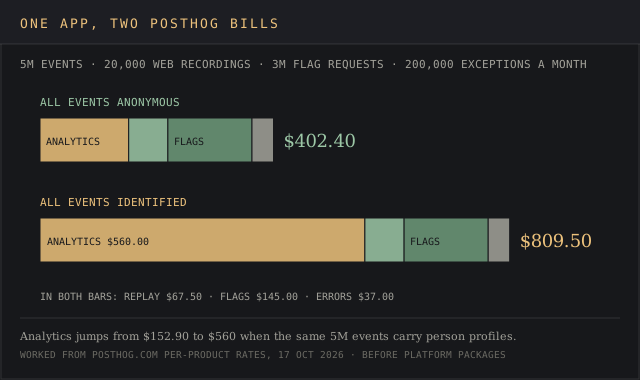
Worked from the published tiers, here is a mid-sized SaaS app: 5M events, 20,000 web recordings, 3M flag requests and 200,000 exceptions a month. The event type swings the total by $407.10.
- Analytics, 5M anonymous events: $50 for 1M to 2M, plus $102.90 for 2M to 5M, totals $152.90.
- Analytics, 5M identified events: $248 plus $312, totals $560.
- Session replay, 20,000 recordings: $50 plus $17.50, totals $67.50.
- Feature flags, 3M requests: $100 plus $45, totals $145.
- Error tracking, 200,000 exceptions: $37.
That puts the month at $402.40 with anonymous events and $809.50 with identified ones. Add Boost for SSO and the identified bill reaches $1,059.50.
Want a monthly-bill chart like this for the tool your buyers compare you with? Send the vendor name.
Email a briefData volume is the input every estimate starts from. Teams without a measured baseline can use PostHog's benchmark of monthly active users times events per user. Its estimation guide lists 87 events per MAU a month for PostHog's own B2B product, 31 for fashion retail and 583 for a speech-to-text API. A B2B app at 50,000 MAU on PostHog's ratio sends about 4.35M events, close to the example above.
What buyers pay in practice
Vendr's PostHog page puts the median annual contract at $58,173, with a low of $20,000 and a high of $70,000. Those are annual Enterprise deals, the tier where a buyer locks rates before usage increases push the bill up the ladder. $58,173 a year works out to $4,848 a month, six times the identified bill in the worked example.
Several Hacker News comments praise the published rates. User ssalka wrote in March 2025 that "Posthog's pricing is much more up-front about what you'll be charged for", and davedx wrote in September 2025: "I love PostHog. The feature set, the listening to the community, the positioning and pricing".
The startup credit draws praise too. Hacker News user mason55, May 2024:
Hacker News user rafael-lua, May 2026, praising it in the past tense:
The free tier draws a red flag or two as well. Hacker News user mrtranscendence wrote in January 2022 that "PostHog is absolutely a paid service, with features only available in non-free tiers." On the incumbents, user malisper wrote in June 2020:
That 2020 comment was about Mixpanel, Amplitude and Heap. PostHog's own Vendr median has since climbed past it.
How to cut the bill
Start with the billing cap. You can set billing limits per product, and the pricing page says "PostHog will never charge you more than what you've set as your billing limit." Past the cap, extra events are dropped and flags return a default response, so a capped product loses data past the limit while the site keeps running.
Event design comes second, and it's where the lion's share of savings sits. Send anonymous events for marketing pages and identify only signed-in users; at 5M events that's the $407.10 gap from the worked example. Sampling replays and switching servers to local evaluation with a current SDK trim the other two meters.
Discounts are the third lever. Three are published:
- Startups under 2 years old with under $5M raised get $50,000 in credit for 12 months, per PostHog for Startups.
- Non-profits get a discount "in most cases" after contacting sales.
- Annual commitments above a set spend earn bigger volume discounts, with no published threshold.
Self-hosting on your own infrastructure is the last route. PostHog's self-host docs offer a free Docker Compose deploy under an MIT license with no vendor support, and its decision flowchart asks if the instance will ingest more than 300,000 events before steering most teams to Cloud. Server costs replace the meter, and with no vendor support the team has to bite the bullet on upgrades.
PostHog against Mixpanel and Amplitude
At 5M events a month, PostHog anonymous events cost about a third of Mixpanel's annual rate, and identified events cost more than both rivals. Our PostHog vs Mixpanel comparison and PostHog vs Amplitude comparison work these figures from each vendor's own published rates.
| Item | PostHog | Mixpanel | Amplitude |
|---|---|---|---|
| Free events a month | 1M | 1M | 2M |
| Cost at 5M events a month | $152.90 anonymous, $560 identified | $438 on annual Growth | $225 on Plus |
| Free session recordings | 5,000 web, 2,500 mobile | 10,000 | 10,000 |
| SSO without a sales call | $250 a month (Boost) | Growth plan | Growth, quoted |
| Vendr median contract | $58,173* | $38,717* | $64,000* |
- The analytics tools and event volumes to compare
- Regions, years and segments
- Where it runs: blog, white-label, gated or lead magnet
- Whose byline goes on it
- Deadline
- 2,500+ words, human-written
- Every figure linked to its source
- Yours to publish, under your name or none
- Hosting here for +$200, with your sponsored links
Figures marked * are Vendr median annual contract values from anonymized buyer data. Every other figure is a list price from the vendor's own pricing page, 17 October 2026.
PostHog's transparent pricing and generous free tier win where multiple tools would otherwise be billed separately. Error tracking, surveys, a data warehouse and feature flags run on one bill; Mixpanel and Amplitude don't sell error tracking at all.
For the wider field of related tools, the customer analytics tools ranking scores ten platforms, and the web analytics pricing report covers 17 vendors from $0 upward. Teams pricing the data layer underneath can check the customer data platform pricing report, which runs 15 vendors from $0 to $2.75 million.
For session recording and heatmaps aimed at non technical users, our Hotjar review covers the Contentsquare Free plan's 200,000 monthly sessions, and the Hotjar vs Amplitude comparison prices it against one of the two rivals above.
Who PostHog's pricing suits
The pricing fits engineers who own the analytics strategy and want to read user behavior from raw events. Usage-based pricing rewards that team, because every event it chooses to skip is money kept. A team that can label events, cap meters and identify only signed-in users gets all the features of a product analytics platform for under $500 a month at 5M events. Between the 1M band and the 250M band, the anonymous unit rate falls 82%, from $0.00005 to $0.000009.
It fits worse inside a product analytics platform budget run by marketing teams measuring user engagement & user interaction with identified profiles on every visit. At high identified event usage, Amplitude comes in lower at every volume to 20M events, and a fixed annual contract is easier to budget. PostHog analytics at 5M identified events costs more than double Amplitude Plus: $560 to $225.
Feature access barely changes between plans. The product analytics page lists the gaps as 1 against 6 projects, 1 against 7 years of retention, 5 alerts against unlimited, and 2 against 10 managed reverse proxies. Web analytics, experiments and PostHog AI run on both under the same usage limits; advanced features such as SAML SSO and RBAC sit in Scale and Enterprise.
Delivered for your site and your byline. Hosting here is optional.
Frequently asked questions
How much does PostHog cost?
PostHog is free up to each product's allowance, including 1M events and 5,000 recordings a month. Past that, anonymous events start at $0.00005 and identified events at $0.000248. A 5M-event app with replay, flags and error tracking runs $402.40 to $809.50 a month.
Is PostHog free?
Yes, for 97% of companies, per PostHog. The free plan, with API access and user behavior analysis included, covers every product up to its monthly free tier with unlimited team members, then drops data past the cap. The paid plan keeps the same allowances and bills only the overage.
How much is PostHog worth?
PostHog raised a $75M Series E at a $1.4B valuation, led by Peak XV Partners, announced on 29 September 2025 in its Series E post.
How much do PostHog feature flags cost?
The first 1M feature flag requests each month are free. After that, requests cost $0.0001 each to 2M, then $0.000045 to 10M, $0.000025 to 50M and $0.00001 beyond. Experiments bill through the same meter.
Bottom line
PostHog pricing is cheap if you read the meter, and its transparent pricing makes the meter easy to read. Free covers most small apps outright, and the paid plan's unit rates sit on public pages with a calculator beside them. The one decision that doubles a bill is identified against anonymous events, and it's made in code before the first invoice.
In a nutshell, set billing limits on the first day, identify only users who sign in, and check server-side flag polling before it reaches the invoice. Teams that want fixed rates move to annual plans, and Vendr's $58,173 median shows what that conversation costs.
Analytics vendors, growth agencies and engineering leads use reports like this one in tool selection and budget reviews.
A report on your topic for a blog page, gated content or a lead magnet.
Written for your client and published under their brand, with my name left off.
Your report on marketintelligencetools.com, with 2 to 3 CTAs carrying your sponsored links.
Default terms: the report is yours to publish, and I keep the right to republish it on this site behind a gate, outside Google's index.
Where every PostHog rate came from, and what it keeps off the page
Free allowances, per-unit tiers and plan limits were read off posthog.com/pricing and the product rate cards for analytics, session replay, feature flags, error tracking, surveys and AI observability on 17 October 2026. The identified-event ladder comes from PostHog's August 2024 analytics pricing post and its event comparison page, the package prices from posthog.com/platform-packages, and the usage examples from PostHog's billing and identify docs.
Contract values are Vendr's tracked PostHog figures, read the same day. The funding round is from PostHog's Series E post of 29 September 2025. Hacker News quotes are verbatim, dated in the text and linked to each comment. Mixpanel and Amplitude figures come from our two comparison pages, which price both from their own rate cards.
PostHog prices Enterprise on request, names no spend threshold for annual volume discounts and gives no size for its non-profit discount.