B2B insights: how buying committees decide and how to research them
 By Jan Suski. I go deep on every review, checking every number against its source and digging up details other coverage misses, a habit from six years of SEO and link building for tech companies. Bylines at Brand24 and Senuto. How the scoring works.
· Prefer this source on Google
The short version 14 points · 60 seconds
- 01B2B buyer insights explain a decision made by a groupForrester counts 13 people per purchase
- 02Committees stall most B2B purchases mid-process86% stall, per Forrester's December 2024 study
- 03About 5% of a B2B market is buying at any momentThe other 95% buys later, from brand memory
- 04B2B sales cycles run close to a full year per deal6sense measured an average of 10.1 months in 2025
- 05Buyers rank vendors before the first sales callThe pre-contact favorite wins four deals in five
- 06Call notes and dashboards miss most of the buying process61% of buyers prefer a rep-free experience
- 07Small populations mean small interview samplesThemes saturated within 12 of 60 interviews
- 08Qualitative research finds the reason, then surveys size itRun both, in that order, before budget moves
- 09Recruiting decision makers is the expensive partCustomer lists, LinkedIn and industry events
- 10First-party data keeps insights current between studiesCRM history, win/loss calls and intent signals
- 11AI drafts and codes fast and remains untested on committeesWithin 13 cents of a human study, on toothpaste
- 12Six common mistakes recur across failed studiesLeading questions and one buyer per account
- 13Insights pay off when marketing, sales and product each own oneA finding with no owner becomes a slide
- 14Win rate and shortlist presence measure the programBoth metrics already sit in the CRM
B2B buyer insights are findings about how a business decides to buy: who sits on the committee, what each member needs to see, and which vendor they favor before a seller ever calls. They matter because that decision is spread across a marketing director, a finance lead, IT and a C-suite sponsor over a cycle that runs close to a year, and consumer market research built for one shopper misses most of it.
This guide is for marketing, product and insights teams at B2B companies running their own B2B market research, and for marketers deciding which research to buy from an agency. It covers committee size, long sales cycles, small respondent pools, the research types that work inside those limits, and how to measure the result. Every figure links to the study it comes from.
What B2B buyer insights are
Insights about B2B buyers are findings about organizational buying behavior that a team can act on: a reason deals stall, a requirement the CFO adds late, a competitor brand the committee already trusts. The raw data behind them comes from interviews, surveys, CRM records and secondary sources.
Each of these insights is the explanation that ties those sources together and points at one of the business decisions in front of the marketing or sales leadership. Data becomes relevant at the moment it answers a question someone in the business has to settle this quarter.
The site's guides to customer intelligence and consumer intelligence work at the level of the individual customer record and the individual shopper.
Research on B2B buyers starts one level up, at the account. A software purchase at a 2,000-person company is one purchase decision with 13 votes, and the vendor needs to know which votes it lost. Done well, the research also tells a vendor which customers are its best fit, what they needed, and how many more companies in the world look like them.
Three facts separate the two worlds. The U.S. has 36,207,130 small businesses, 99.9% of all U.S. companies, according to the SBA Office of Advocacy's 2026 FAQ, so a vendor selling enterprise software draws its target market from the remaining 0.1%. Each of those accounts buys rarely. Each purchase passes through a committee. Those three facts drive every method choice later on this page.
Buying committees and who to put in the sample
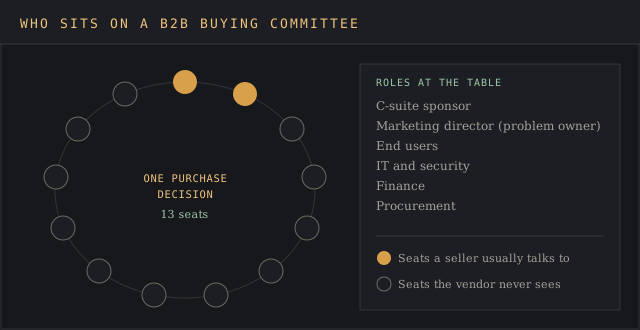
Forrester's State of Business Buying 2024, released on 4 December 2024, found that 13 people inside an organization take part in the average buying decision and that 86% of B2B purchases stall during the process. 81% of buyers said they were dissatisfied with the provider they picked. The 6sense 2025 Buyer Experience Report puts buying groups at 10 or more members.
A committee that size splits decision-making into roles. A software deal usually has an economic sponsor in the C-suite, a marketing director or department head who owns the problem, end users who live with the tool, IT and security reviewers, and procurement. Each role has different pain points and a different question to answer before it signs. Any of them can veto, so insights gathered from one role mislead the marketing team about the other four.
Interviewing one buyer per account captures one vote out of 13, and building a study on the champion alone puts all your eggs in one basket. The sales rep who closed the deal mostly talked to the champion; the security reviewer who held up the contract never appears in the call notes. Buyer personas built from those notes describe the champion and leave the other 12 seats blank, and marketing campaigns aimed at those personas speak to one person in the room.
The fix is account-based analysis, which keeps the focus on the account. Group findings by account tier, industry and company sizes, then compare what each role said. When the finance lead and the end user give different reasons for the same lost deal, both are true, and the gap between them is where the insight sits. Teams that segment data this way can line findings up against the firmographic market segmentation model their marketing team already uses.
Long sales cycles and the 5% of a market that is buying
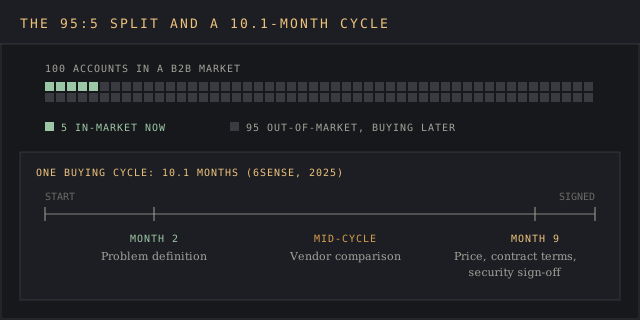
Most of a B2B target audience isn't shopping today. Research by Professor John Dawes of the Ehrenberg-Bass Institute, published as the 95:5 rule, found that only 5% of B2B buyers are in-market at any moment. An IT manager who signed a cloud contract last quarter won't buy another one for years. That leaves the lion's share of the market, 95% of it, forming a shortlist from memory.
When they do buy, the process is slow. 6sense measured average sales cycles at 10.1 months in 2025, down from 11.3 months in 2024, across nearly 4,000 B2B buyers in North America, EMEA and APAC. That's close to a year of meetings, trials and internal review per deal.
Two consequences follow for research. Brand memory that marketing builds during the 95% window decides who makes the shortlist, so tracking brand awareness among out-of-market accounts is B2B market research too, and B2B marketing budgets that only fund lead generation leave that memory to chance.
Second, a study fielded once captures one moment of a 10-month process. A buyer interviewed in month two describes the problem. In month nine, the same buyer talks about price, contract terms and security sign-off.
Where the buyer journey happens before the sales team hears about it
Business buyers do most of the work alone. Gartner surveyed 632 B2B buyers between August and September 2024 and found 61% prefer an overall rep-free buying experience. McKinsey's B2B Pulse survey of nearly 4,000 decision makers, published on 12 September 2024, counted an average of ten interaction channels per buyer journey, up from five in 2016.
McKinsey also found a rule of thirds: buyers split their time roughly evenly between in-person meetings, remote calls and digital self-service at every stage. Product marketing, content marketing and field marketing each own one of those thirds, which is why the buyer journey rarely shows up whole in any single team's data.
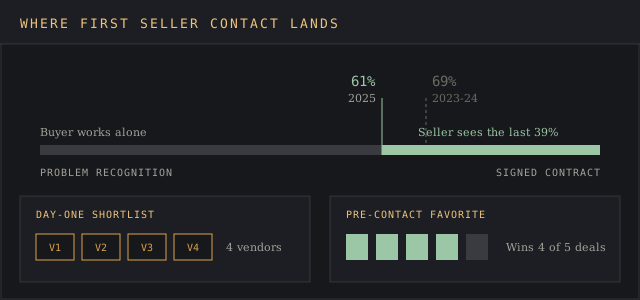
6sense puts a number on how late sellers arrive. First contact now lands 61% of the way through the buyer journey, down from 69% in its 2023 and 2024 studies. Buyers evaluate 5.1 vendors on average, fill about four shortlist spots on day one, and pick the winner from that day-one shortlist 95% of the time. The vendor a buyer favors before contact wins four deals out of five.
For insights and marketing teams, that moves where the evidence lives. The sales team sees the last 39% of the process. Everything before it, the problem framing, the peer recommendations, the review sites, the vendor websites whose marketing copy reads the same, has to be rebuilt through interviews and survey data, because no CRM data field records it. Marketers who wait for the inbound form have already missed the boat on most of those choices.
B2B market research types and when each one fits
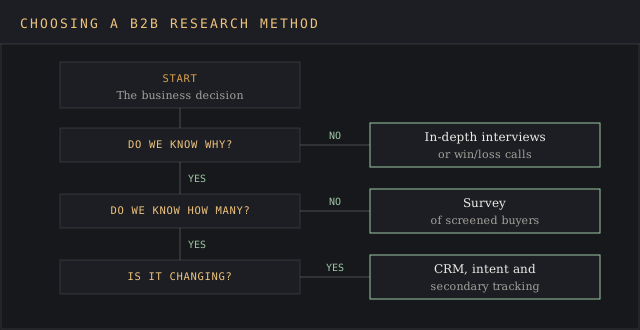
Small populations shape every method. A consumer brand can buy thousands of panel completes from a general audience in a week. A vendor selling to large enterprises draws from the 0.1% of U.S. companies that aren't small businesses, and only a handful of people at each one sat in the meeting. Sample sizes in B2B market research sit far below B2C norms as a result, and qualitative research carries more of the load than it does in consumer marketing.
B2B products are also more complex to research. A buyer comparing data platforms weighs integrations, security reviews and contract terms, so the interviewer needs enough industry knowledge to follow the answer and ask the second question.
In-depth interviews and win/loss analysis
In-depth interviews carry most of the weight in qualitative research. Guest, Bunce and Johnson's 2006 study in Field Methods coded 60 interviews and found thematic saturation within the first 12, with the basic elements of the main themes present after six. That study ran in West Africa on a public-health topic, so treat 12 as a planning floor per role. For a 13-person committee, pick the four or five roles that decide and interview a dozen of each.
Win/loss interviews are the B2B-specific deep dive. A neutral interviewer, usually someone outside the account team, calls the buyer after the decision and asks what settled it, then follows up until the buyer names a reason.
Business buyers tell an outsider what they never told the sales rep: the late security objection, the peer recommendation that put a rival on the list, the week the CFO stopped answering email. Ask which counted for more, a peer's recommendation or the price gap, and the answer tells marketing where its budget belongs.
That's evidence straight from the horse's mouth, and product marketing teams running it at volume use win-loss analysis software to schedule and code the calls.
Transcripts also catch the emotional factors behind buying decisions, such as a sponsor's fear of backing a tool that fails in front of the board. A five-point scale flattens that into a 3. Digging deeper in the interview, with follow-ups on the answer the buyer gave, is what qualitative methods are for.
Focus groups and customer advisory boards
Focus groups are harder to run in B2B marketing research. Employees of competing companies won't discuss vendor choices in one room, and senior titles rarely give up an afternoon. They still work for marketing message testing with peers from non-competing companies, and for watching how a group of customers reacts to a new pricing page. When buyers say every vendor sounds identical, a message test shows which claims set one apart.
Customer advisory boards fill a similar slot: a standing group of existing customers who review roadmaps and name pain points under NDA. The bias is built in, since every member already chose you, so pair insights from advisory-board customer feedback with interviews from lost deals.
Surveys and quantitative research
Quantitative research gives marketers the size of what the interviews found. B2B surveys gather responses from customers and prospects online, by telephone or face-to-face, and phone and in-person fieldwork still earn their place with senior business professionals who ignore email invitations from marketing research firms.
Statistical analysis of survey data can rank requirements by the value buyers place on each and compare segments once each market segment has enough completes to read on its own.
Fielding a survey before the interviews jumps the gun. Quantitative data collected without the interview work first measures answers to questions nobody tested. A survey that lists five purchase criteria will rank those five and miss the sixth, which is how a study can miss the mark while every chart looks clean.
Secondary research and first-party data
Secondary research covers market share, industry trends and market trends from analyst reports, company filings and trade bodies relevant to the category; the guide to secondary market intelligence lists the sources. First-party data supplies the insights secondary sources can't: CRM stage history, deal velocity by segment, support tickets from customers, product usage, and intent data showing which accounts are researching a category right now.
Descriptive analytics on these sources reports what happened. Diagnostic analytics asks why it happened, and cohort analysis tracks how customer behavior shifts between accounts that signed in different quarters. Competitive intelligence belongs here too: keeping an eye on rivals' pricing, positioning and hiring tells the marketing team which competitor a lost deal probably went to before the win/loss call confirms it.
| Method | Question it answers | Who you need | Sample that works | Weak spot |
|---|---|---|---|---|
| In-depth interviews | Why the committee chose | 4 to 5 deciding roles | About 12 per role | Slow to recruit |
| Win/loss interviews | Why a deal was won or lost | Buyers from closed deals | Won and lost deals each quarter | Needs a neutral interviewer |
| Focus groups | How a group reacts to a message | Peers from non-competing companies | One group per segment | Rivals won't share in one room |
| Customer advisory board | What current customers need next | Existing customers | A standing group | Every member already chose you |
| Survey | How many buyers share a need | Screened decision makers | Enough per segment for statistical analysis | Measures only the options listed |
| Secondary research | Market size, share and trends | Analyst and public data | Not applicable | Market-level figures only |
| CRM and intent data | Which accounts are in-market | Your own systems | Every account | Records behavior without the reason |
Running different methodologies on the same question, interviews first and a survey second, catches the errors each one makes alone. The site's longer guide to market research methods covers survey formats and sampling in detail.
Recruiting decision makers for B2B studies
Recruiting is where B2B market research spends its money. Senior business buyers run full calendars, and panels hold plenty of people who claim a title they don't hold. Finding a real VP of procurement in a general panel is a needle in a haystack, and vendors that invest in their own respondent lists skip most of that search.
Three channels reach the right audience. Lists of customers already sit in the marketing automation system, which makes them the cheapest and most relevant source for marketers. The others are the vendor's own lost-deal list, LinkedIn searches by title and company size, and industry events where buyers from one sector gather in one hall.
Each carries higher costs per complete than a consumer panel. Incentives have to match the value of a senior person's time, so B2B honoraria run above B2C rates, and a CFO who gets a token gift card won't show up for the second interview.
The devil's in the details here, because screening carries most of the quality control. Ask about the respondent's role in the last purchase decision, the budget they controlled and the size of their business, then drop anyone whose answers don't line up.
Ensuring research reaches people who sat in the meeting is the whole job of the screener. Respondents are named individuals whose personal data is protected, so recruit through channels that ensure compliance with GDPR and the privacy rules in each respondent's country.
From raw data to deeper insights: analysis and human expertise
Interviews and surveys produce vast amounts of data: transcripts, open-ended text and numbers. Analysis turns them into a short list of actionable insights tied to business objectives.
Marketing research agencies and in-house insights teams hand the mechanical part to software: transcription, first-pass coding, sentiment analysis across hundreds of open-ended answers, cross-tabs on survey data. It tags transcripts at lightning speed and still needs a person to interpret data against what the team knows about the industry.
Human expertise, from researchers and marketers who know the category, decides three things the software can't. It picks which of the insights contradicts the current plan. It spots the answer that only makes sense to someone who knows the industry. And it reads between the lines when a buyer says the price was too high, which in committee deals sometimes means the value case never reached the CFO.
Each of the insights should name which business decisions it changes: which segment marketing targets next, which objection the sales team answers in the first meeting, which feature product builds. Findings that change nothing are valuable insights only on a slide. The guide to market intelligence analysis covers frameworks for this step.
AI, synthetic respondents and B2B research
AI has a tested record on consumer market research questions. In a 2023 Harvard Business School working paper, Ayelet Israeli, James Brand and Donald Ngwe tested GPT as a simulated survey respondent. Its willingness-to-pay estimate for fluoride in toothpaste came to $3.40, against $3.27 from a human study. The AI run took under 15 minutes; comparable consumer studies cost upwards of $20,000 and take three to six months.
The same paper reported limits. Simulated willingness to pay for extra glasses of wine stayed flat, which contradicts economic theory, and yogurt results moved in the right direction but by the wrong amount. Every product tested was a consumer good picked by a single shopper, and the design left business buyers out.
For committee purchases the jury's still out. A simulated buyer can't report that one hospital network's security team blocked a vendor last spring, and business decisions inside a committee turn on facts like that. Marketing teams can use AI to draft questionnaires, code transcripts and summarize the latest research relevant to a category. Keep the fieldwork with real decision makers, and treat a synthetic result as a hypothesis to test before you invest in fieldwork.
Common mistakes in B2B market research
Six errors recur in failed B2B market research studies, and each one has a cheap fix:
- Leading questions. "How much did our onboarding help?" assumes it helped. Ask what happened during onboarding and let the buyer judge.
- A single respondent per account. The champion's view stands in for a committee of 13. Interview at least two roles per account.
- The wrong audience. Panel respondents claim titles at companies they don't work for. Screen on the last purchase, by name and budget.
- Over-reliance on quantitative research. A survey ranks the options you listed and misses the one you didn't. Run qualitative research first.
- A study treated as permanent. Market leaders in a category can change within one 10-month cycle. Run win/loss continuously and refresh surveys every year.
- Research with no owner. A finding nobody owns becomes a slide. Name the team, marketing, sales or product, and the decision before fieldwork starts.
Good insights should challenge assumptions the team already holds. A study that confirms every belief is a red flag for leading questions or a skewed sample, and the only fix is going back to the drawing board on the questionnaire.
How marketing and sales teams use B2B buyer insights
Marketing uses the insights first, because marketing owns the 61% of the journey before a seller arrives. Positioning, messaging and the value proposition come straight from win/loss transcripts: the phrases buyers used for the problem go into ads, landing pages and sales decks.
Brand marketing gets its target audience and buyer personas from the committee map, so a campaign reaches the finance lead and the IT reviewer along with the champion. B2B marketers running account-based marketing use the same insights to pick and tier target accounts against an ideal customer profile, and product marketing uses them to write the comparison pages buyers read on their own.
The sales team gets discovery questions and objection answers. If interviews show security review adds weeks at larger companies, sales can bring the security documentation to the first call. Product teams get requirement data ranked by how many lost deals and current customers cited it. Insights that reach one team and skip the other two produce a marketing message the sales pitch contradicts. Shared findings keep the three teams on the same page.
Marketing leaders also need the insights to defend budget. A marketing director who can show which accounts had the vendor on the shortlist before first contact can justify brand spend, and the pipeline revenue it feeds, that a last-click report credits to nobody. That's the value of tying research to the CRM: the marketing team's work in the 95% window shows up in numbers finance already trusts.
How to measure insight-led decision making
Companies that invest in B2B buyer insights can check the return in two metrics already sitting in the CRM. Win rate by segment shows if the changes marketing and sales made after research moved deals.
Shortlist presence, measured by asking each new opportunity which vendors it considered, shows if brand marketing reached the 95% who weren't buying yet. With the pre-contact favorite winning four deals in five in the 6sense data, shortlist presence is the leading indicator and win rate is the lagging one. A data-driven vendor that studies the pre-contact phase competes for deals its rivals first see at the 61% mark.
Revenue ties the insights program to the business plan, and to the revenue and EBITDA figures finance judges every program by. Track revenue and cycle-length data in the segments where research changed the go-to-market plan, against the 10.1-month baseline. The sales team uses the same findings to prioritize accounts and improve forecasting: an account that matches the profile of past wins gets attention first.
The guides on market intelligence strategy and why market intelligence matters cover how to tie this to business growth targets.
FAQ
What does B2B sales mean?
B2B sales is selling products or services from one business to another. The buyer is an organization, the decision runs through a committee Forrester puts at 13 people, and 6sense measures the average cycle at 10.1 months. B2B marketing is the demand side of the same process: building the brand memory and content that put a vendor on the shortlist.
Can ChatGPT do market research?
It can do parts of it. Marketers use large language models to draft questionnaires, code open-ended answers and summarize secondary research in minutes. Harvard Business School researchers found GPT's simulated answers on toothpaste landed within 13 cents of a human willingness-to-pay study, but every product in that test was a consumer good. For B2B market research and B2B marketing decisions, keep interviews and surveys with real buyers.
What is a B2B inquiry?
A B2B inquiry is a request from a business buyer, or one of a vendor's existing customers, for information, a quote or a demo, sent through a web form, email or a salesperson. It's a late signal. By the time it arrives, the 6sense data puts the buyer 61% of the way through the journey with a ranked shortlist.
How do you target B2B customers?
Define the target market as the companies that match on industry, size and region, then map the target audience inside those accounts by committee role and build buyer personas for each role. Use intent data to focus on the 5% buying now, and keep brand marketing running for the 95% who will buy later. A user persona template gives each role a consistent format.
How many interviews does a B2B study need?
Plan on about 12 per relevant decision role. Guest, Bunce and Johnson found thematic saturation within the first 12 of 60 interviews, with the basic themes visible after six.
How often should B2B buyer insights be refreshed?
Win/loss interviews and CRM signals run continuously. Needs and brand surveys repeat once a year, since a single 10.1-month cycle is long enough for the shortlist in a category to change.
Bottom line
B2B market research has to follow the account. Thirteen people decide, most of the market isn't buying at any given moment, and the favorite is picked before a seller hears the buyer's name. Interviews by role, win/loss calls, screened surveys and first-party data, combined, produce insights that describe that decision. Any one of them alone describes a piece of it, and the marketing team, the sales team and product each need the whole.
Getting it wrong costs the business in a specific way. A team that surveys one champion per account and builds marketing campaigns on the result will spend a year talking to one seat at a table of 13, and find out in the win rate.