Nursing shortage statistics 2026: 17.6% RN turnover and a gap of 0 to 267,330
 By Jan Suski. I go deep on every review, checking every number against its source and digging up details other coverage misses, a habit from six years of SEO and link building for tech companies. Bylines at Surfer, Brand24, and Senuto. How the scoring works.
Hospital staff nurses left their jobs at a 17.6% rate in 2025, and the groups that count registered nurses can't agree on the size of the nursing shortage. Federal modelling projects 267,330 full-time nurses short by 2028, while National Nurses United counts 1.15 million licensed nurses who don't work as nurses and says there's no shortage.
This report covers the nursing workforce in 2026 (vacancy, turnover, burnout, well-being, nursing schools and travel nurses) for hospital leaders, nurse educators and analysts in healthcare market intelligence.
The numbers US and global nursing workforce, 2025 and 2026, checked 30 September 2026
US nursing shortage estimates run from 0 to 267,330 because HRSA models future demand, NSI counts vacancies and NNU counts idle licenses.
Hospitals added 53,500 nurses net in 2025, so the nursing shortage shows up as churn, with 17.6% of staff nurses leaving.
With job satisfaction at 47%, hospitals keep hiring travel nurses, and open travel jobs on the Aya Index sit 67% above the same day in 2025.
How trackers define shortage, vacancy, turnover and burnout
Every tracker counts something different, and the devil's in the details.
- Nursing shortage is projected full-time demand for the nursing workforce minus supply, the method of the Health Resources and Services Administration (HRSA) in the Department of Health and Human Services.
- Vacancy is budgeted posts for nurses left empty, over all budgeted posts, 8.6% in acute care in 2026, down from 9.6%.
- Turnover counts nursing staff who leave in a year, with agency nurses excluded.
- Burnout is exhaustion from chronic work-related stress. 55% of Pennsylvania med-surg nurses score high on it.
- Compassion fatigue is the emotional strain nurses carry from caring for patients in distress.
- Program capacity caps nursing education, and nursing schools turned away 93,176 qualified applications from future nurses in 2025.
How the aging population, retirements and nursing programs connect
An aging population pulls on both ends of the ratio. Older patients with chronic diseases need more patient care, and baby boomers in the nursing workforce are reaching retirement age.
- WHO counts 19% of nurses worldwide aged 55 or older, and in about 20 countries, nurses due to retire within 10 years outnumber younger nurses early in their careers.
- 39.9% of US registered nurses said in NCSBN's 2024 study that they intend to leave or retire within five years, a survey-based market research figure.
- AACN counted 1,588 vacant nursing school faculty positions for nurse educators in October 2025, a 7.2% nurse faculty vacancy rate, and PhD enrollment, the research doctoral degree in nursing education, fell for an 11th year.
WHO's Khassoum Diallo said in September that "Ageing is the hidden health workforce crisis that requires urgent attention."
Nursing shortage size: 0 to 267,330 nurses, depending on who counts
Three US shortage counts appeared in 2026, and they aren't on the same page. HRSA's model, restated by the American Association of Colleges of Nursing, projects 267,330 full-time nurses short by 2028. NSI's hospital survey puts today's nursing shortage at 158,600 nurses.
| Tracker | Figure | What it counts | Date |
|---|---|---|---|
| HRSA via AACN | 267,330 short by 2028 | Modelled supply against demand | Restated Aug 2026 |
| NSI Nursing Solutions | 158,600 short now | Vacancies at 527 hospitals | Mar 2026 |
| National Nurses United | 0 short, 1.15M licensed nurses idle | Licenses minus employed nurses | 26 May 2026 |
| ICN and WHO | 5.8M short worldwide, 4.1M by 2030 | Global nurse density against need | May and Aug 2026 |
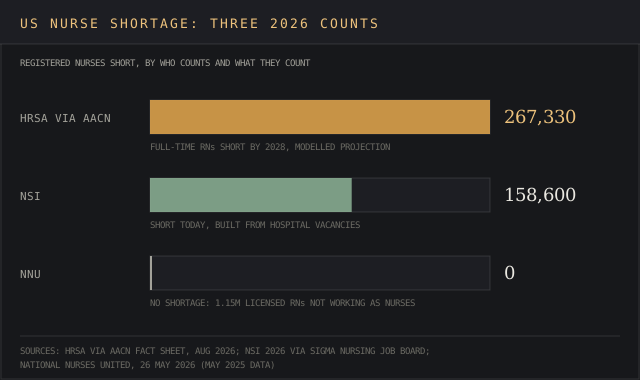
NNU reaches zero by setting 4.91 million active RN licenses against 3.76 million employed registered nurses in May 2025. The Bureau of Labor Statistics projects 180,800 openings for registered nurses a year to 2035.
"The data is clear that the U.S. nursing profession has a retention crisis, not a nurse shortage."
Jamie Brown, RN, president, National Nurses United, 26 May 2026
Worldwide, ICN and WHO put the nursing shortage at 5.8 million nursing professionals in 2023, down from 6.2 million in 2020.
RN turnover rate, vacancy and time to fill: 17.6%, 8.6% and 78 days
Hospitals hired 377,650 nurses in 2025 and lost 324,090 nurses, per NSI, yet one third of hospitals (33.1%) ran at 10% vacancy or higher.
| Metric | NSI 2026 report | What it measures |
|---|---|---|
| Staff nurse turnover | 17.6% (median 18.6%) | Staff nurses who left in 2025 |
| First-year turnover | 22.7% | New nurses who leave within a year |
| Time to recruit | 78 days (56 to 102) | Days to hire nurses with experience |
| Cost of one departure | $60,090 | Replacing one bedside nurse |
Behavioral health lost 22.8% of its staff nurses in 2025, step down 20.3%, emergency 19.1%, critical care 18.3%, med-surg 18.0%, surgical services 13.7% and pediatrics 12.2%.
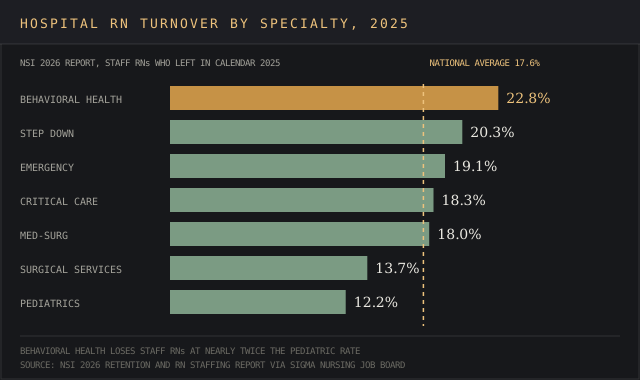
Newly hired nurses are the red flag, making up 29.0% of all separations. At $60,090 per departure, the average hospital loses $5.19 million a year to departing nurses.
Staffing levels in nursing homes run thinner, with 88% below expected nursing staff hours in Q1 2026. The American Nurses Association notes that CMS repealed the 2024 staffing mandate for long-term care facilities on 2 February 2026.
Nurse burnout and nurse well-being: 53% burned out, 47% satisfied
Many nurses burn the candle at both ends. A Nurse.com report restated by AACN found 53% of nurses experiencing burnout in 2026. AACN adds that 24% of nurses across all license types considered leaving in 2025. Nurses who left in an earlier study cited multiple factors, led by planned retirement (39%), burnout (26%) and insufficient staffing (21%).
Higher patient loads drive burnout among nurses. In the 2026 Medical Care study of 2,782 Pennsylvania nurses, each extra patient raised the odds of high burnout by 33% and intent to leave by 27%, at an average of 5.9 patients per nurse.
The Nurse.org survey of 2,090 nurses tracks nurse well-being.
- Satisfaction among nurses fell to 47% in 2026 from 55% a year earlier.
- 43% of nurses are likely to leave the bedside within a year and 23% intend to leave the profession.
- More than 50% of nurses faced verbal threats and 34% don't feel safe on the front lines.
- 37% of nurses worked extra shifts because of financial pressure, adding long hours.
That's a vicious cycle, since each nurse who quits leaves more patients for the nursing staff who stay. On nurse well-being, WHO says only 42% of countries report provisions for nurses' mental health.
Why staffing matters for patient care and patient safety
Fewer nurses means more deaths among patients. The Medical Care study linked 547,689 patients in 132 Pennsylvania hospitals, and each extra patient per nurse raised 30-day mortality odds by 8% and the odds of hospital readmissions by 4%.
Nurses see it. 73% called their workloads unsafe for patients and 63% gave their hospital a C, D or F on patient safety. In New York and Illinois, more than two thirds of 50,044 hospital nurses reported too few staff.
Staff well-being and patient outcomes follow the same ratio. At four patients per nurse, the authors project lower mortality in Pennsylvania, with 3,040 deaths and 1,087 departures of nurses avoided a year.
Workforce costs, about 60% of hospital expenses, rose 5.6% in 2025, per the American Hospital Association's cost report. The association put the pressure on nurses down to paperwork and insurers in a July statement.
"The growing complexity and intensity of patient care, along with overly burdensome regulatory requirements and increased administrative demands from corporate insurers, continue to place significant demands on nurses."
AHA statement to TIME, 30 July 2026
Four steps to keep more nurses
- Find the hotspots. HRSA projects the largest 2038 shortages in California (22%), North Carolina (20%), Georgia (20%), Michigan (18%) and Washington (17%), and workforce intelligence software maps gaps inside a health system.
- Fund nursing education that adds seats at nursing schools. Texas put $5.6 million into 8 institutions and the University of Maryland got more than $6 million. HRSA, a Health and Human Services agency, runs the Nurse Faculty Loan Program, which cancels up to 85% of a loan for up to four years of full-time faculty work.
- Price the travel clock. Travel nurses average $91 an hour and run to $160, and hiring staff nurses saves $66,081 each. That coverage costs an arm and a leg, and recruitment market data shows AMN's travel nurse revenue up 10% in Q2 2026.
- Set a retention target of $295,000 per turnover point and benchmark your turnover against the 17.6% national rate.
Nurses name staffing first. Among 1,778 non-retired nurses who left hospital jobs, 65% said adequate staffing would raise their odds of returning, with flexible scheduling and better wages at 59% each. Better working conditions are the main well-being lever.
Federal money is the risk. AACN's Deborah Trautman warned on 7 May that "efforts to curtail federal support for nursing schools and graduate education" may reverse the gains. The American Nurses Association's 2026 policy priorities note that students in graduate nursing education qualify for half the federal loans of graduate medical students and urge safe staffing in all healthcare settings.
Five mistakes when reading nurse staffing data
Most headline fights over the shortage compare numbers built on different bases, so attach each figure to its source.
- Reading vacancy, turnover and JOLTS separations as one number. The 8.6% is a stock of empty posts, the 17.6% a yearly flow of staff nurses, and the 2.9% monthly separations rate from the Bureau of Labor Statistics covers all health care and social assistance jobs.
- Treating a national number as local. California's projected 2038 shortage is 22%.
- Assuming rural is always worse. In Pennsylvania, 50% of nurses in small or rural hospitals call workloads safe for patients, against 40% in large or urban ones.
- Counting licenses as the workforce. 56% of the 4,043 nurses in a JAMA Network Open sample of hospital leavers were retired.
- Ignoring faculty limits on nursing programs. Applications to baccalaureate and graduate programs rose by 92,672 to 821,491 in 2025, and the same programs turned away 93,176 qualified applications, mostly for lack of faculty and clinical sites. AACN's August fact sheet prints 92,672 as the rejected count, which looks like a swap.
NYC Health + Hospitals cut residency-graduate turnover to 5%
NYC Health + Hospitals had 46% turnover among nurses in 2019, per America's Essential Hospitals, and put a stitch in time with a five-year residency program for new nurses. Turnover among nurses who graduated from the residency, a narrower group, reached 5% in 2025, with $12.7 million a year in avoided costs. Chief nurse executive Natalia Cineas called it in February "instrumental in our recruitment and, of course, retention strategy."
California tried a mandate. Its psychiatric hospitals hired more than 1,000 nurses for the June 2026 ratio rule, yet four counties lost 15% of acute psychiatric beds for patients in week one, per the California Hospital Association.
Older nursing shortage figures still quoted, and what replaced them
Workforce figures age fast, and several from 2007 to 2024 still circulate. Each has a newer number from a named publisher of nursing workforce data.
| Figure still quoted | Where it came from | 2026 figure to use |
|---|---|---|
| 109,000 nurses short by 2028 | Misdated, 108,960 is HRSA's 2038 projection | 267,330 full-time RNs short by 2028 (HRSA via AACN) |
| 510,394 short by 2030 | Older projection, off AACN's page | 267,330 by 2028 |
| 75,000 turned away in 2018, 65,766 in 2023 | Earlier AACN surveys | 93,176 qualified applications in 2025 |
| California short 44,500 RNs by 2030 | Older state projection | California 22% short in 2038 (HRSA via AACN) |
| 203,700 new RNs a year through 2026, 189,100 through 2034 | Earlier BLS projections, the second still on AACN's fact sheet | 180,800 openings a year, 2025 to 2035 (BLS) |
| 116,000 RNs needed to fill vacancies | 2007 estimate | 158,600 short now (NSI) |
| One million baby boomer nurses retiring by 2030 | 2017 Health Affairs blog | 39.9% plan to leave or retire within five years (NCSBN) |
| 74% emotionally exhausted several times a week | No primary source found | 53% experiencing burnout (Nurse.com via AACN) |
| Median RN age of 50 | NCSBN 2024 study | Next update from NCSBN's 2026 Nursing Workforce Survey |
Sources and related resources
Several figures are secondary sources. Keep an eye on NSI's 2027 report and NCSBN's 2026 Nursing Workforce Survey.
- Labor market intelligence
- Talent intelligence tools
- Root cause analysis template
- Life science market report
Frequently asked questions
How bad is the current nursing shortage?
HRSA projects 267,330 full-time nurses short by 2028, and NSI counts 158,600 nurses short now.
Why is there a nursing shortage in 2026?
Turnover runs at 17.6%, baby boomers are retiring, and nursing schools lack nurse faculty, clinical sites, preceptors and classroom space.
Is nursing oversaturated in 2026?
NNU says there's no shortage, with 4.91 million RN licenses against 3.76 million employed nurses.
What is the national average for RN turnover?
17.6% for hospital staff nurses in 2025, with a median of 18.6%.
How many nurses quit within 5 years?
39.9% of registered nurses intend to leave or retire within five years, and 22.7% of new nurses leave in year one.
What is the burnout rate for nurses?
53% of nurses report burnout, and 55% of Pennsylvania med-surg nurses score high burnout.
What are the top 3 causes of nurse burnout?
Higher patient loads (more patients per nurse), insufficient staffing and workplace violence, with more than 50% of nurses facing verbal threats.
What state has the biggest nurse shortage?
California, with a projected 22% shortage of nurses in 2038, then North Carolina and Georgia at 20%.
Is nursing still worth it in 2026?
68% of nurses rate joining the profession 4 or 5 out of 5. BLS projects 41% growth for nurse practitioners to 2035, one of the career options after graduate nursing programs.
Bottom line
Staff nurse turnover sits at 17.6%, satisfaction at 47% and travel openings 67% above 2025, while trackers argue over a nursing shortage of 0 to 267,330 nurses.
Staffing is the cheapest well-being fix in the data. 65% of nurses who left name it, and one turnover point costs the average hospital $295,000. Until more nurses stay in the profession, hospitals pay $91 an hour for travel cover.
How each nursing figure was sourced, and the count nobody keeps
Hospital turnover, vacancy, hiring, cost and time-to-fill figures are NSI Nursing Solutions' 2026 retention report, confirmed on the Sigma Nursing Job Board and AACN's nursing shortage fact sheet (updated August 2026) because the NSI PDF itself would not load for us. Shortage projections are HRSA's, as restated by AACN. Application and faculty figures are AACN's release of 7 May 2026 and its October 2025 faculty survey.
Burnout, mortality and workload figures are the 2026 Medical Care study of Pennsylvania hospitals. Survey figures are Nurse.org via Advisory Board (6 May 2026), Nurse.com via AACN, NCSBN's 2024 study and JAMA Network Open (February 2026). Global figures are WHO and ICN (May and August 2026). Travel figures are the Aya Index (read 28 September 2026) and AMN's Q2 2026 results.
NNU's count comes from its release of 26 May 2026, the openings projections from the BLS Occupational Outlook Handbook, and the NYC residency figures from America's Essential Hospitals (February 2026). Every figure was checked on 30 September 2026.
No federal agency publishes a current count of US nurses short, and HRSA's state projections run to 2038, so every shortage number on this page carries its publisher and date.