Gartner review: what a $49,576 seat buys, and where the trust gaps sit
 By Jan Suski. I go deep on every review, checking every number against its source and digging up details other coverage misses, a habit from six years of SEO and link building for tech companies. Bylines at Brand24 and Senuto. How the scoring works.
· Prefer this source on Google
Best for
an enterprise IT organization with a procurement team that shortlists software every quarter and will use analyst inquiry on live decisions.
Not for
a 10-person marketing team or a startup, since the cheapest public seat lists at $26,715 a year and the content leans toward large enterprises.
What it costs
$26,715 to $240,600 per seat a year on the federal list, with Vendr's buyer data putting the median contract at $80,500, paid up front and non-cancelable.
- Legal name
- Gartner, Inc. (NYSE: IT)
- 2025 revenue
- $6.5 billion, up 4%
- Employees
- 20,244 at the end of 2025
- Client base
- 13,000+ enterprises in about 90 countries
- Contract value
- $5.3 billion, up 1.7% (Q2 2026)
- Cheapest seat
- $26,715 (Core Connect Reference, limited availability)
- IT Leaders Advisor
- $49,576 a year
- Top seat
- $240,600 (Global CIO Team Plus leader)
- Vendr median
- $80,500 across 151 purchases
- Terms
- Non-cancelable, paid in full at the start
- Multi-year share
- 77% of contracts at the end of 2025
- Magic Quadrants listed
- 143, 92 updated in the prior 12 months
- Analysts named
- 2,400+
- Inquiry session
- 30 minutes
- Document review cap
- 20 pages
- G2
- 4.0/5 from 89 reviews
- Trustpilot
- 1.9/5 from 25 reviews, 80% one-star
- Peer Insights freeze period
- 3 months before each Voice of the Customer report
- Stock in 2025
- Down 47.9%
Not forIT buyers who need a vendor rating in every software category, where Gartner lists 143 quadrants.
Not forBuyers who need an analyst on the phone or a vendor rating with Magic Quadrant reach.
Pairs well with Gartner
Gartner sells research subscriptions, analyst time and conferences to the people who sign off on technology and business budgets. Most buyers meet the company through a Magic Quadrant a software seller emailed them, and few have seen what a seat costs or what the contract says, since the company publishes no commercial price list.
This Gartner review covers what a client gets for the money, how the Magic Quadrant and Gartner Peer Insights work, what the federal price list and Vendr's buyer data show about cost, the contract terms, the 2025 stock fall and the four research firms and platforms buyers weigh against it. The figures come from the company's own filings and pages, a GSA schedule and Vendr, and the opinions come from 15 quotes by people who've used or worked with the company.
It's written for IT directors, procurement leads and CMOs deciding if a first subscription, or a renewal, is worth the line item. It pairs with our Gartner pricing report, which prices every seat line by line.
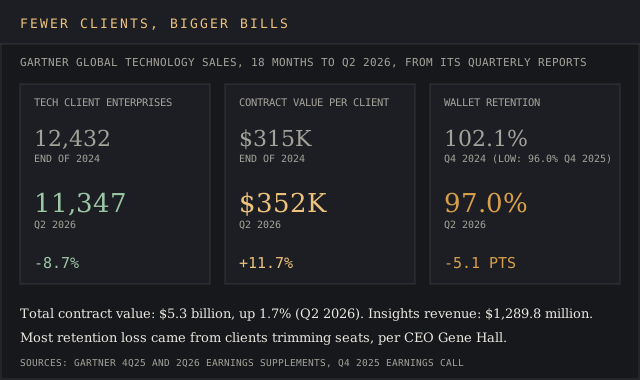
The timing matters. Gartner lost 1,085 technology clients in 18 months, and its stock closed 2025 down 47.9%, so a buyer negotiating today faces a seller under pressure to hold renewals.
What Gartner does, and what a client gets for the money
Gartner, Inc. runs three businesses. Insights, the research subscription, carries the lion's share of revenue, with Conferences and Consulting behind it. Per its 10-K for fiscal 2025, the company booked $6.5 billion of revenue with 20,244 employees and counts 13,000+ enterprises in about 90 countries as clients.
A seat is a named license for one person, priced by that person's role. It opens the research library, the Magic Quadrant and Hype Cycle, the AskGartner AI tool and, on Advisor-level seats, inquiry calls with analysts. Its inquiry policy sizes each session at 30 minutes and caps document review at 20 pages.
Users agree the research holds up, and boards treat it as trusted information. A G2 review from an enterprise software engineer, 1 August 2025, says:
"When I'm looking for high-level insights or trying to evaluate vendors, their reports[, especially] the Magic Quadrant[,] make it easier to see the competitive landscape quickly. [...] It really helps when I need to back up a recommendation or present options to leadership."
Shubham C., Software Engineer, enterprise (1,000+ employees), G2, 1 August 2025
A regional sales manager on G2 put the value in one line in October 2025: "Time = money. Gartner helps me save on time." A technical account manager at a security company wrote in August 2025 that "gartner has the best authentic reviews with deeper insights", then added that "some reports can be too high-level without enough tactical detail".
How the Magic Quadrant works, and the pay-to-play question
The Magic Quadrant is an analyst-led evaluation that places each software company on two axes. Ability to Execute measures how well a company delivers on its promises, and Completeness of Vision measures its market understanding and innovation, across up to 15 weighted criteria. The result puts each one in one of four boxes: Leaders, Challengers, Visionaries or Niche Players.
Gartner listed 143 Magic Quadrants when we checked its research list on 17 October 2026, 92 of them updated in the prior 12 months. Its Magic Quadrant FAQ calls each one "a starting point" and says "Vendor status as a Gartner client does not affect inclusion or positioning". The methodology page warns readers that "focusing on the leaders' quadrant isn't always the best course of action".
The elephant in the room is money, since rated software companies also buy seats, and some critics read between the lines. A Hacker News user wrote in January 2022 that a former employer spent years trying to get onto a Magic Quadrant and only appeared once "they started paying gartner for access to their “specialist knowledge”". The G2 reviewer quoted above put it more mildly:
"And occasionally, the vendor evaluations can feel a bit too influenced by market presence rather than pure product performance."
Shubham C., Software Engineer, enterprise (1,000+ employees), G2, 1 August 2025
Two companies took their ratings to court and lost. ZL Technologies sought about $1.7 billion in 2009, and a federal judge dismissed the case in 2010, writing that "an inherent economic bias does not strip away First Amendment protection of pure opinion." NetScout landed in the Challengers box in 2014 after declining to buy consulting, sued, and in January 2020 the Connecticut Supreme Court held the ratings were "nonactionable expressions of opinion".
Gartner and the courts agree that a Magic Quadrant is opinion, so a buyer should treat it that way too. Use it to build a shortlist, then check each name against reference customers before you sign. Our Gartner vs Forrester comparison sets the quadrant against the Forrester Wave criterion by criterion.
Gartner Peer Insights: the review platform behind most complaints
Peer Insights is the crowdsourced half of how Gartner evaluates software, with reviews from enterprise IT and software buyers published free. The company markets it as a trusted source, and its vendor resources say every review goes through moderation to "validate reviewers' identity, check for potential conflicts of interest, and ensure reviews meet Peer Insights standards for quality". Readers "do not need a Gartner license to read, review, or submit reviews".
Software companies use a Review Sourcing Link to provide reviews from their own customers, and reviews submitted in the three months before each Voice of the Customer report are frozen out of that cycle. Reviewers are often paid in gift cards. A G2 reviewer, a test engineer at a mid-market software company, wrote in July 2026:
"What I like most about Gartner Peer Insights is that the reviews come from real user experiences. [...] Receiving occasional rewards for eligible reviews is a nice bonus, but the main value for me is being able to share honest feedback and help others make informed decisions."
Sree K., Software Development Engineer in Test III, mid-market (51-1,000 employees), G2, 28 July 2026
Incentives can bias any review process, and Trustpilot shows the other side. The company holds a 1.9/5 TrustScore there from 25 reviews, 80% of them one-star, and the company hasn't replied to the negative ones. Most complaints describe rejected reviews. One reviewer wrote in March 2025 that "I submitted genuine reviews on Gartner Peer Insights, only to have them removed without any clear explanation", and said the account was banned.
Another, in January 2025, claimed the platform filters criticism out: "If you appear to write some objective comment: like product X has problems A ; B ; C. Gartner will refuse your comment". A February 2026 reviewer said "I was promised a 25€ gift card for a review, but after jumping through all the hoops, Gartner denied the reward", and found no option to delete the account.
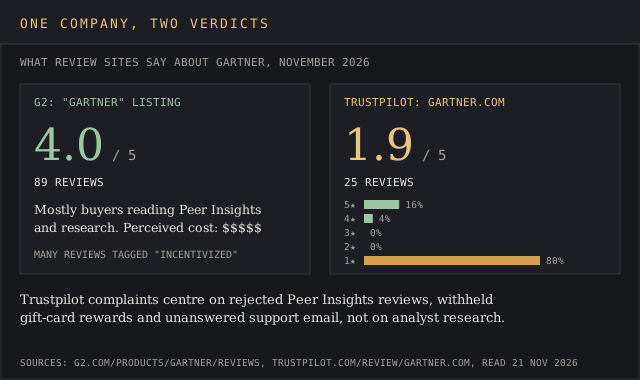
Treat these as a moderation problem and a red flag for the platform's transparency. The reviewers describe a lack of response from the company, and none of the eight complaints we checked comes from someone holding a research seat, so they say little about the analyst research itself.
What a Gartner subscription costs
The company prices each seat by role and publishes no commercial rate card, so the fullest price information in public view is a federal one. The company's GSA schedule, current through 30 January 2026, prices single licenses a year as follows:
- Core Connect Reference, limited availability: $26,715
- IT Leaders Reference: $33,346
- IT Leaders Advisor: $49,576
- CIOs Individual Access Advisor: $78,070
- CFOs Individual Access Advisor: $112,519
- Chief Marketing Executives Member: $138,017
- Global CIO Team Plus leader seat: $240,600
Executive seats cost an arm and a leg, and the CMO role is the clearest case. A chief marketing executive pays $138,017 for one license, which prices most of those teams out before the first call. A buyer holding two or more qualifying licenses on one order drops to the multi-license column, which cuts an IT Leaders Advisor seat to $37,730.
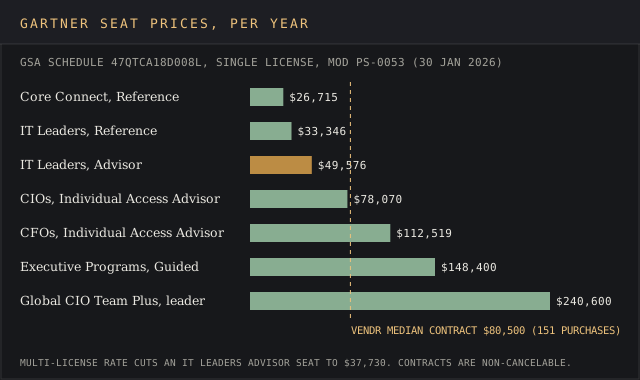
Commercial buyers land in the same place. Vendr's anonymised buyer data puts the median Gartner contract at $80,500 a year across 151 purchases, from $27,232 to $280,068. That's about 1.6 Advisor seats. The full seat-by-seat breakdown, including the price rise since 2024, sits in our Gartner subscription cost report, and the wider category is priced in our market research cost report.
Users feel the price. The G2 engineer quoted earlier wrote that "The biggest downside for me is how expensive and limited access can be." A finance director on Gartner's own Peer Community asked about the industry's value:
"There's utility there. The bigger question to me is whether or not it's worth current price tags for the same levels of service we used to receive."
Director in Finance (non-banking), Gartner Peer Community
Contract terms and support
The devil's in the details of the contract, since each role-based seat carries the same terms. The GSA terms set four conditions:
- Payment in full at the start of the term, on net 30.
- Non-cancelable, terminable only for material breach on 30 days' notice.
- Seats in a group are coterminous, so every seat renews on one date.
- Most contracts run longer than a year, with 77% multi-year at the end of 2025, per the 10-K.
The 10-K also says the company plans to grow revenue "through more effective pricing of our products and services", so expect a renewal quote above last year's. A company with lots of seat holders who never book an inquiry call has paid for all of them in full, a bitter pill to swallow at the first usage review.
Support depends on which part of the company you deal with. The company provides research clients an account team and, on executive seats, an Executive Partner, a former practitioner whose role is to advise the seat holder.
People outside that circle report silence. A Trustpilot reviewer wrote in June 2025 that it was "Absolutely impossible to contact anyone for support. No help center, no chat function, emails are just ignored," about an error on a software company's profile.
A telecom customer on G2, who bought pay-per-click listings from the review sites Gartner sold to G2 on 5 February 2026, gave the company 0/5 in May 2026: "Since the merger with G2, support and client management has been nonexistent. [...] Repeated requests go ignored while they continue to reach out to upsell." That sale of Capterra, Software Advice and GetApp is covered in our report on Capterra's legitimacy.
Why Gartner stock fell, and what it means for buyers
Gartner stock lost 47.9% in 2025, according to The Motley Fool, which cited US federal cost cuts and IT budgets moving to AI. The company cut its revenue forecast by $100 million on 5 August 2025, Reuters reported, and the 10-K says US federal revenue fell about $58 million that year.
Clients are trimming seats. Per the company's 4Q25 earnings supplement, wallet retention fell from 102.1% in Q4 2024 to 96.0% in Q4 2025, and CEO Gene Hall told analysts on the Q4 2025 earnings call that most of the loss came from customers dropping seats. Guidance for 2026 is consolidated revenue of at least $6.455 billion, about 2% growth.
For a buyer, that opens negotiation opportunities. A seller whose technology client count fell from 12,432 to 11,347 has every reason to discount a renewal, so bring Vendr's median and your real seat use to the table, plus a benchmark from one of the tools in our procurement intelligence ranking. The company still has room to absorb it. Contract value grew 1.7% to $5.3 billion in Q2 2026, and management said on the same call that it had bought back $2 billion of stock.
The sales floor feels it first. A former Gartner sales representative wrote on Indeed in August 2018 that "Quotas aren't adjusted for territory or books of business", and called the company "incredibly metric driven". A Chicago account executive added that remote work is nice, but "KPI's all of a sudden appear out of thin air when they want you gone."
That quota pressure matches a September 2025 Trustpilot complaint about "Matthew from event sales cold calling me, misuse of my data."
What Gartner's 2027 technology trends say about its research
The annual trends list is the widest-shared free sample of the company's research, and the company announced the 2027 list on 20 October 2026: large quantitative models, speech reasoning models, world models, AI context platforms, agent coding harness, AI agent identity, autonomous exposure remediation, sovereign tech, disposable applications and wetware as a service.
Governance runs through the whole list. Gene Alvarez, Distinguished VP Analyst, said organizations must become "an active architect of organization, human and machine boundaries", because AI now generates software faster than people can review it. The list pairs that with three predictions:
- By 2027, organizations that prioritize semantics in AI-ready data will raise agentic AI accuracy by up to 80% and cut costs by up to 60%.
- By 2028, 25% of enterprise security breaches will trace back to AI agent abuse.
- By 2030, over 75% of non-US organizations will adopt digital sovereignty strategies to reduce vendor lock-in.
Four of the ten cover security, data and resilience. Autonomous exposure remediation finds, prioritizes and patches vulnerabilities across the digital estate, AI agent identity swaps static credentials for policy-controlled access, and sovereign tech is built to give organizations a realistic exit from critical providers.
AI context platforms cover the data side, giving agents the business context they need to act. Alvarez warned that without one, organizations face "overprivileged agents, compliance failures, low trust and excessive token consumption". The 2026 edition had already framed AI as part of how work gets done, and Gartner's archived trends page says that in 2026 "AI is no longer optional".
The future-of-work release of 9 September 2026 adds the people side of work: build an AI-ready workforce, keep human judgment and knowledge in the loop, and reinvest AI gains in innovation and learning.
The release predicts 30% of employees laid off due to AI replacement will need to be rehired by 2029. The trends flag opportunities for CIOs over five years, and a buyer skimming these free summaries gets a fair sample of the house style, pitched one step above the tactical detail the G2 reviewer missed.
Gartner alternatives: Forrester, IDC, G2 and AlphaSense
Forrester wins for customer experience and B2B marketing teams, and loses on breadth. It booked $396.9 million in 2025 against Gartner's $6.5 billion and serves 1,797 clients, and Vendr's median Forrester contract is $64,240 across 67 purchases. Its Wave scores customer feedback since December 2024. Our Forrester vs Gartner page compares seat prices and methods side by side.
IDC sits between the two on price, with a $68,000 Vendr median, and wins for market sizing and spending forecasts. It loses for a buyer who wants a widely cited vendor rating, since the Magic Quadrant is the one software companies quote in their sales decks.
G2 replaces the crowdsourced half of Gartner at a fraction of the price. Its Market Intelligence product sits in the Enterprise tier with a $28,000 median across 526 purchases, per our G2 review. It loses wherever a buyer needs an analyst on the phone, and our G2 pricing report breaks down its quoted tiers.
A small-business project manager on G2 wanted Gartner to add "more advanced search filters for pricing, company size, industry, and key features", which is the job G2's own filters already do.
AlphaSense wins for teams that need primary sources in place of opinion: filings, earnings calls and expert transcripts searched with AI. Vendr's median is $18,750 across 41 purchases, per our AlphaSense review. It loses for IT vendor selection, where it has no quadrant and no inquiry desk. Buyers comparing the wider field can start from our ranking of competitive intelligence tools.
Questions buyers ask about Gartner
Is Gartner a reputable company?
Gartner, Inc. is a listed company with $6.5 billion of 2025 revenue and 13,000+ client enterprises, and two courts rejected suits over its ratings, so the research side holds up. Its review platform has a weaker record, with a 1.9/5 Trustpilot score driven by rejected Peer Insights reviews.
How much does a Gartner subscription typically cost?
The median contract is $80,500 a year across 151 Vendr purchases. Single seats run from $26,715 to $240,600 on the federal list, and an IT Leaders Advisor seat costs $49,576.
What does Gartner do?
It sells research seats, analyst inquiry, conferences and consulting, and publishes the Magic Quadrant, the Hype Cycle and Peer Insights. Technology clients carry about three quarters of its contract value.
How trustworthy is the Magic Quadrant?
Treat it as opinion. Gartner says client status doesn't affect placement, the courts call the ratings opinion, and users report a tilt toward market presence. Check two reference customers before you act on any quadrant placement.
What does Gartner stand for?
The company carries the name of its founder, Gideon Gartner.
Verdict
Who it's for: an enterprise IT organization with a procurement team and a steady pipeline of software decisions. At $49,576 for an Advisor seat, the price pays back when someone books inquiry calls on live shortlists, uses 143 Magic Quadrants as a starting point and brings the federal list and Vendr's $80,500 median to the renewal. That earns the 85 for enterprise fit.
Who it isn't for: a 10-person marketing team, a startup or a freelancer. A CMO seat lists at $138,017, the content skews toward large enterprises, and the 30-minute inquiry format suits narrow decisions. That's the 30 for a small marketing team, and why G2 at a $28,000 median or AlphaSense at $18,750 fits these buyers better.
Might suit, with caveats: a mid-market company with one or two IT leaders who'd use a single Reference seat at $33,346. Sign for one year where possible, since contracts are non-cancelable, paid up front and 77% multi-year, which earns the 15 for contract flexibility. Price transparency scores 40 because the only public price information is federal, and support scores 40 because research clients get an account team while Peer Insights users report silence.