Business Case Template
 By Jan Suski. I go deep on every review, checking every number against its source and digging up details other coverage misses, a habit from six years of SEO and link building for tech companies. Bylines at Brand24 and Senuto. How the scoring works.
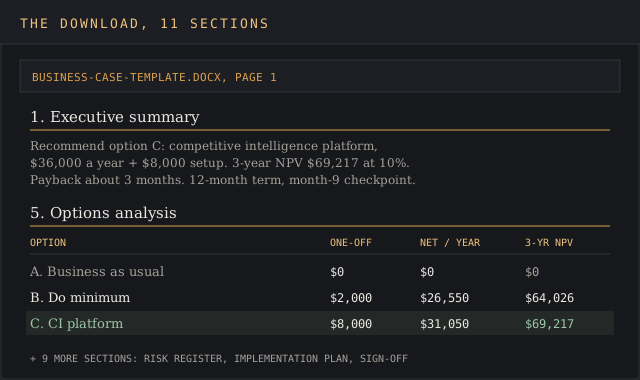
Get the business case template
A Word document with all 11 sections of a business case, from executive summary to sign-off, with options, cost, benefit and risk tables pre-filled with a worked example you overwrite.
Download DOCXA business case template is a fill-in document that turns a request for money into a decision the people holding the budget can make in one meeting, with the rationale for the proposed project written down where everyone can check it. It states the problem, compares the realistic options side by side, prices each one, scores the risks and recommends one path, with the evidence for every number on the page.
This page covers what a business case is and where the standard structure comes from, the 11 sections of the downloadable Word template, a step-by-step method for writing a business case, and a sample business case worked through from problem statement to sign-off: a 180-person software company deciding if a competitive intelligence platform is worth $36,000 a year.
It's written for project managers, product and marketing leads, and anyone in an organization who has to ask a finance team for resources and wants a yes on the first pass. The same business case template works for software purchases, new hires, process changes and capital initiatives.
The reason to use a fixed structure is that decision makers and executives read business cases in the same order every time: the summary, the money, the risks. A well structured business case puts those three where a reader expects them, so the approval conversation starts on the numbers.
Download the free business case template
Download the business case template (DOCX)An 11-section Word document with instruction lines, options and cost tables, a risk register and a sign-off block, pre-filled with the Quillmark worked example.
The business case template file opens in Microsoft Word, Google Docs and LibreOffice Writer. Every table is a plain Word table with no macros, and the document structure mirrors the 11 headings below, so it survives an upload to Google Drive or SharePoint intact.
The grey italic instruction lines can be deleted section by section as you fill it in.
What a business case is
A business case is the document that justifies a proposed project by setting its expected benefits against its costs and risks, and comparing it with the alternatives, including doing nothing new.
In project management it comes first: it's the reason the proposed project exists, and the project charter, plan and budget all follow from the option it recommends. Project managers return to it when costs change, to check if the project still delivers the expected outcomes it was approved for.
It differs from a business plan in scope and structure. A business plan describes a whole company, its market, its team and five years of financial projections.
A business case covers one investment decision inside one of the organizations that already exist: a new system, a new hire, entry into new markets, a facility. Large organizations run dozens a year through the same business case template, which is how decision makers compare a software request with a hiring request on the same page.
The business case template on this page gives that decision a structured starting point and keeps decision making tied to one document. Each section answers one question a reviewer will ask, so a missing answer shows up as an empty heading before the document reaches the people who approve it.
The Five Case Model behind the template
The template follows the UK government's Five Case Model, set out in HM Treasury's guidance on developing business cases. The Five Case Model examines every proposal from five angles, the strategic, economic, commercial, financial and management cases, and the downloadable template keeps all five, renamed for a company setting.
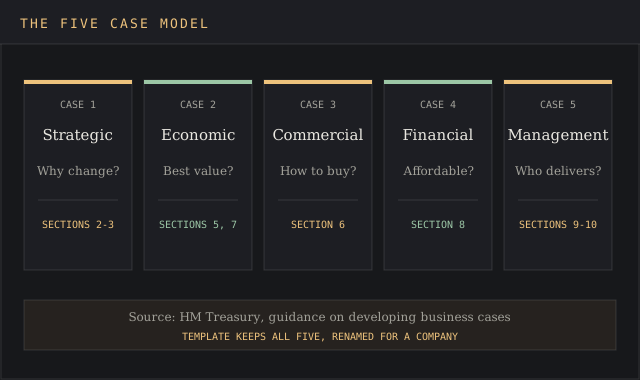
| Case | Question it answers | Where it sits in the template |
|---|---|---|
| Strategic | Why is the change needed, and how does it fit the organization's strategic objectives? | Problem statement, strategic alignment |
| Economic | Which option gives the best value for the money? | Options analysis, expected benefits |
| Commercial | How will the product or service be bought, and on what terms? | Cost estimates, regulatory considerations |
| Financial | Can the organization afford it, and from which budget? | Financial analysis |
| Management | Who delivers it, by when, and how is success measured? | Implementation plan, risk register, change management |
The same guidance writes a business case in three passes: a strategic outline case to agree the need and narrow a long list of options, an outline business case to pick the preferred option, and a full business case that records the procurement result and asks for final sign-off. A $40,000 software decision needs one pass. A capital project worth millions earns all three, because the resources at stake justify the extra management time.
Two habits from the Treasury method carry over to any business. The shortlist always includes a business-as-usual option and a do-minimum option, and the guidance warns practitioners not to assume the organization will do nothing under existing arrangements, because standing still has costs too.
Future cash flows get discounted: the Green Book discounts public projects at 3.5% a year for the first 30 years, and in 2026 the Treasury accepted a review's recommendation to cut that rate to 3%. Private organizations and other non-government organizations use their own hurdle rate, which the finance team sets.
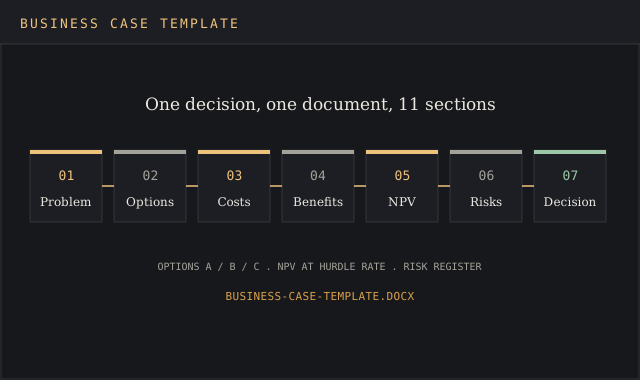
The 11 sections of the business case template
The key components of the business case template below follow the order a reviewer reads in. Each section in the file opens with one grey instruction line saying what belongs there and how long it should run.
| # | Section | What goes in it |
|---|---|---|
| 1 | Executive summary | The problem, the recommended option, its cost, its net present value and the decision requested, in under 200 words |
| 2 | Problem statement | The pain point the proposed solution addresses, in measured terms: lost revenue, hours, error rates, complaints |
| 3 | Strategic alignment | Which strategic objectives and strategic priorities the project serves, named as they appear in the company plan |
| 4 | Project description and scope | What is in and out of scope, who it affects, and the project timeline in one line |
| 5 | Options analysis | Business as usual, do minimum and at least one full option, with pros, cons and a score |
| 6 | Cost estimates | One-off and recurring costs per option, with the source for each figure |
| 7 | Expected benefits | Each benefit with a baseline, a target, the metric and who measures it |
| 8 | Financial analysis | Net present value, payback period and a sensitivity analysis on the riskiest assumption |
| 9 | Risk register | Potential risks scored for likelihood and impact, with mitigation strategies and an owner |
| 10 | Implementation plan | Milestones, resource allocation, change management steps and review dates |
| 11 | Recommendation and approval | The decision requested, the conditions attached, and signatures |
Section 3 is the filter that stops resources flowing to work the plan doesn't need: when several organizations or teams compete for one budget, strategic alignment is how the highest-impact initiatives get ranked first.
Section 4's project description stays short on purpose. The detail belongs in the project charter after approval; the business case document only needs enough scope for the cost estimates to be checkable. Section 7 is where the potential benefits get a number, and section 9 is where risk management starts: the register carries over into the project plan unchanged once the proposed project is approved.
How to write a business case, step by step
Write the sections of the business case template out of order. The executive summary goes last, because it summarises numbers that don't exist until step five.
- Measure the problem. Put a number on the current state: hours per month, deals lost, defects per thousand. Pull it from your own systems or market research, explore how it has moved over the past year, and note the date, since market conditions move. A problem statement without a baseline can't produce a benefit figure later.
- Tie it to strategy. Quote the objective from the annual plan word for word. If no objective fits, that's a red flag worth raising before writing another page.
- List and explore the options. Start with business as usual and do minimum, then add one or two full options for the proposed project. The Treasury guidance works from a long list down to roughly five; most company decisions need three.
- Price each option. Get detailed cost estimates from quotes, rate cards and payroll data, list the people and other resources each option needs, and split one-off from recurring costs. Ask the finance team for the loaded hourly rate and the discount rate they use.
- Quantify the benefits and run the numbers. Convert each benefit into money where you can, discount three to five years of cash flows, then change the weakest assumption and see if the ranking flips. A cost-benefit analysis template runs the same arithmetic in a spreadsheet. This is the financial planning step most first drafts skip.
- Score the risks. Rate each one from 1 to 5 for likelihood and impact, multiply, and assign an owner and one of your mitigation strategies to anything scoring 9 or above. The risk assessment matrix template uses the same 5x5 scale.
- Plan delivery and get stakeholder buy in. Name who implements the proposed project, what they stop doing to free the time, and when the first review happens. Walk the draft past key stakeholders one at a time before the formal meeting.
- Write the summary and the recommendation. One option, one figure, one decision requested from the decision makers. The executive summary template covers that section on its own.
The devil's in the details at step four. A cost line nobody can trace stalls the meeting, and a stitch in time saves nine: a supplier quote attached to the appendix settles the question before anyone asks it.
Sample business case: a competitive intelligence platform
The template ships filled in with this example. Quillmark is a fictional 180-person B2B payroll software company. Its sales team runs about 250 deals a year against two named rivals, wins 24% of them, and its average contract is worth $18,000 a year at a 70% gross margin. Every figure below is an example input, so swap in your own. Filled in, it reads as a complete business case of about four pages.
Problem statement and strategic alignment
A product marketing manager spends 30 hours a month compiling a competitor PDF that reps say is out of date by the time it lands. At a loaded rate of $75 an hour, that's $27,000 a year of labour. Win-loss interviews rank competitor pricing answers among the top three loss reasons. The company plan's second of four objectives is to lift competitive win rate, so the strategic alignment is direct.
Options analysis
| Option | One-off cost | Recurring cost per year | Assumed win-rate lift | Net benefit per year | 3-year NPV at 10% |
|---|---|---|---|---|---|
| A. Business as usual: monthly PDF | $0 | $27,000 labour | 0 points | $0 (baseline) | $0 |
| B. Do minimum: free alerts and a shared battlecard tracker | $2,000 | $16,200 labour | 0.5 points | $26,550 | $64,026 |
| C. Competitive intelligence platform | $8,000 | $36,000 licence + $7,200 labour | 1.5 points | $31,050 | $69,217 |
Each point of win rate is worth 2.5 extra deals a year, or $31,500 of gross margin. Option C's net benefit is $47,250 of margin from a 1.5-point lift, plus $19,800 of labour freed against the baseline, minus the $36,000 licence. Option B's is $15,750 of margin plus $10,800 of labour. The discount rate is Quillmark's 10% hurdle rate, which gives a three-year discount factor of 2.48685.
For a buyer comparing vendors at the cost estimates stage, the competitive intelligence tools ranking lists the platforms and their pricing models, and a vendor evaluation scorecard turns the shortlist into a weighted score.
Financial analysis and sensitivity analysis
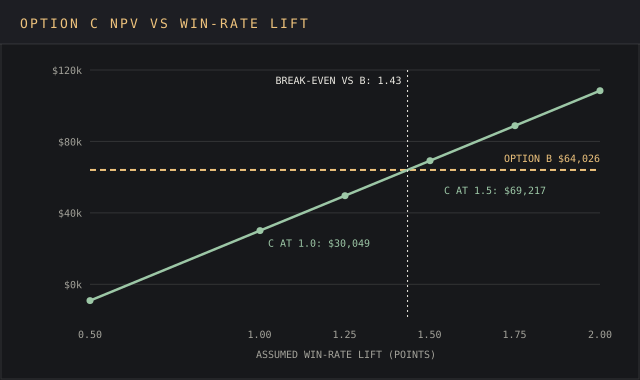
Option C wins on paper by $5,191 of NPV and pays back its $8,000 setup in about three months. That margin is thin, and it rests on one assumption: the 1.5-point lift. The sensitivity analysis in section 8 of the template reruns the numbers under various scenarios.
- At a 1.0-point lift, option C's NPV falls to $30,049, less than half of option B's.
- Option C beats option B only above a 1.43-point lift.
- Option C stays NPV-positive against business as usual down to a 0.62-point lift.
That turns the recommendation into a 12-month purchase with a checkpoint built in. Putting all your eggs in one basket on a multi-year contract would bet $108,000 of licence fees on a figure nobody has measured yet. The NPV calculator reruns any of these rows in a browser, and the win rate calculator sets the baseline.
Risk register
| Risk | Likelihood (1-5) | Impact (1-5) | Score | Mitigation | Owner |
|---|---|---|---|---|---|
| Reps ignore the platform | 3 | 4 | 12 | Battlecards embedded in the CRM deal page; usage reviewed monthly | Sales enablement lead |
| Win-rate lift stays under 1.43 points | 3 | 3 | 9 | 12-month term; month-9 checkpoint against the win-loss baseline | Senior director, product marketing |
| Platform stores call recordings with personal data | 2 | 4 | 8 | Data processing agreement and security review before contract | Legal and IT security |
| Competitor data goes stale | 2 | 3 | 6 | Weekly 30-minute review of every changed battlecard | Product marketing manager |
| Licence price rises at renewal | 3 | 2 | 6 | Renewal uplift capped in the order form | Finance team |
The register gives each risk an owner, and a standalone risk register template keeps tracking them, which is where project success gets decided after the approval meeting. The third row covers the regulatory considerations. A platform that records sales calls processes personal data, so the risk assessments in the template prompt for a data processing agreement before any purchase order goes out.
Implementation plan and recommendation
Month 1 covers procurement and the security review, with risk assessments signed off by IT. Month 2 builds battlecards for the two main rivals, and month 3 rolls them out to 40 reps, which is where the change management work happens: one training session per team, and battlecards placed inside the CRM where reps already work. Months 6 and 9 compare the competitive win rate against the 24% baseline, and month 12 is the renewal decision.
The recommendation asks the VP of Sales and the CFO to approve option C on a 12-month contract, with a fallback to option B at renewal if the month-9 lift is below 1.43 points. That's a decision a sales leader can give the green light to in one meeting, because the exit is written in and the measure of success is agreed before money moves.
Who reviews a business case, and what each reviewer checks
A business case passes through four or five readers before approval, and each one opens it looking for a different page. Writing for those stakeholders one by one is the fastest route to stakeholder buy in, and it shortens decision making by a meeting or two.
| Reviewer | Reads first | Question they need answered |
|---|---|---|
| Sponsor (a senior director or VP) | Executive summary | Does this serve my objectives, and will I defend it to the executives above me? |
| Finance team | Cost estimates, financial analysis | Are the costs complete, and does the NPV hold at our discount rate? |
| Budget-holding executives | Options analysis, recommendation | Why this option over the cheaper one, and what resources does it take from other initiatives? |
| IT, security and legal | Risk register | What data does it touch, and who signs the contract? |
| Delivery team or project management office | Implementation plan | Who does the work, and is the project timeline realistic? |
Decision making speeds up when the business case document answers each of these before the meeting. Decision makers who find their question on the page they open first approve with confidence; the ones who don't send it back with notes.
The good practices are plain, and finance teams in most organizations apply the same practices to every proposed project: one page per question, a source for every figure, and a rationale for every assumption so the reader can make informed decisions without calling the author.
Stakeholders outside the approval chain matter too, and organizations that skip them pay for it at rollout. The sales reps, analysts or operators who'll use the result decide if the expected benefits show up, so the rationale for the change should reach them before rollout.
Costly mistakes in business case writing
These six patterns send drafts back to the drawing board.
- Leaving out business as usual. Without a baseline, there's nothing to measure the expected outcomes against, and every benefit reads as pie in the sky.
- Benefits with no owner. A benefit written as better decision making can't be audited. Competitive win rate moving from 24% to 25.5%, measured by sales operations each quarter, can.
- One-point estimates. A single figure for a forecast hides how wrong it can be. Run a sensitivity analysis on the assumption with the widest range.
- Recurring costs left out. Licence renewals, maintenance and the internal resources needed to run the proposed project all count, and the finance team will add them back if you don't.
- Optimism about timing. The Green Book gives optimism bias its own annex and tells appraisers to adjust for it. A benefit that starts in month one needs a stated reason, or a later start date.
- No exit point. A business case for a multi-year commitment should say what result triggers a stop, so the organization can cut its losses early and move the resources to other initiatives.
The first two are visible on page one. The last four tend to surface in a second approval meeting, the one a business case is written to avoid.
Word, Google Docs or business case software
Word suits a business case document that goes to a board pack as a PDF, since the document prints the same everywhere. Google Docs suits one that five people edit in the same week, since comments and version history are built in and the latest draft stays easily accessible to everyone with the link. Both open the downloadable file without changes.
The weak spot is the financial analysis. Spreadsheets emailed between authors are prone to errors and version-control problems, and when cost figures get pasted into the document by hand, the two drift apart.
JPMorgan's 2013 task force report on its London Whale losses described a risk model that ran through Excel spreadsheets filled in by copying and pasting data; one formula divided by a sum where an average was intended, which roughly halved the volatility the model reported. Keep one source for every number and link the document to it.
A shared file in Google Drive or SharePoint keeps a single version with an edit history, which protects data integrity when five people touch the numbers.
Dedicated capital-planning tools add approval workflows, audit trails and live financial models for organizations that review dozens of business cases a year across many initiatives. For a team writing four a year, a Word business case template plus one spreadsheet and a named owner does the same job.
FAQ
What is a business case in project management?
It's the document that justifies starting a project by comparing its costs, benefits and risks with the alternatives. Project managers and the project management office use it as the reference for scope and for deciding if the project is still worth finishing when costs change.
How do I write a business case?
Measure the problem, link it to a strategic objective, list at least three options including business as usual, price each one, quantify the benefits, score the risks, plan delivery, then write the executive summary last.
What is contained in a business case?
An executive summary, problem statement, strategic alignment, scope, options analysis, cost estimates, expected benefits, financial analysis, risk register, implementation plan and a recommendation with sign-off. The template has a section for each.
What goes into a good business case?
Numbers with sources, a baseline to compare against, benefits with named owners and a definition of project success, a sensitivity analysis on the weakest assumption, and a recommendation that says what happens if the results fall short.
What are the 5 parts of a business plan?
It depends on the source. The SBA's traditional plan format lists eight sections plus an appendix; five-part versions merge them into summary, company, market, operations and financial projections. A business plan covers a whole company; a business case covers one investment inside it. For the plan's numbers, see the financial plan template.
What is the difference between a business case and a case study?
A business case argues for a future decision. Case studies describe something that already happened, usually in a problem, approach, result format.
Is this business case template free to use?
Yes. The business case template downloads as a .docx with no email gate, and you can edit, rebrand and share it inside your organization.
Where can I find Word document templates for a business case?
The download on this page is a free .docx with no sign-up. Microsoft's template gallery and Google Docs' template gallery also carry general proposal and project layouts; check that any you adapt has an options table and a risk register.
Bottom line
Use this business case template when a proposed project needs money, crosses more than one budget owner, or commits the company for longer than a year. The 11 sections make the financial implications, the risks and the alternatives visible on one page each, which keeps decision makers, executives and the delivery team on the same page before the approval meeting.
For an early idea that hasn't earned a cost estimate yet, a feasibility analysis template is the lighter first step, and a SWOT analysis fits when the question is which direction the business should take, before any single investment is on the table.