Target Market Analysis Template
 By Jan Suski. I go deep on every review, checking every number against its source and digging up details other coverage misses, a habit from six years of SEO and link building for tech companies. Bylines at Brand24 and Senuto. How the scoring works.
Get the target market analysis template
An Excel workbook that sizes the market (TAM, SAM, bottom-up SOM), profiles each segment, scores them on five weighted criteria, and builds the target audience statement for the winner.
Download XLSXA target market analysis template is a workbook for deciding who to sell to. It sizes the market in dollars, splits it into customer segments, profiles each segment's demographic data, psychographic data and pain points, scores them, and ends on a one-sentence target audience statement the whole marketing team can repeat.
The free Excel file below does that in five tabs, with a worked example built on the 2022 Economic Census count of 80,535 US landscaping firms. It doubles as a target audience analysis template: the segment profiles are the audience analysis, and the scoring tab picks the ideal customer out of your potential customers.
This page covers the key elements of a target market analysis, how target market and target audience differ, a step-by-step method, the free data sources worth using, the worked example, and the mistakes that leave a team marketing to everyone. It's for founders, product marketers and agency strategists who need a defensible answer before they spend on marketing campaigns, especially those launching into a market they haven't sold to before.
The payoff is measurable. McKinsey's 2021 personalization research found 71% of consumers expect companies to deliver personalized interactions, and 76% get frustrated when that doesn't happen. You can't personalize for a customer you haven't defined.
Download the free target market analysis template
Download the target market analysis template (XLSX)Five tabs: market size, segment profiles, weighted segment scoring, the target audience statement, and a source log. The landscaping software example ships in italic.
The workbook opens in Excel, Google Sheets and LibreOffice Calc. Market size uses plain multiplication and the scoring tab uses SUMPRODUCT, so nothing breaks on import.
What a target market analysis covers
A target market analysis answers three questions: how big is the market, which customer segment inside it should you serve first, and what does that group need to hear. Everything in the template feeds one of the three, and anything that doesn't is cut so you save time on data that never changes a decision.
Audience analysis splits into five categories of data. Four are the classic segmentation bases; the fifth, firmographics, replaces demographics when the buyer is a company.
| Category | Data points | Where it comes from |
|---|---|---|
| Demographic data | Age range, gender, income, education, employment status, socioeconomic status | Census data, Google Analytics, surveys |
| Geographic | Country, region, city, physical location, climate, time zone | CRM addresses, Census, analytics |
| Psychographic data | Values, attitudes, interests, opinions, lifestyle | Interviews, surveys, social media |
| Behavioral | Purchasing habits, usage rates, brand loyalty, buying decisions, channel | Sales data, product analytics, reviews |
| Firmographic (B2B) | Industry, employee count, revenue, decision makers, tech stack | Economic Census, County Business Patterns, CRM |
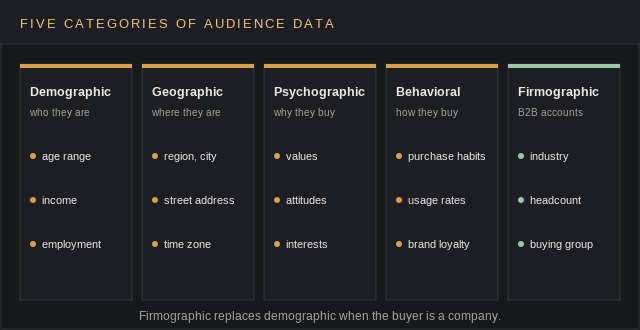
Demographics tell you who someone is; psychographics tell you why they buy. A segment defined only by age range and income ends up with marketing messages that could be sent to anyone in that bracket, and the open rates show it. Target audience analysis needs both halves to identify why one group buys and another doesn't.
Target market vs target audience
The target market is everyone who could buy the product: a specific group with a size you can count. The target audience is the narrower set a campaign is written for, and one target market can hold several different target audiences.
A landscaping software company's target market is US landscaping firms. Its target audience for a spring email campaign might be owners of 5 to 19 person crews in the South who still dispatch by text message. Same market, a sharper intended audience. The target audience analysis examples further down use exactly this split.
A buyer persona sits one level further down. HubSpot defines it as a research-based profile representing a segment of your target audience; in practice it's a semi-fictional profile with a name, a job and a quote. The user persona template builds one, and it works best after this analysis has picked which segment deserves a persona.
Why target audience analysis matters for marketing strategy
An effective marketing strategy starts with a defined audience because every later decision depends on it: channel, price, message, and which features go on the roadmap. Product development and marketing campaigns both draw from the same segment profiles.
- Brand loyalty. In the same McKinsey study, 78% of consumers said personalized content made them more likely to repurchase.
- Revenue. Faster-growing companies drive 40% more of their revenue from personalization than slower-growing peers, per McKinsey.
- B2B reach. Gartner puts a typical buying group for a complex B2B purchase at six to 10 decision makers. A target market analysis that names one buyer misses five of them.
Those figures measure what personalization returns, and personalization starts with knowing the segment. Target audience analysis is how you determine which market segments get the tailored message and which get none.
Businesses without a defined target market tend to spread a small budget across every channel and learn nothing from any of them. Marketing to everyone turns into a wild goose chase: the spend is diluted, and the results can't be traced to a segment. Effective marketing campaigns focus the spend, so customer acquisition costs land on accounts that convert, and success or failure points at one target audience and one message.
What's in the template
Five tabs, in fill order. The first three are numbers; the last two are words and sources.
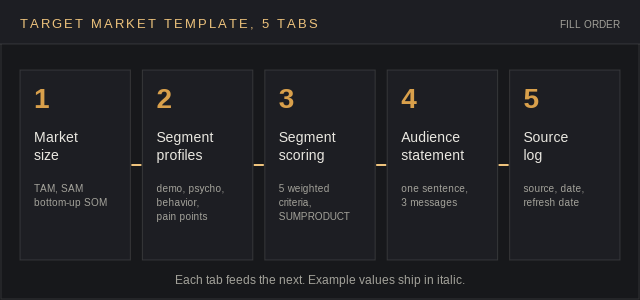
- Market size. TAM, SAM and SOM. Enter account counts and annual price per segment; the tab multiplies them, sums the serviceable segments, and runs a bottom-up SOM from sales capacity.
- Segment profiles. One column per segment with rows for demographics or firmographics, geography, psychographics, behavior, pain points, buying triggers, channels and competitors.
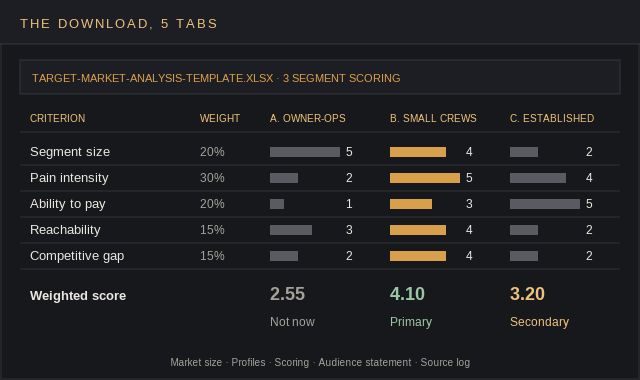
- Segment scoring. Five criteria scored 1 to 5 with weights you set. SUMPRODUCT returns a weighted score, and a nested IF labels each segment Primary, Secondary or Not now.
- Target audience statement. A fill-in sentence for the primary segment, plus the three marketing messages it implies.
- Source log. Every number on the other tabs, its source, the date pulled, and the next refresh date.
Most templates skip the source log, yet it's the tab that lets someone check your work six months later, when consumer habits and competitors have shifted and the analysis needs a refresh.
How to do a target market analysis, step by step
Conducting target audience analysis takes eight steps. The first four gather data; the last four turn it into a decision and create the brief.
Define the products or services and the problem they solve. One sentence. "Scheduling and invoicing software for landscaping crews" sets the product category and rules out half the possible markets on its own.
Mine your existing customers. Pull the customer base from the CRM: industry, size, location, plan, tenure, churn. Existing data from paying customers beats any survey of people who haven't bought, and it's the most relevant information you'll find.
Add external data. Census tables, Google Trends, industry reports and competitor pages fill in what the CRM can't, especially the size of the larger market you haven't reached yet.
Draft three to five segments. Look for a few examples of customers who bought fast and stayed, then split by the variable that changes buying decisions most. For B2B that's usually company size; for consumer products it's often life stage or income.
Size each segment. Account count times annual price gives each segment's share of the TAM. Mark which segments the product can serve today; that sum is the SAM.
Score and pick. Rate each segment on size, pain intensity, ability to pay, reachability and competitive gap. The template weights and ranks them.
Write the target audience statement. Who they are, the problem, the trigger, and what they'll pay, in one sentence. Create one per primary segment.
Test it. Validate assumptions with primary research before the budget moves and look for insights that contradict the profile: ten customer interviews, a short survey, or a small paid campaign aimed at the primary segment only.
Steps 1 to 3 are where most of the time goes. It's worth getting the ball rolling on the CRM export first, since it's the one source nobody else can buy.
Data sources for target market research
Most of the market research a target audience analysis needs is free. The paid tools add speed, and a few add data you can't get elsewhere, but a first pass costs nothing.
| Source | What it gives you | Watch for |
|---|---|---|
| American Community Survey | Age, sex, educational attainment, employment status, income and earnings, occupation, by geography | 1-year estimates only cover areas of 65,000+ people; 5-year estimates cover all areas |
| County Business Patterns | Establishments, employment and payroll by industry and county, annually | Employer establishments only; sole operators are missing |
| Economic Census | Firm counts and revenue by employee size class, by NAICS code | Runs every five years; the latest is 2022 |
| Google Trends | Relative search interest by region and season | Values run 0 to 100 against all searches, not raw volume |
| Google Analytics 4 | Age, gender and interests of site visitors | Needs Google signals and hides values below data thresholds |
| Industry reports and associations | Market share, growth rates, buyer surveys | Check the sample size and who paid for it |
| Social media and reviews | Language customers use, complaints about competitors | Loud users skew it; treat as qualitative |
Google Analytics and your CRM
Google Analytics 4 reports age in six brackets: 18-24, 25-34, 35-44, 45-54, 55-64 and 65+. That's enough to see if your site audience matches the age range you assumed. The CRM tells you who paid, which matters more than who visited.
Google Trends and seasonality
Google Trends scales results on a range of 0 to 100 based on a topic's share of all searches, so it shows when and where interest peaks, never how many people searched. For a seasonal market like landscaping, that seasonal shape decides when the campaign runs.
Information obtained from free sources still needs a date next to it in the source log, along with the relevant table ID so someone else can find it. Census tables refresh annually or every five years; a Trends curve can move in a month.
Target market analysis example: landscaping software
The target audience analysis example in the file is a 14-person software company selling job scheduling and invoicing services to US landscaping businesses. It has three plans: $29 a month for owner-operators, $99 for small crews and $249 for larger firms. The company's figures are the scenario's own; the market counts are real.
Market counts come from the 2022 Economic Census size-of-firm table for NAICS 561730, Landscaping Services: 80,535 full-year employer firms.
| Segment | Employees | Firms | Annual price | Segment value |
|---|---|---|---|---|
| A. Owner-operators | Fewer than 5 | 49,049 | $348 | $17,069,052 |
| B. Small crews | 5 to 19 | 24,626 | $1,188 | $29,255,688 |
| C. Established firms | 20 to 99 | 6,220 | $2,988 | $18,585,360 |
| TAM, segments A to C | $64,910,100 | |||
Firms with 100 or more employees, 640 of them, sit outside the model; they buy enterprise field-service software through procurement, a different sale. The product's dispatch board is built for crews, so solo operators are out of the SAM too: B plus C gives a serviceable market of $47,841,048 across 30,846 firms.
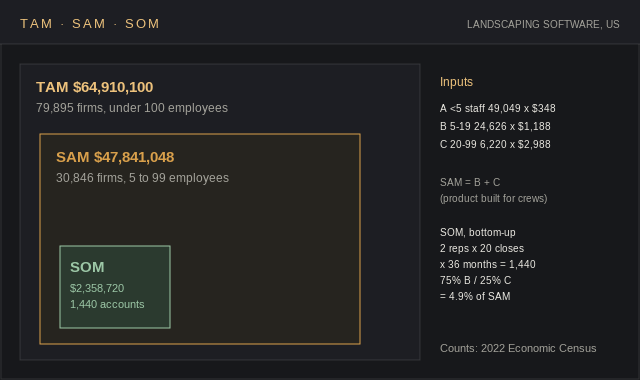
TAM is total demand for the product at its price, SAM is the part of the TAM the product can serve today, and SOM is the realistic share the company can capture. The SOM here is bottom-up. Two sales reps closing 20 accounts a month each for 36 months gives 1,440 accounts. At a 75/25 mix of B and C that's 1,080 small crews and 360 established firms, or $2,358,720 in annual revenue: 4.9% of the SAM. The total addressable market template covers the top-down version.
Segment scoring
| Criterion | Weight | A. Owner-operators | B. Small crews | C. Established firms |
|---|---|---|---|---|
| Segment size | 20% | 5 | 4 | 2 |
| Pain intensity | 30% | 2 | 5 | 4 |
| Ability to pay | 20% | 1 | 3 | 5 |
| Reachability | 15% | 3 | 4 | 2 |
| Competitive gap | 15% | 2 | 4 | 2 |
| Weighted score | 2.55 | 4.10 | 3.20 | |
| Verdict | Not now | Primary | Secondary |
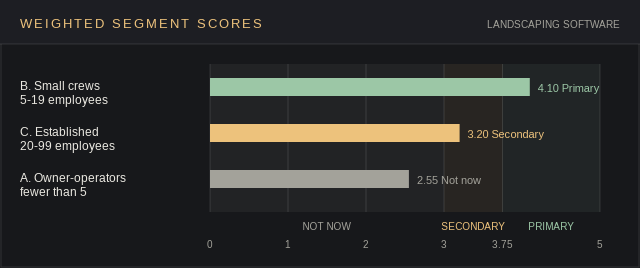
Owner-operators are the biggest segment by count and the worst fit, which the audience analysis makes plain. A two-person crew keeps the schedule in the owner's head, so pain intensity scores a 2, and $29 a month is a hard sell. Small crews hit the nail on the head: enough jobs to double-book and too few office staff to catch it.
Customer profile: small crews
The profile tab for segment B, filled from 18 interviews with current customers in the scenario:
- Firmographics. 5 to 19 employees, 2 to 4 crews, owner still in the field three days a week.
- Owner demographics. Age range 35 to 54, high school or trade background, runs the books on weekends.
- Psychographics. Values reliability and time off on Sundays; distrusts software with annual contracts.
- Behavior. Dispatches by group text, invoices from a desktop on Sunday nights, buys tools after a peer recommends them.
- Pain points. Double-booked jobs, invoices going out two weeks late, no record of which crew did which property.
- Channels. State landscape association events, Facebook groups for lawn-care owners, YouTube equipment reviews.
Target audience statement
"US landscaping companies with 5 to 19 employees, run by an owner who still dispatches crews by text, who lose billable hours to double-booked jobs and late invoices, and who'll pay $99 a month for one app that schedules crews and invoices from the job site."
That sentence decides the ad copy, the trade-show budget and the onboarding emails, and it gives every marketing strategy meeting the same starting point. Anything that doesn't serve it goes on the back burner until segment C's turn comes.
B2B and B2C target markets
Customer segmentation for a consumer product leans on demographics and psychographics: age range, socioeconomic status, employment status, physical location, values. A B2B target market leans on firmographics and the buying group: industry, size, the decision makers and who signs.
| B2C | B2B | |
|---|---|---|
| Main variables | Age, income, life stage, interests | Industry, employee count, revenue, tech stack |
| Who decides | One person or a household | Six to 10 people for a complex purchase, per Gartner |
| Best free data | American Community Survey, Google Analytics | County Business Patterns, Economic Census |
| Segment size | Thousands to millions of people | Hundreds to tens of thousands of accounts |
Digital products sit in both columns. An online course sold to freelancers is B2C on paper and B2B in behavior, since the buyer expenses it. Sellers of digital products should profile the person who pays as well as the person who uses, and those two profiles often need different target audience analysis examples to identify them.
The ideal customer profile template handles the B2B account definition in more depth, and the customer segmentation template scores an existing customer base with RFM. Together with this file, that's the full set of tools a B2B team needs to define ideal target audiences.
Common target market analysis mistakes
- A market of everyone. "Small businesses" belongs on the TAM line. If you can't count the segment from a public table or the CRM, it's too broad to identify in a campaign.
- Demographics with no pain points. Age and income say who; pain points say why they'd switch. A profile without pain points can't produce marketing messages or a marketing strategy.
- Picking the biggest segment. Segment A in the example has twice the firms of segment B and scores lowest. Size is one criterion out of five.
- Skipping competitors. Identify direct and indirect competitors per segment. A segment already served well by a cheaper tool has no competitive gap, whatever its size, and a quick SWOT analysis of your business against that segment shows where you stand.
- Top-down SOM only. "We'll take 5% of the market" isn't a forecast. Build the SOM from reps, close rates and months.
- Never updating it. Consumer habits shift and competitors launch. Put a refresh date on the source log and review the analysis at least once a year.
Excel, Google Sheets or a market research platform
A spreadsheet fits a target market analysis because the core is arithmetic: counts times prices, weights times scores. It also travels; a founder can send it to an investor and a marketing agency can send it to a client without a login.
Market research platforms save time on the data-gathering steps. Survey tools collect psychographic data at volume, and social listening tools pull the language customers use about competitors. Their output still lands in a table like this one, because the decision about which segment to chase is a business strategy call, made by people who know the products or services and the customers.
The market analysis template covers the wider market around your target segments, and the research survey template gives you a questionnaire for step 8.
FAQ
How do I analyze my target audience?
Start with your existing customers, identify the shared traits of the best ones, add public data on the wider market, split it into three to five segments, and score each on size, pain, ability to pay, reach and competition. Profile the winner's demographics, psychographics, behavior and pain points, then test the result with interviews or a small campaign.
What are the 5 categories of audience analysis?
This template uses demographic, geographic, psychographic, behavioral and firmographic data. The first four are the standard segmentation bases; firmographic covers company attributes when the buyer is a business.
Can you give me an example of an audience analysis?
The landscaping example above: 80,535 US firms split into three size segments, scored, with small crews of 5 to 19 employees picked as the primary target audience at a weighted 4.10 out of 5.
What should be included in a target market analysis?
Market size (TAM, SAM and SOM), segment definitions, a profile per segment covering demographics, psychographics, behavior and pain points, a competitor list, a scoring method, a target audience statement, and a log of every source with its date.
What are the four types of target audiences?
Examples vary by source. Most guides group audiences by the four segmentation bases: demographic, geographic, psychographic and behavioral. Some split by purchase intention or by role in the buying process.
Can you give me an example of a customer profile?
Segment B in the worked example: landscaping companies with 5 to 19 employees, owner aged 35 to 54, dispatching by group text, invoicing on Sunday nights, losing hours to double-booked jobs, reachable through state association events and Facebook groups.
What is an example of target marketing?
A scheduling app that runs ads only in Facebook groups for lawn-care owners, with copy about double-booked crews, is target marketing. The same budget spent on a general small-business audience would reach far more people and convert far fewer.
Can ChatGPT do market research?
It can draft segment hypotheses, summarize public reports and suggest survey questions. It can't see your CRM, and the figures it gives need checking against the primary source, since a model will produce a plausible market size with no table behind it.
What is the recommended format for a market analysis?
A spreadsheet for the numbers and a short document for the narrative and insights. This workbook covers the target market; a full market research report adds industry trends, competitors and recommendations around it.
Bottom line
Use this template when you have a product and need to decide who to sell it to first, or when a campaign is underperforming and nobody can say who it was for. It turns a list of possible customers into a ranked set of segments with dollar values and a one-sentence brief.
If the customer base already exists and the job is splitting it, the customer segmentation template is the better fit. If the question is the size of the whole category, start with the TAM template. And if one segment is already chosen and the team needs a face to write for, move on to a buyer persona.