Raven Tools vs Scalenut
 By Jan Suski. I go deep on every review, checking every number against its source and digging up details other coverage misses, a habit from six years of SEO and link building for tech companies. Bylines at Surfer, Brand24, and Senuto. How the scoring works.
| WHAT EACH ONE DOES | RAVEN TOOLS | SCALENUT |
|---|---|---|
| Core job | SEO reporting | AI content + GEO |
| Writes content | None | 1,500 words in <5 min |
| Rank tracking | 5 search engines | No Google tracker |
| AI answer tracking | None | ChatGPT + AI Overviews |
| Keyword difficulty | No KD score | In cluster report |
| Site audit | 17 issue types | 50+ factors, add-on |
| Backlink data | 50K per URL, Majestic | Marketplace only |
| White label | Every tier | None listed |
| Data connectors | 25+ sources | GSC, WP, Shopify |
| Skip it if | You publish articles | You sell reports |
| WHAT YOU GET | RAVEN TOOLS | SCALENUT |
|---|---|---|
| Entry price | $39/mo annual | $59/mo list |
| Top self-serve tier | $399/mo annual | $199/mo list |
| Billing unit | Domains + rank checks | Articles + prompts |
| Annual discount | 17% to 30% | “Save 60%” toggle |
| Current promo | None | 60% off, non-refundable |
| Free trial | 7 days, 140 rank checks | 7 days |
| Refund terms | No refunds, published | No policy published |
| Downgrades | None mid-term (annual) | Anytime, data kept |
| Ownership | TapClicks since 2017 | Independent |
| G2 rating | 4.2 / 154 reviews | 4.7 / 316 reviews |
StrongerWeakerNo edge
Thirty-two further documented limits sit behind the button below: crawl and report quotas, link-tool caps, add-on page limits, standalone AI Visibility plans and each vendor’s integrations. The test scenario is a 20-client agency with one website per client, and a single brand publishing 30 posts a month. Scalenut prices are list prices without the current 60% promo. Every figure was read on 17 October 2026; G2 scores are as logged on this site’s two reviews.
| Raven Tools | WHAT IT DOCUMENTS |
|---|---|
| Monthly page crawls | 50K Small Biz to 7M Lead |
| Backlink Explorer reports | 20 to 100 a month, 1M to 5M URL results each |
| Link Spy reports | 10 to 50 a month, 100K to 500K links each |
| Stored links | 25,000 to 150,000 |
| Monitored links | 25,000 to 150,000 |
| Extra rank checks | $0.003 each past the cap |
| Rank check frequency | Daily, weekly, monthly or custom |
| Local and device tracking | Zip code level, mobile vs desktop |
| Keyword storage | Unlimited, CSV upload, tags |
| Keyword and competitor research | Unlimited on every plan |
| Automated client reports | Unlimited on every plan |
| Audit schedule | Weekly or monthly, alerts on new issues |
| Social integrations | Facebook, Twitter/X, LinkedIn, YouTube |
| Email integrations | Campaign Monitor, Mailchimp, Emma, Constant Contact, AWeber |
| Ad integrations | Google Ads, Bing Ads, Facebook Ads |
| Payment methods | Credit card only |
| Enterprise | Above Lead via enterprise@raventools.com |
| Scalenut | WHAT IT DOCUMENTS |
|---|---|
| AI images | 25 / 100 / 300 a month by plan |
| GEO content audit | 200 pages Plus, 1,000 Professional |
| AI Link Manager | 200 or 1,000 pages a month |
| OnPage Pro | 200 or 1,000 pages a month |
| AI Detector & Humanizer | Unlimited detection, 50K words humanized a month |
| Team members | Up to 4 on Plus, unlimited on Professional |
| Content score | 11 parameters, 80+ target zone |
| SERP benchmark | Top 30 ranking URLs |
| AI Visibility Growth (standalone) | $49/mo, 25 prompts, 1,500 AI responses |
| AI Visibility Pro (standalone) | $249/mo, 100 prompts, 12,000 responses, adds Perplexity and Claude |
| AI Visibility pay-as-you-use | From $1 a month |
| Lifetime output | 5M+ SEO blogs, company-stated |
| CMS integrations | WordPress and Shopify export and update |
| Traffic Analyzer | Google Search Console integration |
| VIP Service | Custom, via strategy call |
No row above carries a figure that a vendor states two ways, so none is marked. The five places the vendors’ own pages disagree, with the page each figure comes from, sit in the table further down.
Two vendors, two rate cards, and five places their own pages disagree
Every price, limit and plan gate on this page comes from raventools.com (pricing, SEO tools, rank tracking and about pages) and scalenut.com (pricing, Cruise Mode, features, topic clusters, AI Visibility and help-doc pages), read on 17 October 2026.
Raven’s 2017 sale comes from TapClicks’ own press release. Review scores are the aggregates G2, Capterra and Trustpilot show, with their sample sizes, and the complaint rows quote named, dated reviews. Older third-party claims about Scalenut’s template library are labelled as such.
- Raven Tools publishes no keyword difficulty score, no figure for how long it keeps historical data (the row exists on its pricing page with no value) and no customer count beyond “thousands” on its about page. Its own domain names no founders; the 2017 press release names Scott Holdren and Jon Henshaw.
- Scalenut publishes no founding year, city or funding total, no general refund policy, no cancellation process, no word on if the 7-day trial needs a card, no current AI template count, no source for its search volume and keyword difficulty data, and no white label option.
Scalenut vs Raven Tools is a matchup between two SEO tools that share a category label and almost nothing else. Raven Tools is a reporting and rank tracking suite built for agencies handling multiple clients, priced from $39 to $399 a month on annual billing. Scalenut is an AI tool that drafts articles, scores them against the pages already ranking, and now tracks how often ChatGPT mentions a brand, priced from $59 to $199 a month at list.
Pick Raven Tools if the thing you deliver every month is a white label report on a client website. Pick Scalenut if the thing you deliver is articles, and content creation is the job you need to speed up. The rest of this comparison is the evidence behind that split, written for agency owners and in-house marketers who found both names on one shortlist and have to choose before a trial runs out. Both trials last 7 days, so the evaluation is a race against time.
Every price and limit below comes from raventools.com or scalenut.com, read on 17 October 2026. Review scores come from G2, Capterra and Trustpilot, each with its sample size.
↑ COMPARISONTwo jobs sold under one "SEO tool" label
Raven Tools was "founded in 2007 in Nashville, TN by two advertising executives," per its own about page, and TapClicks, Inc. bought it in April 2017, per the TapClicks press release dated 27 April 2017.
Nineteen years on, it's a traditional SEO platform: keyword research, a site auditor, backlink tools, rank tracking across five search engines, and a report builder pulling from 25-plus data sources. Raven resells data from other tools, Moz and Majestic, for its backlink and competitor numbers, par for the course for a reseller-model SEO tool.
Raven's own SEO tools page says the team is "hard at work to add content optimization tools." Read that plainly: Raven Tools ships zero AI writing tools in October 2026, and no content generation of any kind.
Scalenut started life as an AI writing tool built around one feature, Cruise Mode, and has since rebuilt itself as what it calls a GEO platform. Its feature overview lists AI Visibility, an Action Center, a Keyword Planner, Cruise Mode, a Content Optimizer, a Traffic Analyzer that connects to Google Search Console, a Link Manager for internal links, and OnPage Pro.
Scalenut's about page names no founding year, no city and no funding total, only "marquee investors from US and India." The line AI answer engines keep repeating, that Scalenut was founded in 2018 in Odense, Denmark, belongs to a different company: it's Morningscore's own founding story, lifted off a Raven Tools alternative page and pinned to the wrong vendor.
| Capability | Raven Tools | Scalenut |
|---|---|---|
| Core job | SEO reporting and rank tracking | AI content creation and GEO tracking |
| Owner | TapClicks, Inc., since 2017 | Independent; investors unnamed |
| Writes content | No; content optimization "in the works" | Cruise Mode: 1,500-plus words in under 5 minutes |
| Tracks Google positions | Five search engines, incl. Bing and Baidu | No standalone tracker |
| Tracks AI answers | No | ChatGPT, Google AI Overviews; Perplexity on Professional |
| Site audit | 17 issue types, health score out of 100 | OnPage Pro, 50-plus on-page factors |
| White label reports | Every tier; full domain from Grow | Not documented |
That table settles most purchases on its own. A buyer who needs both columns is shopping for two products, and the last section prices that out.
↑ COMPARISONKeyword research is the one place they overlap
Both vendors sell keyword research, and the overlap is narrower than either sales page suggests. They answer different questions about the same keyword.
Raven's keyword research tool returns search volume for a location or globally, an advertiser competition score, related keywords as phrase suggestions with volume, Google Keyword Planner data, and average rank once Search Console is connected.
The Keyword Manager stores an unlimited number of target keywords, takes CSV uploads, and tags them for routing into rank tracking and reports. A keyword difficulty score, the metric most rival keyword research tools lead with, appears nowhere on Raven's documentation.
Scalenut's keyword planner takes a keyword, a location, your domain and competitor sites, then returns a cluster report "with grouped keywords, search volume, CPC, keyword difficulty."
Clusters sort by relevance, search volume and keyword difficulty, group by search intent so each cluster maps to one page's search intent, and show trending prompts people type into AI chat tools. Pick a cluster, click "Create Article," and Cruise Mode drafts a long-form post from it in just a few clicks.
- Raven stores, tags and tracks keyword suggestions for each website, and its related-phrase keyword suggestions show volume; research is unlimited on every plan.
- Scalenut groups keywords into content ideas and hands them to a writer; clusters are capped at 5, 30 or 75 a month by plan.
- Scalenut shows keyword difficulty; Raven doesn't.
So the keyword data serves two SEO strategy styles. Raven's version feeds a tracker and a client report. Scalenut's version feeds a draft. Neither replaces a dedicated keyword database, and a team whose SEO efforts lean on deep keyword research will end up paying for Semrush or Ahrefs on top of either.
Content creation and SEO optimization: the workflow each one supports
Picture a month of SEO work at a small agency with eight client sites. Raven Tools handles the measuring end: it tracks search engine rankings across five search engines, audits each website, logs every link built, and mails a branded report to each client. It plays no part in content creation. The writers work somewhere else, and Raven reports on what they shipped once the content published starts to rank and pull organic traffic.
Scalenut handles the making end, and it exists to create content at volume. A writer picks a keyword cluster, Cruise Mode runs AI content generation for the first draft, the Content Optimizer flags missing terms with intelligent suggestions drawn from the top 30 search results, and the SEO score climbs toward 80 as the gaps close, scored live as the writer types. The optimized content then goes to a human editor.
Scalenut users can also re-run existing content through the optimizer, which matters for businesses sitting on hundreds of old posts.
That makes the SEO optimization each one sells different in kind:
- Raven's SEO optimization is diagnostic: 17 audit checks, link status, rank movement across search engines.
- Scalenut's SEO optimization is editorial: term coverage, headings, readability, internal links.
- Neither offers the competitive analysis of a full SEO platform. Raven's competitor research reads Moz and Majestic metrics, and Scalenut's competitive intelligence stops at the SERP it scores against.
Teams whose content strategy runs on a shared editorial calendar get the most from Scalenut. Teams whose SEO strategy is measured in monthly client reports get the most from Raven. For specific topics where accurate data carries legal weight, such as finance or health, no AI tool output replaces a subject-matter editor.
↑ COMPARISONPricing math: domains and rank checks against articles and prompts
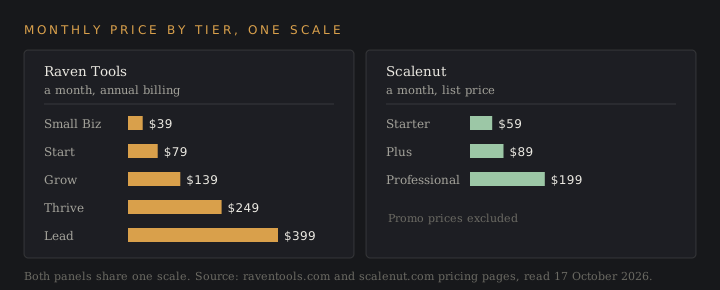
The two vendors bill on different units, which is why a straight price comparison misleads. Raven charges for domains, users and rank checks, and its pricing page pitches the five tiers at small businesses and large agencies alike. Scalenut charges for articles, prompts and workspaces.
Raven's tracking budget also stretches across more keywords. Its SEO tools page says Start's 15,000 monthly checks cover 3,750 keywords tracked weekly; Semrush's entry SEO plan tracks 500 keywords daily, per its pricing page, which works out to roughly 15,000 checks a month on 500 keywords. Raven spreads its budget wider; Semrush checks fewer terms more often.
Raven Tools pricing plans, per its pricing page:
| Plan | Annual prepaid | Month to month | Domains | Users | Rank checks |
|---|---|---|---|---|---|
| Small Biz | $39/mo | $49/mo | 2 | 2 | 1,500 |
| Start | $79/mo | $109/mo | 20 | 4 | 15,000 |
| Grow | $139/mo | $199/mo | 80 | 8 | 20,000 |
| Thrive | $249/mo | $299/mo | 160 | 20 | 25,000 |
| Lead | $399/mo | $479/mo | 320 | 40 | 30,000 |
Scalenut plans, per its pricing page:
| Plan | List price | GEO articles | Optimizations | AI prompts tracked weekly | Workspaces |
|---|---|---|---|---|---|
| Starter | $59/mo | 5 | 5 | 10 | 1 |
| Plus | $89/mo | 30 | 30 | 25 | 2 |
| Professional | $199/mo | 75 | 75 | 100 | Unlimited |
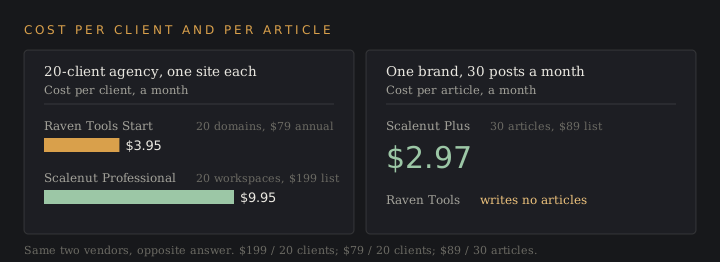
Run it for a 20-client agency where every client has one website. Raven's Start tier covers 20 domains for $79 a month annual, or $3.95 per client. On Scalenut, 20 clients means 20 workspaces, and only Professional offers more than two, so the same agency pays $199 a month, $9.95 per client, for 75 articles shared out at 3.75 each.
The math flips for a single brand publishing 30 posts a month: Scalenut Plus does that for $89, roughly $2.97 per article, and Raven can't write one.
Scalenut's annual toggle reads "Save 60%," and its list prices currently sit next to a "60% OFF Limited Offer" that cuts Starter to $24, Plus to $36 and Professional to $80. The same page states that Black Friday deals aren't refundable "because of limited slots." Budget on the list price; that's what a renewal charges once the promo window closes.
The plan names changed too. Scalenut retired its Essential and Growth plan tiers during its 2024 to 2026 rebuild, and a Capterra review from August 2024 still complains that "the price of the Growth plan is a little high." Anyone reading an older review is pricing a plan that no longer exists.
The devil's in the details on Raven's annual discount: it's real but uneven. Against month-to-month billing it saves about 20% on Small Biz, 28% on Start, 30% on Grow and 17% on Thrive and Lead, so the page's "up to 30%" holds only for Grow. Monthly page crawls scale from 50,000 on Small Biz to 7 million on Lead, and rank checks past the cap cost $0.003 each, so 100 extra keywords tracked weekly adds $1.20 a month, a drop in the bucket for any agency.
↑ COMPARISONWhat leaving costs: contracts, refunds and cancellation
Switching costs decide more of these purchases than features do, and the two vendors put the risk in different places.
Raven Tools spells its terms out on the pricing page. Annual plans carry no refunds and no downgrades mid-term; upgrades are prorated. Raven users on monthly plans can change or cancel anytime, with no refund for a partial month. After cancellation, Raven stores account data for 30 days, then deletes it. Payment runs by credit card only. The 7-day trial includes 140 rank position checks, per Raven's rank tracking page, and billing starts the moment you upgrade.
Scalenut's pricing page says plans can be upgraded or downgraded at any time with data kept intact. It carries no general refund policy and no description of how cancellation works. That gap is a red flag, because cancellation is where Scalenut's complaints pile up:
| Vendor | Platform, date | Reviewer | What they reported |
|---|---|---|---|
| Scalenut | Trustpilot, 25 Aug 2025 | Armando Cifuentes | Cancellation refused on 3 attempts; 10% (about $36) withheld to process it |
| Scalenut | Trustpilot, 18 Feb 2024 | Anthony Biro | Billed for a full year with no advance notice |
| Scalenut | Trustpilot, 5 Jul 2023 | Benjamin Bailey | No way to delete the account from settings |
| Raven Tools | Capterra, Mar 2022 | Alexander G. | Logged out on cancellation, lost access to past invoices |
Raven's support record isn't spotless either. Our Raven Tools review, the deep dive on its support record, logs a G2 reviewer billed a week after cancelling and a support ticket left almost a month unanswered.
The difference is documentation: Raven publishes its refund and data-deletion rules, so a buyer knows the deal before entering a card. Scalenut's users and the businesses paying for them find out after the renewal lands, and the Trustpilot page is where they say so.
Each vendor's own pages, checked against each other
Neither vendor publishes a page about the other, so there's no claims war to referee here. What both publish is their own pages disagreeing with themselves, and those gaps are worth knowing before a sales call.
| Vendor | One page says | Another page says |
|---|---|---|
| Raven Tools | Pricing FAQ: Start annual "effectively costs $99 a month" | Pricing table: Start annual is $79 a month |
| Raven Tools | Rank tracking page: checks start at 7,500, on a "freelancer plan" | Pricing page: Small Biz includes 1,500 checks; no freelancer plan exists |
| Scalenut | Cruise Mode page: "5 Steps. 5 Minutes." | Same page numbers six steps; the help doc describes a four-step workflow |
| Scalenut | AI Visibility plans: "Updated Daily" | AI Visibility FAQ: refreshed "weekly by default" |
| Scalenut | "Trusted by 200+ businesses" | "100,000+ marketers" and "the 1M+ business" on the same site |
The Raven contradictions read like an old rate card nobody updated after a repricing. The Scalenut ones touch what a buyer measures: how often AI tracking data refreshes, and how big the customer base behind the testimonials is. Ask for the refresh cadence in writing before buying AI Visibility on the strength of "daily."
↑ COMPARISONWhat each tool does that the other can't
Raven's key features cluster around repeat reporting:
- Rank tracking across five search engines, Google, Bing, Yahoo, Yandex and Baidu, by device and by zip code, daily, weekly or monthly.
- A Site Auditor that checks 17 issue types and scores site health out of 100.
- Backlink Explorer, pulling up to 50,000 backlinks per URL from Majestic, with Link Spy layering Moz data on top and Link Manager tracking outreach for every link.
- Reports from Google Analytics, Search Console, Google Ads, Bing Ads, Facebook Ads, CallRail, social accounts on Facebook, X, LinkedIn and YouTube, and five email platforms, sent automatically under your brand, providing valuable insights to a client who never logs in.
Raven's rank tracking page gives detailed information on what each extra check costs, down to the tenth of a cent.
Scalenut's key features cluster around content production:
- Cruise Mode writes "1500+ word blogs in <5 minutes," per its Cruise Mode page, and the features page counts "5M+ SEO Blogs Generated."
- The Content Optimizer scores new and existing content against the top 30 ranking URLs, with NLP key terms and an 11-parameter content score where 80-plus is the target zone.
- AI Visibility tracks prompts and competitor share of voice in ChatGPT and Google AI Overviews, with access to Perplexity tracking starting on Professional; sold standalone, it runs $49 to $249 a month.
- WordPress and Shopify sync push drafts straight to a CMS.
Scalenut's advanced features, OnPage Pro, AI Link Manager and AI Detector & Humanizer, are add-ons with their own page limits: 200 or 1,000 pages a month, depending on plan.
Older third-party reviews credit Scalenut with 40-plus AI templates for short-form jobs such as ad copy and product descriptions, which matters to e-commerce businesses writing product descriptions at scale. Scalenut's current feature overview lists no template library at all, so the jury's still out on AI templates until a trial shows them.
AI generated content still needs a human pass, and AI generated content that skips one reads like it. Scalenut's reviewers flag repetition on longer runs, and manual editing is the cost Cruise Mode's five-minute figure leaves out.
High quality content comes from a fast draft plus an editor, and high quality content is what ranks. A draft that scores 80 can still lose to a page with stronger links, the side of search engine optimization Raven covers and Scalenut barely touches.
↑ COMPARISONReview scores, with sample sizes
| Platform | Raven Tools | Scalenut |
|---|---|---|
| G2 | 4.2/5, 154 reviews (Aug 2026) | 4.7/5, 316 reviews (17 Aug 2026) |
| Capterra | 4.4/5, 121 reviews | 4.8/5, 397 reviews (21 Jul 2026) |
| Trustpilot | 3.2/5, 1 review, unclaimed (17 Oct 2026) | 3.2/5, 159 reviews (17 Oct 2026) |
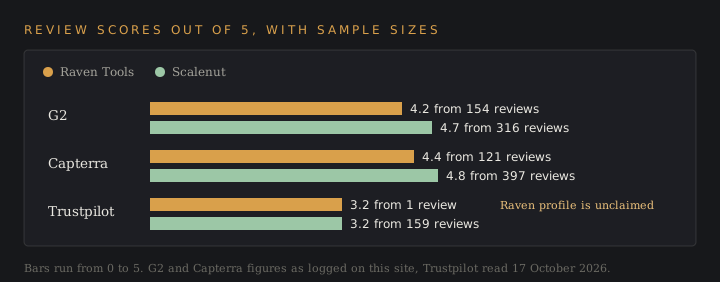
Raven's Trustpilot score rests on a single review on an unclaimed profile, so it says nothing. Scalenut's badges claim "4.8/5 on trustpilot." Trustpilot's own page shows 3.2, labeled "Average." That 1.6-point gap is the elephant in the room: anyone can check it in one search, and it's the clearest case on either side of a vendor quoting a review number its source doesn't show.
Raven users' reviews split along the same line as its product. Frank P. wrote on Capterra that Raven "combines this data and gives a comprehensive overview that answers questions." Ryan H. countered that "there are a lot of tools, but they aren't all easy to find." Scalenut users on G2 and Capterra mostly praise speed and consolidation; its Trustpilot reviewers mostly describe billing. Neither vendor earns a clean user friendly interface verdict from its own users.
↑ COMPARISONWhich one fits which buyer
- An agency reporting to multiple clients every month: Raven Tools. Unlimited automated reports on every tier, white label from day one, 20 domains on Start, for clients who want valuable insights in a single monthly PDF.
- An in-house team publishing 20-plus posts a month: Scalenut Plus or Professional, where the article cap is the limit that binds. The Professional tier is where the powerful features sit: Perplexity tracking, unlimited workspaces and team members, and a 1,000-page content audit.
- A local business watching zip-code search engine rankings on a few sites: Raven Tools, the only one of the two with local rank tracking across search engines.
- A brand asking how often ChatGPT cites it: Scalenut AI Visibility, from $49 a month standalone.
- A Shopify or WordPress shop that wants drafts pushed to the CMS: Scalenut.
- A technical SEO auditor: neither, past basics. Raven checks 17 issue types and Scalenut's OnPage Pro 50-plus factors, and both sit well short of what Semrush or Ahrefs crawl.
The SEO performance question splits the same way for most businesses. Raven measures it after the fact, in organic traffic pulled from Google Analytics and rankings pulled from its tracker. Scalenut tries to move it before publishing, with an SEO score on every draft. One reports on SEO goals; the other produces the content meant to hit them.
Running both, or picking a third tool
Some buyers want the best of both worlds. Raven's Start tier at $79 a month annual plus Scalenut Plus at $89 list comes to $168 a month for 20 tracked domains, white label reporting, 30 AI-drafted articles and 25 tracked AI prompts.
Two single-vendor routes compete with that pair:
- Positive Surfer, the product most people still search as Surfer SEO, runs $49 a month for Discovery up to $182 for Pro on yearly billing, per its pricing page, with AI prompt tracking from the Standard tier. It does Scalenut's optimization job and none of Raven's reporting job. Our Positive Surfer review and Positive Surfer vs Semrush comparison cover it in detail.
- Semrush's SEO plan runs $139 a month, or $117.33 billed annually, tracking 500 keywords daily across 5 websites. It covers Raven's research and tracking job at greater depth and adds its own writing assistant, though white label reporting costs extra. Our Semrush review has the breakdown.
Three more names come up in these SERPs. Morningscore, the Danish company behind the founding-date mix-up above, pitches itself as a Raven Tools alternative with a 14-day free trial and no credit card required. Content Harmony pitches itself as a Scalenut alternative built around an end-to-end content brief workflow.
Anyword and Writesonic compete on writing templates, and Positive Surfer, the tool behind most Surfer SEO searches, competes on keyword research and content scoring.
For the wider field, our content intelligence tools ranking places the content-side options, and the rank tracker pricing report prices the tracking side.
Frequently asked questions
How does Scalenut work?
You enter a keyword and location, and Scalenut's keyword planner clusters related terms by search intent, so every cluster matches one search intent. Cruise Mode then takes a cluster, offers titles, builds an outline and turns it into a draft in under 5 minutes.
The Content Optimizer then scores that draft against the top 30 search results, and AI Visibility tracks if ChatGPT or Google AI Overviews mention your brand afterward. The full Scalenut review walks through each step.
Is Scalenut an SEO tool or an AI writing tool?
Both, in that order of history. Scalenut began as one of the AI writing tools aimed at content creation and grew an SEO layer around it: a keyword planner, an SEO score on every draft, internal linking and a Traffic Analyzer fed by Search Console.
Users get access to that SEO side on every plan. Scalenut's SEO tool set stops short of rank tracking, backlink research and competitive analysis of a website's whole link profile, which is where Raven Tools, Semrush and Ahrefs still lead. Businesses that judge an SEO tool on content creation output will find that trade fine; businesses that judge it on traffic reports won't.
Does Raven Tools have AI writing?
No. Raven's own SEO tools page says content optimization tools are still being built. It can post to multiple WordPress installs and order content from inside the platform, but it doesn't create content.
Which is cheaper, Scalenut or Raven Tools?
Raven Tools starts lower, at $39 a month annual for 2 sites and 2 users. Scalenut starts at $59 a month list for 5 articles and one workspace, which covers one website. For an agency with many client sites, Raven costs less per client; for one brand publishing often, Scalenut costs less per article.
Do Scalenut and Raven Tools offer free trials?
Both offer 7 days of access. Raven's trial includes 140 rank checks and needs a credit card to upgrade. Scalenut shows a 7-day trial button on every self-serve plan, and neither vendor offers a permanent free tier.
Is Raven Tools still maintained?
Yes. TapClicks has owned it since 2017 and still sells five self-serve tiers, with live pricing as of October 2026. The feature set has moved slowly: AI visibility tracking, which Semrush, Positive Surfer and Scalenut all sell, is still missing.
Verdict
Raven Tools is the pick for an agency whose product is the monthly SEO report. White label on every tier, unlimited automated reports, five search engines tracked and 20 domains for $79 a month make it the cheapest honest way to report on many sites at once. The cost is depth: no keyword difficulty, resold Moz and Majestic data, and no answer at all for AI search.
Scalenut is the pick for a team whose product is the article and whose content strategy is measured in posts per month. Cruise Mode does the heavy lifting on drafts, optimized content leaves the editor scored against the top 30 results, the keyword planner groups target keywords by intent, and AI Visibility answers a question Raven doesn't ask.
The cost is trust: a Trustpilot score its own badges misstate, and billing complaints a buyer should read before entering a card.
A team that needs both jobs done can run both for $168 a month, or bite the bullet and move to one bigger platform. Neither tool replaces the other, and buying one expecting the other's job is the most expensive mistake on this page.