Clozd pricing in 2026: a $50,800 median contract billed by the interview
 By Jan Suski. I go deep on every review, checking every number against its source and digging up details other coverage misses, a habit from six years of SEO and link building for tech companies. Bylines at Surfer, Brand24, and Senuto. How the scoring works.
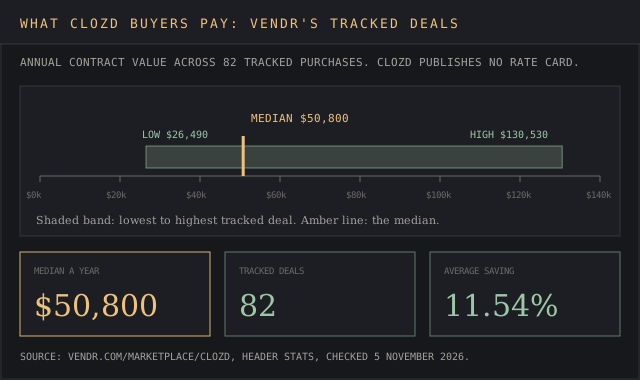
Clozd pricing comes as a quote, and the median buyer signs for $50,800 a year across 82 deals tracked by Vendr. Tracked deals range from $26,490 to $130,530. Clozd prints no rate card on its own site, so that spread is the closest thing to a price list the market has, and par for the course in win-loss research.
This report covers the win-loss analysis vendor's pricing structure: the self-service package, the managed service program, enterprise contracts, the per interview unit that sets the total cost, and the hidden costs a first quote leaves out. It's written for sales, product marketing and competitive intelligence teams budgeting for win-loss interviews with buyers.
Those figures matter because Clozd sells two service models on one platform: a managed program its consultants run, and a self-service package your own team runs. The model and the interview count you commit to decide where in the $26,490 to $130,530 range a quote lands.
The numbers Clozd pricing, checked 5 November 2026
Monthly, the median contract works out to about $4,233.
The highest tracked deal, $130,530, runs about 2.6 times the median, so scope moves a Clozd quote further than any discount does.
An 11.54% saving takes about $5,860 off a median contract.
I'll write a 2,500+ word report on the vendor you name, with tracked contract values, service models and quote drivers sourced line by line. Yours to publish, from $200.
How much Clozd costs
Plan on roughly $50,000 a year for a typical Clozd win-loss program.
Vendr reports Clozd figures as annual contracts, and any contract length past one year is a point to negotiate. Its purchase data moved from the $50,100 median our win-loss analysis software ranking recorded on 14 October 2026 to $50,800 by November.
Half of tracked buyers pay less. The cheapest tracked deal, $26,490, buys a small win-loss program for companies with a modest number of deals.
The top of the range is where the money goes. Vendr's highest tracked deal is $130,530, and none of the 82 tracked purchases runs above it, which tells you most companies in its data buy a mid-sized win-loss program on annual contracts.
G2 sends pricing questions back to the vendor too. Its Clozd listing carries a 4.8 rating from 295 reviews. You'll need to read between the lines of the Vendr data and the scope of your own sales motion to arrive at a number before the first call.
Clozd pricing structure: service model, interview volume and platform
Clozd pricing bundles three things in one quote: an interview service, an interview count and access to the Clozd platform. The platform page says software-only plans exist and lists AI interviews, live interviews, workflow automation, a transcription agent, a decision analysis agent and a tagging agent. Clozd pricing for each of them stays off the page.
The work comes in four shapes, set out below from Clozd's own product pages. None of them carries a published price, so Vendr's tracked range is the yardstick for every quote.
Self-service package
On self-service, your team handles outreach, interviews and analysis on the Clozd platform, with the transcription, tagging and decision analysis agents doing the processing. Clozd supplies the software and the method. The quality of the win-loss research rests on your own interviewers, so a self-service buyer pays less labour to Clozd and more hours inside the company.
Ask the rep for the per interview rate in writing. That unit is what scales the bill as the program grows.
Managed service package
The managed program is what Clozd built its name on. Its program page says a program manager, a senior director and an associate consultant run each account, described as "MBA-level experts". They design the interview guide, build contact lists, send outreach, conduct win-loss interviews with buyers, tag decision factors and present reports and insights.
Three named roles per account is the labour a managed quote pays for. The program page names consultants with 1,500, 2,000 and 3,000 interviews each behind them.
Enterprise package
Enterprise agreements cover several business units, regions or product lines, often with churn and onboarding interviews added to the win-loss work. Clozd quotes them individually. The highest Clozd contract on Vendr's record is $130,530, so a quote above that sits outside anything its 82 tracked buyers paid.
AI interviews and the software-only plan
Clozd's AI interviews, also called Flex Interviews, run through an AI interviewer that the platform page says "listens to every response and asks relevant follow-ups." The same page says AI-powered interviews can run inside one program alongside live interviews. That mix lets buyers put live calls on high value deals and AI interviews on the long tail.
The software-only plan is quoted separately, and Clozd publishes no per-seat or per-interview price for the AI interviewer. The help center's integrations section lists Salesforce, HubSpot, Microsoft Dynamics, Salesloft, Chorus, Gong, Slack, an MCP server and the Clozd API, so connecting your CRM shouldn't add a separate product line.
What drives a Clozd quote
Expected interview volume sets most of the Clozd pricing. Clozd, Hindsight and User Intuition all describe the bill in interviews, so the count you commit to is the first line to settle.
Four other levers move a quote:
- Service model: managed service or self-service, which decides who carries the interviewing labour.
- Interview format: live interviews with a consultant or the AI interviewer on the platform.
- Scope: win-loss analysis only, or churn, onboarding and market research programs as well.
- Contract length: Vendr records Clozd deals as annual contracts, so a multi-year term is a separate negotiation.
Clozd's per interview pricing also explains the competitor attacks. Hindsight's comparison page says "Clozd charges per interview" and that interviews priced one at a time keep coverage under 5% of deals. That's a rival's marketing claim with no cited source, but the logic holds: a team closing 400 deals a quarter pays for 400 interviews to cover every deal, and a per interview contract bills each one.
Copy these lines into an email, fill them in and send. I reply with scope and a price within 2 to 3 business days.
Open the emailHidden costs and additional fees
Five charges sit outside the interview bundle, and the devil's in the details on every one. Ask for each as its own line in the quote:
- Onboarding and implementation: a one-time fee for setup and for training your users.
- Overage: interviews beyond the contracted count, billed per interview. Get the overage rate on the order form.
- Unused interviews: ask if interviews you don't run roll into the next period or expire.
- Renewal increases: get the year-two price, or a written cap on it, before you sign.
- Integrations: confirm which of the CRM, call recording and Slack connections come in the base contract.
Unused interviews are the charge that matters most for a lean budget. Buyers decline interviews, and a G2 reviewer in computer networking wrote that "the only downside is that sometimes customers opt not to participate." Every interview a buyer declines is one you've paid for. Plan the expected interview volume from your real response-rate data, and keep an eye on it each quarter.
Internal ownership is the one cost no vendor quotes, and it still matters to the budget. Self-service moves outreach, scheduling and analysis onto your team, and a managed service program still needs someone in sales enablement or product marketing to turn reports into changes. Without that owner the reports sit on a shelf, and the program pays for itself on paper only.
How to negotiate Clozd pricing
Vendr records an average saving of 11.54% against Clozd's opening quote across its tracked deals. Treat it as the floor of the ask, since it's what the average tracked buyer already got.
- Commit to a realistic interview count. The count sets the bill, and a lower number you'll hit beats a higher one you'll miss.
- Price self-service against managed service, and judge interview quality on a sample before choosing.
- Ask for a multi-year term with renewal increases capped in writing.
- Fix the overage rate up front, and ask for unused interviews to roll into the next quarter.
- Bring outside quotes. A quote from Klue, Corporate Visions or a vendor of AI-moderated interviews gives the sales rep a reason to move.
Cut to the chase on scope in the first call. A sales rep can only price what buyers tell them, and a team that arrives with its closed deal count, response rate and target interview volume gets a quote it can compare line by line with other vendors.
What G2 reviewers say about cost and value
Clozd buyers rarely print a dollar figure in reviews, but pricing comes up often in the dislikes. A Director of Market Intelligence at a mid-market company put it in seven words on G2 in October 2023: "Pricing is high, but there is strong value."
The cost shapes how buyers use the product and which deals get interviewed. A mid-market reviewer, Manny L., wrote in January 2024:
"they can be a little expensive so we need to be selective on the accounts that we interview"
G2 review, mid-market company, January 2024 (source)
A verified reviewer in IT services gave the advice most finance buyers would want to hear before signing:
"It's a significant investment so work with the team on ways to prove the value and ROI."
G2 review, verified user in information technology and services, December 2023 (source)
The same reviewer wrote that "The cost is comparable to other vendors." Interview volume is the other matter reviewers raise. Kaden P. wrote in April 2024, "I wish we could get more responses and feedback throughout the year." An Enterprise program manager for customer insights flagged speed: "At times there can be a lag between the interview and transcribing service."
Interview quality and the depth of research draw the praise, which matters most at enterprise scale. Meredith A. wrote that Clozd "has provided us very valuable feedback and quick turnaround with interviews." A reviewer on Gartner Peer Insights in September 2026 named the limit of that depth: "Level of depth of findings, especially in more technical products."
What a win-loss analysis program delivers for the price
The interview fees buy research, and the research buys one answer: why you win and lose. Clozd's guide frames win-loss analysis as direct buyer feedback collected after each closed deal, won or lost, and its program page lists what that means in practice. Setup covers a project plan, an interview guide and target-audience selection, so the scope is fixed before the first call goes out.
After setup, the work runs in four stages:
- Outreach: contact lists, email sequences and scheduling, with participant incentives paid out of the program.
- Interviews: recorded and transcribed in real time, live or AI-led.
- Analysis: tagging of positive and negative decision factors, plus AI that groups Decision Drivers, themes, quotes and summaries.
- Delivery: insights, reports and dashboards shared through Slack, Teams, the CRM or email.
Quality depends on the buyer as much as the vendor. A G2 reviewer in retail wrote that "the feedback we get is really dependent on the quality of the interviewee and how real an opportunity was." Research data from a buyer who never took the deal seriously won't move a win rate on future deals, whatever the program costs.
The outcome Clozd sells is win-loss insight at the deal level, joined to CRM data, so a team can sort insights by competitor, segment or rep. Commissioned buyer research outside a win-loss platform is priced differently, and our market research cost report breaks down those agency fees. Win-loss programs that run for years build the deepest data set and the clearest win rate trend, and Clozd's own research ties program age to results.
ROI figures Clozd publishes for win-loss programs
Clozd sells the price against win rate gains for sales and product teams, and its win-loss analysis guide carries the numbers it leans on. Most come from the 2025 State of Win-Loss Analysis report, run by Clozd with The Alliance, so they're the vendor's own research:
- 63% of companies with win-loss programs increased their win rates.
- 85% of ongoing win-loss programs report a positive ROI.
- 84% of win-loss programs running two years or longer report sustained win rate growth.
- 97% of companies with a program plan to maintain or increase the investment.
The guide also quotes Todd Berkowitz, a Research VP at Gartner, on a 15% to 30% increase in revenue from win-loss analysis. And it claims 85% of the loss reasons in your CRM are wrong, because buyer and seller reasons align only 15% of the time.
Take those as a vendor's research, then test the strategy against your own sales data. A team closing $10 million in new business a year needs about 0.51% more of it, $50,800, to cover a median contract. Clozd ties each interview and its data to a closed deal in Salesforce or HubSpot, so you can track win rate by competitor before and after a change in deals of every size.
Who Clozd is priced for
Clozd fits mid-market and enterprise B2B companies running win-loss programs on a long sales cycle, deals worth five or six figures and enough lost deals each quarter to fill an interview plan. Mid-market companies with 51 to 1,000 employees write most of the G2 reviews quoted here.
It's a weak fit for a startup closing a handful of deals. At $26,490, the cheapest tracked contract, a team with 80 closed deals a year would spend about $331 per deal on win-loss analysis before any participant payments. At that volume a managed program would cost an arm and a leg for each insight it returns.
Most teams that buy Clozd want one of three outcomes from their win-loss insights: sales leadership wants decision criteria from lost deals, product wants insights on feature gaps ranked by revenue, and the C suite wants a number for competitive positioning. Getting all three groups on the same page before the purchase decides who owns the reports and the strategy that follows them.
Teams that already pay for a CI platform can set the two budgets side by side with our competitive intelligence pricing report.
Clozd against competitive alternatives
Clozd's median sits $4,559 below Gong's, a small difference, and well above Klue's and Corporate Visions'. The table compares the pricing each vendor or Vendr publishes, with Vendr medians covering each vendor's whole contract.
| Vendor | Price on record | Source | How it captures win-loss data |
|---|---|---|---|
| Clozd | $50,800* median a year, 82 deals | Vendr | Live and AI buyer interviews, managed or self-service |
| Gong | $55,359* median a year, 1,145 deals | Vendr | Seller-side call recordings against CRM outcomes |
| Klue | $30,000* median a year, 106 deals | Vendr | Human and AI buyer interviews alongside battlecards |
| Corporate Visions (TruVoice) | $25,000* median a year, all products | Vendr | Deal-triggered surveys plus interviews |
| User Intuition | $2,499 a month for 100 voice interviews; $30 per voice interview pay-as-you-go | User Intuition | Self-serve AI-moderated interviews |
- The vendors to compare, e.g. Clozd, Klue, Gong and Corporate Visions
- Regions, years and segments
- Where it runs: blog, white-label, gated or lead magnet
- Whose byline goes on it
- Deadline
- 2,500+ words, human-written
- Every figure linked to its source
- Yours to publish, under your name or none
- Hosting here for +$200, with your sponsored links
* Vendr median annual contract value from tracked purchases. User Intuition figures are its own list prices.
The biggest difference between these win-loss vendors comes down to who talks to the buyer. Gong reads your own reps' calls, so it hears the buyer only on recorded sales calls; our Gong pricing report breaks down its seat and platform fees, and the revenue intelligence pricing report sets it against its category.
Klue's pricing bundles win-loss with competitive intelligence battlecards, which suits a team already running Klue, and our Crayon vs Klue comparison covers that battlecard side.
User Intuition is the price floor. Its published rate is $30 per voice interview on the pay-as-you-go Starter plan and about $25 on the $2,499-a-month Professional plan, which comes to $29,988 a year. Its Clozd comparison says it returns results in 24 hours. Hindsight lists Clozd's time to insight as 60 to 90 days, a competitor's figure with no source attached.
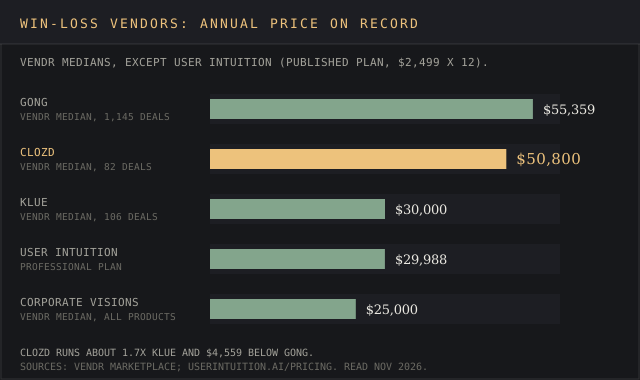
The choice depends on what your win-loss analysis needs to hear and at what scale. A team that needs ongoing continuous learning from every closed deal at low cost per interview will look at AI tools first. A team that needs a consultant to probe a C suite buyer on a lost deal is paying for the managed program, and the cost effective option is the one that answers the question.
What to budget for a first year
Start from the median and price the extras as separate lines. A first-year budget for a mid-sized program covers:
- Base contract: $50,800, Vendr's tracked median.
- Onboarding: a one-time fee, quoted by Clozd.
- Overage: the per interview rate for anything past the contracted count.
- Integrations outside the base contract, if any.
- Internal time: one owner on your sales team or in product marketing, part time.
Buyers planning a managed program well above 100 interviews should test their quote against Vendr's $130,530 tracked ceiling, and keep an eye on the interview count they commit to. Expect the cost to scale with that count, and the win rate outcome to decide if it was worth it.
Delivered for your site and your byline. Hosting here is optional.
Frequently asked questions
What does Clozd do?
Clozd runs win-loss interviews with buyers after a deal closes, either through its own consultants or through the AI interviewer on its platform, then turns the answers into insights on why you win and lose. Its program page says the team has done more than 50,000 interviews, and the platform also covers churn, onboarding and market research programs.
What is win loss?
Win-loss analysis is the practice of asking buyers why they chose or rejected you, then using the answers to change sales, product and pricing strategy. The business outcome is a higher win rate on future deals. Clozd's guide defines it around direct buyer feedback on a closed deal, won or lost, and reports that 63% of companies running a program raised their win rate.
How much does Clozd cost?
Vendr's median across annual contracts is $50,800, from 82 tracked deals, with tracked deals between $26,490 and $130,530. Clozd publishes no rate card, and buyers in Vendr's data saved 11.54% on average against the opening quote.
Does Clozd publish transparent pricing?
No. Clozd's site lists no transparent pricing for any package, and G2 sends pricing questions back to the vendor, so clarity on cost comes from Vendr's tracked purchase data.
Bottom line
Clozd pricing is an interview count wrapped in a service model, sold to buyers who want to know why they win and lose. The median buyer pays $50,800 a year on Vendr's data, and no tracked buyer paid more than $130,530.
Bite the bullet on the interview count first: pick a number you'll hit, price self-service against managed service, and lock overage and renewal caps before you sign. The 11.54% average saving is the floor for what a prepared buyer should ask for.
Buyers who need consultant-led insights on high value lost deals will find Clozd priced about where Gong is. Buyers who need win-loss data on more deals at low cost per interview have cheaper competitive alternatives at $30 an interview, and the difference between the two is depth of research against coverage of deals.
Win-loss vendors, research agencies and enablement teams use reports like this one in budget reviews and vendor calls.
A report on your topic for a blog page, gated content or a lead magnet.
Written for your client and published under their brand, with my name left off.
Your report on marketintelligencetools.com, with 2 to 3 CTAs carrying your sponsored links.
Default terms: the report is yours to publish, and I keep the right to republish it on this site behind a gate, outside Google's index.
Where the Clozd numbers came from, and the prices Clozd keeps to its sales calls
The median, purchase count, low and high deal and average saving are the header figures on vendr.com/marketplace/clozd, checked 5 November 2026; the 14 October 2026 median comes from our own ranking's earlier read of the same page.
Gong, Klue and Corporate Visions medians are the header figures on their Vendr marketplace pages. Service roles, interview counts and platform features come from clozd.com/product/program and clozd.com/product/platform; integrations from help.clozd.com; ROI percentages from clozd.com/guides/win-loss-analysis, which cites the 2025 State of Win-Loss Analysis report Clozd ran with The Alliance.
Reviewer quotes come from g2.com and gartner.com. Competitor claims come from usehindsight.com and userintuition.ai, and are labelled as theirs.
Clozd publishes no list price, no per interview rate, no price for the AI interviewer and no onboarding fee, so none of those appears here as a number.