Deepfake statistics 2026: 8 million deepfakes shared, $893 million in FBI-logged losses
 By Jan Suski. I go deep on every review, checking every number against its source and digging up details other coverage misses, a habit from six years of SEO and link building for tech companies. Bylines at Brand24 and Senuto. How the scoring works.
The numbers Deepfake fraud and detection, checked 19 November 2026
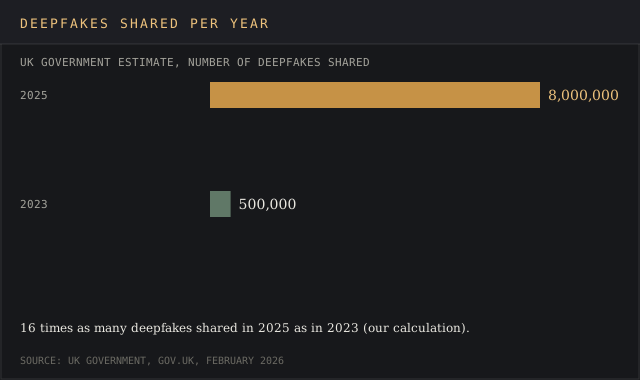
The UK estimate implies a 16-fold rise in deepfake content shared over two years (our calculation), faster than any loss figure has grown.
Reported losses still sit in the hundreds of millions, while Deloitte projects tens of billions, because the FBI counts only complaints that mention AI and Deloitte models all generative AI fraud.
With 62% of organizations attacked and 0.1% of people able to spot every fake, human judgment can't be the control that stops deepfake fraud.
Security, identity and fraud vendors quote deepfake numbers in every pitch. Send the industry or the country and I'll source a version you own.
An estimated 8 million deepfakes were shared in 2025, up from 500,000 in 2023, according to UK government figures. In the United States, the FBI's Internet Crime Complaint Center logged 22,364 complaints with an AI link and $893 million in losses in 2025, the first year it counted AI-related fraud on its own.
This report collects deepfake statistics on artificial intelligence fraud and synthetic media from the bodies that measured them: government agencies, the FBI, Gartner, Deloitte, Ballotpedia and the vendors whose own data is the only source, each named next to its number.
It covers how many deepfakes exist, deepfake fraud losses, deepfake attacks on companies and financial institutions, deepfake content online, voice cloning, identity verification, human detection and deepfake legislation.
It's for security teams, finance leaders, fraud analysts and reporters. Deepfake statistics circulate without sources more than almost any other topic, so every figure below names its publisher and date, and recycled figures we couldn't trace to a study are left out.
How many deepfakes exist: deepfake statistics on volume
No registry counts deepfakes, so the jury's still out on the true volume and every figure is an estimate. The UK government's 8 million for 2025 is the most quoted, and it's a government projection first published in a 2025 case study by the Home Office's Accelerated Capability Environment, per Biometric Update. The same figure reappeared in the February 2026 announcement of a deepfake detection framework built with Microsoft.
Incident trackers count far fewer cases because they only log deepfake incidents that reach the news. Resemble AI's 2025 Deepfake Threat Report verified 1,567 unique incidents in 2025 with more than $1.28 billion in documented fraud losses. Surfshark's dataset counted 580 deepfake incidents in the first half of 2025, almost four times the whole of 2024.
Phone channels show the same curve. Pindrop's 2025 Voice Intelligence and Security Report, based on more than 1.2 billion customer calls, found deepfake fraud attempts rose 1,300% in 2024, from about one a month to seven a day.
Copy these lines into an email, fill them in and send. I reply with scope and a price within 2 to 3 business days.
Open the emailAI deepfake technology also got cheap, and deepfake tech is easy to reach. Creating a convincing deepfake no longer needs a studio or special deepfake technology skills. In McAfee's research, three seconds of audio produced an AI generated voice, a cloned voice with an 85% match to the original. That's how much audio a voicemail greeting or a short social clip holds, and it explains why deepfake creation has moved from novelty to a mainstream attack vector.
Deepfake fraud losses: four estimates that disagree
Deepfake fraud losses depend on who is counting and how, and deepfake statistics on money are the least settled of all. The four main figures for 2025 below range from $893 million to $1.65 billion, and none of them is a full census. The devil's in the details of each method.
| Estimate | What it counts | Scope | Publisher |
|---|---|---|---|
| $893 million | Losses in IC3 complaints where the victim mentioned AI | US, 2025 | FBI IC3 |
| $1.1 billion | Deepfake-related fraud and scam losses from public incident data | Worldwide, 2025, January 2026 count | Surfshark |
| $1.28 billion | Documented fraud losses in 1,567 verified incidents | Worldwide, 2025 | Resemble AI |
| $1.65 billion | Deepfake fraud and scam losses, revised dataset | Worldwide, 2025, April 2026 count | Surfshark |
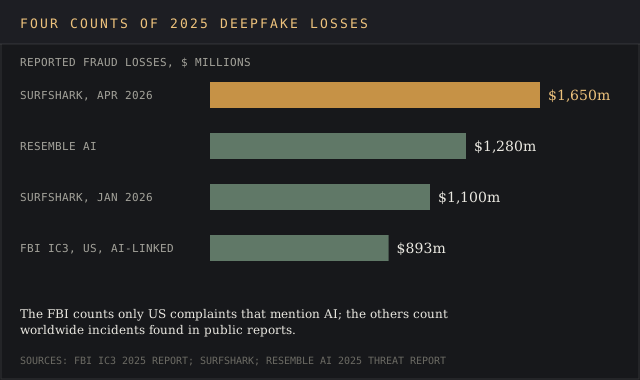
The FBI number is the floor. IC3 analysts tagged a complaint as AI-related only when the filer mentioned AI, so many deepfake scams sit in other fraud categories. Total IC3 losses reached $20.877 billion across 1,008,597 complaints in 2025, so AI-tagged losses were about 4.3% of the total (our calculation).
Surfshark's counts come from the AI Incident Database and Resemble AI's tracker. Its January 2026 study put 2025 losses at $1.1 billion, tripling from $360 million in 2024, with celebrity impersonation in fake investment pitches making up 80% of losses. Its April 2026 update raised 2025 to $1.65 billion and put US losses across its dataset at $712 million, the most of any country.
Projections run far higher. Deloitte's Center for Financial Services expects fraud losses enabled by generative AI to reach $40 billion in the US by 2027, up from $12.3 billion in 2023, a 32% annual growth rate. That covers all generative AI fraud, deepfake fraud incidents included, and it's a forecast.
Deepfake attacks on companies and company executives
Deepfake attacks have become routine for large companies, and they're no flash in the pan for deepfake fraud teams. In a Gartner survey of 302 cybersecurity leaders fielded from March to May 2025, 62% said their organization had faced at least one deepfake attack in the prior 12 months that involved social engineering or exploited automated processes.
Gartner's September 2025 note to CIOs added that 43% reported at least one deepfake incident on an audio call and 37% on a video call.
Business leaders expect the deepfake threat and AI deepfake attacks to cost them. In a 2024 Gartner survey of 456 CEOs and senior executives, 62% said deepfakes will create at least some operating costs and complications in the next three years.
The Arup Hong Kong incident is the case every finance team now studies. In early 2024, an employee in the engineering firm's Hong Kong office joined a video conference with what looked and sounded like the company's CFO and other colleagues. Every other face on the call was fake, built with deepfake technology. The employee made 15 transfers totaling HK$200 million, about $25.6 million, before checking with head office.
Corporate deepfakes and the deepfake attacks behind them target the payment process more than the IT stack. Surfshark's April 2026 data puts corporate attacks, such as fake CEOs requesting transfers, at 25% of all reported deepfake fraud losses, second only to investment scams at 52%.
Businesses that encountered synthetic identity fraud and deepfake voice or video
Identity verification firm Regula surveyed more than 1,000 fraud prevention experts across several countries. Some 46% of organizations had encountered synthetic identity fraud in the past year, 37% had faced voice deepfakes and 29% video deepfakes, per Security Journal Americas. In banking, 49% had recently come across synthetic identity fraud.
| Attack type | Share of organizations hit | Source |
|---|---|---|
| Any deepfake attack, past 12 months | 62% | Gartner, 2025 |
| Synthetic identity fraud, past year | 46% | Regula |
| Deepfake on an audio call | 43% | Gartner, 2025 |
| Voice deepfakes | 37% | Regula |
| Deepfake on a video call | 37% | Gartner, 2025 |
| Video deepfakes | 29% | Regula |
- The industry, region or attack type to cover
- Regions, years and segments
- Where it runs: blog, white-label, gated or lead magnet
- Whose byline goes on it
- Deadline
- 2,500+ words, human-written
- Every figure linked to its source
- Yours to publish, under your name or none
- Hosting here for +$200, with your sponsored links
Synthetic identity fraud mixes real and fake details, such as a real name with a fake Social Security number, and AI generated deepfakes fill the gaps, so the synthetic media makes the fake part look real. Deepfake enabled fraud and older schemes now overlap: Regula's 2025 survey found deepfakes hit businesses about as often as identity spoofing and biometric fraud, each around a third.
Deepfake fraud at financial institutions
Banks, insurers and payment firms are the main targets of deepfake related fraud because they move money on the strength of a voice, a face or a document. Deloitte's Center for Financial Services expects generative AI to drive US fraud losses to $40 billion by 2027, and estimates that generative AI email fraud alone could reach about $11.5 billion by 2027 under an aggressive adoption scenario.
The data from financial institutions points the same way. Pindrop found synthetic voice attacks on banks rose 149% in 2024, Regula found 49% of banking firms had recently come across synthetic identity fraud, and Entrust found fraud at digital banks and payment firms concentrates at account takeover and log-in, after a customer is already onboarded.
Deloitte hits the nail on the head: AI tools make deepfake videos, synthetic voices and counterfeit documents cheaper and easier for malicious actors to produce. Its report notes deepfake incidents in fintech rose 700% in 2023. For banks, that's a fundamental shift in fraud risk, since controls built on recognizing a customer's voice or face were designed before AI generated voice and video existed.
Deepfake technology also blurs into other financial fraud and raises the fraud risk across every payment channel. The FBI's 2025 report says criminals use AI to create fake profiles, voice recordings and video, so a deepfake fraud incident can show up under business email compromise, romance or investment fraud.
Deepfake content online: who is targeted
Deepfake content online goes well beyond financial fraud, and artificial intelligence makes AI deepfake abuse cheap at any scale. The UK government frames deepfakes first as a threat to women and girls, and its 2026 detection framework tests tools against sexual abuse, fraud and impersonation. Resemble AI found deepfake incidents in 2025 reached a combined audience of 296.4 billion views, about 37 times the global internet population.
Fraud on social media follows celebrities. Surfshark's January 2026 study found impersonation of famous people in fake investment pitches made up 80% of deepfake-related losses in 2025 and 96% of losses on social media platforms, about $886 million, with Facebook first among platforms. These fake videos use AI generated deepfakes of public figures to push crypto and trading schemes, and malicious actors buy ads to spread them.
Politics is the other target. In McAfee research from early 2024, 23% of Americans said they had recently come across a political deepfake they later found was fake. Deepfake images and audio clips of candidates are the reason 33 states now regulate political deepfakes.
The AI tools are a dime a dozen. Generative AI vendors, detection firms among them, let anyone open a free account to generate synthetic voice or video, which is why the deepfake era looks less like a niche crime and more like mass production of fake content.
Voice cloning statistics: deepfake fraud attempts by phone
Voice cloning is the cheapest deepfake to make and the easiest to deliver, and deepfake attacks by phone are where most consumers meet one. McAfee's Artificial Imposter study surveyed 7,054 people in seven countries: one in four had faced an AI voice cloning scam or knew someone who had, one in ten had received a message from a cloned voice, and 77% of those targeted lost money.
The losses add up, and for some victims they're the last straw. Of the people who lost money, 36% lost between $500 and $3,000 and 7% lost between $5,000 and $15,000. McAfee also found 45% would reply to a voicemail from a friend or family member asking for money, and 53% of adults share their voice online at least once a week, which is all the raw material a cloned voice needs.
Contact centers carry the heaviest load of deepfake attacks. Pindrop's analysis of 1.2 billion calls found synthetic voice attacks rose 475% at insurers and 149% at banks in 2024, and Pindrop's April 2025 guide put synthetic audio in 1 in every 106 contact center calls. Pindrop projected deepfaked calls would rise another 155% in 2025.
Pindrop's April 2025 guide put synthetic audio in 1 in every 106 contact center calls, after synthetic voice attacks rose 475% at insurers in 2024.
Contact center calls carrying synthetic audio
Source: Pindrope.g. synthetic voice attempts in your sector
Source: linked, checked, datedA person's voice has become a weak password, the elephant in the room for call centers, so voice alone shouldn't verify a caller. McAfee advises families to agree code words, so a cloned voice asking for money can be challenged.
Deepfake fraud in identity verification
Deepfake attacks now target the selfie checks that banks and crypto exchanges use to open accounts. Entrust's 2026 Identity Fraud Report, based on more than 1 billion identity verifications across 195 countries, found deepfakes were linked to one in five biometric fraud attempts. Deepfaked selfies rose 58% in 2025 and injection attacks, which feed fake video straight into the camera stream, rose 40%.
Real time deepfake tools and other AI generated deepfakes make those deepfake attacks harder to catch, and deepfake detection has to work in seconds. A fraudster can run a face swap on a live video call or a liveness check, so a system built to confirm a live person sees a moving, blinking face that isn't real. iProov's 2024 Threat Intelligence Report counted a 704% increase in face swap attacks.
Crypto and fintech take the lion's share of hits because they onboard customers remotely. Entrust found sectors with sign-up bonuses, such as crypto, saw the highest rates of onboarding fraud, at 67% of fraud attempts.
Can people correctly identify deepfakes? Human detection statistics
Most people can't, and deepfake statistics on human detection are consistent. In iProov's 2025 study of 2,000 UK and US consumers, only 0.1% correctly identified every deepfake and real image and video, even after being told to look for fakes. Participants were 36% less likely to spot a deepfake video than a fake image, and over 60% were confident in their answers anyway.
Awareness is patchy, a red flag for older users. Some 22% of iProov's participants had never heard of deepfakes, rising to 30% of 55 to 64 year olds and 39% of those 65 and over. Only 11% critically analyze the source and context of content to judge if it's fake, and 74% worry about the societal impact of deepfakes.
Lab studies find human detection near chance. A July 2025 World Economic Forum article by Reality Defender's CEO cites a Nature study putting human accuracy at 55% to 60%, and Washington Post reporting that automated detection tools lose 45 to 50 percentage points of accuracy on real-world deepfakes compared with lab tests.
That's the detection gap. Deepfake detection technology improves, deepfake creation improves faster, and the detection arms race gives companies a false sense of safety if they rely on a tool alone. The World Economic Forum piece puts it plainly: verification protocols that synthetic media can't compromise are becoming standard practice, and verification protocols are now the main deepfake detection layer at many firms.
Deepfake legislation: US states, federal law and the EU
States have hit the ground running, and 49 have enacted deepfake legislation of some kind. Ballotpedia's tracker counted 49 states with at least one deepfake law by July 2026. Forty-eight states have enacted laws on sexually explicit deepfakes, up from 45 a year earlier, and 33 regulate political deepfakes. Ballotpedia found 87% of state deepfake laws were enacted in 2024 or later.
| Law or rule | What it does | Date |
|---|---|---|
| State deepfake laws | 49 states with at least one law; 48 on sexually explicit deepfakes; 33 on political deepfakes | July 2026 (Ballotpedia) |
| TAKE IT DOWN Act | Platforms must remove non-consensual intimate images, AI generated ones included, within 48 hours of a valid request | Signed May 19, 2025; platform duties from May 19, 2026 |
| EU AI Act, Article 50 | Requires AI generated content, deepfakes included, to be disclosed and machine-readable as AI generated | Applies from August 2, 2026 |
| UK criminal offense | Creating or requesting non-consensual intimate deepfakes of adults | In force 2026 |
The federal TAKE IT DOWN Act is the first US law aimed at deepfake abuse. It criminalizes publishing non-consensual intimate images, real or AI generated, and requires covered platforms to remove them within 48 hours of a valid request. The Federal Trade Commission enforces the platform duties, which took effect on May 19, 2026.
In Europe, Article 50 of the EU AI Act (Regulation 2024/1689) sets transparency duties for AI generated content and deepfakes from August 2, 2026. The EU and US approaches differ: Europe labels AI generated content at the source, while US law targets specific harms after the fact.
Deepfake risks for business: what companies do about them
Deepfake risks, deepfake fraud and the wider deepfake threat hit finance teams first, because a convincing deepfake of a company's CFO on a live video call can move money in minutes.
The path forward is process: a call-back on a known number for any payment request made by video or voice, and a second approval for large transfers. Arup's employee had fallen victim before anyone called head office, and other staff who have fallen victim to a deepfake video call report the same pressure to act fast.
Other fraud controls still cut the mustard. Multi factor authentication, out-of-band confirmation and code words for executives cut the value of a cloned voice. Training helps people slow down, though iProov's data shows training alone won't make people correctly identify fakes.
Company leaders need to treat deepfake scams as one of the evolving cyber risks that touch payments, hiring and customer onboarding. Gartner's 2025 data shows deepfake attacks on audio and video calls at more than a third of organizations, so handling deepfake attacks belongs in incident response plans alongside phishing and other evolving cyber risks such as ransomware.
Delivered for your site and your byline. Hosting here is optional.
Frequently asked questions
What are the statistics on the use of deepfakes?
The UK government estimates 8 million deepfakes were shared in 2025, up from 500,000 in 2023. Gartner found 62% of organizations faced a deepfake attack in the past 12 months, and the FBI logged $893 million in losses in AI-related complaints in 2025.
In what states are deepfakes illegal?
No state bans deepfakes outright. By July 2026, 49 states had at least one deepfake law, 48 restrict sexually explicit deepfakes and 33 regulate political deepfakes, per Ballotpedia. The laws target specific harms such as non-consensual imagery, election deception and fraud.
Are deepfakes legal or illegal?
Making a deepfake isn't illegal in itself in the US. Using one for non-consensual intimate imagery, fraud or some election communications is illegal under state laws and, for intimate images, the federal TAKE IT DOWN Act.
Can you spot a deep fake?
Rarely, and deepfake video is the hardest. Only 0.1% of people in iProov's 2025 test identified every deepfake and real item correctly, so few people correctly identify a deepfake video every time, and people were 36% less likely to spot fake video deepfakes than fake deepfake images.
What is the 3 finger test for AI?
It's an informal check for real time deepfake video: ask the person on a video call to hold up three fingers or wave a hand across their face, since some face-swap tools glitch when hands cover the face. We found no published study measuring how often it works, so treat it as a prompt to verify by another channel.
What are the statistics on AI-generated misinformation?
In McAfee research from early 2024 with 7,000 people, 23% of Americans said they had recently come across a political deepfake they later found was fake. Thirty-three states now regulate political deepfakes, per Ballotpedia.
Bottom line
Deepfake statistics agree on direction and disagree on size, and the deepfake fraud trend points up in every dataset. The UK estimates 8 million deepfakes shared in 2025, 62% of organizations faced deepfake attacks, and reported deepfake fraud losses for 2025 run from $893 million to $1.65 billion depending on the counter.
People can't be the defense against deepfake video or audio: 0.1% spotted every fake in iProov's test, and more than half of people were confident anyway. The controls that work are process controls, such as call-backs, second approvals and code words, backed by detection tools.
Regulation is getting up to speed. Forty-nine states have deepfake laws, the TAKE IT DOWN Act's platform duties began in May 2026, and the EU AI Act's labeling rules apply from August 2026.
Identity vendors, banks and security consultancies publish reports like this one as lead magnets and client briefs.
A report on your topic for a blog page, gated content or a lead magnet.
Written for your client and published under their brand, with my name left off.
Your report on marketintelligencetools.com, with 2 to 3 CTAs carrying your sponsored links.
Default terms: the report is yours to publish, and I keep the right to republish it on this site behind a gate, outside Google's index.
The agencies, surveys and incident trackers behind each deepfake figure, and the count nobody keeps
Government and law: gov.uk (deepfake detection framework, February 2026), biometricupdate.com (UK figure's origin, February 2025), pymnts.com (FBI IC3 2025 report coverage), news.ballotpedia.org (state deepfake laws, 30 July 2026) and lw.com (TAKE IT DOWN Act, May 2025).
Research houses and surveys: gartner.com (22 September 2025 survey release and 2 September 2025 CIO note), deloitte.com (Center for Financial Services deepfake banking fraud report), weforum.org (July 2025), securityjournalamericas.com (Regula survey) and scmp.com (Arup case, May 2024).
Vendor data, quoted as the only source for its measure: entrust.com (2026 Identity Fraud Report), businesswire.com (iProov study, February 2025), resemble.ai (2025 Deepfake Threat Report), surfshark.com (January and April 2026 datasets) and speechtechmag.com (Pindrop 2025 report). All figures checked 19 November 2026. No agency counts deepfakes created or shared, so every volume figure above is an estimate or an incident tally.