Banking stats 2026: 94% of US adults banked, 44% bank mostly by app
 By Jan Suski. I go deep on every review, checking every number against its source and digging up details other coverage misses, a habit from six years of SEO and link building for tech companies. Bylines at Brand24 and Senuto. How the scoring works.
The numbers US and global banking, checked 19 November 2026
The FDIC's 48.3% and the ABA's 44% measure different things, households by primary access method and consumers by most-used method, yet both put mobile apps first.
Six percent of adults and 4.2% of households are unbanked, so roughly 5.6 million households still run their money outside the banking system.
US banks earned $90.1 billion in a single quarter, close to a fourteenth of the $1.3 trillion McKinsey counts for global banking in all of 2025.
I'll write a 2,500+ word report on the market you name, with regulator data, survey figures and filings linked to their sources. Yours to publish, from $200.
Ninety-four percent of US adults had a bank account in 2025, according to the Federal Reserve's household survey, and 44% of consumers managed their banking mostly through a mobile banking app in the past year, per an October 2026 American Bankers Association survey. FDIC-insured institutions earned $90.1 billion in the April to June period of 2026.
This report gathers banking statistics and data from the bodies that publish them: the FDIC, the Federal Reserve, the National Credit Union Administration, the World Bank and the American Bankers Association, plus McKinsey and Bankrate where they're the only source. It covers mobile banking statistics, mobile banking apps, online banking, unbanked and underbanked households, account balances and fees, the size of the US banking industry and global banking.
It's for analysts, bankers, fintech teams and reporters who need a banking figure with its source attached, and for consumers checking how their own accounts compare. Several headline numbers disagree because they count households against adults, or bank charters against holding companies, so each one below names its publisher and scope.
These numbers matter because they show where customers bank, who is left out and how much the industry earns, which is what banks, fintechs and investors use to size demand for digital banking services and to price deposits.
Mobile banking statistics: how Americans manage their accounts
Mobile banking has been the top banking channel in the ABA's survey for seven years running, so it's no flash in the pan. In the October 2026 poll of 4,402 adults, 44% said they used a mobile banking app most often to manage their accounts in the past year, against 20% online on a laptop or PC and 10% at branches.
| Method used most often | All consumers | Gen Z | Millennials | Gen X | Baby boomers |
|---|---|---|---|---|---|
| Mobile app | 44% | 54% | 54% | 40% | 32% |
| Online (laptop or PC) | 20% | 10% | 13% | 20% | 34% |
| Branch | 10% | 4% | 6% | 11% | 18% |
| ATM | 6% | 4% | 9% | 6% | 3% |
| Telephone | 6% | 6% | 5% | 8% | 6% |
Copy these lines into an email, fill them in and send. I reply with scope and a price within 2 to 3 business days.
Open the email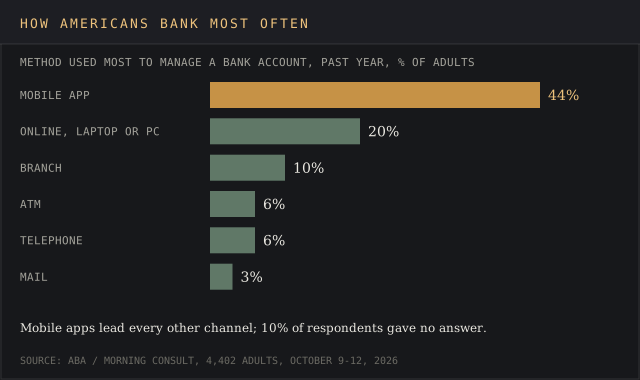
App adoption is strongest among younger generations: 54% of Gen Z and millennials used a mobile banking app most often, against 32% of baby boomers, who still favor online banking at 34%. Boomers are the only generation where branches reach 18%.
The ABA number swings year to year. It read 26% for mobile in 2017, its first year, and 55% in October 2024, a record, before the 2026 poll added a 10% "don't know" option. Read between the lines and track the trend over several years, keeping in mind that small changes in a survey's questions move the headline.
The FDIC measures the same shift through households. In its 2023 National Survey of Unbanked and Underbanked Households, 48.3% of banked households used mobile banking as their primary method of account access. Over the past decade, mobile banking as the primary method rose almost ninefold, while bank teller use fell by more than half and online banking dropped by more than a third.
Consumers rate their mobile banking apps well. In the 2026 ABA survey, 95% of account holders gave their bank's online and mobile app experience one of the top three grades on a five-point scale, and 75% agreed that innovation and technology make financial services easier to access.
Online banking statistics: computer, branch and ATM use
Online banking on a PC is the second banking channel and shrinking, as more consumers move their finances to the phone. The ABA's 20% for laptop or PC banking in 2026 compares with 27% in its October 2022 survey. The FDIC's household data shows the same slide, with online banking as the primary method down by more than a third over a decade.
Branches hold a small but steady share of banking activity, far from dead in the water. Ten percent of consumers used branches most often in 2026, and the share stays highest among baby boomers. ATM banking sits at 6%, and out-of-network ATM use costs more every year: Bankrate's 2025 Checking Account and ATM Fee Study put the average total at a record $4.86, a $3.22 surcharge plus a $1.64 fee from the customer's own bank.
Mobile banking applications now handle most routine tasks a branch once did: checking a balance, depositing a check by photo, paying bills, moving funds between accounts and sending money to other people.
Bank apps sit beside wallets such as Apple Pay and Google Pay, and most banks publish their apps on the App Store and Google Play. Each mobile banking app adds features, but the core list of banking services is the same at nearly every bank, and debit card controls and payments sit at the top of it.
Mobile banking apps: users, features and security
Mobile banking apps have become the default front door to banking. Seven in ten Americans used a mobile device to manage their accounts at least once a month in an ABA survey reported in December 2024, and 46% of users did so more than three times a month, per the Oklahoma Bankers Association's summary.
The same survey found 29% of adults used a mobile app for transactions such as paying someone or transferring money in the past year, rising to 44% among 18 to 34 year olds.
Users of mobile banking apps expect the same core features everywhere: real-time balances, mobile check deposit, bill pay to settle bills, transfers between accounts and card controls that let users lock a debit card from the app or set debit spending alerts. Banks also push alerts on large transactions, which turns the app into a first line of fraud control for consumers and business account holders.
Security is where banks can't cut corners. ABA President Rob Nichols said in the 2026 release that mobile banking pairs easy access with biometric and two-factor authentication. The risk sits on the user side too: in the World Bank's Findex data, only about half of the 4 billion adults in low- and middle-income economies who own a phone protect it with a password.
App users don't split cleanly by age, and the distribution of use across generations is narrowing. Mobile banking apps lead among users in Gen Z, millennials and Gen X in the ABA's 2026 data, and 32% of baby boomers now bank mostly by app, close to the 34% who bank mostly online. For banks and credit unions, mobile banking apps are now where most customers see their brand each week, compared with a branch they may visit a few times a year.
For anyone sizing the market for mobile banking statistics and app users, the useful split is primary channel, frequency of use and the services used inside the app. Payments, transfers and bill pay are the transactions most users open the app for, and digital wallets such as Apple Pay and Google Pay are where many mobile banking users now pay at the checkout.
Unbanked and underbanked households
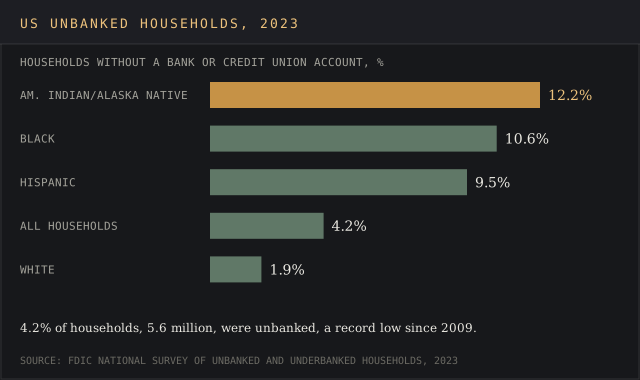
The FDIC's biennial survey with the Census Bureau is the main source on unbanked and underbanked households. In 2023, 4.2% of US households, or 5.6 million, had no bank or credit union account, the lowest rate since the survey began in 2009 and down from 8.2% in 2011. Another 14.2% of households, 19.0 million, were underbanked: they had an account but also used nonbank services such as check cashers or money orders.
| Household group | Unbanked rate, 2023 |
|---|---|
| All households | 4.2% |
| White | 1.9% |
| Hispanic | 9.5% |
| Black | 10.6% |
| American Indian or Alaska Native | 12.2% |
Want an access-gap chart like this for your own region? Send the country and the groups.
Email a briefUnbanked households run their money and financial transactions mostly in cash, outside bank accounts. The FDIC found 66.2% of unbanked households relied entirely on cash or other physical currency, while 33.8% used prepaid cards or nonbank services such as PayPal, Venmo or Cash App.
The Fed's SHED counts adults, and its rate runs higher. Six percent of adults were unbanked in 2025, a level that has held since 2021, meaning neither they nor a partner had checking, savings or money market accounts. Income accounts for the lion's share of the gap: 21% of adults in families under $25,000 were unbanked, against 8% at $25,000 to $49,999 and 3% at $50,000 to $99,999. Nearly all adults earning $100,000 or more had an account.
The two surveys aren't at sixes and sevens. The FDIC asks if anyone in a household has an account; the Fed asks about each adult and their spouse or partner. A household rate will always sit below an adult rate when unbanked people live alongside banked ones.
Unbanked adults also turn to other tools, and some use crypto as a substitute currency. The Fed found 6% of unbanked adults used cryptocurrency for transactions, against 2% of banked adults. The FDIC found 4.8% of households owned or used crypto in 2023, and 92.6% of them held it as an investment. On the trading side, Coinbase counted 7.4 million monthly transacting users in Q3 2026, per our Coinbase statistics.
Bank account balances, savings rates and fees
The Federal Reserve's 2025 Survey of Consumer Finances, released October 9, 2026, puts transaction accounts at the center of family finances. Banking statistics from the SCF show 98.7% of families held checking, savings, money market or similar accounts, the most common financial asset in the survey. Among them, the median balance was $8,200 and the mean was $62,900, per IBTimes' reading of the Fed data. The median fell 6% after inflation from 2022.
Compared with the median, the mean is 7.7 times higher (our calculation), because a small share of families hold large cash balances. Stock market participation slipped from 58% to 56% of families between surveys, and median stock holdings among owners rose 36% to $77,400, which suggests wealthier families keep more financial assets in stocks, bonds, other securities and funds.
Savings accounts pay a drop in the bucket at the median bank, which is why consumers with large balances move money to high-yield accounts at online banks and other financial institutions. The FDIC's national rate for savings was 0.39% in early 2026, the figure the FDIC publishes monthly from rates at insured banks. High-yield online accounts pay several times that, so where consumers keep their funds can affect returns more than the size of the deposits.
Fees add insult to injury on the balances in those accounts, and consumers feel it most on checking accounts. Bankrate found the average overdraft fee was $26.77 in 2025, down 1%, and the average nonsufficient funds fee fell to a record low of $16.82. In the Fed's SHED, 17% of bank account holders with family earnings under $25,000 and 20% at $25,000 to $49,999 paid an overdraft fee in the prior year.
Fees drive which accounts consumers choose. In Bankrate's checking account survey, no or low fees was the most important factor for keeping an account, cited by 18.4%, just ahead of "it's the account I've always had" at 18.2%. The average customer kept a brick-and-mortar checking account for 19 years.
FDIC-insured institutions: US banking industry in numbers
The FDIC's Quarterly Banking Profile is the industry's report card. For April to June 2026, it covered 4,238 insured commercial banks and savings banks, which earned net income of $90.1 billion, up 12% from the first three months of the year and 28.7% from a year earlier.
| Measure, Q2 2026 | Value | Source |
|---|---|---|
| Insured banks and savings banks | 4,238 | FDIC |
| Total assets | $26.5 trillion | FDIC, via American Banker |
| Total loans and leases | $13.9 trillion, up 1.8% since March | FDIC |
| Net profit | $90.1 billion | FDIC |
| Return on assets | 1.37% | FDIC |
| Net interest margin | 3.32% | FDIC |
| Banks on the Problem Bank List | 47 | FDIC |
| Deposit Insurance Fund reserve ratio | 1.48% | FDIC |
- The institutions, region or metrics to cover
- Regions, years and segments
- Where it runs: blog, white-label, gated or lead magnet
- Whose byline goes on it
- Deadline
- 2,500+ words, human-written
- Every figure linked to its source
- Yours to publish, under your name or none
- Hosting here for +$200, with your sponsored links
Return on assets of 1.37% was close to the 1.41% record since 1984, FDIC Chairman Travis Hill said at the briefing, per PYMNTS. Domestic deposits grew 0.8% from March to June, the eighth straight quarterly increase, and lending rose 6.8% from a year earlier.
Credit quality is mixed by loan type. The St. Louis Fed's Q2 2026 analysis put delinquency rates at 2.85% for credit cards and 3.71% for auto loans, while net charge-offs eased to 0.57% of average loans. Banks' holdings of investment securities, mostly Treasury and agency bonds, rose 0.4% over the same period.
Bank failures ticked up from a low base. Six US banks failed in 2026 through September, against two in each of 2024 and 2025. The largest, Nano Banc in Irvine, California, had $736 million in assets when it closed on September 25, 2026, and the FDIC estimated a $114 million cost to the Deposit Insurance Fund, per CryptoSlate. All six were small banks, and reading a 2023-style crisis into them would make a mountain out of a molehill.
Credit unions are the other half of the system. The NCUA counted 4,214 federally insured credit unions with 146.1 million members at June 30, 2026, holding total assets of $2.50 trillion, up 5.0% in a year. Any banking figure should say which of the two it covers.
How big is US banking? Four figures that measure it differently
The size of US banking depends on the legal entity counted. Bank charters, holding companies and credit unions file different reports, so their totals don't add up neatly, and the devil's in the details of each scope.
| Figure | What it counts | Date | Publisher |
|---|---|---|---|
| $33.3 trillion | Aggregate assets in the St. Louis Fed's bank analytics, up 8% in a year | Q2 2026 | Federal Reserve Bank of St. Louis |
| $26.5 trillion | Total assets of 4,238 FDIC-insured banks | Q2 2026 | FDIC |
| $5.0 trillion | JPMorganChase, holding company assets | June 30, 2026 | JPMorganChase |
| $4.09 trillion | JPMorgan Chase Bank, N.A., bank charter assets, the Chase consumer bank | June 30, 2026 | CFPB institution list |
The FDIC's $26.5 trillion counts insured banks and savings institutions. The St. Louis Fed's $33.3 trillion, up 2% from the first quarter, is a wider aggregate, so the two shouldn't be mixed in one comparison. Chase shows the same effect at firm level: JPMorganChase reports $5.0 trillion of assets, while its national bank charter holds $4.09 trillion.
Global banking statistics: profits and account ownership
Banks are on a roll, and banking is the most profitable industry in the world. McKinsey's Global Banking Annual Review 2026 puts global bank net income at $1.3 trillion in 2025, up 7% from 2024's record. Revenues before risk costs rose from $6.1 trillion to $6.4 trillion, and the global net interest margin slipped from 1.65% to 1.63% as rates fell in major countries.
McKinsey's Global Banking Annual Review 2026 puts global bank net income at $1.3 trillion in 2025, up 7% from 2024's record.
Global bank net income in 2025
Source: McKinseye.g. bank profitability in your country
Source: linked, checked, datedAccess to financial services keeps widening across countries and economies. The World Bank's Global Findex 2025, built on surveys of more than 145,000 adults in 141 economies during 2024, found 79% of adults worldwide had an account at a bank, similar financial institution or mobile money provider, up from 74% in 2021 and 51% in 2011.
| Global Findex 2025 measure | Value |
|---|---|
| Adults with an account worldwide | 79% |
| Adults with an account, low- and middle-income economies | 75% |
| Adults without an account | 1.3 billion |
| Adults in developing economies saving in a financial account | 40% |
| Adults in developing economies making a digital merchant payment | 42% |
| Women with an account, against men | 77% against 81% |
Mobile money drove much of the growth in low- and middle-income countries, where many adults opened their first financial accounts on a phone. Ten percent of adults in developing economies used a mobile money account to save in 2024, and about 900 million adults without an account own a mobile phone. Among the countries of South Asia, India stands out, with 90% of both men and women holding accounts.
Account ownership still varies widely across countries. In the Middle East and North Africa, 53% of adults held an account in 2024, up from 45% in 2021, while in Sub-Saharan Africa formal saving rose 12 points to 35% of adults. The World Bank's development data covers 141 economies, so comparisons between countries rest on one consistent survey of financial services use.
Cross-border activity between countries is tracked separately, for example by central banks reporting to the BIS. The Bank for International Settlements publishes consolidated banking statistics on banks' claims on borrowers across countries, the standard source for international payments exposure and bank lending between economies.
Banking trends: fraud, fintech and AI
Fraud is now a mainstream banking and financial problem, and Fed research tracks it every year. The Fed's SHED found 20% of adults were hit by financial fraud or scams in 2025, and among adults earning under $50,000 the median loss was $400. Four in ten of those adults couldn't cover a $100 emergency from savings, so even a small loss can be the last straw.
Banks feel the attacks too. In the KPMG 2026 Banking Technology Survey of 200 US banking executives, 76% said their bank saw more cyberattacks over the past year and 92% are raising cybersecurity budgets, per ABA Banking Journal. In the same survey, 80% expect AI to disrupt their business models within three to five years.
Competition for the customer relationship, retail and business alike, is the theme of McKinsey's 2026 review, which names fintechs, neobanks, AI and stablecoins as the forces that could pull customers away from banks. US banks hold the deposits and lending process for now, and deposits remain a bank's largest liability, but nonbank apps increasingly own the screen where customers pay and save.
AI is widening that gap. Among consumers who use AI for banking, 74% rely on external platforms such as ChatGPT, Claude or Gemini, and fewer use their own bank's chatbot, McKinsey's review found, per finews. Neobanks earned an estimated $39.5 billion in global revenue in 2024, per Business of Apps.
For data teams, the useful banking KPIs are the ones regulators publish quarterly: return on assets, net interest margin, the loan-to-deposit ratio (75.6% in the St. Louis Fed's Q2 data), noncurrent loans and the problem-bank count. Each is published for every insured bank, so anyone can compare a bank against the industry data.
Delivered for your site and your byline. Hosting here is optional.
Frequently asked questions
What percentage of people use mobile banking?
In the ABA's October 2026 survey, 44% of US consumers used a mobile app most often to manage their bank accounts. The FDIC found 48.3% of banked households used mobile banking as their primary access method in 2023.
What percent of people use online banking?
Twenty percent of consumers used online banking on a laptop or PC most often in 2026, per the ABA. Counting apps and PCs together, 64% of consumers bank mostly online (our sum).
What is the $3,000 bank rule?
Under the Bank Secrecy Act, financial institutions must collect and keep records on funds transfers of $3,000 or more, under 31 CFR 1010.410. Cash purchases of money orders or cashier's checks from $3,000 to $10,000 also require recordkeeping. It's a recordkeeping rule, and it doesn't trigger a report on its own.
Is it safe to have more than $250,000 in a bank account?
FDIC insurance covers up to $250,000 per depositor, per insured bank, for each account ownership category. Money above that at one bank in one category is uninsured, so depositors with larger balances spread funds across banks or ownership categories.
How are statistics used in banking?
Financial institutions use statistics for credit scoring, fraud detection, deposit pricing and stress testing, and every model needs clean transaction data. Regulators use the same data to rate banks: the FDIC's Problem Bank List, 47 banks in Q2 2026, comes from CAMELS ratings built on call report data.
What are KPIs in banking?
The main banking KPIs are return on assets (1.37% for the industry in Q2 2026), net interest margin (3.32%), loan-to-deposit ratio, efficiency ratio, noncurrent loan rate and capital ratios such as CET1, which the St. Louis Fed put at 12.66%.
Bottom line
These banking stats show a system that's widely used and profitable. Ninety-four percent of US adults have an account, 44% bank mostly through a mobile app, and FDIC-insured institutions earned $90.1 billion in one quarter of 2026.
The gaps sit at the bottom of the earnings ladder. Twenty-one percent of adults earning under $25,000 a year lack a bank account, Black and American Indian households are unbanked at 5.6 and 6.4 times the White rate, and the median family holds $8,200 in transaction accounts.
When quoting banking statistics or other financial statistics, name the unit: households or adults, bank charters or holding companies, banks or credit unions. Keep an eye on that one choice, because most disagreements between sources come down to it.
Fintechs, bank software vendors and consultancies use reports like this one in sales calls and client briefs.
A report on your topic for a blog page, gated content or a lead magnet.
Written for your client and published under their brand, with my name left off.
Your report on marketintelligencetools.com, with 2 to 3 CTAs carrying your sponsored links.
Default terms: the report is yours to publish, and I keep the right to republish it on this site behind a gate, outside Google's index.
The regulators, surveys and filings behind these banking stats, and what banks keep to themselves
Regulators and central banks: fdic.gov and content.govdelivery.com (Quarterly Banking Profile, Q2 2026; 2023 National Survey of Unbanked and Underbanked Households), federalreserve.gov (SHED 2025, May 2026; Survey of Consumer Finances, 9 October 2026), stlouisfed.org (bank analytics, Q2 2026, September 2026), fred.stlouisfed.org (national savings rate) and ncua.gov (Q2 2026 credit union data).
Rules and registers: ecfr.gov (31 CFR 1010.410) and files.consumerfinance.gov (institution list, 30 June 2026).
Surveys and research houses: aba.com (Morning Consult survey, October 2026), oba.com (ABA survey summary, December 2024), bankrate.com (2025 Checking Account and ATM Fee Study), kpmg.com and bankingjournal.aba.com (2026 Banking Technology Survey, June 2026), mckinsey.com and finews.com (Global Banking Annual Review 2026), biia.com (World Bank Global Findex 2025) and businessofapps.com (neobank revenue).
Press coverage used where the primary file was unavailable: americanbanker.com, pymnts.com, ibtimes.co.uk, cryptoslate.com and m.bankingexchange.com. Company filing: jpmorganchaseco.gcs-web.com (Q2 2026). All figures checked 19 November 2026. No regulator publishes mobile app usage by bank, so every channel figure here comes from a survey.