BNPL statistics 2026: 16% of US adults used it, $156.7 billion in loans
 By Jan Suski. I go deep on every review, checking every number against its source and digging up details other coverage misses, a habit from six years of SEO and link building for tech companies. Bylines at Brand24 and Senuto. How the scoring works.
The numbers US buy now, pay later, checked 19 November 2026
Issuance of $156.7 billion is more than double the $70 billion transaction estimate, because the Fed figure counts long-term installment loans that the Richmond estimate leaves out.
Past-year use of 16% and 90-day use of 37% come from different questions and samples: the Fed's nationally representative survey and J.D. Power's checkout study of 3,909 customers.
A 1.83% charge-off rate sits under half the 4.19% rate on bank credit cards, yet 26% of users still paid late, so most late BNPL payments get caught up before they become losses.
Lenders, payment firms and retailers quote BNPL numbers in every pitch. Send the country, the lender set or the retail category and I'll source a version you own.
Sixteen percent of US adults used buy now, pay later (BNPL) payments in 2025, up from 10% in 2021, according to the Federal Reserve's Survey of Household Economics and Decisionmaking (SHED). Fed economists put total BNPL credit issued by six US lenders at $156.7 billion in 2025, and 26% of users paid late at least once in the past year.
This report collects the buy now, pay later statistics that come from a named publisher: two Federal Reserve System surveys, the Consumer Financial Protection Bureau's loan-level data, three regional Fed research notes, lender filings and four private surveys. It covers buy now, pay later usage, the size of the BNPL market, market share by lender, who the BNPL users are, what they buy, late payment rates, loan stacking and regulation.
It's written for analysts, lenders, retailers and reporters who quote these numbers. The headline figures disagree with each other because each publisher counts something different, so every figure below names its source and what it measures. With one in six US adults using BNPL and most of these loans missing from credit files, these numbers are what lenders, regulators and retailers use to judge the risk.
BNPL usage: how many Americans use buy now, pay later
Four publishers report on how many consumers use BNPL services, and their answers run from 16% to 51% because each one asks a different question over a different time window. The table lines them up. Each one hits the nail on the head for its own question, and they describe different slices of the same behavior.
| Publisher | Question asked | Result | Field dates and sample |
|---|---|---|---|
| Federal Reserve Board (SHED) | Used BNPL in the past 12 months | 16% | October 2025, nearly 13,000 adults |
| J.D. Power | Used BNPL for a purchase in the past 90 days | 37% | January 2025 to January 2026, 3,909 customers |
| LendingTree | Ever used BNPL | 47% | 2026 online surveys, about 2,000 adults each |
| Gallup | Ever used BNPL for online purchases | 51% | April 1 to 15, 2026, 1,024 adults |
Copy these lines into an email, fill them in and send. I reply with scope and a price within 2 to 3 business days.
Open the emailThe SHED is the only probability survey of the four, which is why most economists quote the Fed report. It shows steady growth: 10% in 2021, the first year the Fed asked, 15% in 2024 and 16% in 2025. Gallup's 51% means more than half of US adults have tried a BNPL plan at least once, while only 27% use one frequently or occasionally.
J.D. Power's 37% rose five points in a year, and half of consumers under 40 made at least one purchase with BNPL in the past 90 days. An earlier New York Fed survey, cited by the Federal Reserve Bank of Richmond, found that 64% of respondents had been offered BNPL by June 2023 and 29% of those offered went on to use it.
LendingTree's monthly tracker shows where demand is heading. In October 2026, 43% of Americans were at least considering a BNPL loan that month, and 52% expected to apply within six months. The December 2025 peak of 48% is no flash in the pan: holiday demand pushes the reading up every year.
BNPL market size: four Federal Reserve figures that disagree
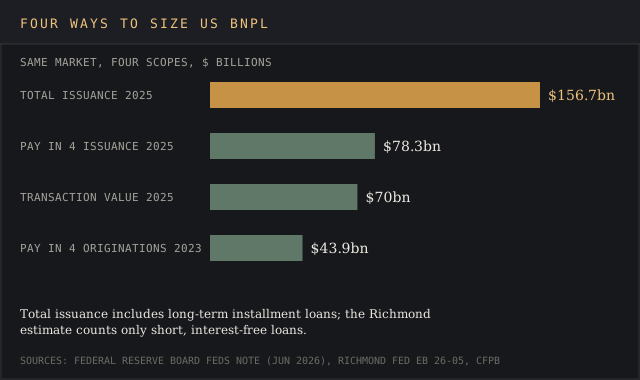
The size of the buy now, pay later market depends on which loans count. The Federal Reserve System and the CFPB publish four different numbers, and each is correct for its own scope. The gap between them is the most misquoted part of BNPL statistics, and the devil's in the details of each scope.
| Figure | What it counts | Year | Publisher |
|---|---|---|---|
| $156.7 billion | Total issuance from six lenders: Pay in 4, short-term and longer-term installment loans | 2025 | Federal Reserve Board |
| $78.3 billion | Pay in 4 loans only | 2025 | Federal Reserve Board |
| $70 billion | Transaction value, coverage-adjusted, Pay in 4 style loans | 2025 | Federal Reserve Bank of Richmond |
| $43.9 billion | Pay in 4 originations, six lenders, loan-level data | 2023 | Consumer Financial Protection Bureau |
Want a market-size chart like this for your own product line? Send the market and the years.
Email a briefThe $156.7 billion figure comes from a June 2026 FEDS Note report by Nina Acree, Kayleigh Barnes, Alexander Bruce and Simona Hannon, built from lender filings. Pay in 4 plans accounted for $78.3 billion, or 50%. Short-term installment loans up to 30 days added $31.2 billion and longer-term installment loans added $47.1 billion. Zero-interest loans made up $98.7 billion, or 63% of the total, down from 83% in 2020 and 2021.
Zhu Wang's Richmond Fed estimate of about $70 billion counts only the short, interest-free product. It grew about 20% a year in real terms since 2021 and equals 1.1% of the more than $6.3 trillion Americans put on credit cards in 2025. Average outstanding BNPL debt is about $3.02 billion, roughly 400 times smaller than the $1.23 trillion of credit card debt.
The CFPB's loan-level series shows the curve. Six lenders issued $2.2 billion of Pay in 4 loans in 2019, $25.5 billion in 2021 and $43.9 billion in 2023, and the loan count rose from 19.8 million to 335.8 million over the same period. An older CFPB series for the top five lenders, cited by the Richmond Fed, ran from $2 billion in 2019 to $24.2 billion in 2021.
The average loan size barely moved: $111 in 2019 and $131 in 2023. BNPL grew by adding borrowers and purchases, while the ticket per loan stayed flat.
BNPL companies: market share by lender
Six BNPL companies issued nearly all US BNPL credit in 2025, and the Fed's report names each one. The Fed's lender-by-lender table shows how the BNPL market splits. Shares below are our calculation from the Fed's totals.
| Lender | Pay in 4 ($bn) | Short-term ($bn) | Longer-term ($bn) | Total 2025 ($bn) | Market share |
|---|---|---|---|---|---|
| Afterpay (Block) | 30.0 | 23.7 | 0 | 53.7 | 34.3% |
| Affirm | 6.3 | 0 | 35.0 | 41.3 | 26.4% |
| PayPal | 25.2 | 0 | 1.3 | 26.5 | 16.9% |
| Klarna | 7.0 | 7.5 | 9.4 | 23.9 | 15.3% |
| Zip | 5.9 | 0 | 1.4 | 7.3 | 4.7% |
| Sezzle | 3.9 | 0 | 0 | 3.9 | 2.5% |
- The lenders, markets and loan types to compare
- Regions, years and segments
- Where it runs: blog, white-label, gated or lead magnet
- Whose byline goes on it
- Deadline
- 2,500+ words, human-written
- Every figure linked to its source
- Yours to publish, under your name or none
- Hosting here for +$200, with your sponsored links
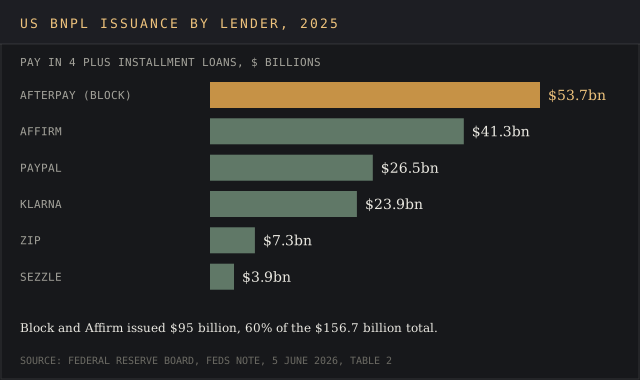
Block, through Afterpay and Cash App, takes the lion's share as the largest issuer, and Block and PayPal together hold 70% of US Pay in 4 volume. Affirm and Block wrote over 90% of the interest-bearing loans. Cash App Borrow adds small loans of close to $500, according to the Fed note.
Affirm reports its own numbers in a different unit, gross merchandise volume. For the fiscal year that ended June 30, 2026, which covers the second half of 2025 and the first half of 2026, Affirm's annual report shows GMV of $50.2 billion, up 37%. Amazon accounted for 22% of it, the clearest sign of what major retailers bring to a lender.
Affirm's fourth-quarter GMV reached $14.1 billion, up 36% on the same period a year earlier. The company added new customers to reach 27.8 million active consumers, up 21%, who made about 7.0 purchases each over the year.
Klarna's global GMV was $128 billion, with $26.9 billion in the US, per the Fed note. Consumer-side market share looks different from issuance. In LendingTree's March 2026 survey of BNPL users, 56% had used PayPal, 45% Affirm, 41% Klarna and 33% Cash App Afterpay.
Who BNPL users are: age, Gen Z, gender, race and income
BNPL consumers skew young, female, lower-income, Black and Hispanic, according to the SHED. The Fed's 2025 figures are the cleanest demographic breakdown because they come from a nationally representative sample of all adults.
| Group | Used BNPL in 2025 | Paid late, share of users |
|---|---|---|
| Ages 18 to 29 | 22% | 32% |
| Ages 30 to 44 | 21% | 31% |
| Ages 45 to 59 | 17% | 22% |
| Ages 60 and over | 9% | 12% |
| Black adults | 29% | 32% |
| Hispanic adults | 26% | 26% |
| White adults | 12% | 21% |
| Asian adults | 11% | 16% |
| Women | 19% | 27% |
| Men | 14% | 23% |
| Income under $25,000 | 18% | 40% |
| Income $25,000 to $49,999 | 23% | 33% |
| Income $100,000 or more | 12% | 11% |
Younger adults use BNPL more than twice as often as adults 60 and over, 22% against 9%, and adults under 45 use it at 21% to 22%. Women are 36% more likely than men to use it (19% against 14%, our calculation). Use is also higher among adults without a four-year college degree. Black and Hispanic adults report higher BNPL use than White and Asian adults, 29% and 26% against 12% and 11%, so Black adults use it at 2.4 times the White rate.
Private surveys that ask about ever using BNPL put Gen Z far higher. LendingTree's survey found 61% of Gen Z consumers had used BNPL, against 59% of earners on $100,000 or more and 69% of parents of young children. Among baby boomers, only 20% of consumers were considering a BNPL loan in October 2026, against 57% of millennials and 61% of Gen Z.
The gender gap reverses between surveys. LendingTree's ever-used figures show men at 52% and women at 42%, while the Fed's past-year figures show women ahead. The two surveys differ in time window and sampling, so the Fed's number is the one to quote for current use.
Read between the lines of the age table and liquidity matters more than age. Among adults whose savings couldn't cover a $100 emergency expense, 31% used BNPL in 2025, against 8% of those who could cover $2,000 or more, according to the Fed's August 2026 Consumer and Community Context.
BNPL purchases: what consumers buy with BNPL services
Clothing still leads, but BNPL purchases have spread into groceries, travel and medical bills. The Fed's purchase-type table covers BNPL users in 2025.
| Purchase type | Share of BNPL users |
|---|---|
| Clothing or accessories | 49% |
| Electronics | 32% |
| Furniture or appliances | 26% |
| Groceries or food delivery | 20% |
| Travel | 19% |
| Medical or veterinary | 8% |
| Other | 16% |
One in five BNPL consumers bought groceries or food delivery with it, and that share rises to 29% for users with incomes under $50,000. LendingTree's March 2026 report found the same 29% for groceries overall, up from 25% a year earlier and 14% two years earlier, with baby boomers at 16%. In the same survey, 54% said they need BNPL to make ends meet, and 13% had used it for rent.
Healthcare purchases are small, but they're where users most often land in hot water. Only 8% of consumers bought medical or veterinary care with BNPL, but 34% of those consumers were charged a late fee or an overdraft or NSF fee, the highest of any purchase type in the Fed data.
Holiday retail purchases show the online shopping side of BNPL purchases. Adobe tracked $20 billion of BNPL spending in the 2025 holiday season, up 9.8%, and $1.03 billion on Cyber Monday alone, the first day to pass $1 billion. That's 7.8% of the $257.8 billion Americans spent on online purchases that season (our calculation). Our Black Friday statistics report covers the wider holiday picture.
The Fed asked consumers why they chose BNPL as a payment method. Spreading out payments was cited by 87% and convenience by 82%. LendingTree's question asked for one primary reason: 31% said ease of use and 11% said no interest.
Late payment and BNPL credit risk
Late payments are counted differently by each publisher, and the Fed and LendingTree land far apart. In the SHED, 26% of BNPL users paid late at least once in the past year. In LendingTree's March 2026 survey, 47% of users paid late in the past year, up from 41% in 2025 and 34% in 2024. That 47% means nearly half of BNPL users in an online panel paid late, against roughly one in four in the Fed's sample.
Paying late and defaulting are different outcomes, and lumping them together makes a mountain out of a molehill. LendingTree found 72% of consumers who paid late were about a week late or less on their payments, and 90% of borrowers who asked for a late fee waiver got the fee reduced or waived. The Fed found 64% of users who paid late were charged extra, which is 17% of all BNPL users.
Missed payments also hit bank accounts. Most BNPL plans pull installment payments from a checking account or the debit cards linked to it, and 11% of BNPL consumers had one of their payments trigger an overdraft or NSF fee in 2025. That share was 18% among users with less than $100 in emergency savings and 4% among those with $2,000 or more.
The consumers who paid late cluster where the Fed would expect, and the shares below count users who paid late at least once. Among users with incomes under $25,000, 40% paid late; at $100,000 or more, 11% paid late. Users aged 18 to 29 paid late at 32%, those 60 and over at 12%.
BNPL charge-off rates stay low, and about 1.83% of BNPL loans from the six largest lenders defaulted and were charged off in 2023. The Richmond Fed reports the BNPL charge-off rate at 2.63% in 2022 and 1.83% in 2023, against 4.19% for credit cards at commercial banks in Q4 2023. Dollar charge-offs fell to 0.92% of transaction value in 2023, the lowest since 2019.
Low losses come despite a subprime borrower base: most BNPL borrowers carry lower credit scores than card borrowers. In 2021 and 2022, 45% of originations went to deep-subprime borrowers with FICO scores of 300 to 579, and 16% to subprime borrowers at 580 to 619, so 61% went to borrowers with subprime or deep-subprime scores (our sum). Even the highest-default groups of consumers repaid 96% of loans and made their payments, so about 4% went unpaid.
Pay in 4 loans are repaid over about six weeks, per the Richmond Fed, a short repayment period by consumer credit standards.
Loan stacking, phantom debt and BNPL credit reporting
Holding multiple BNPL loans at once is par for the course. LendingTree found 63% of BNPL consumers have held multiple BNPL loans at the same time, and 25% have held three or more, a share that reaches 29% for Gen Z. A borrower who has lost track of one of four repayment schedules misses payments, and late fees and overdraft charges follow.
These loans have been called phantom debt because most of them haven't appeared at the credit bureaus. In June 2025, FICO launched FICO Score 10 BNPL and FICO Score 10 T BNPL, the first scores from a major scoring company to include BNPL data. Lenders can use them alongside older scores, and many still rely on FICO Score 8.
Against traditional credit, BNPL is a drop in the bucket. Total US household debt was $17.9 trillion in Q3 2024, including $12.6 trillion in mortgages, $3.2 trillion in student and auto loans and $1.2 trillion in credit card debt, per the Richmond Fed. BNPL's $3 billion outstanding balance is small next to personal loans and other consumer credit products, though buy now, pay later users include consumers that traditional consumer credit products often miss.
The Fed's report found that credit card balances grew fastest for respondents finding it hard to get by: the average SHED cardholder balance rose $748 in two years, to $7,279 in 2025. Many buy now, pay later users carry that card debt alongside their installment loans and the payments on both.
BNPL payment economics: merchant fees and merchant adoption
Merchants pay for each BNPL payment and shoppers don't. Merchant fees charged by most BNPL providers run 5% to 8% of the sale, against 2% to 3% for credit cards, according to research cited in the Fed's FEDS Note. Retailers accept the higher payment method cost to win larger purchases and new customers, and BNPL providers compete for them on that fee.
Merchant fees charged by most BNPL providers run 5% to 8% of the sale, against 2% to 3% for credit cards, per research cited in the Fed's FEDS Note.
Merchant fees charged by most BNPL providers
Source: Federal Reserve FEDS Notee.g. checkout fees for the payment methods your merchants use
Source: linked, checked, datedMerchant adoption keeps climbing, and banks have jumped on the bandwagon. Affirm reported about 571,000 active merchants at the end of fiscal 2026, up more than 50%. Banks are entering with their own buy now, pay later services too: J.D. Power found bank-branded BNPL plans scored 704 on its 1,000-point satisfaction scale, up 59 points, while fintech BNPL brands scored 603, down 17. Chase ranked first at 706, and banks are pitching these plans to existing customers.
Fintech BNPL providers still dominate volume. Among J.D. Power's respondents who took out a BNPL loan in the past 90 days, 97% used a fintech, per Digital Transactions' coverage of the study.
The product mix is moving past four equal installments. Classic Pay in 4 splits a purchase into four equal installments due two weeks apart. Zip's Pay in 8 stretches the repayment period to 14 weeks, and Affirm's longer installment payments run up to five years at APRs up to 36% on loans up to $30,000. Interest-bearing BNPL products reached $58.0 billion, 37% of 2025 issuance.
Buy now, pay later trends in the 2026 data
Four buy now, pay later trends run through every report cited here. Buy now, pay later services are moving from discretionary purchases into essentials such as groceries, rent and medical payments. Consumers are stacking loans. Banks are launching their own plans. And BNPL products are getting longer and more expensive, with interest-bearing loans at 37% of issuance.
The consumers behind these buy now, pay later trends have less cash on hand than the average cardholder. Adults with under $100 in emergency savings used BNPL at almost four times the rate of consumers with $2,000 set aside, per the Fed report. Gallup's report shows the same income gradient: 37% of consumers earning under $48,000 use BNPL frequently or occasionally, against 21% of those earning $90,000 or more.
Frequency of payments is rising faster than reach. Affirm's active consumers grew 21% while purchases per consumer grew 20%, and the CFPB report counted 335.8 million loans in 2023 against 19.8 million in 2019. Buy now, pay later users are making more payments each year, so late fees and overdraft risk compound per person.
Buy now, pay later usage among consumers is also spreading across payment methods. Pay later BNPL options now sit inside credit card apps and bank checkout flows, and J.D. Power found bank-branded BNPL services among the highest-rated in its report. For anyone tracking buy now, pay later statistics, the payment count per user is the number to add to the usual adoption rate.
BNPL regulation: federal pullback, state rules
Federal oversight of BNPL credit and similar credit products has swung twice in two years, and with it the rules on payments. In May 2024, the Consumer Financial Protection Bureau issued an interpretive rule that classified BNPL lenders as credit card providers under the Truth in Lending Act and Regulation Z, requiring billing statements and dispute investigations. It took effect July 30, 2024.
A year later the rule was dead in the water. On May 6, 2025, the CFPB said it wouldn't prioritize enforcement, and on May 12, 2025, the CFPB withdrew the 2024 BNPL Interpretive Rule along with dozens of other guidance documents.
States have picked up the slack. New York enacted its Buy Now Pay Later Act in May 2025, and the Department of Financial Services published draft rules on February 23, 2026, followed by a formal proposal on July 15, 2026, per Venable. The rules would require BNPL lenders to hold a state license, cap fees, mandate disclosures and set underwriting standards. They take effect 180 days after adoption.
For BNPL lenders operating nationally, New York's rule is the first state licensing regime written for BNPL, so it's the one to watch.
Delivered for your site and your byline. Hosting here is optional.
Frequently asked questions
What percentage of people use buy now, pay later?
Sixteen percent of US adults used BNPL in the past year, according to the Fed's 2025 SHED. Gallup's report found 51% have used it at least once to pay online, and J.D. Power found 37% used it in the past 90 days.
What is the most used buy now, pay later?
PayPal. In LendingTree's March 2026 survey, 56% of BNPL users had used PayPal's Pay in 4, ahead of Affirm at 45%, Klarna at 41% and Cash App Afterpay at 33%.
Who is the largest buy now, pay later company?
Among BNPL companies, by US issuance, Block's Afterpay is largest, with $53.7 billion of BNPL loans in 2025, a 34.3% market share by our calculation from Fed figures. Affirm is second at $41.3 billion. Klarna is larger worldwide by GMV, at $128 billion.
How many people use buy now, pay later?
Affirm alone had 27.8 million active consumers in mid-2026. The CFPB counted about 45 million monthly BNPL app users at the end of 2024, up from about 10 million in early 2021, per the Fed's August 2026 article.
Does buy now, pay later hurt your credit score?
Most BNPL loans haven't been reported to the credit bureaus, so on-time payments rarely helped consumers and late payments rarely hurt them. That's changing: FICO's BNPL scores, launched in 2025, count BNPL loans, and lenders using them will see late payments.
Is buy now, pay later a trap?
For a minority of consumers, the data points that way. In LendingTree's 2026 survey, 68% said BNPL makes them overspend, 54% regretted a BNPL purchase and 47% paid late in the past year on their payments. The Fed found 11% of consumers had a BNPL payment trigger an overdraft fee.
Bottom line
The Fed puts buy now, pay later use at 16% of adults and total issuance at $156.7 billion in 2025, with Afterpay, Affirm, PayPal and Klarna writing 93% of it. Quote the issuance and transaction figures with their scope and keep payments data separate from loan data, because $156.7 billion and $70 billion measure different loans.
Risk shows up in late payments more than losses, and the report figures agree on that. A quarter to nearly half of BNPL users paid late in the past year, depending on the survey, while charge-offs stayed under 2%. The users who paid late are concentrated among lower-income, younger and liquidity-constrained borrowers.
Late fees and BNPL charge-off rates will move first if those payments come under strain. Keep an eye on three things in the buy now, pay later market for 2027: New York's licensing rule, FICO's BNPL scores reaching lenders, and the rising share of interest-bearing loans in total issuance.
Lenders, fintechs and retailers publish reports like this one as lead magnets, investor material and client briefs.
A report on your topic for a blog page, gated content or a lead magnet.
Written for your client and published under their brand, with my name left off.
Your report on marketintelligencetools.com, with 2 to 3 CTAs carrying your sponsored links.
Default terms: the report is yours to publish, and I keep the right to republish it on this site behind a gate, outside Google's index.
Where each BNPL figure comes from, and the loan data no lender discloses
Federal Reserve: federalreserve.gov (Economic Well-Being of US Households in 2025, the SHED, May 2026; FEDS Notes on BNPL beyond Pay in 4, 5 June 2026; Consumer and Community Context, August 2026), richmondfed.org (Economic Briefs 25-03 and 26-05) and consumerfinance.gov (the CFPB's BNPL market report and its BNPL compliance page recording the 12 May 2025 withdrawal of the interpretive rule).
Lenders and scoring: sec.gov (Affirm's fiscal 2026 annual report), crowdfundinsider.com (Affirm Q4 fiscal 2026 results, August 2026) and investors.fico.com (FICO Score 10 BNPL launch, June 2025).
Surveys and spending trackers: jdpower.com (2026 US Buy Now Pay Later Satisfaction Study), digitaltransactions.net (coverage of the same study), lendingtree.com (BNPL surveys March to October 2026), news.gallup.com (April 2026 poll) and news.adobe.com (2025 holiday season, January 2026). State rules: venable.com (New York DFS proposals, 2026).
All figures checked 19 November 2026. No lender publishes US delinquency rates by borrower income, and the Fed's issuance totals cover six lenders only, so smaller providers sit outside every market total above.