Average student loan debt in 2026: $40,467 per federal borrower
 By Jan Suski. I go deep on every review, checking every number against its source and digging up details other coverage misses, a habit from six years of SEO and link building for tech companies. Bylines at Brand24 and Senuto. How the scoring works.
The numbers US student loans, checked 19 November 2026
The average federal balance is roughly twice the median, so a minority of large, mostly graduate balances sets the headline number.
About one in five federal student loan borrowers is in default, and 14% of federally managed dollars sit in defaulted federal student debt.
A smaller share of undergraduates borrows than a decade ago, and new bachelor's debt fell from $35,350 to $30,220 in 2025 dollars between the 2019-20 and 2024-25 classes.
Lenders, refinancing apps and colleges quote student loan numbers in every pitch. Send the state or the degree and I'll source a version you own.
The average student loan debt per federal borrower was $40,467 in March 2026: $1.724 trillion in outstanding federal student loans spread across 42.6 million recipients, per the Department of Education's Federal Student Aid data center (the division is our calculation). The typical borrower owes far less: the Federal Reserve puts the median balance between $20,000 and $24,999.
Student loan debt totals between $1.66 trillion and $1.88 trillion depending on who counts it, and 10.9% of balances were 90 or more days late in Q3 2026. Meanwhile, only 47% of 2024-25 bachelor's degree recipients graduated with debt, down from 55% five years earlier.
These student loan debt statistics come from Federal Student Aid, the New York Fed, the Federal Reserve Board, the College Board and NCES, each linked and dated. They cover totals, averages by degree and institution, repayment and default, and who holds the debt. They're written for borrowers, parents and analysts who need to know which number answers which question.
How much student loan debt is outstanding: three totals for one market
Three agencies publish the total amount of outstanding student debt, each from its own records. Every one of them is correct for what it measures, and the gap between them is $229 billion.
| Publisher | Total | What it counts | Date |
|---|---|---|---|
| Federal Reserve G.19 | $1,884.6 billion | All student loans held by the federal government, banks, credit unions and other lenders | Q3 2026 |
| Federal Student Aid | $1.724 trillion | Federal loans only: Direct, FFEL and Perkins, with accrued interest | 31 Mar 2026 |
| New York Fed | $1.656 trillion | Student loan balances on Equifax credit reports, from its Consumer Credit Panel | Q3 2026 |
Copy these lines into an email, fill them in and send. I reply with scope and a price within 2 to 3 business days.
Open the emailThe G.19 consumer credit release is the broadest count. It puts federal government-held student loans at $1,632.9 billion, about 87% of the total, so about $251.7 billion sits with other holders, including private lenders and commercially held FFEL loans (our calculation).
The New York Fed's figure comes from credit records, so balances that are missing from credit files or reported late drop out. In a nutshell, use G.19 for the size of the market, Federal Student Aid for federal borrowers, and the New York Fed for delinquency trends.
Inside the federal portfolio, Direct Loans hold about 91% of dollars, FFEL about 9%, and the old Perkins loans less than one-sixth of one percent, per Federal Student Aid's September 2026 update. Direct Loans, including the subsidized and unsubsidized loans still often called Stafford loans, replaced new FFEL lending in July 2010, and the Perkins program stopped making loans in 2017. Direct Loans hold the lion's share of outstanding student loans today.
Student debt is also the third-largest household debt in the New York Fed's report, behind mortgages at $13.374 trillion and auto loans at $1.734 trillion. Auto loans are now the biggest non-housing debt, and student balances grew just $3 billion in the year to Q3 2026, the smallest increase of any category and a drop in the bucket on a $1.656 trillion base. Mortgage and credit card balances are covered in the real estate statistics report.
Average student loan debt by borrower, degree and school
The average amount a borrower owes depends on which group is being averaged. The main measures:
- Every federal borrower: $40,467, the March 2026 portfolio divided by recipients (our calculation)
- Typical borrower with debt from their own education: median between $20,000 and $24,999, and 28% owe under $10,000, per the Fed's 2024 household survey
- 2024-25 bachelor's recipients who borrowed: $30,220, per the College Board
- 2015-16 bachelor's completers, federal loans for undergraduate and graduate study combined: $45,300 borrowed, per NCES
Most student loan borrowers owe less than $25,000, so the average is pulled up by graduate debt and higher levels of borrowing for professional degrees. Graduate students took 48 percent of federal education loans in 2025-26, up from 33% in 2010-11, borrowing $43.2 billion against $46.5 billion for undergraduates, according to the College Board's Trends in College Pricing and Student Aid 2026. A graduate degree or professional program can add six figures to a balance.
Borrowing is common across education levels. The Fed's 2024 survey found 71% of adults attended some education after high school, and 48% of adults with a bachelor's degree and 54% of those with a graduate degree took out student loans for it.
The type of school matters as much as the degree or education level. The Fed's 2024 survey found that 65% of adults who attended for profit schools borrowed for their own education, against 54% of those who attended private not-for-profit schools and 38% of those who attended public institutions.
Private not-for-profit colleges charge higher sticker prices, and adults who attended private colleges borrowed more often. A graduate school program at a private university can cost an arm and a leg on top of that.
Fewer college graduates borrow, and they borrow less
The borrowing rate has declined over the last decade. The College Board reports that 47 percent of 2024-25 bachelor's degree recipients from public and private nonprofit four-year colleges graduated with debt, averaging $30,220, against 55% and $35,350 for 2019-20 graduates in 2025 dollars.
NCES data on first-time, full-time undergraduate students shows the same trend for college students who attend college for the first time, and the decline holds across postsecondary education. The share receiving loans fell from 50% in 2010-11 to 38% in 2020-21, and the average annual loan fell 8% to $7,700 in constant dollars. Total borrowing by students and parents fell 38% between 2010-11 and 2023-24 in 2025 dollars, then rose to $105.0 billion in 2025-26.
Young college graduates still carry the debt for years. The Fed's survey found 25% of young adults aged 18 to 29 had student loans in 2025, against 22% of those aged 30 to 44, 15% at 45 to 59 and 5% of older adults past 60. Student debt is a burden that follows a graduate into early financial decisions about housing and savings, and the Fed's Economic Well-Being of U.S. Households report tracks that economic well being every year.
Repayment, delinquency and default
Federal student loan payments restarted after the pandemic pause, borrowers had to bite the bullet, and delinquency followed. Outstanding student loans in delinquency are the series to keep an eye on. The New York Fed's Q3 2026 report shows 10.9% of student loan balances 90 or more days past due, up from 10.6% in Q2 2026.
The New York Fed's Q3 2026 report shows 10.9% of student loan balances 90 or more days past due, up from 10.6% in Q2 2026.
Student loan balances 90+ days past due, Q3 2026
Source: New York Fede.g. delinquency in your state
Source: linked, checked, datedFederal Student Aid's June 2026 figures break the federal portfolio down by status:
- 9.3 million recipients in default, holding $234 billion, about 14% of the $1.64 trillion federally managed portfolio
- About 8 million recipients with a loan in forbearance, holding about $459 billion
- About $658 billion in active repayment, roughly 40% of the portfolio
- Nearly 20% of borrowers in active repayment, about 3.5 million, more than 30 days delinquent
- About 13 million borrowers enrolled in income-driven repayment plans
Repayment stress follows income. Among borrowers with outstanding loans in the Fed's 2024 survey, 27% earning under $25,000 were behind on payments, against 10% of those earning $100,000 or more. Twenty percent of all borrowers were behind compared with 16% in 2023, and 57% were required to make payments as of October 2024, up from 37% in 2022.
Counting everyone who ever borrowed for their own education, including people who have paid off their loans, the 2024 survey found 59% had fully repaid, 33% still owed and were current, and 8% were behind.
The 2025 survey added that 41% of borrowers required to pay had trouble making payments in the past year, or 23% of all adults with student loan debt. That's the elephant in the room for anyone reading the federal loan debt total as a sign of health.
Who is behind: for-profit schools and Black borrowers
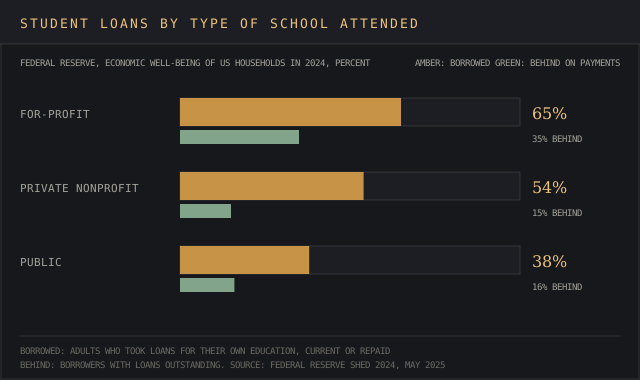
For-profit schools stand out at both ends. The Fed's 2024 report found 35% of borrowers from for-profit schools behind on payments, against 16% from public schools and 15% from private not-for-profit schools. Fourteen percent of Black adults who pursued education after high school attended for-profit schools.
Repayment progress also splits by race. NCES followed 2015-16 bachelor's completers four years after graduation and found they owed 78% of what they had borrowed on average. Black completers owed 105%, the only group owing more than they borrowed, while Asian completers owed 63%. Borrowers who had received a Pell Grant owed 85%, against 66% for those who hadn't.
Interest that outruns payments makes a balance grow over time, which is how a group of borrowers can owe more than it borrowed. The Gen Z statistics report covers how the youngest borrowers are entering this market.
Parents, grandparents and older adults with student debt
Parents and grandparents borrow money for college too. The Fed's 2025 survey found that of adults with student loans, 81% held debt for their own education and 28% held debt from financing a child's or grandchild's education.
Older adults carry less of it: 5% of adults 60 and older had student loans in 2025. The 2025 budget law changed repayment for new federal loans made from 1 July 2026: borrowers choose a standard plan or the new Repayment Assistance Plan, which Federal Student Aid says launched in July 2026.
Federal student loan interest rates for 2026-27 are fixed at 6.52% for undergraduates, 8.07% for graduate unsubsidized loans and 9.07% for PLUS loans, per Federal Student Aid's rate announcement.
How student debt is tracked
Each source answers a different question about outstanding debt, and the devil's in the details of what each one counts. The data triangulation method applies here directly:
- Federal Student Aid: administrative records for every federal loan, published quarterly
- New York Fed: a sample of credit reports, published quarterly, the main delinquency series
- Federal Reserve G.19: lender-reported credit outstanding, the widest total
- Federal Reserve Board household survey: what adults say about their own loans, published each May for the prior October
- College Board and NCES: borrowing by degree, sector and year of graduation, covering postsecondary students at every level
Survey figures carry the usual limits of self-reported data, and administrative counts are tallied at the loan level, so one recipient can appear in two statuses. Federal Student Aid flags that caveat in its releases.
For context on higher education spending outside the loan market, the online learning statistics report covers enrollment in online programs, and the small business statistics and entrepreneur statistics reports cover the graduates who start companies with debt on their books.
Where each student debt figure was published, and the limits of each count
Federal records: studentaid.gov (federal student loan portfolio, 31 March 2026) and fsapartners.ed.gov (FSA Data Center updates of 23 June and 22 September 2026, and the 4 June 2026 interest rate announcement).
Credit and survey data: newyorkfed.org (Household Debt and Credit, Q3 2026), federalreserve.gov (G.19 consumer credit and the Economic Well-Being of US Households reports published in 2025 and 2026). Borrowing by degree: research.collegeboard.org (Trends in Student Aid and Trends in College Pricing and Student Aid 2026) and nces.ed.gov. All figures checked 19 November 2026.
Survey figures rest on what adults report about their own loans, and Federal Student Aid tallies its counts at the loan level, so one recipient can appear in two statuses.
Delivered for your site and your byline. Hosting here is optional.
Frequently asked questions
How much does the average person have in student loan debt?
The average federal borrower owes $40,467, based on Federal Student Aid's March 2026 portfolio (our calculation). The median borrower owes $20,000 to $24,999, per the Federal Reserve's survey, so the typical balance is about half the average.
What percentage of the population has student loan debt?
Sixteen percent of US adults had student loans in 2025, per the Fed's survey, rising to 25% of adults aged 18 to 29. Federal Student Aid counts 42.6 million federal recipients.
What is the average student debt after 4 years of college?
For 2024-25 bachelor's recipients who borrowed, the College Board puts the average at $30,220, and 47% of graduates borrowed at all.
How many people have $100,000 in student loans?
Federal Student Aid publishes a portfolio-by-debt-size table, and the Fed's survey shows most borrowers owe under $25,000. Six-figure balances are concentrated among graduate and professional borrowers, who took 48% of federal loans in 2025-26.
How much would a $70,000 student loan be monthly?
On a 10-year standard plan at the 2026-27 graduate rate of 8.07%, about $852 a month; at the undergraduate rate of 6.52%, about $796 (our calculations). For comparison, a typical $22,500 balance at 6.52% costs about $256 a month over 10 years. An income-driven plan ties the payment to income.
Do unpaid student loans go away after 7 years?
Federal student loans stay owed until they're repaid, discharged or forgiven, and 9.3 million federal recipients were in default in June 2026. Income-driven plans forgive remaining balances after a set number of years of payments.
Bottom line
Average student loan debt is $40,467 per federal borrower, but the median borrower owes $20,000 to $24,999, and graduate borrowing drives the gap.
The total is $1.66 trillion to $1.88 trillion depending on the source, growth has stalled, and 47% of new bachelor's graduates borrow, down from 55% five years earlier.
Repayment is where the strain shows: 10.9% of balances are seriously delinquent, 9.3 million federal recipients are in default, and borrowers from for-profit schools and low-income households fall behind most.
Lenders, loan servicers and education companies use reports like this one in blog pages, pitches and lead magnets.
A report on your topic for a blog page, gated content or a lead magnet.
Written for your client and published under their brand, with my name left off.
Your report on marketintelligencetools.com, with 2 to 3 CTAs carrying your sponsored links.
Default terms: the report is yours to publish, and I keep the right to republish it on this site behind a gate, outside Google's index.