Klarna revenue 2026: $3.5 billion in 2025, four $1 billion quarters in a row
 By Jan Suski. I go deep on every review, checking every number against its source and digging up details other coverage misses, a habit from six years of SEO and link building for tech companies. Bylines at Brand24 and Senuto. How the scoring works.
The numbers Klarna Group plc financials, checked 19 November 2026
Revenue grew faster than volume in 2025 (25% against 22%), so Klarna earned more per dollar it processed.
The 2026 guidance midpoint of $4.12 billion would mean about 17% growth on 2025, down from the 25% pace.
Klarna's financials show an adjusted profit of $65 million in 2025 alongside a $273 million reported loss.
I'll write a 2,500+ word report on the company you name, built from its filings, earnings releases and named analyst estimates. Yours to publish, from $200.
Klarna revenue reached $3.5 billion in 2025, up 25% on 2024, and the company has now booked four straight quarters above $1 billion. The full-year 2025 results also show $127.9 billion in gross merchandise volume and a $65 million adjusted operating profit, while the audited bottom line was a $273 million net loss.
This page tracks Klarna Group plc's financials by year and by quarter, the volume behind them, where the money comes from, how many people use the Klarna app, and how the company compares with other BNPL providers. Every figure links to the filing, release or regulator that published the data.
It's written for investors reading the KLAR ticker with financial market intelligence tools, merchants weighing Klarna at checkout, and analysts who need one sourced set of Klarna statistics. The numbers move every quarter, so the dates matter as much as the digits.
Klarna revenue by year
Klarna's annual revenue has risen in every year its filings cover since 2023. The IPO prospectus filed in March 2025 reported $2.81 billion for 2024, up 24% from $2.28 billion in 2023, and a $21 million net profit after a $244 million loss the year before.
| Year | Revenue | Growth | Net income | GMV |
|---|---|---|---|---|
| 2023 | $2.28 billion | n/a | -$244 million | $92 billion |
| 2024 | $2.81 billion | 24% | $21 million | $105 billion |
| 2025 | $3.5 billion | 25% | -$273 million | $127.9 billion |
| 2026 (guidance) | $4.08 to $4.16 billion | about 17% at midpoint | not guided | $149 to $151 billion |
The 2025 loss came while revenue rose. Klarna's 2025 annual report on Form 20-F records, for the year to 31 December 2025, funding costs of $667 million, up from $297 million in 2023, with consumer deposits of $13 billion now covering about 90% of funding. Klarna pays interest to bank customers on those deposits, and the $370 million rise in funding costs over two years is larger than the $273 million loss.
Klarna Group plc financials by quarter
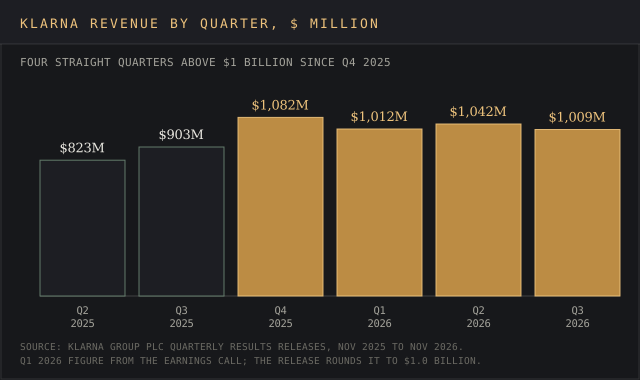
Sales crossed $1 billion in three months for the first time at the end of 2025. The Q4 2025 release, dated 19 February 2026, put it at $1.082 billion, up 38%, with U.S. revenue up 58%.
Copy these lines into an email, fill them in and send. I reply with scope and a price within 2 to 3 business days.
Open the email- Q3 2025: $903 million, up 26%, in Klarna's first report as a listed company, with a $95 million net loss.
- Q4 2025: $1.082 billion, up 38%, the first billion-dollar quarter.
- Q1 2026: $1.012 billion, up 44%, per the earnings call, with net income of $1 million and adjusted operating profit of $68 million.
- Q2 2026: $1.042 billion, up 27% from $823 million, and a $4 million net profit.
- July to September 2026: $1.009 billion, up 12%, with a $65 million net loss and $21 million adjusted operating income.
The Q3 2026 release, published 17 November 2026, kept full-year revenue guidance at $4.08 to $4.16 billion, which implies $1,017 to $1,097 million for October to December 2026, the period that includes the holiday peak covered in our Black Friday statistics. Transaction margin dollars, the figure Klarna uses for what it keeps after transaction costs, rose 32% to $371 million in the same period, on payments volume of $36.1 billion.
Gross merchandise volume and take rate
Gross merchandise volume is the total value of purchases paid through Klarna, and it's the base the revenue sits on. It reached $105 billion in 2024, up 14% according to the prospectus figures, then $127.9 billion in 2025.
Income as a percentage of GMV is the take rate, the one ratio that tells you how much Klarna keeps from the payments it handles. At $3.5 billion on $127.9 billion, 2025 works out to about 2.7%. Klarna's own 2026 outlook sets revenue at 2.74% to 2.75% of GMV, so the company expects the rate to hold flat while transactions grow to $149 to $151 billion.
Klarna attributed about $600 million of its 2026 GMV cut to currency translation, so the outlook is subject to exchange rates as well as demand.
Volume growth has slowed in 2026. GMV rose 33% to $33.7 billion in Q1, then 10% to $36.1 billion in Q3. The U.S. grew faster in both quarters, at 39% and 24%.
Klarna business model and sources of income
Klarna earns most of its money from merchants, who pay a fee on each purchase consumers pay for with Klarna. Its U.S. Wikipink page says the business "is built on charging retailers" and that Pay in 4 and Pay Later carry no interest for the consumer. Longer Financing plans do charge interest, at 0.00% to 35.99% APR.
Digital payments are the category Klarna competes in, and BNPL is one product category inside it. Its February 2026 app release cites McKinsey data that about nine in ten consumers in the US and Europe use digital payments. Klarna started in online payments for e-commerce, a market our ecommerce statistics size at $6.4 trillion in global sales, and consumers can now pay with it online, in store and through Apple Pay and Google Pay.
The mix is shifting toward interest income from credit products. In Q2 2026, transaction and services income was $707 million and interest income was $266 million, up from $219 million a year earlier. Fair Financing, the interest-bearing installment product, grew GMV 165% in Q4 2025 and reached $3.6 billion of U.S. volume in Q3 2026.
- Pay in 4: four interest free payments, the core BNPL product.
- Pay in 30 / Pay Later: one payment due later, also interest free.
- Fair Financing: point-of-sale loans over months, interest-bearing.
- Klarna Card and balance: a card for everyday spending in store and online, tied to a bank account, 5 million active card users in Q1 2026.
- Advertising and data services sold to merchants on its platform, which grew from $13 million in 2020 to $180 million in 2024.
Klarna Group plc calls itself a "global digital bank and flexible payments provider" in its 2026 releases and an AI-powered "payments and commerce network" in its company profile. Banking consumers using its global digital bank services doubled to 15.8 million by Q4 2025, up 101%, and default placement with PSP partners Stripe and Nexi puts Klarna next to card payments at checkout.
Credit losses and underwriting
Provisions for credit losses are the money Klarna sets aside for loans it expects won't be repaid. The rapid growth of Fair Financing pushed them up in 2025. They ran at 0.72% of GMV in Q3 2025, fell to 0.65% in Q4 2025 and to 0.56% in Q3 2026. In dollars, Klarna booked $250 million of provisions in Q4 2025 alone, City AM reported.
Co-founder and CEO Sebastian Siemiatkowski blamed the timing of the accounting. His Q4 2025 shareholder letter, as quoted by City AM, reads:
"When growth outpaces expectations, those day-one provisions temporarily weigh on margins, even when credit quality remains strong and lifetime economics are attractive."
Klarna co-founder and chief executive, shareholder letter, February 2026
Klarna's underwriting relies on short credit terms and small balances, scored by the machine-learning models its 20-F describes. The average U.S. customer balance is $87 against $6,730 on credit cards, average order value is $140, a figure to read against the spending data in our retail industry statistics, and over 99% of lending is repaid, per Wikipink.
Late fees on missed payments run up to $7 and are capped at 25% of the purchase. Klarna uses the $87 versus $6,730 gap to argue its customers carry less debt than credit card users on revolving credit.
Klarna users and app usage
Klarna counted 122 million active consumers in Q3 2026, up 7%, who pay with Klarna across 26 countries, and average revenue per active consumer of $34.0, up 21%. In the U.S., 29 million consumers used Klarna in Q4 2025, which the company put at 11% of the population over the previous 12 months.
The Klarna app had more than 55 million monthly active users and 9 million daily users on 25 February 2026, with daily engagement up about 53%. Klarna's about page lists 3.4 million transactions per day and 3,000 employees. The 9 million daily users are the customers who open the app every day, a usage figure closer to a bank's than a checkout button's. For a peer payment app's numbers, see our Venmo statistics.
- Average U.S. user age: 36.
- Fastest-growing U.S. segment: Boomers aged 50 and over, while younger buyers covered in our Gen Z statistics and millennials statistics remain the larger base.
- Merchants: 1.35 million in Q3 2026, with brands such as Nike, Adidas and IKEA accepting it, per Stripe's merchant guide.
- Merchants offering Fair Financing: 283,000, up from 150,000 a year earlier.
Revenue per employee reached $1.24 million in Q4 2025 and nearly $1.4 million in Q1 2026, about four times the 2022 level. Klarna's prospectus credited AI technology in customer services with the work of 800 staff and savings of more than $39 million in a year. Our customer service statistics track how other companies deploy AI agents, and the AI adoption statistics show how far firms outside fintech have gone.
Why published Klarna statistics disagree
Search for Klarna users and you'll find 93 million, 114 million, 118 million and 122 million, often on one site. All four are Klarna's own numbers from different dates: 93 million active consumers at the end of 2024, 114 million in Q3 2025, 118 million in Q4 2025 and 122 million in Q3 2026.
A "43 million U.S. users" figure still circulates on statistics sites that recycle older data, while Klarna's own Q4 2025 release states 29 million U.S. consumers. Compare any figure with the date of the filing behind it before you use it.
Revenue figures split the same way. The 2023 total appears as $2.28 billion in Reuters' prospectus coverage and $2.2 billion in other summaries.
Klarna reported in Swedish kronor before the U.S. listing, and Finansinspektionen's 2024 decision gives 2023 group turnover as close to SEK 25 billion. The Q1 2026 headline says "$1.0 billion" while the call put it at $1.012 billion. The average balance shows $87 on the Wikipink page and $88 in the Q3 2025 investor presentation, as PYMNTS reported.
This page quotes each figure with the filing date attached, so a 2024 number never sits next to a 2026 one without a label.
Market share against other BNPL providers
Klarna's Q3 2026 GMV of $36.1 billion was about 2.6 times the volume Affirm, its largest U.S. rival, processed in its June quarter, while quarterly revenue was close. Affirm's fiscal Q4 2026 letter reported $1.2 billion of revenue and $14.1 billion of GMV for the quarter, and full-year GMV above $50 billion.
| Metric | Klarna | Affirm |
|---|---|---|
| Latest quarterly revenue | $1.009 billion (Q3 2026) | $1.2 billion (fiscal Q4 2026) |
| Latest quarterly GMV | $36.1 billion | $14.1 billion |
| Annual GMV | $127.9 billion (2025) | above $50 billion (FY to June 2026) |
| U.S. GMV, Q1 2026 | $7.1 billion | $11.6 billion |
| Revenue as share of GMV | about 2.7% | about 8.3% (June 2026 quarter) |
- The providers, markets or metrics to compare
- Regions, years and segments
- Where it runs: blog, white-label, gated or lead magnet
- Whose byline goes on it
- Deadline
- 2,500+ words, human-written
- Every figure linked to its source
- Yours to publish, under your name or none
- Hosting here for +$200, with your sponsored links
Klarna trails in the U.S. eMarketer compared Klarna's $7.1 billion of U.S. GMV in Q1 2026 with Affirm's $11.6 billion in the same quarter. Affirm earns about 8.3% of GMV on longer, interest-bearing loans, and Klarna's model leans on short, merchant-paid plans, so market share by volume and market share by revenue give two different leaders. For U.S. market-wide figures, see our BNPL statistics report.
Klarna's IPO, valuation and stock
Klarna Group plc launched its listing on the New York Stock Exchange on 10 September 2025 under the NYSE ticker KLAR. It priced 34.3 million shares at $40. The majority came from existing investors, and Klarna sold only 5 million of them, TechCrunch reported. Sequoia Capital, its largest shareholder, sold some of its stake.
Private investors valued the Swedish company at about $46 billion in June 2021, and the July 2022 down round valued it at $6.7 billion, per its funding history. Chrysalis put it at $14.6 billion in late 2024, Fortune noted. On the NYSE, the shares closed at $19.51 on 17 August 2026 and fell about 18% before the next open after Klarna cut its 2026 GMV outlook from above $155 billion to $149 to $151 billion.
Founders, CEO and regulation
Klarna was founded in Stockholm, Sweden, in 2005 by Sebastian Siemiatkowski, Niklas Adalberth and Victor Jacobsson. Siemiatkowski, the co-founder of Klarna who still runs it as CEO, held about 7% at the IPO, a stake valued at around $1 billion at $40 a share, according to Fortune. Jacobsson owned 8.4%.
The largest regulatory penalty so far is Swedish. On 11 December 2024, Sweden's financial regulator Finansinspektionen issued Klarna Bank, which got its banking licence in 2017, a remark and a SEK 500 million fine for anti-money-laundering failures, citing its risk assessment and customer due diligence on the invoice product.
Klarna said the review concerned rule interpretation, with no actual cases of money laundering. Consumer-side losses to scams on payment apps are tracked in our fraud statistics.
Delivered for your site and your byline. Hosting here is optional.
Frequently asked questions
How is Klarna doing financially?
Revenue was $1.009 billion in Q3 2026, the fourth quarter in a row above $1 billion, with a $65 million net loss and $21 million of adjusted operating income. Klarna guided to $4.08 to $4.16 billion of revenue for 2026 and expects a net profit in Q4.
Is Klarna making a profit?
Klarna reported a net profit in two of the last four periods it published. It earned $1 million in Q1 2026 and $4 million in Q2 2026, then lost $65 million in Q3. The full year 2025 ended with a $273 million net loss.
How many people use Klarna?
122 million active consumers worldwide in Q3 2026, and 29 million in the U.S. as of Q4 2025. The app had 55 million monthly users in February 2026.
Who uses Klarna?
The average U.S. user is 36, per Klarna's own data, and Boomers aged 50 and over are the fastest-growing segment. Average order value is $140.
Who is Klarna's biggest competitor?
Affirm in the U.S., which reported $1.2 billion of revenue in its June 2026 quarter. Afterpay, owned by Block, PayPal's pay-later plans and other pay-later lenders compete for the same checkout slot, alongside credit card issuers.
Who is Klarna's chief executive?
Sebastian Siemiatkowski, who co-founded the business in Stockholm in 2005.
Why is Klarna stock falling?
The biggest drop followed the Q2 2026 release on 18 August 2026, when Klarna lowered its 2026 GMV and revenue outlook. Shares fell about 18% before the open.
What is the downside to Klarna?
Late fees of up to $7 per missed payment, interest of up to 35.99% APR on Financing plans, and easy repeat use. Several open plans can add up to more debt than one $87 balance suggests. Klarna says less than 1% of active U.S. users have been referred to debt collection.
Bottom line
Klarna revenue grew from $2.28 billion in 2023 to $3.5 billion in 2025, and the company has held above $1 billion a quarter since Q4 2025. Growth slowed to 12% in Q3 2026 and the 2026 outlook was cut once.
Interest income rose to $266 million in Q2 2026, deposits supply about 90% of funding, and the Klarna Card passed 5 million active users. Reported profit now depends on how fast Fair Financing loans grow against the provisions booked on day one, which is the number to watch in the Q4 2026 release.
Investors, payment firms and fintech marketers use reports like this one in investor decks and competitive briefs.
A report on your topic for a blog page, gated content or a lead magnet.
Written for your client and published under their brand, with my name left off.
Your report on marketintelligencetools.com, with 2 to 3 CTAs carrying your sponsored links.
Default terms: the report is yours to publish, and I keep the right to republish it on this site behind a gate, outside Google's index.
The filings, releases and trackers behind each Klarna figure, and what the company leaves out
Company filings and releases: investors.klarna.com (full-year 2025 results; Q4 2025 release, 19 February 2026; Q1 2026 release, 14 May 2026), via.tt.se (Business Wire copy of the Q3 2026 release, 17 November 2026), sec.gov (2025 annual report on Form 20-F), klarna.com (Wikipink page, app usage release of 25 February 2026, about page) and investors.affirm.com (Affirm fiscal Q4 2026 shareholder letter).
Earnings coverage and transcripts: fool.com (Q1 2026 call transcript, 18 May 2026), rttnews.com (Q2 2026 results, 18 August 2026), fastcompany.com (Q3 2025 results), fidelity.com (Reuters on the March 2025 prospectus), pymnts.com, bankingdive.com, americanbanker.com, cityam.com, emarketer.com, techcrunch.com and fortune.com. Regulator: fi.se (Finansinspektionen decision, 11 December 2024). Merchant list: stripe.com. Funding history: en.wikipedia.org.
All figures checked 19 November 2026. Klarna guides on GMV, revenue, transaction margin dollars and adjusted operating income, and gives no net income guidance for 2026, so the reported bottom line for the year is only known when the Q4 release lands.