Fraud statistics 2026: $15.9 billion in reported losses and where the money goes
 By Jan Suski. I go deep on every review, checking every number against its source and digging up details other coverage misses, a habit from six years of SEO and link building for tech companies. Bylines at Brand24 and Senuto. How the scoring works.
Americans told the Federal Trade Commission they lost $15.9 billion to fraud in 2025, across 3 million reports, according to FTC testimony to the Joint Economic Committee. That's up from $12.5 billion in 2024 and the highest figure on record. The FBI's Internet Crime Complaint Center logged a bigger number for the same year: $20.9 billion.
This page gathers the fraud statistics on online scams that hold up: reported losses by scam type, contact method and age group, identity theft and credit card fraud counts, and the survey data on how many Americans fall victim. It's for fraud, risk and compliance teams at financial institutions and small businesses, analysts sizing the fraud prevention market, and anyone who wants to check a headline figure against the agency that published it.
The numbers US fraud and scam losses, checked November 2026
FTC data show reported fraud losses rose about 27% in a year while report volume rose about 15%, so scammers are taking more money from each of their victims.
Investment scams alone account for half of all money reported lost to the FTC, more than imposter scams, shopping scams and romance scams combined.
Every total here is a floor: the FTC says reported losses are a fraction of what consumers lose, and its own estimate of fraud against older adults runs to $119.5 billion.
Fraud prevention vendors, banks and insurers quote loss numbers in every pitch. Send the country, the scam type or the sector and I'll source a version you own.
How much money Americans lose to fraud each year
The FTC's Consumer Sentinel Network is the broadest US fraud database, pulling reports from consumers and nearly 180 data contributors. Its reported losses have climbed every year this decade, per the FTC's written testimony:
- 2021: more than $6 billion
- 2022: nearly $9 billion
- 2023: more than $10 billion
- 2024: $12.5 billion, from 2.6 million fraud reports
- 2025: $15.9 billion, from 3 million fraud reports
The 2025 total was about 25% higher than 2024 by the FTC's own rounding, and fraud losses have roughly quintupled since 2020. In 2024, only 38% of fraud reports involved money lost, so the total is driven by a minority of reports carrying large sums. Credit cards were the payment method named most often in 2025 reports, but bank transfers carried the highest aggregate losses, followed by cryptocurrency.
By contrast, the FBI's Internet Crime Complaint Center counts a narrower set of internet crimes and still lands higher, because businesses report to it too. Its 2025 report recorded 1,008,597 complaints, almost 3,000 a day, and $20.877 billion in reported losses, up 26% from 2024.
Online scams ranked by reported losses
The FTC and FBI agree on the order at the top: investment fraud first, by a wide margin. The table pairs each agency's 2025 figure for the main scam types where both publish one.
| Scam type, 2025 | FTC reported losses | FBI IC3 reported losses |
|---|---|---|
| Investment scams | $7.9 billion | $8.65 billion |
| Imposter scams | $3.5 billion | Not a single IC3 category |
| Business email compromise | Not tracked separately | $3.05 billion |
| Tech support scams | Counted under imposters | $2.13 billion |
| Romance and confidence scams | Counted under imposters | $929 million |
| Any scam involving cryptocurrency | Second-largest payment method by losses | $11.37 billion |
Copy these lines into an email, fill them in and send. I reply with scope and a price within 2 to 3 business days.
Open the emailInvestment scams are the lion's share of the problem. Most promise high returns from crypto trading platforms and fake websites that look real until the victim tries to withdraw, and the fraudsters behind them build cloned sites to look like real exchanges. The IC3's crypto figure overlaps the other rows, since crypto is a payment rail across several scam types.
A real exchange files its numbers with the SEC, and our Coinbase statistics trace one through its 10-Qs and shareholder letters.
Imposter scams were the most common types of fraud reported to the FTC, at more than 1 million reports and nearly one in three fraud reports. Reported imposter losses have risen nearly threefold since 2020, according to the FTC's June 2026 data release. These are the scam calls, text messages and phishing emails that pose as a bank, a government agency or a tech company.
Tech support scams cost $2.13 billion by the FBI's count, and romance scams $929 million. Romance scams are hard to size because victims are slow to report, and the longer a scammer keeps a victim engaged, the more money moves.
Where online scams start: social media, phone calls and text messages
Social media, covered in our social media statistics report, is now the costliest way scammers reach Americans, and the online platforms themselves are where the fraudulent ads and profiles live. Consumers reported losing $2.1 billion to scams that started on social media in 2025, eight times the 2020 figure, per the FTC's April 2026 release.
- Nearly 30% of people who lost money to a scam said it started on social media
- Investment scams accounted for $1.1 billion of social media losses, more than half
- More than 40% of people who lost money to a social media scam bought something from an ad, the online shopping scams pattern
- Nearly 60% of people who lost money to a romance scam said it started on social media
- Facebook carried the highest reported losses, followed by WhatsApp and Instagram (see our Facebook statistics)
Every age group except people 80 and over lost more to social media scams than to any other contact method; for the oldest group, phone calls ranked first.
The phone and inbox are where volume lives. In Pew's 2025 survey, 68% of US adults said they get scam phone calls at least weekly, 63% get scam emails and 61% get scam text messages. Gen Digital's survey work, cited on Norton's scam statistics page, counted two scam calls and three scam texts a week for the average American and put scam attempts at nearly 174 every second worldwide.
Phishing leads the FBI's complaint counts. The IC3 logged 191,561 phishing and spoofing complaints in 2025, ahead of extortion at 89,129 and personal data breach at 67,456. Phishing emails and suspicious links are the usual first step, which is why multi factor authentication on bank and email accounts blocks so many takeovers that start with a stolen password.
How scammers work: the most common types of online scams
Most online scams follow one of a handful of scripts. Knowing the script is the cheapest defence most people have, and the FTC data show the same five scripts behind the vast majority of reported losses.
- Investment scams. A contact on social media or a messaging app points the victim to fake websites showing fake gains. Fraudsters let early withdrawals through, then block access once the deposits grow.
- Imposter scams. Phone calls, text messages or phishing emails claiming to be a bank, a government agency or a delivery company, with an urgent request to move money to a "safe" bank account.
- Online shopping scams. Ads for goods that never ship, a growing slice of the ecommerce market, sold through cloned shopping sites, fake websites or marketplace listings on online platforms.
- Tech support scams. A pop-up on fraudulent websites or a call warning of threats on the victim's computer, followed by a request for remote access and payment. Scammers then use that access to drain accounts.
- Romance scams. A relationship built over weeks or months on dating sites and social media, ending in a request for money for an emergency or an investment.
Americans can cut their exposure with a few habits: ignore unsolicited phone calls and messages that ask for money or codes, never click suspicious links in text messages, turn on multi factor authentication for every bank and email account, and check the address of websites before entering card details. Financial losses are easier to contain when people report fast to their bank, and the FTC and IC3 both take reports online.
Online scams also hit businesses. Business email compromise, where scammers pose as a supplier or executive and send a payment request, cost $3.05 billion in 2025 by the IC3's count, and small businesses without a second approval step on payments carry most of the harm.
Who falls victim: age group, income and race
Online scams are common in every age group, and Pew's results by age show that age changes the type of harm more than the odds of being targeted. Pew Research Center surveyed 9,397 US adults in April 2025 and found 73% had experienced at least one online scam or attack, with 32% in the past year. About three quarters of adults under 30 reported one, against 66% of adults 65 and older.
Younger adults lose money to online scams more often. About a quarter of 18 to 29 year olds had lost money to an online scam or attack, against about 15% of those 65 and older. Older Americans lose bigger sums when they do lose, and age is the clearest predictor of loss size:
- People 60 and over reported $7.75 billion in internet crime losses to the IC3 in 2025, up 59%, across 201,266 complaints
- Older adults reported about $3 billion in fraud losses to the FTC in 2025, about five times the 2020 figure, per the FTC's older adults report
- The same FTC report estimated the full cost of fraud against older adults in 2025 at as much as $119.5 billion once unreported losses are counted
- Investment scam losses among older adults jumped 42% to more than $1 billion
Income and race matter too. In Pew's survey, 26% of lower-income adults had lost money to a scam, against 15% of upper-income adults. About three in ten Black or Hispanic adults had faced three or more types of scams, against 18% of White adults. And 84% of all adults, including 82% of those under 30, said people 65 and older are likely to fall victim, choosing the top two answers on Pew's scale.
Identity theft and credit card fraud statistics
Identity theft is the second-largest complaint category in the FTC's database. The Consumer Sentinel Network Data Book 2024 counted about 1.1 million identity theft reports, 17% of all reports, and credit card fraud was the most common form, at roughly 449,000 reports. Most of those involve new accounts opened in a victim's name, and the total number of identity theft reports in 2025 was on track to beat 2024 by the third quarter, per FTC data dashboards.
Card fraud is also the most common scam experience in surveys. In Pew's data, 48% of US adults had a fraudulent charge on a credit or debit card, the most common of the multiple types of scams it asked about. 36% had been hit by online shopping scams on fake websites, 29% had an online account hacked, and 24% had been tricked into giving away personal information. Across all the questions, most people who'd been hit had faced more than one type of scam.
Worldwide, payment card fraud losses fell 1.2% to $33.41 billion in 2024, per the Nilson Report. That works out to 6.43 cents per $100 of card volume. The US carried 26.31% of card volume but 41.87% of card fraud losses, and Nilson projects global losses of $41.06 billion by 2030.
The data feeding identity theft keeps growing. The Identity Theft Resource Center tracked a record 3,322 data compromises in 2025, a trend our data breach statistics report follows, up 5% from 2024 and 79% over five years, though victim notices fell to 278.8 million from 1.37 billion as mega-breaches dried up. Financial institutions led all industries with 739 compromises, according to American Banker's reading of the report.
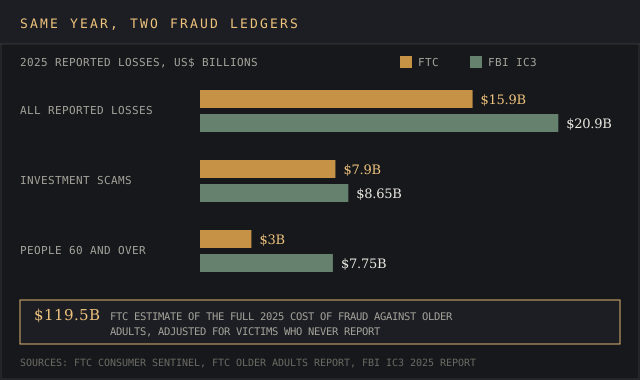
Want a two-database chart like this for your own country? Send the agencies and the years.
Email a briefWhy the published fraud figures disagree
Search "how much money is lost to scams each year" and you'll get $12.5 billion, $15.9 billion, $20.9 billion, $33.41 billion or $119.5 billion. None of them is wrong. They count different things, and mixing them is how most pages about online scams go off the rails. Matching each figure to its database is source credibility work.
- FTC Consumer Sentinel ($15.9 billion, 2025). Consumer fraud reports to the FTC and its data contributors, including some IC3 reports. Excludes most business losses.
- FBI IC3 ($20.9 billion, 2025). Complaints about internet crimes from individuals and businesses, so business email compromise ($3.05 billion) sits inside it.
- FTC older adults estimate ($119.5 billion). A model of total losses, adjusting reported figures for the share of victims who never report.
- Nilson ($33.41 billion, 2024). Card industry losses worldwide, borne by issuers, merchants and acquirers, most of which consumers never see.
- Last year's figure. $12.5 billion is the FTC's 2024 total, still quoted on pages that haven't updated.
The two federal databases also overlap, since the IC3 is one of the FTC's data contributors, so adding them double counts. Reading between the lines of all five, the direction is the same: losses are rising faster than reports.
Fraud trends and threats for 2026
- Bigger losses per victim. FTC losses rose 27% in 2025 on 15% more reports.
- Crypto as the payment rail for online scams. The IC3 tied $11.37 billion of 2025 losses to cryptocurrency.
- Social media as the front door. Eightfold growth in social media scam losses since 2020.
- Older victims, larger sums. IC3 losses for people 60 and over grew 59% in a year.
- More breaches, fewer victims per breach. ITRC counts rose while notices fell 79%.
These threats compound: a breached password gives scammers access to online accounts, the account gives them a trusted name to message from, and the message carries the request for money. Teams building a fraud intelligence stack can compare vendors in our risk intelligence software ranking and the threat data covered in our cybersecurity statistics report.
Delivered for your site and your byline. Hosting here is optional.
Frequently asked questions
What is the most common online scam?
Among online scams, imposter scams lead by count: more than 1 million FTC reports in 2025, nearly one in three fraud reports. In Pew's survey, credit or debit card fraud was the most common experience, reported by 48% of adults.
What percentage of people have been scammed online?
Roughly three quarters of US adults, 73%, have experienced an online scam or attack, and 21% have lost money to one, according to Pew Research Center's 2025 survey.
How common is fraud on credit cards?
Credit card fraud was the most common form of identity theft in the FTC's 2024 data, at about 449,000 reports, and 48% of US adults told Pew they'd had a fraudulent card charge.
What are the current scam trends?
Investment scams paid in crypto, scams that start on social media and dating sites, and imposter scams posing as banks or agencies. Losses are growing faster than report counts.
How many people get scammed per year?
The FTC received 3 million fraud reports in 2025 and the FBI's IC3 about 1 million internet crime complaints. Most victims of scams and internet crimes never report, so both are undercounts.
What should you never open in spam emails?
Links and attachments, which lead to scam sites or install malware. Phishing and spoofing produced 191,561 IC3 complaints in 2025, the top complaint type by count, and they start with a click on a link.
Bottom line
US consumers reported $15.9 billion in fraud losses to the FTC in 2025 and the FBI logged $20.9 billion in internet crime losses. Investment scams take about half the money lost to online scams, social media is where the costliest scams start, and older adults lose the largest sums.
Before quoting any fraud statistics on scams, check which database produced the figure and for which year. The FTC, the FBI, the card industry and the FTC's own underreporting model answer four different questions.
Fraud prevention, identity and payments companies use reports like this one in pitches, sales decks and press outreach.
A report on your topic for a blog page, gated content or a lead magnet.
Written for your client and published under their brand, with my name left off.
Your report on marketintelligencetools.com, with 2 to 3 CTAs carrying your sponsored links.
Default terms: the report is yours to publish, and I keep the right to republish it on this site behind a gate, outside Google's index.
Which agency counted which loss, and what no fraud database captures
Consumer fraud totals are the Federal Trade Commission's Consumer Sentinel Network: the FTC's testimony to the Joint Economic Committee on 25 March 2026, its April 2026 social media release, its June 2026 imposter scam release, its 2026 older adults report and the Consumer Sentinel Network Data Book 2024. Internet crime figures are the FBI's 2025 Internet Crime Report.
Survey figures are Pew Research Center's Online Scams and Attacks in America Today (31 July 2025, 9,397 adults) and Gen Digital's Dynata surveys cited on Norton's scam statistics page. Card fraud is the Nilson Report's 7 January 2026 release. Breach counts are the Identity Theft Resource Center's 2025 Annual Data Breach Report (29 January 2026), with the industry split as reported by American Banker.
Every figure was checked in November 2026. The FTC's full 2025 Data Book was not retrievable at the time of checking, so identity theft counts use the 2024 edition. No agency publishes a single, deduplicated US fraud total: the FTC and FBI databases overlap, and both miss most unreported losses.