Netflix statistics 2026: subscribers, revenue, viewing and ad tier data
 By Jan Suski. I go deep on every review, checking every number against its source and digging up details other coverage misses, a habit from six years of SEO and link building for tech companies. Bylines at Surfer, Brand24, and Senuto. How the scoring works.
The numbers Netflix filings and viewing data, checked 17 October 2026
Netflix's net income has grown almost fourfold in five years, from $2.76 billion in 2020 to $10.98 billion in 2025.
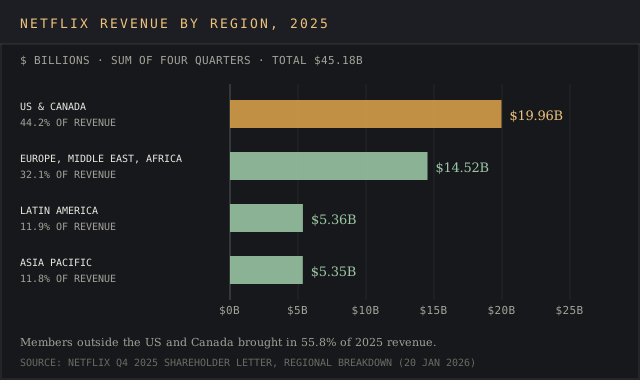
Members outside the US and Canada produced 55.8% of 2025 revenue, so the company earns most of its money abroad.
Advertising is still small: over $1.5 billion in 2025, about 3% of revenue, with roughly $3 billion forecast for 2026.
Streamers, ad agencies and media analysts quote subscriber and viewing numbers in every deck. Send the platform or the country and I'll source a version you own.
Netflix booked $45.18 billion of revenue in 2025, up 16%, and earned $10.98 billion of net income, according to its Q4 2025 shareholder letter (20 January 2026). The same letter says the company crossed 325 million paid memberships during the fourth quarter. That's the last subscriber count Netflix has published.
This report collects the Netflix statistics analysts, media buyers and investors quote most: Netflix subscribers by region, Netflix revenue and net income by year, content spend, viewing hours, the ad-supported tier, pricing and the stock.
Every figure comes straight from the horse's mouth: Netflix's own SEC filings and shareholder letters, its newsroom, or the research house that measured it (Nielsen, Pew Research Center, Parrot Analytics). Statistics pages quoting Netflix are a dime a dozen, and several of the numbers they repeat don't match the company's filings; where that happens, this report says so.
Figures are current to 17 October 2026. Netflix reports its third-quarter 2026 results on 20 October 2026, so the latest quarter covered here is the second, which ended 30 June.
How many subscribers Netflix has in 2026
Netflix had over 325 million paid memberships at the end of 2025. The Q4 2025 letter put it in one line: "With over 325M paid memberships, we're now serving an audience approaching one billion people globally." The company counts a paying household as one membership, so the number of Netflix users is larger than the subscriber count.
The "approaching one billion" figure is Netflix's own estimate of everyone watching on those accounts. Netflix subscribers pay per household; Netflix users are every person on the profiles of that subscription.
The last exact count is 301.63 million paid subscribers at 31 December 2024, from the Q4 2024 letter (21 January 2025). Netflix added 18.91 million that quarter, the most in its history. Six months earlier, at the end of June 2024, the regional tables in the Q3 2024 letter (17 October 2024) add up to 277.6 million.
Netflix stopped reporting subscribers every quarter from Q1 2025. The Q4 2024 letter says the company would "no longer report paid memberships and ARM on a regular quarterly basis" and would announce memberships at milestones. The 325 million mark in January 2026 is the first milestone it has used. Revenue, operating margin and engagement data are now the numbers the company steers by, and the last full count of paid subscribers Netflix published is the 2024 figure.
| Year end | Paid memberships | Change on the previous year | Source |
|---|---|---|---|
| 2020 | 203.66 million | n/a | Q4 2021 letter |
| 2021 | 221.84 million | +18.18 million | Q4 2021 letter |
| 2022 | 230.75 million | +8.91 million | Q4 2023 letter |
| 2023 | 260.28 million | +29.53 million | Q4 2023 letter |
| 2024 | 301.63 million | +41.35 million | Q4 2024 letter |
| 2025 | Over 325 million | Not disclosed exactly | Q4 2025 letter |
Copy these lines into an email, fill them in and send. I reply with scope and a price within 2 to 3 business days.
Open the emailNetflix subscriber growth stalled in 2022 and then took off in 2023 and 2024, the two years Netflix rolled out paid sharing and its ad-supported tier. That 70.88 million gain across two years came from the same service at higher prices. Charging for password sharing turned out to be a blessing in disguise for Netflix's books.
Subscribers by region: Netflix's last full count
The Q4 2024 letter carries the final regional split. The US and Canada (UCAN) had 89.63 million paid subscribers, Europe, the Middle East and Africa (EMEA) 101.13 million subscribers, Latin America 53.33 million and Asia Pacific 57.54 million. EMEA is the largest region by subscribers, while UCAN is the largest by revenue.

Asia Pacific grew fastest, up 26.9% from 45.34 million at the end of 2023. UCAN grew 11.9% from 80.13 million, a big number for a market where the Pew Research Center already counts 72% of US adults as Netflix viewers.
Latin America added 7.33 million Netflix subscribers in 2024 and Europe, the Middle East and Africa 12.32 million subscribers. Japan was the largest single contributor to member growth in Q1 2026, helped by the World Baseball Classic, which drew 31.4 million viewers, per the Q1 2026 letter (16 April 2026).
Netflix revenue and net income
Netflix revenue reached $45.18 billion in 2025, up from $39.00 billion in 2024, a 16% rise (17% at constant currency). Operating income was $13.33 billion, a 29.5% operating margin against 26.7% the previous year. Netflix earned $10.98 billion, $2.53 a share on a split-adjusted basis, and generated $9.46 billion of free cash flow.

Want a revenue chart like this for another media company? Send the company and the years.
Email a brief| Year | Revenue | Operating margin | Net income |
|---|---|---|---|
| 2020 | $25.00 billion | 18% | $2.76 billion |
| 2021 | $29.70 billion | 21% | $5.12 billion |
| 2022 | $31.62 billion | 18% | $4.49 billion |
| 2023 | $33.72 billion | 21% | $5.41 billion |
| 2024 | $39.00 billion | 26.7% | $8.71 billion |
| 2025 | $45.18 billion | 29.5% | $10.98 billion |
Figures for 2020 and 2021 come from the Q4 2021 letter (20 January 2022), 2022 and 2023 from the Q4 2023 letter (23 January 2024), and 2024 and 2025 from the Q4 2025 letter. 2022 is the one dip in profit, the year subscriber growth slowed to 8.91 million.
The 2026 run rate is higher again. Q1 2026 revenue was $12.25 billion, up 16%, and Q1 net income jumped to $5.28 billion because Netflix booked a $2.8 billion termination fee from the Warner Bros. deal in other income. Q2 2026 revenue came in at $12.56 billion, up 13%, with operating income of $4.19 billion, a 33.4% operating margin, and net income of $3.40 billion.
For the full year, the Q2 letter narrowed guidance to $51.0 billion to $51.4 billion of revenue, up 13% to 14%, at a 31.5% operating margin. It forecast Q3 2026 revenue of about $12.86 billion. Free cash flow in Q2 was $1.53 billion, down from $2.27 billion a year earlier, after Netflix spent $4.7 billion buying back stock in the quarter, its largest buyback quarter on record.
Netflix revenue by region
Netflix earned $19.96 billion in the US and Canada in 2025, the lion's share at 44.2% of revenue. That's the sum of the four quarterly figures in the Q4 2025 letter's regional breakdown. Europe, the Middle East and Africa brought in $14.52 billion (32.1%), Latin America $5.36 billion (11.9%) and Asia Pacific $5.35 billion (11.8%). Every dollar of it is booked as streaming revenue; the company reports no separate DVD or games line.
- The platform, market or ad metric to cover
- Regions, years and segments
- Where it runs: blog, white-label, gated or lead magnet
- Whose byline goes on it
- Deadline
- 2,500+ words, human-written
- Every figure linked to its source
- Yours to publish, under your name or none
- Hosting here for +$200, with your sponsored links
The gap between subscriber share and revenue share is the subscription price customers pay. Average monthly revenue per membership (ARM) in Q4 2024 was $17.26 in UCAN, $11.11 in EMEA, $8.00 in Latin America and $7.34 in Asia Pacific. A US subscriber was worth 2.35 times an Asia Pacific one. Some aggregators still quote 48% of revenue from the US and Canada; the 2025 filings put it at 44.2%, and Q2 2026 lower again at 43.2% ($5.43 billion of $12.56 billion).
Latin America grew 21% in Q2 2026, the fastest of the four regions, followed by Asia Pacific at 16%, Europe, the Middle East and Africa at 14% and UCAN at 10%, per the Q2 2026 Form 10-Q. UCAN's figure reflects only part of a quarter at the new US prices. Deferred revenue, mostly membership fees customers paid in advance, stood at $1.797 billion at 30 June 2026.
How much Netflix spends on movies, series and live events
Netflix spent $17.10 billion in cash on content in 2025, up from $16.22 billion in 2024, per the Q4 2025 letter. Content amortization, the cost that hits the income statement, was $16.42 billion. Some statistics sites quote $18 billion for 2025; the company's own figure is $17.10 billion. For 2026 Netflix guides amortization up about 10% and cash spend at roughly 1.1 times amortization, which by our arithmetic puts the 2026 Netflix spend on content near $20 billion.
The budget has more than doubled since 2018, when the Q4 2017 letter said Netflix planned "to spend $7.5-$8.0 billion on content on a P&L basis in 2018." That letter also said Netflix was increasingly self-producing its original content. Content assets on the balance sheet, original content and licensed titles together, stood at $33.84 billion at 30 June 2026.
Netflix spends a growing slice of its streaming budget on live content production. Live programming took about 5% of 2026 content spend but produced about 1% of view hours, the Q2 2026 letter says. The 2026 live slate includes NFL games on Thanksgiving Eve and Christmas Day, two MLB events and a Tyson Fury against Anthony Joshua fight.
Original programming carries the brand. Parrot Analytics, a demand-measurement house, found Netflix accounted for one quarter of the world's streaming original series in Q2 2024 and 32.9% of demand for original content on streaming services, in a July 2024 analysis. Licensed broadcast series made up 1% of TV shows in the US catalog but drew 7.1% of demand, so quality content bought from other studios still holds its own next to original programming.
Netflix's original content also competes with HBO Max for awards. The Television Academy's 78th Emmy Awards list, published on 8 July 2026, credits Beef with 16 Emmy nominations, The Beast in Me with 9 and The Diplomat with 7. HBO Max's The Pitt led all programs with 25.
Netflix also runs Tudum, a fan website of behind-the-scenes videos and exclusive interviews about its original content, which draws over 24 million views a month, per the 2026 upfront. It promotes new movies and series on a platform the company owns.
How many people watch Netflix
Netflix members watched over 97 billion hours in the first half of 2026, up 2% on the first half of 2025, par for the course after 1.5% growth in 2025, and the highest half-year total on record, per the What We Watched report published 16 July 2026. The second half of 2025 logged 96 billion hours, per the previous report (20 January 2026).
In the first half of 2026, Netflix members watched over 97 billion hours, up 2% on a year earlier, per Netflix's What We Watched report.
Hours of Netflix viewed in the first half of 2026
Source: Netflix What We Watched reporte.g. streaming hours in your country
Source: linked, checked, datedBy our arithmetic, 97 billion hours across the 181 days of the first half and 325 million-plus paid memberships works out to at most about 1 hour 39 minutes of Netflix per membership per day, since the membership base has grown since that milestone. Non-English titles made up over a third of all viewing on the platform in both halves. Netflix will cut the report from twice a year to once a year, starting in Q1 2027, so the next full data drop will cover all of 2026.
| Title | Views | Period |
|---|---|---|
| KPop Demon Hunters (film) | 482 million | H2 2025 |
| War Machine (film) | 147 million | H1 2026 |
| The Rip (film) | 136 million | H1 2026 |
| Happy Gilmore 2 (film) | 135 million | H2 2025 |
| Wednesday Season 2 | 124 million | H2 2025 |
| His & Hers (series) | 104 million | H1 2026 |
| Bridgerton Season 4 | 100 million | H1 2026 |
Movies took four of the seven slots in the table. KPop Demon Hunters, an animated movie, set the record for a six-month period at 482 million views, more than three times the biggest title of H1 2026. His & Hers was the most-watched show on the platform that half, with 104 million views.
In the US, Nielsen measures share of all TV viewing. Netflix hit 9.0% of US TV time in December 2025, its highest month on The Gauge, when streaming as a whole took a record 47.5%. By our arithmetic that puts Netflix at about 18.9% of all US streaming time that month.
Streaming competitors trail on the same Nielsen data. Prime Video had 4.3% of television viewing and The Roku Channel 3.0%. Nielsen's July 2026 Gauge, published 10 September 2026, put streaming at 49.0% of US TV and YouTube at a record 14.2%, with Disney streaming (Disney+ and Hulu) at 4.7% and Peacock at 2.6%.
Outside the US, the share is lower. Netflix estimates it holds about 5% of global TV view share, per its Q1 2026 letter, and the Q4 2025 letter says its share of TV time sits below 10% in its major markets.
Recommendations drive most of what Netflix users watch. Two Netflix executives, Carlos Gomez-Uribe and Neil Hunt, wrote in ACM Transactions on Management Information Systems (December 2015) that recommendations influence "about 80% of hours streamed at Netflix," with users finding the other 20% through search. They put the value of personalization at over $1 billion a year, because users who find something to watch keep paying.
Netflix users in the US
The Pew Research Center surveyed 9,397 US adults from 14 to 20 April 2025 and found 83% use a streaming service and 72% watch Netflix, the most-used video streaming service the survey named, per its July 2025 short read. Only 36% subscribe to cable or satellite television.
| Streaming service | Share of US adults who watch it |
|---|---|
| Netflix | 72% |
| Amazon Prime Video | 67% |
| Hulu | 52% |
| Disney+ | 48% |
| Paramount+ | 44% |
| Peacock or HBO Max (combined in the survey) | 41% |
Age matters less than you'd expect among Netflix users. Pew found 80% of adults under 30 and 81% of those aged 30 to 49 watch Netflix, against 70% of 50 to 64 year olds and 53% of those 65 and older. Amazon Prime Video is the closest competitor at 67%, five points behind, and Hulu, owned by Disney, sits at 52%. Pew's data puts Netflix first in the US streaming world on reach, and Netflix users under 50 are close to universal at 80% or more.
For a wider view of how Netflix sits against YouTube, Disney and Paramount, our streaming statistics report covers US TV share and churn across every major streaming service, and the YouTube statistics report covers the platform that now outranks Netflix on The Gauge.
The ad-supported tier and Netflix advertising
Netflix launched its ad-supported tier on 3 November 2022 in 12 countries at $6.99 a month in the US, per its 13 October 2022 announcement. That tier now costs $8.99.
At the May 2026 upfront, Netflix said the tier reaches "more than 250M global monthly active viewers," and that over 80% of ad-tier users watch every week. Netflix pitches advertisers on quality content and attention, and 44% of members who see an ad on Netflix never saw it on broadcast TV or other streamers, per the same upfront.
The ads plan hit the ground running and is now the default entry point. It accounted for 40% of sign-ups in ad markets in Q4 2023, over 50% in Q3 2024, over 55% in Q4 2024 and over 60% in Q1 2026, according to the four shareholder letters. Netflix doesn't publish the share of total subscribers on the ad-supported tier, so the 30% figure on statistics sites is a third-party estimate.
The advertising business grew more than 2.5 times to over $1.5 billion of revenue in 2025, and Netflix expects about $3 billion in 2026. It works with over 4,000 advertising clients, up 70% in a year.
Fifteen more countries get the ads tier from 2027, Poland, the Netherlands and Thailand among them. For context on where that $3 billion fits, our advertising industry statistics report sizes the global ad market, and Amazon statistics covers the Prime Video ad business Netflix sells against.
Netflix plans, prices and password sharing
US customers pay Netflix $8.99 a month for Standard with ads, $19.99 for Standard and $26.99 for Premium, per its help center on 17 October 2026. An extra member outside the household costs $7.99 with ads or $9.99 without.
For a price-sensitive user, the cheapest way to subscribe is Standard with ads; the subscription cost of Premium is three times higher. US prices rose in the first half of 2026, and the Q2 letter says the changes are performing in line with the previous year's increases.
Password sharing became a paid add-on in 2023. Netflix said in a February 2023 update that "over 100 million households are sharing accounts" and Netflix started charging extra-member fees in Canada, New Zealand, Portugal and Spain that month. By January 2024 the Q4 2023 letter called paid sharing "our normal course of business." Netflix cut its losses on free account sharing and the 2023 and 2024 subscriber gains followed.
Downloads are capped by subscription tier. Netflix users on ad-free plans get up to 100 active downloads per device, while the ads plan allows 15 downloads per device per calendar month, per the Netflix downloads page. Some titles can only be downloaded a set number of times a year, and each download expires.
A user who travels often will hit the 15-download ceiling on the ads plan long before an ad-free user notices any download limit at all; the devil's in the details of the tier you pick.
Netflix games sit inside the same Netflix app and subscription, with no extra charge to play. The Q2 2026 letter says daily players of Netflix Playground, launched in April 2026, have tripled, and kids mobile game engagement among users is up 600% year over year. Our video game industry statistics report puts those numbers next to the rest of the games market.
Netflix history in numbers: DVDs to 190 countries
Netflix started as a DVD rental service. The company was incorporated in Delaware in August 1997, per its 2011 Form 10-K, and co-founder Marc Randolph, its first CEO, dates the website launch to 14 April 1998. The red envelope DVD-by-mail service, which mailed DVDs to members' homes, competed with Blockbuster stores and other DVD rental services for a decade before streaming arrived.
- 2007: Netflix launched its streaming service in the US.
- September 2010: Canada, its first market outside the US.
- September 2011: Latin America and the Caribbean.
- January 2012: the UK and Ireland, the start of Europe.
- Q3 2015: Japan, its first Asian market, which the 14 October 2015 letter called "a successful launch."
- 6 January 2016: over 130 new countries at once, for over 190 in total, per Netflix's CES announcement.
- 29 September 2023: the last DVD rentals shipped.
The January 2016 launch left out China, plus Crimea, North Korea and Syria because of US government restrictions on American companies. Netflix had over 70 million members at the time, so the base grew 4.6-fold in the decade to the 325 million milestone.
Co-CEO Ted Sarandos announced the end of DVD rentals in an 18 April 2023 post, closing out what he called a 25-year run. In July 2011, per the 10-K, Netflix had split DVD and streaming into separate plans. DVD rentals had been a drop in the bucket of revenue for years by the time the last disc went out.
Netflix leadership and the Warner Bros. deal
Netflix is run by co-CEOs Ted Sarandos and Greg Peters. Co-founder Reed Hastings told the board he wouldn't stand for re-election at the 4 June 2026 annual meeting, per the Q1 2026 letter, ending his time as chairman. Both co-CEOs drew a $3 million base salary in 2024, per the company's 2025 proxy statement.
The biggest deal in the company's history ended up dead in the water. Netflix signed an agreement on 4 December 2025 to buy Warner Bros. Discovery's streaming and studios business, HBO Max and the Warner Bros. film studio included, and amended it to all cash at $27.75 per share on 19 January 2026. Warner Bros. Discovery terminated it on 27 February 2026 to merge with Paramount Skydance, which paid Netflix's $2.8 billion termination fee, per the Q2 2026 10-Q.
Netflix sent the fee straight back to shareholders. It bought back $5.98 billion of stock in the first half of 2026, and the board added a $25 billion authorization in April. Netflix ended June with $9.1 billion of cash against $14.3 billion of debt on the balance sheet.
Netflix stock in October 2026
$1,000 put into Netflix stock in October 2016 would have been worth about $6,950 on 16 October 2026. That's the split-adjusted close of $10.15 on 14 October 2016 against $70.53 on 16 October 2026, per Financial Modeling Prep's price history; Netflix pays no dividend. At that price and the 4.16 billion shares outstanding on 30 June 2026, the company was worth roughly $294 billion.
Netflix trades on Nasdaq under NFLX. The share count fell from 4.22 billion at the end of 2025 as buybacks retired stock. For another company report built the same way from filings, see our Walmart statistics.
Where Netflix data comes from
Every subscriber, revenue and spend figure in this report traces to one of three Netflix sources: the shareholder letter filed as an 8-K exhibit each quarter, the 10-Q and 10-K on SEC EDGAR, and the What We Watched engagement reports with their downloadable spreadsheets. Third parties fill the gaps: Nielsen for US TV share, Pew for US adult usage, Parrot Analytics for demand. The engagement reports are the only source here for global viewing hours on the platform.
The subscriber gap matters most when comparing streaming services. Netflix's last regional subscriber table dates from December 2024, so any 2026 Netflix subscriber number by region on a third-party site is a model built on that 301.63 million baseline.
App intelligence vendors estimate Netflix app download counts and active users by country; our Sensor Tower pricing report covers what that data costs, and our Similarweb review covers traffic estimates for the Netflix website. Treat any download estimate as a model output, since the company publishes no app download numbers itself.
Delivered for your site and your byline. Hosting here is optional.
Frequently asked questions
How many subscribers does Netflix have in total?
Netflix had over 325 million paid memberships at the end of 2025, its last disclosed milestone. The last exact Netflix subscriber figure is 301.63 million at 31 December 2024. Netflix says those accounts serve an audience "approaching one billion people."
Is Netflix losing subscribers in 2026, or still growing?
Netflix is growing. It stopped quarterly subscriber reporting in 2025, but the Q1 2026 letter says Japan led member growth that quarter, revenue grew 13% in Q2 2026, and H1 2026 viewing rose 2%. The 20 October 2026 letter covers the third quarter.
How many people are watching Netflix?
The company says its 325 million-plus paid subscriptions serve an audience approaching one billion people. In the US, Pew counts 72% of adults as Netflix users.
How much does Netflix spend on content?
$17.10 billion in cash in 2025, with about $20 billion implied for 2026 by the company's guidance.
Who are the members of Netflix's management team?
Ted Sarandos and Greg Peters are co-CEOs. Reed Hastings left the board at the June 2026 annual meeting.
What if I invested $1,000 in Netflix 10 years ago?
About $6,950 at the 16 October 2026 close of $70.53, from a split-adjusted $10.15 on 14 October 2016, with no dividends along the way.
Is Netflix currently profitable, and has it ever made a profit?
Yes. Netflix earned $10.98 billion in 2025 and $3.40 billion in Q2 2026 alone. It has posted a profit in every year since 2020, with $4.49 billion in 2022 the only down year.
What are Netflix's viewer stats?
Members watched over 97 billion hours in the first half of 2026 and 96 billion in the second half of 2025. Netflix held 9.0% of US TV time in December 2025, per Nielsen, and 72% of US adults watch it, per Pew.
What's the cheapest way to subscribe to Netflix?
Standard with ads, the cheapest streaming option at $8.99 a month in the US as of 17 October 2026. It caps downloads at 15 per device per month.
How can I view my Netflix activity history?
Users open Account in the Netflix app or on the viewing activity page, pick a profile and select Viewing activity. It lists every title that profile has watched, with dates.
Bottom line
Netflix is a $45 billion a year streaming business growing at 13% to 16%, with a 33.4% operating margin in its latest quarter. Its subscriber count has gone dark since the 301.63 million reported for 2024, apart from the 325 million milestone, so Netflix revenue by region and engagement hours are now the numbers worth tracking.
The money still comes mostly from paid subscriptions, and Netflix users keep watching more: 97 billion hours in six months. Advertising is on course for about $3 billion in 2026, roughly 6% of forecast revenue, and the US and Canada still bring home the bacon at 44.2% of the total. The Q3 2026 letter on 20 October 2026 will be the next checkpoint.
Streaming services, ad tech firms and media agencies publish reports like this one as lead magnets and client briefs.
A report on your topic for a blog page, gated content or a lead magnet.
Written for your client and published under their brand, with my name left off.
Your report on marketintelligencetools.com, with 2 to 3 CTAs carrying your sponsored links.
Default terms: the report is yours to publish, and I keep the right to republish it on this site behind a gate, outside Google's index.
The filings, letters and audience studies behind each Netflix figure, and what the company stopped publishing
Company filings: sec.gov (Netflix shareholder letters for Q4 2017, Q4 2021, Q4 2023, Q3 2024, Q4 2024, Q4 2025, Q1 2026 and Q2 2026; the Q2 2026 Form 10-Q; the 2011 Form 10-K; the 2025 proxy statement).
Netflix's own pages: about.netflix.com (What We Watched reports of 20 January and 16 July 2026; Upfront 2026, 13 May 2026; the ads plan announcement of 13 October 2022; the sharing update of February 2023; the global launch of 6 January 2016; the DVD closing post of 18 April 2023) and help.netflix.com (plans, prices and download limits, read 17 October 2026).
Audience and demand: nielsen.com (The Gauge, 20 January and 10 September 2026), pewresearch.org (streaming survey, 1 July 2025), parrotanalytics.com (July 2024), televisionacademy.com (78th Emmy nominations, 8 July 2026) and dl.acm.org (Gomez-Uribe and Hunt, December 2015). History: marcrandolph.com. Share prices: Financial Modeling Prep price history.
Every figure was checked against its source on 17 October 2026. Netflix has published no quarterly subscriber count since Q4 2024, no share of members on the ads plan and no app download numbers, so any such figure on another site is a model.