SEO statistics 2026: 68% zero-click searches, 91% Google share and an $84B market
 By Jan Suski. I go deep on every review, checking every number against its source and digging up details other coverage misses, a habit from six years of SEO and link building for tech companies. Bylines at Brand24 and Senuto. How the scoring works.
68.01% of US Google searches ended without a click to any website in the first four months of 2026, up from 60.45% in 2024, according to SparkToro's analysis of Similarweb data. Google still handled 91.05% of worldwide searches in October 2026, per StatCounter, and Mordor Intelligence sizes the global SEO services market at $83.98 billion for 2026.
This report collects SEO statistics for 2026 from the firms that measure them: search volume and market share, click-through rates, zero click searches, Google AI Overviews, backlinks, technical SEO, the SEO industry and its pay, and local SEO statistics. Every figure links to the study behind it, with the date and sample where the publisher gives one.
These SEO stats and search engine statistics are written for SEO professionals and SEO specialists building a business case, marketers setting digital marketing strategies, and local business owners deciding how much to spend. Many SEO stats in circulation are years old and lose their date on the way, so the dates below matter as much as the numbers.
The numbers Search, clicks and the SEO market, checked November 2026
Two in three Google searches now end without a click, so ranking first buys a smaller share of traffic than it did in 2024.
Position one's click-through rate drops from 22.6% to 3.6% when an AI answer sits above it, in First Page Sage's 2026 data.
Published estimates of the 2025 SEO services market run from $74.78 billion to $92.74 billion, so the market size depends on which house you ask.
I'll write a 2,500+ word report on the search market you name, with click-through, zero-click and AI Overview data linked to the study behind each figure. Yours to publish, from $200.
Search engine statistics: volume and market share
Google sees more than 5 trillion searches a year, based on internal data from January 2025. It was the first volume Google had shared since 2016, when it said "at least 2 trillion", Search Engine Land reported. Spread over a year, 5 trillion works out to about 14 billion Google searches a day and 158,548 a second.
Search engine market share has barely moved, and Google's lead over other search engines decides where SEO effort goes. Google accounts for 91.05% of searches worldwide across all devices in StatCounter's October 2026 figures, with Bing a distant second. Bing's 4.80% is the only other share above 2%.
| Search engine | Worldwide market share, October 2026 |
|---|---|
| 91.05% | |
| Bing | 4.80% |
| Yahoo | 1.18% |
| Yandex | 1.14% |
| DuckDuckGo | 0.64% |
| Baidu | 0.42% |
For SEO, Google holding the lion's share means one ranking system decides most organic search traffic in most countries. Our Google search statistics report covers query volume, revenue and device data for Google alone.
Mobile searches and web traffic by device
Most internet users now browse on phones, and search engines index web pages on their mobile versions. Mobile devices made up 59.9% of worldwide web traffic in October 2026, against 38.51% for desktop and 1.59% for tablets, StatCounter reported. Google ranks pages on their mobile version, so a site that works on desktop and breaks on phones loses rankings on both.
Organic search results and click-through rates
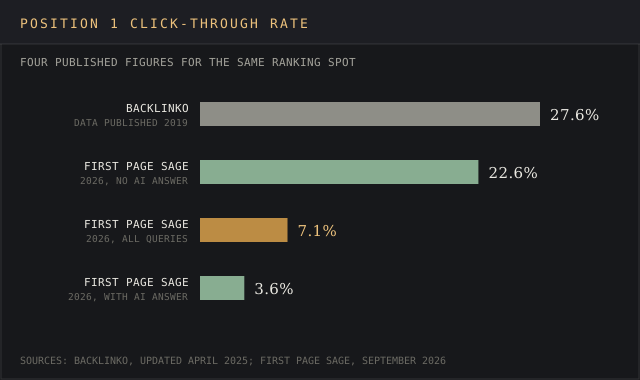
The average click through rate of the first organic result depends on which study you read and what sits above it. Two studies give four different figures, because they sample different years and query mixes.
| Study | Position 1 CTR | Data |
|---|---|---|
| Backlinko | 27.6% | 4 million search results, published 2019, updated April 2025 |
| First Page Sage, no AI answer | 22.6% | 3.67 billion impressions, March to August 2026 |
| First Page Sage, blended | 7.1% | Same data, all queries |
| First Page Sage, with AI answer | 3.6% | Same data, queries with an AI answer |
Copy these lines into an email, fill them in and send. I reply with scope and a price within 2 to 3 business days.
Open the emailIn Backlinko's study, the first organic result took 27.6% of clicks, and the top result was 10 times more likely to be clicked than the tenth, and only 0.63% of Google searchers clicked anything on page two, which makes a click from page two a long shot. First Page Sage's September 2026 report draws on Google Search Console data from 1,184 domains, which is why its numbers run lower. It counts every impression, including searches where nobody clicks.
Featured snippets now get an 11.4% CTR and show on 6.8% of queries, down from roughly a third in 2025, First Page Sage reports. In the same data, the Google local pack averages a 13.1% CTR across its three spots, higher than any organic position below the first.
Title tags and meta descriptions
Meta descriptions shape the snippet searchers read under each result in the search rankings. Google rewrote the hardcoded meta description 62.78% of the time in Ahrefs' study of 20,000 keywords, and 25.02% of top-ranking pages had no meta description at all. Meta titles and title tags still matter more, because the title carries the query's words into the ranking and the clickable headline.
Organic search against paid search
Organic clicks cost nothing per visit, which is the core of the SEO case. Paid search clicks averaged $5.42 across Google and Microsoft Ads between April 2025 and March 2026, with an 8.18% average conversion rate, per WordStream by LocaliQ. A page that ranks for a query with a monthly search volume of 1,000 and earns a 7.1% CTR gets about 71 clicks a month, worth roughly $385 at that average CPC, by our arithmetic.
Both channels share the same search results page on most search engines, and ads sit above the organic search results on commercial queries. To get up to speed on the paid side, our search engine marketing statistics report covers it in full.
Zero click searches
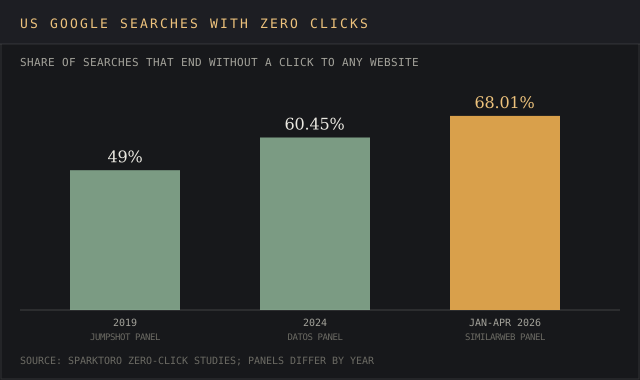
Zero click searches are Google searches that end without a click to any website, and in 2026 they're par for the course. SparkToro first measured 49% in 2019, and the share has risen at every reading since. In January to April 2026 it reached 68.01% of US searches, and the share of searches that led to another Google search rose 7.2 points over the two years, Search Engine Land reported.
Want a trend chart like this for your own market? Send the metric and the years.
Email a briefThe panels differ by year, Datos in 2024 and Similarweb in 2026, so the trend is approximate and SparkToro says so. The study also excludes searches inside Google's mobile app, where zero-click rates may run higher. The UK came out highest of the six countries measured, at 69.5%.
A zero-click search can still deliver value. A searcher who reads a business's hours, phone number or rating on the Google search results page still acted on SEO work. The click is a smaller slice of what a ranking delivers, so web traffic alone undercounts online visibility. Organic traffic reports in analytics miss the searchers who got their answer on the search results page itself.
Google AI Overviews statistics
Google AI Overviews now show on close to half of tracked searches. BrightEdge measured AI Overview presence rising from roughly 30% to 48% of tracked keywords over a year, a 58% increase, with just over half of queries still returning a standard results page.
Semrush's tracking shows how fast the spread happened. AI Overviews appeared on over 13% of US desktop searches in March 2025, up from 6% in January, and 88.1% of the queries that triggered them were informational, Search Engine Land reported. By August 2026, a Semrush panel of 400 commercial keywords showed AI Overviews on 88% of them, up from 45.75% in September 2025, per a later Semrush study.
The rollout rose and fell during 2025. Semrush's study of more than 10 million keywords, refreshed on 15 December 2025, found AI Overviews on 6.49% of keywords in January 2025, a peak of 24.61% in July and 15.69% by November. Over the same months the informational share of triggering queries fell from 91.3% to 57.1%, as Google moved AI Overviews into navigational and commercial search queries.
On keywords that gained an AI Overview between May and October 2025, Semrush measured the zero-click rate falling from 33.75% to 31.53%. That sits against the click losses below because Semrush measured whole results pages while the CTR studies measured the pages ranking in them.
Branded searches followed. Ahrefs found AI Overviews on 83% of branded queries in September 2026, from 232.8 million US desktop crawls, a 12-point rise since July.
What AI Overviews do to clicks
Pew Research Center tracked 900 US adult internet users through March 2025 and found that users clicked a traditional search result on 8% of visits with an AI summary, against 15% without one. Only 1% clicked a link inside the summary. Users ended their browsing session on 26% of pages with a summary, against 16% without.
- Ahrefs: the top-ranking page gets a 58% lower average CTR when an AI Overview appears, per its updated study
- Seer Interactive: organic CTR on AI Overview queries fell 61%, from 1.76% in June 2024 to 0.61%, per its September 2025 update
- First Page Sage: position one falls from 22.6% to 3.6% CTR with an AI answer present
The direction is the same in every study, though the jury's still out on the size of the drop, which varies with the sample. SEO professionals now track AI citations and brand mentions next to rankings, since a page cited in an AI Overview can win visibility without a click. Our AI share of voice report covers how to measure it.
AI SEO statistics: AI generated content and AI tools
74% of new web content contains AI generated content, and 87% of marketers surveyed (769 of 879) use AI to create or help create content, according to Ahrefs' AI SEO statistics. A 2026 survey of 204 SEO practitioners cited by Mordor Intelligence found 57% using AI tools to restructure existing content, headings and answer blocks.
AI search still sends little traffic next to Google. Ahrefs measured Google sending 345 times more traffic than ChatGPT, Gemini and Perplexity combined. Within that small AI slice, ChatGPT accounts for 77.97% of AI referral traffic and Perplexity 15.10%, per SE Ranking. Our AI traffic report tracks how much of a site's visits AI tools drive.
Those few AI visitors convert well. AI search sent 0.5% of Ahrefs' own traffic and 12.1% of its signups, so its AI search visitors converted at 23 times the rate of organic search visitors, Ahrefs reported in June 2025. That's one site's data, and Ahrefs says so.
Users also split their search intent across more places, a shift Positive Surfer's 2026 SEO trends report describes as fragmenting across alternative discovery platforms. For SEO, that adds places to rank beyond search engines, while Google and other search engines still send the bulk of search traffic.
Pages, backlinks and top ranking pages
Ahrefs' study of about 14 billion pages found 96.55% get no Google traffic at all, and another 1.94% get between one and ten visits a month. Its index held about 20 million pages with zero backlinks from other domains, and only 2,997 of them got more than 1,000 monthly search visits. A page with steady Google traffic is the needle in a haystack.
Backlinks still separate the top result from the rest. Backlinko's analysis of 11.8 million search results found the first result has 3.8 times more backlinks than positions two to ten, and three times as many referring domains. The average first-page result ran to 1,447 words.
- 94.74% of keywords get 10 or fewer searches a month, per Ahrefs
- 72.9% of pages in Google's top 10 are more than three years old, per Ahrefs
- 30.9% of featured snippets come from the page ranking first, per Ahrefs
The long tail holds most of the web's queries even though each keyword's monthly search volume is small, which is why a page targeting one low-volume query can still earn steady organic traffic. Link building for those pages is a long game, and the age of top ranking pages shows it, since most took years to get there. Our link building statistics report covers link building costs and which tactics SEO specialists use.
Internal links and technical SEO
Technical SEO covers the site architecture, crawl errors, page speed and structured data that let search engines read a site. Google Search Console reports crawl and indexing problems for free and is worth keeping an eye on after every site change. Internal links decide how ranking signals flow between pages.
Page speed is the technical SEO issue with the clearest user data. 53% of mobile visits are likely to be abandoned if a page takes longer than three seconds to load, Google reported from an analysis of 10,000+ mobile domains in September 2016. A later Google and SOASTA study found the probability of a bounce rises 113% as load time goes from one second to seven.
Mordor Intelligence's technical SEO services report sizes that segment at $15.73 billion in 2025, growing to $28.37 billion by 2031.
SEO industry market size
The SEO industry market size depends on the research house. Four of the five published estimates below give a 2025 figure for the global SEO services market, from $74.78 billion to $92.74 billion, a gap of $18 billion, and their long-range forecasts drift further apart.
| Research house | Base estimate | Forecast | CAGR |
|---|---|---|---|
| Mordor Intelligence | $74.9B (2025), $83.98B (2026) | $148.86B by 2031 | 12.12% |
| Market Research Future | $74.78B (2025) | $134.83B by 2035 | 6.07% |
| IMARC Group | $80.7B (2024) | $339.3B by 2033 | 16.44% |
| MarkNtel Advisors | $87.43B (2025), $92.11B (2026) | $108.27B by 2032 | 2.73% |
| The Business Research Company | $92.74B (2025) | $203.83B by 2030 | 17.1% |
- The country, service line or tool category to size
- Regions, years and segments
- Where it runs: blog, white-label, gated or lead magnet
- Whose byline goes on it
- Deadline
- 2,500+ words, human-written
- Every figure linked to its source
- Yours to publish, under your name or none
- Hosting here for +$200, with your sponsored links
Mordor's forecast runs from $83.98 billion in 2026 to $148.86 billion in 2031, a 12.12% CAGR. The base years agree within about 25%, and the forecasts spread from $108 billion to $339 billion. The difference comes from scope. Some houses count freelancers, in-house teams or content services as part of SEO services, and each picks its own growth assumption. These forecasts are far from set in stone, so a pitch deck quoting one figure should name the house and the year.
Inside Mordor's global SEO services market figures, on-page work accounted for $31.29 billion in 2025, small and medium enterprises for 58.40% of spend and North America for 33.90% of revenue. Retainer and subscription models held 61.46% of the market in 2026.
SEO salaries and the cost of SEO services
The median SEO salary in Ahrefs' survey was $58,288 in 2024, up from $49,211 in 2023, per its SEO salary study. In the UK, Reboot Online's analysis of 8,318 job adverts from 2025 and 2026 puts the median at £39,719 and the mean at £43,426.
| UK SEO pay, 2025 to 2026 | Figure |
|---|---|
| Median SEO salary | £39,719 |
| Mean SEO engineer salary | £47,772 |
| Mean salary in London | £50,774 |
| Median SEO director salary | £82,117 |
| Highest advertised SEO specialist salary | £163,482 |
By role and place, SEO engineers earn a mean of £47,772 and SEO directors a median of £82,117 in Reboot's data. London pays a mean of £50,774, and the top advertised salary for an SEO specialist reached £163,482.
How much SEO services cost
Ahrefs' SEO pricing survey found 78.2% of providers charge monthly retainers for some or all of their work. The most common retainer band was $501 to $1,000 a month, chosen by 20.4% of respondents, and 24% charge $75 to $100 an hour. For one-off projects, 21.2% charge $2,501 to $5,000.
Ahrefs' SEO pricing survey found 78.2% of providers charge monthly retainers for some or all of their work, and the most common band, $501 to $1,000 a month, was chosen by 20.4% of respondents.
SEO providers charging monthly retainers for some or all of their work
Source: Ahrefse.g. SEO pricing in your country or niche
Source: linked, checked, datedReboot Online reports an average SEO cost of just over £6,820 per client in 2025 from its own data, and £4,010 for SEO consultancy. Software sits on top of service fees, and our SEO tools pricing report lists what 16 vendors charge for SEO tools, from free plans upward. For a single job, rank tracker pricing runs $69.86 to $299 for the same 1,000 keywords.
SEO ROI
Return on SEO is measured over months, since 72.9% of top-10 pages are over three years old and most SEO campaigns take time to compound.
First Page Sage, an SEO agency reporting its own campaigns from 2021 to 2025, puts ROI at 702% for B2B SaaS with a 7-month break-even, 1,389% for real estate and 317% for eCommerce. It says positive ROI arrives over 6 to 12 months, with the peak in the second or third year. Those are first-party figures from a firm that sells SEO, so read them as an upper reference.
First Page Sage's 2026 CAC benchmarks put organic customer acquisition below paid acquisition in 25 of 27 B2B industries, the clearest cost argument for SEO next to paid search. Our SEO ROI calculator runs the numbers for your own traffic and conversion rate.
Local SEO statistics
Local SEO statistics measure how people find nearby businesses through search engines. Local SEO wins visibility in the Google local pack, Google Maps and local search queries such as "near me" searches. These local SEO statistics come from BrightLocal's 2026 consumer survey, Google's own research and First Page Sage's CTR data.
In 2016, Google said 30% of mobile searches were related to location. The same research found that 76% of people who search on their smartphone for something nearby visit a related business within a day, and 28% of those searches result in a purchase, per Think with Google. Those local mobile searches are the most direct line from a local search to a sale.
Local search results look different from national search results, and these local SEO statistics show why. A local search shows the map pack above the organic search results, pulls in reviews and hours, and changes with the searcher's location. For local queries, search engines weigh distance, relevance and prominence, a mix Google describes in its local ranking help page.
Online business reviews
97% of US consumers read reviews for local businesses, BrightLocal's Local Consumer Review Survey found from 1,002 respondents in February 2026. Consumers read reviews on Google most, at 71%, down from 83% in 2025.
- 68% require at least a 4-star rating before using a local business
- 31% will only use businesses rated 4.5 stars or higher, up from 17% in 2025, as consumers raise the bar
- 89% expect owners to respond to reviews
- 80% are likely to use a business that responds to all of its reviews
Recency and volume both count. 74% of consumers care only about reviews from the last three months, and 47% won't use a business with fewer than 20 reviews, BrightLocal found. 85% are more likely to use a business after reading positive reviews, and 54% visit the business website next, which ties local business reviews straight to website traffic.
Ignoring reviews is a red flag for customers. 42% of consumers are unlikely to use a business that ignores its reviews, 50% are put off by templated replies, and 81% expect a response within a week.
Local business reviews feed rankings as well as decisions, since review count and rating are part of what Google weighs for the local pack. A business with a 3.9 rating loses 68% of consumers before they read a word.
AI in local search
45% of consumers now use ChatGPT or other AI tools for local business recommendations, up from 6% a year earlier, making AI the third most used source in BrightLocal's 2026 survey. 40% say they trust AI platforms for those recommendations. AI answers draw on the same local business information that search engines use, so an accurate Google Business Profile and consistent listings feed both.
Where local search happens
Local search and local SEO spread across more platforms than Google, and local search results on Apple Maps draw on different data. The average consumer uses six review sites, and Apple Maps use nearly doubled from 14% to 27% between BrightLocal's 2025 and 2026 surveys, while local news sites fell from 48% to 29%. Google still leads at 71% as the review site consumers use most.
Many small firms still lack the basics. Only 35% of the small businesses in BrightLocal's 2026 survey have a Google Business Profile, and 40% have a dedicated website. Those businesses fly under the radar in local search, so local SEO starts with listings and a site before any ranking work.
Google Business Profile and the local pack
A Google Business Profile carries the hours, phone number, photos, posts and reviews that show in the Google local pack and Google Maps. Google Business Profile conversions, such as calls, direction requests and website clicks, show up in the profile's own performance view. The 13.1% local pack CTR in First Page Sage's data beats every organic position below the first, which is why a profile is the cheapest piece of local SEO to get right.
A dedicated local marketing strategy pairs the profile with local business websites that carry the same name, address and phone number, location pages for each branch, and reviews. Local SEO is particularly valuable for small and medium-sized businesses, which Mordor counts as 58.40% of SEO services spend.
Visual search statistics
Google Lens handles more than 25 billion queries a month, and 1 in 5 Lens searches shows commercial intent, according to Google's own search trends report. A picture is worth a thousand words to a shopper, and visual search runs on the same index as text search, so image alt text, product images and structured data decide which web pages a Lens query surfaces.
For a retail or local business, a photo search for a product often returns a shopping result or a nearby store. That makes product images and the Google Business Profile photo set part of SEO, alongside text on the page.
SEO statistics on voice search
Voice search statistics are thinner than other SEO statistics, and the best-known voice search usage research is now dated. Backlinko's 2018 study of 10,000 Google Home results found the average voice search result is 29 words long and loads in 4.6 seconds. 70.4% of voice search answers came from HTTPS pages, 74.9% from pages ranking in the desktop top three, and 40.7% from a featured snippet.
Each voice search result draws on the same organic search results as typed queries, so voice search rewards the pages already ranking near the top. Mordor Intelligence forecasts voice search as the fastest-growing access channel for SEO services, at a 22.2% CAGR from 2027 to 2032, from a small base next to mobile search, which held 59.74% of the market.
Spoken queries and AI chat now blur together on most phones. A spoken question to a phone assistant often returns an AI-written answer, which puts voice search and its optimization in the same bucket as AI Overviews and featured snippets, all of which favour short, direct answers near the top of a page.
What the SEO statistics say about SEO strategy for 2026
Read together, these SEO statistics 2026 figures point to five priorities for an SEO strategy in 2026. Each one rests on a figure above.
- Zero in on specific search queries: 94.74% of keywords get 10 or fewer searches a month, so the long tail holds the volume
- Build links to the pages that matter: the first result carries 3.8 times the backlinks of positions two to ten
- Write for answer engines: AI Overviews show on about half of tracked queries and favour short, direct answers
- Fix mobile first: 59.9% of web traffic comes from phones, and search engines rank the mobile version
- For a local business, put reviews and the profile ahead of content: 97% of consumers read reviews, and the local pack outdraws organic positions two to ten
Local intent changes the plan the most. A query with local intent, such as a service plus a town name, triggers the local pack and Google Maps, and the business that wins it gets calls and visits without a website visit. Search engines read local intent from the query and the searcher's location, so the same keyword can show different search results a few miles apart, and local search rank trackers check from set locations.
Local queries also reward a different kind of page. Web pages for a local business need the name, address and phone number on the page, location-specific content and reviews, while national pages compete on depth and backlinks. An SEO strategy that treats both the same way under-serves one of them.
SEO trends for 2026
The SEO statistics for 2026 point the same way from several angles, across search engines and AI answers alike. Zero click searches climbed to 68%, AI Overviews reached about half of tracked queries, and the click-through rate on position one fell sharply wherever an AI answer appears. Google's 91% share and 5 trillion yearly searches mean the channel is still the largest source of website traffic for most business websites.
- Measure visibility beyond clicks: AI citations, brand mentions and impressions in Google Search Console
- Write content marketing pieces that answer a question in the first lines, since AI Overviews and featured snippets lift those answers
- Keep technical SEO clean so search engines and AI crawlers can read every page
- Treat reviews and the Google Business Profile as ranking work for any local business
Our content marketing statistics report covers how teams plan and budget content, and the competitive intelligence SEO tools ranking compares the platforms SEO professionals use to track rivals.
Delivered for your site and your byline. Hosting here is optional.
Frequently asked questions
Is SEO dead in 2026?
SEO is still the largest source of search traffic. Google handles more than 5 trillion searches a year and holds 91.05% of search engine market share. SEO now competes for visibility on the results page as well as traffic, since 68.01% of US Google searches ended without a click in early 2026.
Does local SEO still work?
Yes. 76% of people who search on a smartphone for something nearby visit a related business within a day, per Google, and the local pack averages a 13.1% CTR in First Page Sage's 2026 data. 97% of consumers read reviews for local businesses.
How much should I pay for local SEO?
The most common SEO retainer in Ahrefs' pricing survey was $501 to $1,000 a month, and the most common hourly rate $75 to $100.
What percentage of Google searches are local?
In 2016, Google said 30% of mobile searches were related to location. Our search in November 2026 turned up no later Google publication with a newer share of local intent.
How many searches does Google get per day?
About 14 billion, based on Google's statement in 2025 that it sees more than 5 trillion searches a year.
What is the 80/20 rule in SEO?
It's the idea that a small share of pages or keywords drives most results. Ahrefs' data fits it, since 96.55% of pages get no Google traffic, so the few pages that rank carry nearly all of a site's search traffic.
What are the main SEO KPIs?
Organic traffic, online visibility on search engines, rankings for target keywords, click-through rate, conversions from organic search, backlinks, and in 2026 AI citations. Google Search Console reports clicks, impressions, CTR and average position for free.
What's a good SEO score?
Each SEO tool scores pages on its own scale, so a 92 means different things in different tools. Judge SEO by rankings, clicks and conversions from organic search.
What is the best SEO tool in 2026?
It depends on the job. Our Ahrefs vs Semrush comparison covers the two largest suites, and the SEO tools pricing report lists 16 vendors by price.
Bottom line
The top SEO statistics for 2026, and the local SEO statistics beside them, describe a channel that's still the largest on the web and pays out fewer clicks per search. Google processes more than 5 trillion searches a year with a 91% share, while 68% of US searches end without a click and AI Overviews show on about half of tracked queries.
The market keeps growing regardless, with 2025 estimates of $75 billion to $93 billion depending on the house. For local businesses, reviews and the Google Business Profile carry the most weight per dollar. For everyone else, the work now covers rankings, AI citations and on-page answers, measured against dated sources.
SEO agencies, tool vendors and in-house teams publish reports like this one as lead magnets and client briefs.
A report on your topic for a blog page, gated content or a lead magnet.
Written for your client and published under their brand, with my name left off.
Your report on marketintelligencetools.com, with 2 to 3 CTAs carrying your sponsored links.
Default terms: the report is yours to publish, and I keep the right to republish it on this site behind a gate, outside Google's index.
The studies behind each SEO figure, and the number Google keeps back
Search volume comes from Google, as reported by Search Engine Land, and market share and device split from StatCounter (October 2026). Zero-click data is SparkToro's 2019, 2024 and January to April 2026 studies, built on Datos and Similarweb panels. Click-through rates come from Backlinko's 2019 study, First Page Sage's September 2026 report (1,184 domains) and Ahrefs.
AI Overview figures come from BrightEdge, Semrush (refreshed 15 December 2025, plus its August 2026 commercial panel), Ahrefs (September 2026), Pew Research Center (March 2025) and Seer Interactive (September 2025). AI referral shares are SE Ranking's, and the search fragmentation point is Positive Surfer's 2026 SEO trends report.
Page, keyword and backlink data come from Ahrefs and Backlinko. Speed figures are Google's analysis of 10,000+ mobile domains and the Google and SOASTA research on Think with Google. Market sizes come from Mordor Intelligence, Market Research Future, IMARC Group, MarkNtel Advisors and The Business Research Company, with the technical SEO figure read from Research and Markets.
Pay comes from Ahrefs' salary and pricing surveys and Reboot Online's analysis of 8,318 UK job adverts. Local and visual search figures come from Think with Google, Google's local ranking help page, BrightLocal (February 2026) and Google's search trends report. Voice search is Backlinko's 2018 study.
All figures were checked on 19 November 2026. Google publishes no aggregate click-through rate for organic results, and its 2025 search volume figure was the first it had shared since 2016.