Research Brief Template
 By Jan Suski. I go deep on every review, checking every number against its source and digging up details other coverage misses, a habit from six years of SEO and link building for tech companies. Bylines at Brand24 and Senuto. How the scoring works.
Get the research brief template
A Word brief in ten sections on three pages, from background and objectives to budget, deadline and sign-off, written so an agency can respond with a proposal without a follow-up call.
Download DOCXA research brief template is the document a client fills in to describe a future market research project before anyone designs it: what the business needs to decide, what the research has to find out, who to ask, and the budget and deadline. The file on this page is a Word document with ten sections on three pages, guidance in every section, a worked example filled in, and a one-page proposal checklist for agencies.
This page covers what each section asks for, how to write a research brief in six steps, and a full market research brief for a hypothetical coffee roaster commissioning a survey from an agency. It's written for marketing and insights teams at companies briefing an outside agency, and for product teams briefing an in-house researcher; the same sections apply in academic and UX research.
The brief is the cheapest point to fix a study. Every gap in it becomes a question the agency asks, a guess the agency makes, or a line in the final report that answers something nobody asked. In market research, the devil's in the details, and the brief is where the details get written down.
Download the free research brief template
Download the research brief template (DOCX)Ten sections on three pages, each with a grey italic prompt and the Harbor & Pine example entry, plus a proposal checklist for agencies on page four.
The file opens in Word, Google Docs and LibreOffice. Every section is a two-column table (prompt on the left, answer on the right), so you can enter answers anywhere and the file survives being pasted into an email or a procurement portal.
What a research brief does
A research brief is a description of a research project to be carried out in the future, in the definition the research platform We Are Testers uses in its guide to the market research brief. The client writes it and sends it to one or more agencies, which use it to design a proposal and can suggest improvements to the methodology the client had in mind. The same information also goes to internal research partners when no agency is involved.
It does three jobs. It puts the client team on the same page before money is spent. It gives agencies the same information, so the responses clients get back can be compared line by line. And it sets the benchmark the final report gets judged against: if the brief says the study must size purchase intent by state, a report without state-level figures is incomplete, and everyone can see it. The brief is the description of success, written before the analysis starts.
A brief also stops scope creep. Every request that arrives mid-project gets checked against the objectives section; anything outside it becomes a separate study with its own budget. That rule is the reason objectives should be set in stone before the agency starts fieldwork.
The ten sections of the research brief template
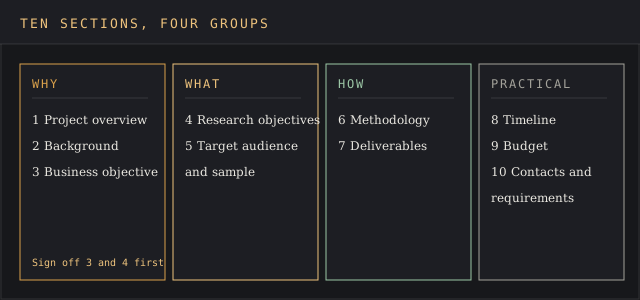
The sections follow the order an agency reads in, and the process of filling them in runs the same way: why the study exists, what it must answer, how it could be done, and the practical constraints. Jakub Wierusz's checklist for SurveyLab uses ten sections in the same order, from company background to contact information.
| Section | What goes in it |
|---|---|
| 1. Project overview | Title, brief owner, date, version |
| 2. Background | Company, market, competition, trends, previous research |
| 3. Business objective | The decision the findings feed, and its date |
| 4. Research objectives | Three or four things the research must find out, and the information each needs |
| 5. Target audience and sample | Population, age and other criteria, sample size, quotas |
| 6. Methodology preferences | Preferred method, or open to proposal; questions that must stay comparable |
| 7. Deliverables | Topline, final report format, data files, and how results are delivered |
| 8. Timeline | Milestones from brief to final report, with the decision deadline |
| 9. Budget | A range, and what it includes |
| 10. Contacts and requirements | Primary contact, sign-off, consent and data rules, proposal format |
Sections 3 and 4 carry the brief. We Are Testers calls them strategic objectives (what you'll do with the research) and information objectives (the specific answers it has to give), and says the most important thing in a market research brief is knowing what you're going to do with the research. In this case, the business objective tells the agency which answers matter, and the research objectives tell it what information to collect.
How to write a research brief, step by step
- Start with the business objective. Write the decision and the date it gets made, then check it with whoever makes it and take action on any change before you continue.
- Write three or four research objectives. IFF Research's guide on how to write an effective research brief suggests around three or four overarching aims, with research questions under each.
- Fill in the background, including previous research, competitor brands and market trends, so the agency doesn't pay to rediscover them.
- Define the target audience as screening criteria an agency can field: age, location, purchase behavior, and any quotas.
- Set the practical frame: a budget range, a timeline with a draft and a final report, and the deadline.
- Add contacts, the sign-off process and the proposal requirements, then share the same file with every agency by email on the same day.
On timing, IFF's guide asks for start and end dates at a minimum, and separate milestones for a draft and a final report, with enough time between them for review and revision. On money, a budget range in the brief lets agencies propose a method that fits it; SurveyLab notes it rules out costly options early. Leaving it blank sends every agency off on a wild goose chase toward its own guess, and the people reading the proposals end up comparing studies of three sizes.
Worked example: a cold brew market research brief
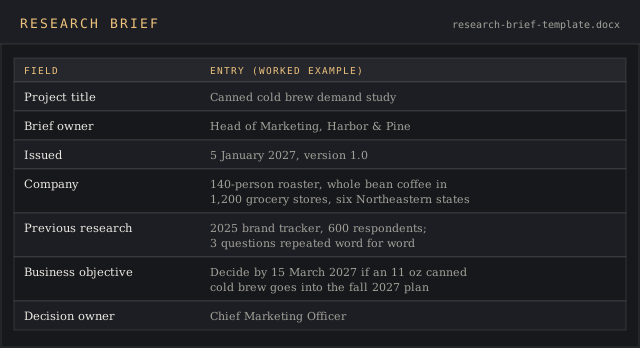
Harbor & Pine is a hypothetical 140-person coffee roaster selling whole-bean coffee through 1,200 grocery stores in six Northeastern states. Two retail partners have asked for a canned cold brew. The marketing team needs a market research agency to provide accurate demand figures before the 2027 retail plan is set, and the brief below is what it sends to three agencies.
| Section | Harbor & Pine entry |
|---|---|
| Business objective | Decide by 15 March 2027 if an 11 oz canned cold brew goes into the fall 2027 retail plan |
| Research objectives | 1. Purchase intent among current buyers and among category buyers. 2. Price acceptance at $3.49 and $3.99 per can. 3. Grocery or convenience as the first channel. 4. Brand fit against private-label and national brands. |
| Previous research | 2025 brand tracker, 600 respondents; three of its questions must be repeated word for word |
| Target audience | Adults aged 21 to 54 in the six states who bought ready-to-drink coffee in the past 3 months |
| Sample | 800 completes, quotas by state and age band, plus a boost of 200 current Harbor & Pine buyers |
| Methodology | 12-minute online survey preferred; agencies may propose an alternative design |
| Deliverables | Topline, final report as a slide deck, crosstabs, raw data in CSV and SPSS format |
| Budget | $28,000 to $35,000, including panel costs and incentives |
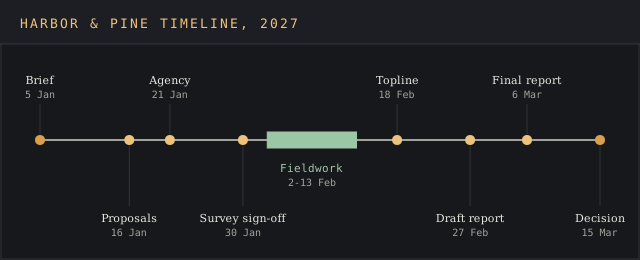
The timeline works back from the decision. Brief issued 5 January; agency questions by 9 January; proposals due 16 January; agency chosen 21 January; questionnaire signed off 30 January; fieldwork 2 to 13 February; topline 18 February; draft report 27 February; final report 6 March. That leaves nine days between the final report and the planning meeting, enough for a second read.
The repeated tracker questions are the detail agencies most often miss. Because the brief names them, every proposal has to show how they'll be included, and the findings stay comparable with 2025. The brief asks agencies to respond by email with a proposal of no more than eight pages, and names the four criteria it will be judged on: method fit, cost, timeline and team. Those four drop straight into a vendor evaluation scorecard when the proposals arrive.
Common mistakes in a research brief
- Objectives with no decision behind them. "Understand the cold brew market" can't be finished; "decide by 15 March" can.
- A list of 15 research questions. If everything is a priority, the agency picks for you.
- No budget. Proposals come back at three prices for three different studies and can't be compared.
- Prescribing the method and the questions. Give agencies room to suggest a better research design and a way to test it; that's part of what you're paying for.
- Cutting corners on the background. An agency that doesn't know the 2025 tracker exists will propose to measure the same thing again.
- One deadline only. Without a draft report milestone, review happens in the last two days.
Most of these come from writing the brief in one sitting the day before it goes out, which sends the agencies back to the drawing board after the first call. Have someone outside the project read it and say back what the study is for; if they can't, the agency won't either.
FAQ
What should be included in a research brief?
Background, the business objective, research objectives, target audience and sample, methodology preferences, deliverables, a timeline, a budget and contacts. The template on this page puts those into ten sections, and the guides from SurveyLab, IFF Research and We Are Testers each cover the same ground in their own order.
What is the difference between a research brief and a research proposal?
The client writes the brief to describe what it needs; the agency writes the proposal in response, setting out the research design, sample, method, price and team. A good brief makes proposals from different agencies easy to compare.
How long should a market research brief be?
Two to four pages for most projects. The worked example fits on three. Length matters less than clear objectives and clear requirements; if the brief needs more than four pages, the background section is usually doing the work of a report.
Bottom line
Use this research brief template when a market research study is going to an outside agency, or to an in-house team that will spend more than a few days on it. Fill in sections 3 and 4 first and get them signed off, and the other eight sections follow from them. To create a brief for a second study, copy the file and keep the background section; it rarely changes between projects.
For interviews run by your own team, the customer research template carries the plan, guide and findings in one file. For a survey, pair the brief with the research survey template, and when the agency's findings arrive, the market research report template shows how to present them, with its own one-page brief for smaller projects.