Digital trend marketing: how to test a trend before it gets budget
 By Jan Suski. I go deep on every review, checking every number against its source and digging up details other coverage misses, a habit from six years of SEO and link building for tech companies. Bylines at Surfer, Brand24, and Senuto. How the scoring works.
The short version 11 points · 40 seconds
- 01Trend tracking is a market intelligence jobA trend earns money on primary data
- 02US internet ad revenue hit $258.6 billion in 2024Social ad revenue grew 36.7%, per IAB and PwC
- 03Four tests separate a durable shift from a fadAdoption, platform, measurement, regulation
- 04AI search has the hardest usage numbers of any trendOver 2 billion monthly AI Overviews users
- 05Short-form video passed the platform test earlyYouTube Shorts tops 200 billion daily views
- 06TikTok Shop gave social commerce US checkout in 2023Launched September 12 with creator affiliates
- 07Personalization pays when it runs on first party dataMcKinsey puts the lift at 10 to 15% of revenue
- 08Chrome kept third-party cookies in April 2025Apple Mail began hiding opens in 2021
- 09Privacy law prices some tracking tactics outSephora's 2022 California settlement: $1.2 million
- 10A two-person team can run trend analysis monthlyGoogle Trends, one tracker sheet, a capped pilot
- 11A trend earns its budget only by moving a business metricBudgets sat flat at 7.7% of company revenue
Trend marketing in digital channels is the practice of spotting a shift in how buyers search, watch, shop or talk on social media and the wider web, checking it against primary data, and deciding how much budget it gets. It fails in one predictable way: a team jumps on the bandwagon after a conference talk and funds a channel its buyers never adopted.
This page covers the latest digital marketing trends of 2025 and 2026 with the evidence behind each one, the four tests that decide if a trend deserves money, the two platform decisions that rewrote cookie and email plans, and a monthly routine a two-person team can run.
It's for marketing professionals & digital marketers who defend a budget line each quarter.
What digital marketing trends are, and what tracking them involves
A digital marketing trend is a change in buyer behavior or platform mechanics on search engines, social media or retail sites that shows up in spend, usage or policy data across several platforms and quarters. TikTok Shop's US launch on September 12, 2023 qualifies.
The TikTok newsroom announcement describes a Shop tab, LIVE Shopping inside the For You feed and a commission-based affiliate program for creators, enabling businesses to sell inside the feed.
Tracking these shifts is a branch of market intelligence, the same discipline laid out in our guide to market intelligence fundamentals, pointed at marketing channels. The inputs are platform disclosures, ad revenue reports, regulator decisions and search demand. The output is a short list of digital marketing trends ranked by how much budget each one deserves in this quarter's digital marketing strategy.
The source is what separates trend tracking from trend chasing. A list of top digital marketing trends quoting a percentage with no link to the survey behind it gives a marketer nothing to check, and talk is cheap. An ad revenue report with a published methodology gives the same marketer a number to plan against.
Where digital marketing budgets moved in 2024
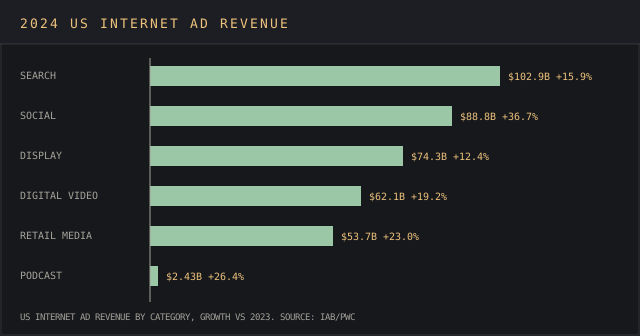
Money already spent is the clearest trend signal there is. The IAB/PwC Internet Advertising Revenue Report, published April 17, 2025, put US internet ad revenue at $258.6 billion for 2024, up 14.9% on 2023. Its category split shows which marketing channels advertisers backed with cash across the US digital marketing landscape.
| Ad category (IAB/PwC) | 2024 US revenue | Growth vs 2023 | Share of total |
|---|---|---|---|
| Search | $102.9B | 15.9% | 39.8% |
| Social | $88.8B | 36.7% | 34.3% |
| Display | $74.3B | 12.4% | 28.7% |
| Digital video | $62.1B | 19.2% | 24.0% |
| Retail media | $53.7B | 23.0% | 20.8% |
| Podcast | $2.43B | 26.4% | 0.9% |
The shares add up past 100% because IAB's categories overlap; a video ad sold on a social app counts in both rows.
Social media is the standout. IAB credits the 36.7% jump in social media ad revenue to advertisers putting more into user generated content and creators.
Search still holds the lion's share at $102.9 billion, which tells a team cutting search engine optimization to fund a newer channel exactly how much demand it's walking away from. Our advertising industry statistics report carries the global split.
Four tests a trend passes before it gets budget

Every one of the latest trends on a 2026 list can be checked with the same four questions, in order. A trend that fails the first one never reaches the fourth, which keeps the research cheap and marketing efforts pointed at channels that pass.
- Buyer adoption. Do your target audiences use the thing now, in numbers a platform or a survey firm has published?
- Platform commitment. Has the platform, be it Google or one of the social media platforms, shipped the feature to everyone, with ad products attached, or is it still a beta?
- Measurement. Can the result be traced to a KPI your finance team already accepts?
- Regulatory exposure. Does the tactic depend on customer data that a privacy law or a browser setting can switch off?
The first test needs the most care in marketing strategies built from trend lists. Adoption data has to come straight from the horse's mouth: a platform's earnings call, a regulator filing or a research firm's own release. Our guide to secondary market intelligence covers how to trace a figure back to the page that first published it.
Gartner's Hype Cycle methodology gives the second test a vocabulary. It names five phases: Innovation Trigger, Peak of Inflated Expectations, Trough of Disillusionment, Slope of Enlightenment and Plateau of Productivity. A trend sitting at the peak has press coverage and few shipped ad products. One on the slope has both.
The latest digital marketing trends, checked against the evidence
Seven digital marketing trends recur across trend lists published in the marketing world for 2025 and 2026, each tied to technological advancements in search, video or data. Here's how each one does against the four tests, with the primary figure behind it.
AI tools for content creation and marketing automation
Generative artificial intelligence has already passed the adoption test inside marketing teams. Gartner's 2025 CMO Spend Survey of 402 marketing leaders found that just 1% said GenAI investments weren't a priority. The returns they reported were operational: 49% cited improved time efficiency and 40% improved cost efficiency.
The same survey puts a number on the agency question. 22% of CMOs said GenAI let them rely less on external agencies, and 39% planned to cut agency budgets.
AI powered tools now draft briefs, create content variants and run marketing automation sequences that used to need a freelancer. Teams chain those steps, brief to draft to scheduled send, into one automated workflow with a person approving at each gate, and content creation software with AI built in now ships inside the writing, design and email software teams already pay for.
The editorial risk sits on the output side, because a model trained on the same public text produces similar phrasing for every brand that prompts it. The workable split for marketing strategies that use generative AI is artificial intelligence for data analysis and first drafts, and a human editor on anything published under the brand's message.
Low-effort AI copy reads the same across brands, so authentic human detail, such as a named customer, a real number or a founder's own words, is what makes a post worth reading. Our content marketing statistics report tracks how content marketing trends are shifting around AI output.
Artificial intelligence in search and the new search engine optimization
AI answers inside search results, at Google and at other search engines such as Bing, are the trend with the biggest measured audience. On Alphabet's Q2 2025 earnings call on July 23, 2025, the company said AI Overviews had over 2 billion monthly users, and that AI Mode had over 100 million monthly active users in the US and India.
That changes what an SEO strategy aims at, and a brand already writing answer-first pages is ahead of the curve. A brand cited inside an AI answer gets visibility even when the searcher never clicks, so search rankings and web traffic stop being the only scoreboard.
Keyword research still matters, but the unit of work moves toward answering search intent in clear, quotable passages of relevant content, backed by structured data, the schema markup that answer-engine optimization depends on. AI tools for keyword research now group relevant keywords by user intent, which speeds up that planning. The AI traffic report measures how much referral traffic AI assistants send in practice.
Page experience still counts toward search engine rankings. Google made Interaction to Next Paint one of the Core Web Vitals on March 12, 2024, replacing First Input Delay, per the web.dev announcement. Mobile devices carry most of that traffic: StatCounter measured mobile at 58.99% of worldwide page views in September 2026, more than half of the total.
Short form video content and video marketing
Short-form video passes all four tests. The same Alphabet call reported over 200 billion daily views on YouTube Shorts, and IAB's report called digital video the fastest-growing ad format of 2024, at nearly a quarter of total ad revenue.
For video marketing, content marketing and social media marketing teams, the practical question is production cost per test. Teams that create content in one vertical shoot can run it on Shorts, TikTok and Instagram Reels the same week, so one phone shoot feeds multiple platforms with video content. Teams that only produce polished brand films for one channel miss the boat on the volume these feeds reward.
Viewers share clips, click through to the brand's site and convert, so the measurement test for video is the conversion rate of the page each clip points to, read in your own analytics. Live streaming adds a real-time layer, and TikTok's LIVE Shopping lets a viewer buy during the stream.
Social commerce, influencer marketing and user generated content
Social media platforms now work as a discovery engine and a storefront at once, closing the sale inside the app. TikTok Shop's in-feed product tags and LIVE Shopping turned a video view into a checkout, and the affiliate program pays creators a commission on what they sell.
User generated content works as the social proof in that loop, and content marketing teams can repost it with the creator's permission. That's the mechanism behind social commerce, and it turns social media marketing into a sales channel with its own checkout data; our TikTok statistics page tracks how far the Shop has spread since.
Influencer marketing follows the same money. IAB tied social's 2024 growth to increased investment in user generated content, and creators, from celebrities down to micro-accounts with niche target audiences, are the ones producing it.
For smaller creators with niche followings, reach is small by design, so score an influencer test on brand awareness lift and engagement per creator. AI tools take on the screening step, summarizing a creator's recent posts and audience comments before anyone signs. The devil's in the details: contracts, usage rights and platform fees decide the margin. Our breakdown of influencer marketing platform pricing shows what eight vendors charge to find and manage creators.
Personalization built on first party data
Personalization has the strongest outcome data of any trend on this list. McKinsey's November 2021 study, The value of getting personalization right, or wrong, is multiplying, found that 71% of consumers expect personalized interactions and 76% get frustrated when they don't get them. It measured the usual revenue lift from personalization at 10 to 15 percent.
The catch is the fuel. Personalization that depends on cross-site tracking or bought lists carries regulatory exposure; personalization running on customer data a buyer handed over, such as purchase history and email preferences, keeps working when browser settings change.
Predictive analytics and data analysis on that owned data drive the dynamic content, such as a product block in a personalized email that updates with a reader's browsing in real time, and the send-time choices that shape customer experience, customer engagement and customer loyalty.
Voice search, visual search and conversational marketing
This group is where the adoption test does the most work. Voice search optimization means writing answers in full spoken sentences, which smart speakers and phone assistants read aloud. Visual search lets a shopper photograph a product to find it. Both belong on the watch list; keep an eye on your own analytics for spoken-style questions and image-led product searches from your buyers before funding either.
Conversational marketing is easier to test, because a chat assistant built on artificial intelligence can take over customer interactions on a single support or sales page, giving instant answers at any hour. Our chatbot statistics report tracks adoption with sourced figures.
Email marketing and SMS marketing
Email marketing runs on owned data, which keeps it clear of the cookie decision in Chrome. Its measurement changed in 2021 when Apple Mail let readers hide opens, and the reliable metrics now are clicks, replies and revenue per send. SMS marketing works on the same owned-list logic with stricter consent rules. Our email marketing statistics and SMS marketing statistics reports carry the benchmarks for both.
Two platform decisions that rewrote cookie and email plans
Forecasts of digital marketing trends break when a platform changes course, and two platform changes since 2021 forced rework on digital marketing efforts built around cookies and open rates.
The first is third-party cookies in Chrome. On April 22, 2025, Anthony Chavez, VP of Privacy Sandbox at Google, wrote in a Privacy Sandbox update that Google had decided to maintain its current approach and "will not be rolling out a new standalone prompt for third-party cookies." Teams that had rebuilt ad targeting for a Chrome without third-party cookies were planning against a change Google then shelved.
The second is Apple Mail. Apple's June 7, 2021 announcement of Mail Privacy Protection said the feature stops senders from using invisible pixels, helps users prevent senders from knowing when they open an email, and masks their IP address. Open rate stopped meaning what it used to for every Apple Mail reader who turned the feature on.
Both cases point to the same rule. Build on first party data and on metrics the platform can't switch off, and a reversal costs one slide in a deck.
Privacy rules decide which trends survive
Regulation is the fourth test for any digital marketing plan, and it has a price tag. On August 24, 2022, California's Attorney General announced a settlement with Sephora requiring $1.2 million in penalties under the California Consumer Privacy Act.
The state said Sephora let third-party companies place tracking software on its site and app, treated that as a sale of consumer data, and found the retailer ignored opt-out requests sent through Global Privacy Control signals.
The tactics involved, retargeting pixels for social media platforms and analytics tags, sit underneath many marketing materials and campaigns that never mention privacy at all. A digital marketing tactic that adds another tracker to the site adds exposure under the CCPA in California and the GDPR in Europe.
Consumer expectations about data now set the ceiling on how far marketing strategies built on personalization can go, and a brand whose stated brand values include privacy has to show it in the tag manager. Transparency about what gets collected is what persuades buyers to hand data over, and a data breach spends that trust in a single news cycle.
Running trend analysis with a small team
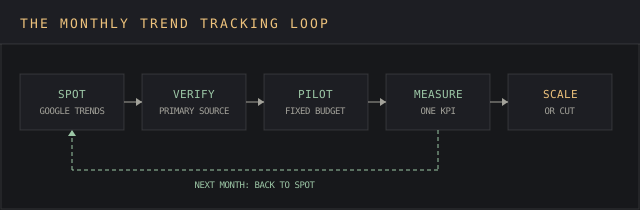
A small team can cover trend analysis in one monthly session, as long as the steps run in the same order every time and every trend goes through all five.
Start with demand. Google Trends draws on a largely unfiltered sample of real searches and scales each topic from 0 to 100 against all searches in that place and period.
That makes it a relative measure: a line climbing from 20 to 60 shows relative interest tripling, with absolute volume left out of the chart. Pair it with your own search console data to see the real numbers; teams with a few years of history can run predictive analytics on those exports to project next quarter's demand.
Then log it. Our free trend tracker template keeps each trend on one row with its source, test result and next review date, so a trend parked on the back burner gets a second look on schedule. Teams that outgrow a spreadsheet can compare the dedicated trend research tools, and those tracking competitors' campaigns across social channels can look at marketing intelligence tools.
Finally, cap the pilot. AI powered tools make test variants cheap to produce, which is a reason to run more small tests and fewer big ones. Gartner's survey found paid media takes 30.6% of marketing budgets, so a test funded at a few percent of the paid line keeps the downside small.
Putting all your eggs in one basket on an untested channel is how a quarter's pipeline goes missing. A team that wants faster signals can borrow the methods in our guide to real-time market intelligence.
Measuring if a trend earned its budget
A trend earned its budget when the marketing efforts behind it moved a number the business already tracks: pipeline, revenue, cost per acquisition or customer retention. Likes and impressions belong in the pilot notes.
Gartner's 2025 survey shows why the bar is high. Marketing budgets sat at 7.7% of company revenue for the second year running, and 59% of CMOs said they didn't have enough budget to execute their strategy. Marketing strategies that add a channel compete for the same flat pool, so a test that can't show marketing success against the key performance indicators the business tracks gets cut, and a team that cuts its losses early has money left for the next one.
Read between the lines of a pilot report, too. A content marketing series that lifts customer experience scores while revenue holds flat may still be worth keeping, provided the team says so up front and measures it that way. Our piece on why market intelligence matters covers how to tie research spend to decisions the business can audit.
FAQ
What are the current trends in digital marketing?
The trends with primary evidence behind them in 2025 and 2026 are AI search answers (over 2 billion monthly AI Overviews users), short-form video (over 200 billion daily YouTube Shorts views), social commerce, creator-led influencer marketing, AI tools in content creation, and personalization on data customers hand over. Voice and visual search stay on the watch list.
What is a trend analysis in marketing?
Trend analysis in marketing tracks a metric over time, such as search demand, ad spend by channel or consumer behavior on a platform, to see which way it's moving and how fast. Google Trends, ad revenue reports and your own analytics are the usual inputs, reviewed on a fixed schedule.
What are the 7 types of digital marketing?
A common seven-way split is search engine optimization, PPC advertising, social media marketing, content marketing, email marketing, influencer and affiliate marketing, and video marketing. Some lists swap in text-message campaigns or display advertising.
Is voice search worth a budget line in 2026?
Only when your own search data shows question-style queries from your target audiences. Writing answers in plain spoken sentences helps both voice search and AI answers, so the work can sit inside the existing SEO strategy without a separate budget.
How do privacy laws affect a current digital marketing strategy?
They decide which tracking a strategy can rely on. California's $1.2 million Sephora settlement in 2022 involved third-party trackers on a retail site, so any trend that adds tags to your pages needs a privacy review before launch.
Bottom line
Following digital marketing trends comes down to one habit: no trend gets money until primary data shows your buyers using it, the platform committed to it, a metric that can measure it and a privacy rule that won't switch it off. Technological advancements will keep producing new digital marketing trends, and the tests stay the same.
Getting it wrong costs in two directions. Marketing strategies that fund every trend on a list run a flat 7.7% budget dry before the winners show up. Ignore them and the channels growing 19% to 37% a year belong to whichever competitor tested them first, along with the competitive advantage of a year's head start in data.