AI marketing statistics 2026: 96% of big brands use AI, 30% are ready to scale it
 By Jan Suski. I go deep on every review, checking every number against its source and digging up details other coverage misses, a habit from six years of SEO and link building for tech companies. Bylines at Brand24 and Senuto. How the scoring works.
96% of major brand owners use generative or agentic AI in marketing, up from 45% in 2023, according to the World Federation of Advertisers' September 2026 survey. Only 30% of CMOs say their organization is ready to scale it, per Gartner's 2026 CMO Spend Survey.
That gap is the story the 2026 AI marketing statistics tell: brands use AI everywhere, and few have fully implemented AI in the way they run marketing.
This report collects the AI in marketing statistics from the surveys that publish their sample and method: WFA, Gartner, The CMO Survey from Duke University, McKinsey, Salesforce, the Marketing AI Institute and Invoca, with each one's sample stated. It covers AI adoption, budgets, use cases, results, AI agents, jobs and the size of the AI marketing market.
Most AI marketing statistics online are a dime a dozen, copied from vendor blogs with the survey stripped off. Each of these data points carries its publisher and sample size, so marketing leaders can tell a 54-person brand panel from a 4,450-person vendor survey.
The numbers AI in marketing, adoption to budgets, checked 17 November 2026
Use is near-universal among big brands, while depth is not: generative AI touches 22.4% of marketing work.
CMOs fund AI by shifting money, since total marketing budgets moved from 7.7% to 7.8% of company revenue in a year.
Measurement trails adoption: most teams running agents can't tie them to revenue.
Martech vendors and agencies quote AI adoption rates in every pitch. Send the category and I'll source a version you own.
AI adoption in marketing: how many marketers use AI
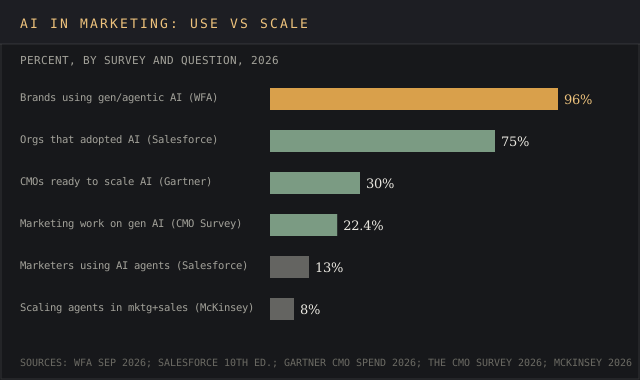
How many marketers use AI depends on what the survey asks, and the answers run from 8% to 96%. That spread is the most useful of all the AI in marketing statistics, because it separates trying a tool from running a function on it.
| Measure | Figure | Sample | Published by |
|---|---|---|---|
| Major brands using generative or agent-based AI | 96% | 54 leaders at 46 brands | WFA |
| Marketers whose organizations have adopted AI | 75% | 4,450 marketers | Salesforce |
| Respondents using AI regularly in at least one business function | nearly 9 in 10 | Global survey | McKinsey |
| Marketing activities using generative AI | 22.4% | 308 senior marketers | The CMO Survey |
| Marketers using self-directed AI agents | 13% | 4,450 marketers | Salesforce |
| Respondents scaling AI agents in marketing and sales | 8% | Global survey | McKinsey |
AI adoption in marketing by survey and question, 2026
The WFA's 96% is the top of the marketing industry: 46 brand owners with $93 billion of combined ad spend. Two years earlier, only 45% of that group had adopted AI, so most big brands that use AI today moved in a single budget cycle.
Salesforce's 10th State of Marketing report found 75% of marketers' organizations had adopted AI, but only 13% were using self-directed AI agents, per Salesforce's summary of the report. Nearly two-thirds, 64%, said they struggle to keep up with changing customer behavior, and 48% hadn't worked out how to adapt their marketing strategies to AI.
Few have finished the wiring. 61% said AI isn't yet part of fully integrated AI systems across their marketing stack, so the teams that use AI still run it tool by tool, per Content Grip's summary.
The CMO Survey measures depth, and its AI in marketing statistics reveal how far most companies still have to go. Companies use generative AI in 22.4% of their marketing activities in 2026, up from 7.0% in 2024, per the survey's founder Christine Moorman writing for the American Marketing Association. Respondents expect AI to power more than half of marketing activities within three years.
Copy these lines into an email, fill them in and send. I reply with scope and a price within 2 to 3 business days.
Open the emailFor the economy-wide numbers behind these surveys, our AI adoption statistics track business and consumer use outside marketing.
AI marketing budgets: what CMOs spend on AI
CMOs allocate an average of 15.3% of their marketing budgets to AI initiatives as companies plan for AI as a competitive advantage, per Gartner's 2026 CMO Spend Survey of 401 CMOs and senior marketers in North America, the UK and Europe, fielded January to March 2026. 70% call becoming an AI leader a critical goal for 2026, and 70% say their processes aren't mature enough to scale it.
Most CMOs bit off more than they can chew, and the money isn't new. Total marketing budgets rose from 7.7% to 7.8% of company revenue, per MarTech's report on the survey, so AI spend comes out of other lines. The 30% of organizations Gartner rates as AI-ready, ahead of the curve on data and process, spend 21.3% of budgets on AI and run marketing budgets of 8.9% of revenue.
Training is the line that shrinks. The CMO Survey puts training and development at 3.8% of marketing budgets in 2026, down from 5.8% in 2019, and leaders rate their own training on emerging technology at 3.9 out of 7.
How marketers use AI: content creation leads
Content creation takes the lion's share of AI use in every survey, and content creation tools are the most common artificial intelligence in marketing teams' stacks, from basic content creation such as product descriptions to full campaign assets. The WFA found 80% of big brands use AI for content creation, and The CMO Survey found 73.9% of companies use AI for it.
| Use case | Brands using AI for it |
|---|---|
| Content creation | 80% |
| Content ideation and production | 74% |
| Research and insights | 72% |
| Media buying and optimization | 54% |
| Strategy and planning | 48% |
| Workflow automation and autonomous agents | 46% |
- The use case, industry or region to cover
- Regions, years and segments
- Where it runs: blog, white-label, gated or lead magnet
- Whose byline goes on it
- Deadline
- 2,500+ words, human-written
- Every figure linked to its source
- Yours to publish, under your name or none
- Hosting here for +$200, with your sponsored links
AI use cases among major brands (WFA, 2026)
The CMO Survey's list runs in the same order with lower numbers for companies that use AI in marketing campaigns: personalization at 65.4%, automation at 48.9%, data analysis at 46.3% and targeting at 45.2%. AI driven personalization is the second use case in both, and Salesforce found 79% of UK marketers need more personalized content than they can produce.
Search is the newest line. Generative engine optimization is the AI-answer cousin of search engine optimization. 41.5% of companies in The CMO Survey now do it, a category that didn't exist in earlier editions, and 73% of WFA brands monitor or measure their visibility in AI answers. Only 8% of those brands have a clear strategy for it. Our AI traffic report tracks how much referral traffic those answer engines send.
AI's impact on marketing results and ROI
Marketers report gains, and the gains are smaller than the adoption numbers. Turning AI use into marketing success is easier said than done. The CMO Survey's 2026 respondents credit AI with a 14.1% rise in sales productivity, a 10.8% rise in customer satisfaction and a 14.6% cut in marketing overhead. Those statistics highlight cost and speed more than business growth.
At company level, the picture is flatter. McKinsey's state of AI in 2026 survey found 80% of respondents say AI improved their own productivity and 50% say it helps them make better decisions, while only 37% attribute any EBIT impact to AI, about the same as a year earlier. High performers, who attribute at least 5% of EBIT to AI, stayed at about 6% of respondents.
- Productivity gains: 80% of McKinsey respondents report better individual productivity, the most common of the reported productivity gains.
- Cost: marketing overhead down 14.6% at CMO Survey companies.
- Revenue: sales productivity up 14.1% at the same companies.
- Enterprise profit: 37% of McKinsey respondents see any EBIT effect.
Salesforce adds a sales number from the shopping side, where AI shapes customer experiences and customer engagement directly: AI and agents drove 20% of global orders during the 2025 holiday season, $262 billion in sales, per its State of Marketing announcement. That's artificial intelligence on the customer's side of the screen, through AI assistants and chat, where users interact with brands before they reach a website.
AI agents in marketing: live, but hard to measure
Agents that handle customer interactions have moved from pilots to production faster than the measurement behind them. Invoca's 2026 Broken Funnel Report, a survey of 451 US B2C marketing leaders run by Gather from September 14 to October 5, 2026, found 7 in 10 brands have agents live or in pilot, per its November 2026 release.
Invoca's 2026 Broken Funnel Report, a survey of 451 US B2C marketing leaders, found 7 in 10 brands have agents live or in pilot.
B2C brands with AI agents live or in pilot, 2026
Source: Invocae.g. AI agent use among US insurers
Source: linked, checked, dated- 73% of marketers running agents don't use revenue, bookings or conversion as the primary KPI.
- 74% can't fully track an agent-handled lead from first click to conversion.
- 86% can identify leads who started their research in an AI answer engine.
- 26% can tie agent conversations to the campaign or ad that drove them.
- 19% can reliably send conversation outcomes back to ad platforms.
McKinsey sees the same pattern across the economy. 40% of respondents at companies with more than $1 billion in revenue report scaling agents, up from 27% a year earlier, while marketing and sales sits at 8% scaling agents, behind IT at 12%.
Agentic AI in marketing is ahead of the plumbing, a red flag for anyone budgeting on agent ROI. The customer data that would let an agent recognize a returning customer is the most-requested feature in Invoca's survey, at 41%, and fewer than 1 in 3 teams have agents that can use journey data today.
AI tools, AI platforms and what marketing professionals say
Marketing professionals rate AI tools higher than their employers fund them. The Marketing AI Institute's 2026 State of AI for Business Report, with more than 2,100 respondents, found 74% call AI "critically important" or "very important" to their success over the next 12 months, per the institute's write-up.
The AI tools and AI platforms marketers rely on sit on a short list at most big brands. 55% of WFA members keep a centrally approved tool list with governance for new tools, up from 18% in 2023, and 59% write AI clauses on IP, confidentiality and training data into contracts.
Under the brand names, AI marketing tools run on the same few AI systems: large language models for natural language processing and content generation, and machine learning on customer data and historical sales data for targeting and forecasting. Our machine learning statistics report covers the market and the methods behind them.
Generative AI tools and other AI technology now sit inside the email, ad, marketing automation and analytics software marketers already pay for, which makes integrated AI a common purchase and its spend hard to see. The line between AI technology and ordinary digital marketing software is blurring, and teams that use AI bought this way rarely see a separate line item for it.
- Literacy: 69% of WFA members describe their AI literacy as moderate.
- Training: 55% rank training and upskilling as a top-three priority.
- Scaling: 63% rank scaling AI across marketing campaigns as a top-three priority.
- Building in-house: nearly 60% of CMO Survey leaders build AI capability internally, a share unchanged since 2020.
Digital marketers who want to stay ahead are filling the gap themselves. Social Media Examiner's 2026 AI Marketing Industry Report found marketers taking charge of their own AI learning and paying for generative AI access, per eMarketer, as AI use outpaces company training on emerging trends.
AI governance, brand safety and data privacy
Big brands keep a human in the loop on every AI model they deploy. 75% of WFA members require human oversight of AI-generated outputs, 70% keep lists of approved or prohibited tools, and 69% require agencies to disclose their AI use. Only 13% have a great deal of visibility into how their agencies use AI.
The barriers to scaling are mostly plumbing and policy. WFA members cite technology integration (45%), governance and legal requirements (43%), data quality and access (37%) and skills (35%). Gartner's numbers point the same way: the 70% of CMOs who aren't ready cite process maturity, data infrastructure and talent.
Consumers are less keen than marketers on AI generated content. The Next Web's report on Canva's 2026 State of Marketing and AI Report found 97% of marketers in its sample use AI daily, while 78% of consumers prefer human-made ads and 87% say the best advertising needs a human touch.
That's a brand loyalty risk for any team shipping AI generated content or AI generated ads without a review step. Consumer behavior hasn't caught up with how much AI content brands produce, and customer experiences built on unreviewed output are where the 78% notice it.
Paid placements inside chatbots are still early, and ad campaigns inside AI answers are a test budget at most brands. 4% of WFA brands rank advertising in LLMs a top priority and 20% are testing it, while 85% are concerned about brand visibility, control and transparency there.
Is AI replacing marketing jobs?
Not in the federal projections. The Bureau of Labor Statistics projects employment of advertising, promotions and marketing managers to grow 6% from 2024 to 2034, from 434,000 jobs, with about 36,400 openings a year, per the Occupational Outlook Handbook. The median marketing manager earned $161,030 in May 2024.
Executives expect cuts anyway, and the jury's still out on how many arrive. In McKinsey's 2026 survey, 39% of respondents expect AI-related declines in their organization's total employment in the coming year, up from 32%. Reported reductions over the past year fell well short of what the previous year's respondents had predicted.
The CMO Survey shows the squeeze in hiring more than in layoffs: marketing headcount growth slowed by more than half compared with the prior year, and leaders rate their own hiring for marketing technology at 3.7 out of 7.
AI marketing market size: why the forecasts disagree
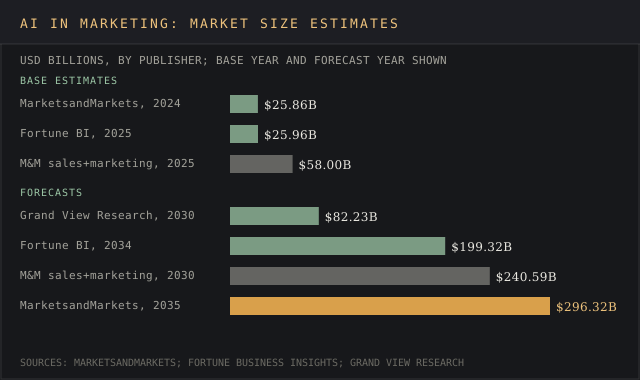
The devil's in the details with market sizing, and every market research house draws the line in a different place. They size the AI marketing market between $25.86 billion and $57.99 billion today, and their forecasts for the next decade run from $82.23 billion to $296.32 billion. The spread comes from scope: some count AI tools sold to marketing teams, others fold in sales software and CRM.
| Publisher | Scope | Base figure | Forecast |
|---|---|---|---|
| MarketsandMarkets | AI in marketing | $25.86 billion (2024) | $296.32 billion by 2035 |
| Fortune Business Insights | AI in marketing | $25.96 billion (2025) | $199.32 billion by 2034 |
| MarketsandMarkets | AI for sales and marketing | $58.00 billion (2025) | $240.59 billion by 2030 |
| Grand View Research | AI in marketing | n/a in summary | $82.23 billion by 2030 |
Published estimates of the AI in marketing market
The two narrow AI-in-marketing estimates are on the same page on the base, about $26 billion, and split by $97 billion on the forecast because they project to different years at 25.2% and 25.42% a year. Global AI marketing revenue in any single forecast year is one house's model of market trends, and the gap between them is the margin of error.
Delivered for your site and your byline. Hosting here is optional.
Frequently asked questions
How is AI currently used in marketing?
Brands use AI mostly for content. 80% of major brands use AI for content creation of AI generated copy and images, 72% for research and insights and 54% for media buying, per the WFA. Personalization, automation and data analysis follow in The CMO Survey.
What percentage of marketers use AI?
Most marketers use AI. 75% of marketers' organizations have adopted AI, per Salesforce, and 96% of major brands use generative or agent-based AI, per the WFA. By share of work, generative AI covers 22.4% of marketing activities.
What percentage of advertising is AI?
The surveys measure use more than share of spend: 54% of WFA brands use AI for media buying and optimization, and 20% are testing paid placements in LLMs.
Is AI replacing marketing jobs?
The BLS projects 6% growth for marketing managers from 2024 to 2034. Hiring has slowed: CMO Survey respondents more than halved headcount growth year over year.
Is marketing going to be overtaken by AI?
CMO Survey respondents expect AI to power more than half of marketing activities within three years, up from 22.4% for generative AI today. Human review stays: 75% of big brands require it.
What percentage of the market is in AI?
For marketing budgets, 15.3% goes to AI initiatives, per Gartner. AI-ready marketing organizations put 21.3% there.
Bottom line
AI in marketing is close to universal at big brands, and still shallow. The vast majority of major brands, 96%, use it, 22.4% of marketing activities run on generative AI, and 30% of CMOs say they can scale it.
Keep an eye on the budget line: it's real, at 15.3% of marketing spend, but it's shifted from elsewhere, and training is the line losing out. Measurement is the weak spot: 37% of companies see any EBIT effect, and 74% of teams running agents can't trace an agent-handled lead to a sale. Teams that want to stay ahead will need that tracking before the next budget round.
For the wider picture of how content teams are changing, see our content marketing statistics.
Martech vendors, agencies and consultancies publish reports like this one as gated content and client explainers.
A report on your topic for a blog page, gated content or a lead magnet.
Written for your client and published under their brand, with my name left off.
Your report on marketintelligencetools.com, with 2 to 3 CTAs carrying your sponsored links.
Default terms: the report is yours to publish, and I keep the right to republish it on this site behind a gate, outside Google's index.
Where the AI marketing figures come from, and what none of the surveys measure
Adoption and use-case figures come from the World Federation of Advertisers' September 2026 survey of 54 leaders at 46 brands, Salesforce's 10th State of Marketing report (4,450 marketers), The CMO Survey's 2026 edition (308 senior marketers), McKinsey's state of AI in 2026 and the Marketing AI Institute's 2026 State of AI for Business Report.
Budget figures come from Gartner's 2026 CMO Spend Survey (401 CMOs, January to March 2026). Agent figures come from Invoca's 2026 Broken Funnel Report (451 US B2C marketing leaders), jobs data from the BLS Occupational Outlook Handbook and market sizes from MarketsandMarkets, Fortune Business Insights and Grand View Research. All were checked on 17 November 2026.
No survey here measures the share of total ad spend that runs through AI tools, or AI's effect on marketing revenue at company level.