Seeq pricing: quote-only licenses, three support plan tiers and what users report
 By Jan Suski. I go deep on every review, checking every number against its source and digging up details other coverage misses, a habit from six years of SEO and link building for tech companies. Bylines at Surfer, Brand24, and Senuto. How the scoring works.
Seeq doesn't publish a price list. Its own AWS Marketplace listing says pricing "is based on your specific requirements and eligibility" and routes every request to info@seeq.com, and G2 lists one edition, Seeq Enterprise, at "Contact Us".
What the company does publish is the structure around the license: three Customer Success Plan tiers, their training discounts and their session allowances. This report pulls those figures together with what real users on G2, PeerSpot and AWS Marketplace say they paid for, so a buyer can walk into the first sales call with numbers on the table.
It's written for the process control engineer, reliability lead or digital manager who has to put a Seeq line into next year's budget before the quote arrives.
The numbers Seeq pricing, checked 5 November 2026
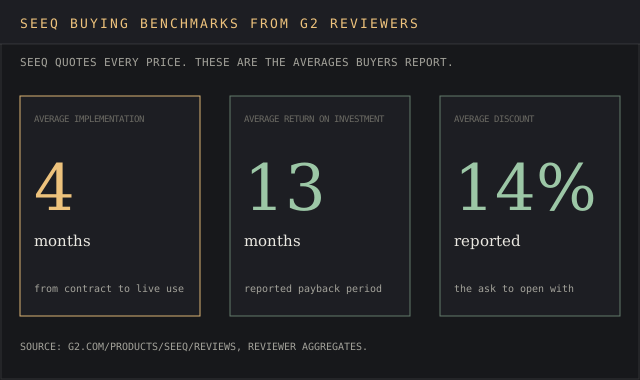
Every Seeq price is negotiated, so the 14% average discount G2 reviewers report is the closest thing to a public benchmark.
The support plan you pick changes the cost of training, since the private training discount moves from 25% to 35%.
A 4-month average rollout means the first year's license runs for roughly a third of a year before analysts get full value from it.
I'll write a 2,500+ word report on the industrial software vendor you name, with plan inclusions, quote drivers and user price reports sourced line by line. Yours to publish, from $200.
How much Seeq costs
The honest answer is a quote, and the price depends on how many teams and systems the deal covers. Seeq sells one product line through sales, and the company's own marketplace pages carry no rate card. TrustRadius adds that no free version or trial is available, so there's no self-serve price to anchor on.
Third-party estimates fill the gap, and they should be read as estimates. Software Finder says Seeq pricing "is estimated to start at $1,200/user/year, according to industry benchmarks," and puts onboarding at "$25,000–$100,000 for an initial plant." Neither figure comes from Seeq, and the company hasn't confirmed either one.
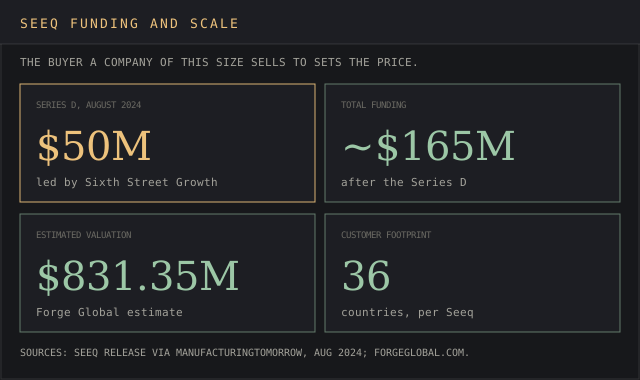
Those estimates are a drop in the bucket next to what the funding implies the company expects to sell. Seeq raised a $50 million Series D in August 2024 led by Sixth Street Growth, bringing total funding to about $165 million, and said it had hundreds of customers in 36 countries. Forge Global estimates the post-money valuation at $831.35 million. A company priced like that sells multi-plant agreements to industrial organizations, and the price follows.
What a Seeq license includes, from data analysis to advanced analytics
Seeq offers a set of modules under one subscription, enabling plant teams to work on the same data in one place. Pricing for each module isn't listed on the Seeq website. The AWS listing describes "a module called Workbench" with pre-configured analytics tools, conditions built "in a matter of a few clicks," and a built-in Python environment that Seeq brands as Data Lab.
- Workbench: the trend tool process staff use to visualize time series data, clean signals, identify events and build calculations.
- Capsule Time: a view that, per the Seeq Knowledge Base, "overlays the capsules within your conditions," so recurring events such as batch runs line up from their start time across long sensor histories.
- Organizer: reports and dashboards; Software Finder notes it can update compliance reports with pollutant exceedance results.
- Data Lab: Python-powered notebooks where data scientists analyze the same operational data and share insights back to Workbench.
- Seeq AI and Seeq Intelligence: the AI assistant and the agentic layer, which Seeq's products page pairs with an analyst quote naming Agent Q.
On connectivity, Seeq integrates with AWS, Microsoft Azure, AVEVA and Databricks, according to the same products page. Software Finder says it "connects to plant historians and relational databases without duplicating data," which means data access doesn't require a migration project before the first analysis. Its FAQ also confirms Seeq offers a REST API.
That connected systems approach is the main selling point to industrial teams who already run AVEVA PI. Reviewers on AWS reference PI ProcessBook and PI Vision as the tools Seeq sits beside, so the license adds analytics and new functionalities without replacing the historian.
Seeq AI, Seeq Intelligence and other industrial AI in the price
Seeq AI is the line most likely to move a 2026 quote. Seeq's products page calls the company an industrial AI platform and names Seeq Intelligence, with Agent Q, as the agentic layer that reads across operational data systems. The AWS listing adds that Seeq's AI agents are integrated with Amazon Quick, the AWS assistant.
Neither page attaches a separate price to the AI assistant or its agent functionalities. Ask the rep in writing if Seeq AI and the agent layer sit inside the base license or arrive as a line item, because demand for industrial AI features is where vendors add tiers first.
The company's framing is that industrial AI should incorporate human expertise from the people who know the plant. In practice that means the AI assistant drafts conditions and calculations inside Workbench to identify anomalies and accelerate root-cause work, and an engineer checks them against the operational context only a person on the unit has.
- Data analysis: users analyze trends, conditions and batches in Workbench and Capsule Time.
- Advanced analytics: data scientists perform modeling in Data Lab on the same operational data.
- Insights at scale: Organizer publishes those insights to the teams and managers whose decision making depends on them, with access controlled per user.
Those three functions decide how many teams touch the product, and so how many seats the quote counts. A buyer with interest in only the first one shouldn't pay for all three, and a buyer with interest in AI should test it on real quality data first.
Seeq Customer Success Plans, tier by tier
Here's the one part of Seeq pricing the company spells out on its website. The Success Plans page lists three tiers "with set pricing and inclusions," then hides the dollar amounts behind a form. The inclusions are public, and they center on people: a designated manager, an analytics engineer and a set number of sessions.
| Inclusion | Premium | Premium Plus | Ultimate |
|---|---|---|---|
| Customer Success Manager | Designated | Designated | Designated Senior |
| Analytics Engineer | Shared | Designated | Designated Senior |
| Software Support Engineer | None | None | Designated |
| Executive Business Review | Virtual | Annual, in person | Twice a year, in person |
| Awareness sessions | Up to 2 | Up to 4 | Up to 8 |
| User workshops | Up to 2 | Up to 4 | Up to 8 |
| Use case consultations | Up to 2 | Up to 4 | Up to 8 |
| Value Engineering Program | No | Included | Included |
| Seeq Mentors Program | No | Included | Included |
| Private training discount | 25% | 30% | 35% |
| Support ticket response tier | Premium | Premium | Ultimate |
Copy these lines into an email, fill them in and send. I reply with scope and a price within 2 to 3 business days.
Open the email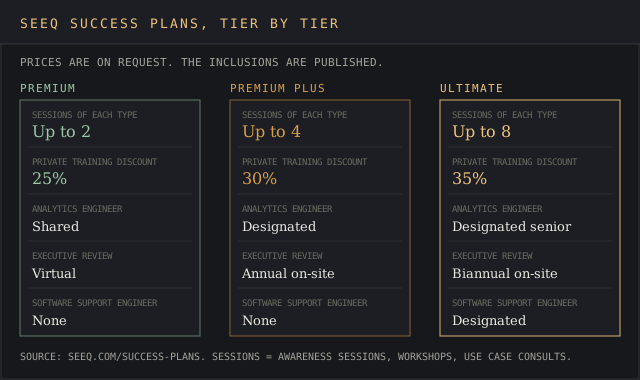
Premium
The entry tier gives a designated customer manager and a shared Analytics Engineer. Sessions cap at two of each kind, the business review is virtual, and the user community and integration consultation aren't included.
Premium Plus
The analytics engineer becomes designated, the business review moves in person once a year, and the Value Engineering Program, Mentors Program and integration consultation switch on. It's the tier where human expertise from Seeq's side scales with adoption, and where the Value Engineering Program puts a number on performance gains.
Ultimate
Ultimate is for organizations with global operations. It adds a designated software support engineer, senior staff in both lead roles, two in-person reviews a year, global support and the 35% training discount. Companies rolling out across a dozen plants will find it's the best of both worlds: a fixed allowance of 8 sessions per type and a named engineer on tickets.
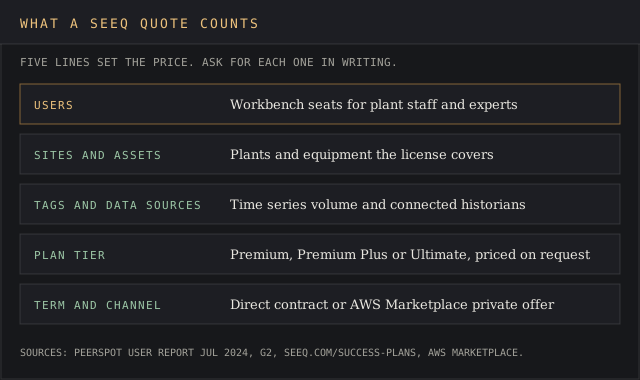
What drives a Seeq quote
Seeq doesn't publish its license metric, so the drivers come from users. A senior data scientist at Tridiagonal Solutions told PeerSpot in July 2024 that "Seeq has changed its strategy" and that pricing is "Most likely" tied to sites, assets or tags, adding: "There's no standard pricing."
- Users: the number of process staff and subject matter experts who need a Workbench seat to analyze data and perform investigations. Per-user licensing is the model buyers expect, and the license-pool request on G2 points the same way.
- Sites and assets: how many plants and how much equipment the license covers, which matters most to industrial organizations with many units.
- Tags and data sources: the volume of time series data and the number of connected historians.
- Support plan tier: Premium, Premium Plus or Ultimate, each at set pricing on request.
- Term and channel: a direct contract or an AWS private offer billed through the AWS account.
Want a quote-driver chart like this for the analytics vendor your plants are evaluating? Send the vendor name.
Email a briefG2's pricing page adds that some reviewers want "tiered license pools to support broader organizational adoption," which suggests per-user pools are part of how deals are written today. Ask the rep to beat around the bush less and name the license unit in writing before discussing a number.
Data access, implementation and other costs outside the platform fee
The license is only one line. A Seeq rollout carries three more, and buyers who skip them end up back at the drawing board when finance asks for the full year-one cost.
- Implementation: G2 reviewers report a 4-month average; Software Finder's $25,000 to $100,000 initial-plant estimate is the only published figure, and it's an estimate.
- Support plan: priced per tier, separate from the license.
- Training: open instructor-led courses (Foundations, Advanced, Data Lab) come with every plan, the Seeq Knowledge Base is public, and private training is discounted 25% to 35%.
- Integration work: data connections, authentication and security get consultation on every tier, but the customer's own IT does the build.
Data access is the step most likely to slip. A stitch in time saves nine here. Getting the historian connection and security review scoped before signing, which means enabling IT early, keeps the 4-month average from turning into a 9-month one.
What real users say about Seeq's price
User comments on price split between "worth it" and "pricey," and the split tracks company size. Taken together they describe the overall experience of buying Seeq from the customer side. Seven reviewers on PeerSpot and AWS Marketplace spoke to cost directly.
"My experience with pricing, setup cost, and licensing shows that Seeq is generally a bit pricey,"
David Grigsby, Manager of System Integration at a 51 to 200 person tech services firm, on PeerSpot, May 2026. He added that the company tends to "negotiate based on that," meaning the value it provides.
Pravin Kuchhadiya, Area Manager for Process Digitalisation at Nayara Energy, called it "a moderate cost compared to other tools and solutions out there in the manufacturing sector" on PeerSpot in August 2024.
"Regarding pricing, I would like to start using Seeq with flexible costs since when you work in analytics,"
An engineer at a 201 to 500 person software company on PeerSpot, April 2026, who added that "it is possible to gradually increase costs."
Patrick Dixon of Dixon Process Automation Services told PeerSpot in July 2024 that "The solution is certainly worth the investment" and that "Some of the licenses are much higher than what Seeq might be," comparing it with distributed control system licenses.
On AWS Marketplace in May 2026, Arthur Henderson wrote "The price is right on the spot. I do not see any problem with it," and Bilal Hajam said "it has a yearly licensing structure, and its ownership cost is not so high."
Software Finder's summary of reviews runs the other way for buyers smaller than the large manufacturers Seeq targets, describing the cost as high "particularly for smaller sites or teams with limited use cases." Large organizations with many plants absorb it across teams and industries; a single plant with one use case is the bitter pill to swallow.
How to negotiate a Seeq contract
The ball is in your court once the quote lands, because Seeq prices against value. Grigsby's comment that the company negotiates based on what it delivers is the lever: bring documented results from a pilot and the price discussion moves to ROI, with real performance data behind every number.
- Use G2's 14% average discount as the floor of the ask.
- Ask for a ramp, starting with a small user pool and growing it, which the PeerSpot engineer above asked for.
- Put the support plan tier on the table separately, since Seeq prices it apart from the license.
- Price the AWS private offer against a direct contract if the company already buys through AWS.
- Get the license metric (users, sites, assets or tags) written into the order form.
- The industrial analytics tools and plans to compare
- Regions, years and segments
- Where it runs: blog, white-label, gated or lead magnet
- Whose byline goes on it
- Deadline
- 2,500+ words, human-written
- Every figure linked to its source
- Yours to publish, under your name or none
- Hosting here for +$200, with your sponsored links
Seeq's pitch is that plant teams accelerate decisions and improve performance with their own data, turning plant expertise into insights other teams can reuse. A pilot that proves it on one asset class, with quality, downtime and performance metrics, is the strongest card a buyer can bring to a price talk. Pilots accelerate the decision making on both sides of the table.
Seeq against its alternatives
Industrial AI vendors rarely publish prices, and Seeq sits in that norm; our market intelligence platform pricing report tracks what 49 vendors across 40 categories charge. Our industrial data analytics ranking places Seeq first and runs a Seeq vs TrendMiner comparison, and our predictive intelligence software ranking covers the forecasting side. The table below sticks to what each vendor publishes about price.
| Tool | Published price | How it's sold | Source |
|---|---|---|---|
| Seeq | None; one Enterprise edition on request | Sales quote or AWS private offer | AWS Marketplace |
| TrendMiner | None published | Subscription, listed on AWS Marketplace since May 2022 | Processing Magazine |
| Grafana Cloud | Free tier; Pro $19 a month plus usage; Enterprise from $25,000 a year | Self-serve, then committed spend | Grafana |
Prices are list prices read off each vendor's own page on 5 November 2026. Seeq and TrendMiner publish none, and no Vendr median appears in this table.
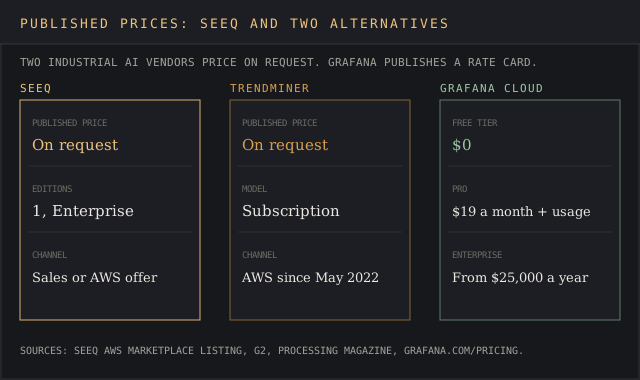
Grafana comes up because users raise it. Grigsby told PeerSpot that Grafana "is more out of the box and open source, so there is no cost," though it's a dashboard tool and doesn't ship Capsule Time or condition-based analysis for a process control engineer.
Who Seeq is priced for: teams with human expertise to scale
Seeq's own products page lists seven industries: oil and gas, chemicals and petrochemicals, pharma and life sciences, mining and metals, power and utilities, food and beverage, and semiconductors. Those industries are full of leading industrial companies running historians at scale, and the price reflects that buyer.
The typical user is a process or reliability engineer with years of knowledge about a unit, plus data scientists writing Python. Seeq frames its industrial AI as powered by human expertise, built to accelerate the work of the people who hold that expertise. Its website cites a webinar on cutting fleet compliance reporting effort by 75%, a single-customer figure.
Seeq's pitch to industrial operations is that plant staff can spot equipment problems early enough to cut downtime, optimize operations and make better decisions in near real time, and one AWS Marketplace reviewer titled a May 2026 review "Data insights have optimized cycle times and guided strategic maintenance decisions." For a team with one plant and one problem, that value often doesn't cover a full license, and the cost becomes a hard sell.
What to budget for year one
Without a public rate card, a Seeq budget is a list of line items for the sales rep to price. Bite the bullet and request each one separately, then run the multi-year total through the NPV calculator.
- The Seeq Enterprise license, with the metric stated
- One support plan tier
- Implementation services for the first plant
- Private training if open courses don't fit the schedule
- Internal IT time for historian connections and security review
Buyers who come in ahead of the curve with this list get a quote that reads like a bill of materials. Buyers who don't get one number and no way to compare it.
Delivered for your site and your byline. Hosting here is optional.
Frequently asked questions
These are the common questions buyers ask before a first Seeq call.
How much does Seeq cost?
Seeq doesn't publish a price. Software Finder estimates a start of $1,200 per user per year and $25,000 to $100,000 to onboard an initial plant; both are third-party estimates.
What types of Seeq price plans are available?
G2 lists one edition, Seeq Enterprise. Separately, Seeq sells three support plans: Premium, Premium Plus and Ultimate.
Does Seeq offer an API?
Yes. Seeq offers a REST API, and Data Lab adds a built-in Python environment for scripted analysis.
What level of support does Seeq offer?
Support ticketing runs at a Premium response tier on the two lower plans and an Ultimate tier on the top plan, which also adds a designated software support engineer.
Who are the typical users of Seeq?
Process, reliability and quality engineers who bring deep knowledge of their units, in oil and gas, chemicals, pharma, food and beverage, mining, utilities and semiconductors, plus the data scientists who work alongside them. Their expertise is what the industrial AI layer draws on.
What other apps does Seeq integrate with?
Seeq integrates with AWS, Microsoft Azure, Databricks and AVEVA, and reads plant historians and relational databases in place, so access to operational data stays in the source systems.
Bottom line
Seeq pricing is a quote built from users, sites, data sources and a support plan tier, and the company publishes only the tier inclusions. The price figures a buyer can use going in are G2's 14% average discount, the 4-month rollout and the 25% to 35% training discounts.
Seeq's price makes sense once the insights reach several teams and the industrial AI features improve performance in real time across units. For enterprises with several plants and an existing PI estate, user reports describe the cost as moderate against the value. For a single plant with one use case, the same reports call it pricey, and a ramped contract is the way in.
Analytics vendors, historian partners and plant digital teams use reports like this one in sales calls and budget reviews.
A report on your topic for a blog page, gated content or a lead magnet.
Written for your client and published under their brand, with my name left off.
Your report on marketintelligencetools.com, with 2 to 3 CTAs carrying your sponsored links.
Default terms: the report is yours to publish, and I keep the right to republish it on this site behind a gate, outside Google's index.
Where every Seeq number on this page was read, and what Seeq keeps behind the sales form
The single Enterprise edition, the 4-month implementation, 13-month payback and 14% average discount: g2.com/products/seeq. Support plan inclusions, session counts and the 25% to 35% training discounts: seeq.com/success-plans. Modules, the AI layer, integrations and the seven industries: seeq.com/products and the Seeq AWS Marketplace listing. Capsule Time: support.seeq.com. All read 5 November 2026.
Seeq’s 6 August 2024 announcement, carried by ManufacturingTomorrow, is the source for the $50 million Series D and the 36-country customer base. The $831.35 million valuation: Forge Global’s estimate.
The $1,200 per user and $25,000 to $100,000 onboarding figures: Software Finder’s estimates. Trial status: TrustRadius. User quotes: PeerSpot and AWS Marketplace reviews, dated in the text. Grafana Cloud prices: grafana.com/pricing. TrendMiner’s AWS listing: Processing Magazine, May 2022.
Seeq publishes no license price, no license metric, no support plan price and no separate price for Seeq AI or Seeq Intelligence. Every Seeq figure above is a structure, a reviewer average or a third-party estimate.