Best catalog management software in 2026: 10 product catalog management tools ranked
 By Jan Suski. I go deep on every review, checking every number against its source and digging up details other coverage misses, a habit from six years of SEO and link building for tech companies. Bylines at Surfer, Brand24, and Senuto. How the scoring works.
· Prefer this source on Google
Catalog management software comparison table
One row per tool, in ranked order. The ceiling column carries each vendor's own published cap or network figure, so the units differ by row.
| Rank | Provider | Published catalog ceiling or network | Entry price | Best fit |
|---|---|---|---|---|
| 1 | Plytix | SKU-banded plans from 100 SKUs, unlimited seats | €0; Pro from €149/mo | Small and mid-size brands with one to five channels |
| 2 | Pimcore | No product, asset or site limits on paid editions | $9,900/yr Professional | Teams with PHP developers who want to self-host |
| 3 | Akeneo | 100+ community connectors, 80,000+ downloads | $0 Community Edition; paid on quote | Open-source buyers who may move to SaaS later |
| 4 | Ergonode | 1,000 to 300,000 products by tier | €0; Advance from €5,990/yr | Mid-market catalogs that want a capped, priced plan |
| 5 | Salsify | Users configured in 140 countries | $52,100 Vendr median* | CPG brands syndicating to large US retailers |
| 6 | Stibo Systems STEP | 100+ prebuilt connectors | $97,391 Vendr median* | Distributors and manufacturers with millions of SKUs |
| 7 | Catsy | 39 named retailer, ERP and ecommerce integrations | Quote only | Industrial and Shopify sellers needing PIM and DAM together |
| 8 | Sales Layer | 10,000 to 200,000 SKUs by tier | Quote only | B2B manufacturers with fixed user counts |
| 9 | Syndigo | 3,500+ retailers, 15,000+ brands in network | Quote only | Food, grocery and consumer brands sending GDSN data |
| 10 | inriver | 1,000 to 1,000,000+ SKUs, 1,600+ brands | Quote only | Manufacturers publishing in many languages and print |
Medians marked * are anonymised buyer-reported contract values published by Vendr. Everything else is the price the vendor publishes itself.
Where these figures come from
SKU ceilings, network counts and list prices are each vendor's own published figure, read in October 2026, with the source linked in each entry. Medians marked * are Vendr's anonymised buyer-reported contract values for Salsify and Stibo Systems. Akeneo prints no figure for its paid editions, and Catsy, Sales Layer, Syndigo and inriver publish no price and carry no Vendr median, so those rows say quote only.
Brands comparing the wider CPG stack, from trade promotion to retail execution, will find it on the CPG software ranking. Supplier catalogs and punchout for buying teams sit on the indirect procurement software ranking.
Catalog management software holds the product catalogs a company sells from in one database, then pushes the approved version to each storefront, marketplace and print run.
The category overlaps with PIM, short for product information management, and most catalog management solutions on this page sell under both labels. A product catalog management system collects, organizes, enriches, updates and distributes product data, so the same title, price and spec sheet land on Shopify, Amazon and a distributor feed at once.
This page ranks ten catalog management solutions on five tests a buyer can run in an afternoon. Entry prices run from €0 at Plytix and Ergonode to a $97,391 Vendr median for Stibo Systems STEP. Five of the ten have no paid price on record anywhere, and contact-sales buttons are a dime a dozen in this category.
It's written for ecommerce, marketing and product data teams at brands selling through more than one channel. Procurement teams looking for supplier catalogs and punchout belong on the AI procurement software ranking; the catalogs here face customers.
The timing is set by channel count. Each new marketplace adds its own attribute rules, and Syndigo says it validates content against nearly 4,000 retailer requirements. Keeping product catalogs in spreadsheets stops working long before that number. Brands selling across multiple sales channels hit the limit first, because each channel rejects product listings that miss its required fields.

Evaluation criteria for catalog management software
Five criteria decide the shortlist, and the ranking below applies them in this order. Each one returns a yes, a no or a number from the vendor's own pages. A tool's rank follows its pass count; a tie goes to the lower published entry price, then to the tool passing the earlier criterion.
1. Published entry price for a paid tier
A price on the vendor's domain, or a Vendr header median, passes. A lower paid entry price ranks higher. "Contact sales" fails, because a buyer can't compare a number nobody has shown them.
2. Published SKU or product ceiling per tier
The test is a stated cap: 10,000 SKUs, 300,000 products, or "no limit" in writing. Product catalog management pricing usually scales with SKU count, so a missing ceiling means the bill for large product catalogs is unknown until the quote lands.
3. Stated channel network or connector count
The tool passes if the vendor prints a number of retailers, marketplaces or prebuilt connectors, or names at least ten of them. Syndigo's 3,500+ retailers passes. Six integration logos with no total fails.
4. Self-hosted or open-source deployment
Yes if a buyer can download and run the software on their own servers. Cloud-based catalog management software stores data on the vendor's infrastructure, which suits most teams, but an open-source option removes the license floor entirely.
5. Independent review footprint
The tool passes at 100 or more reviews on G2 or Capterra. Below that, a handful of reviewers decide the average, and one angry implementation swings it.
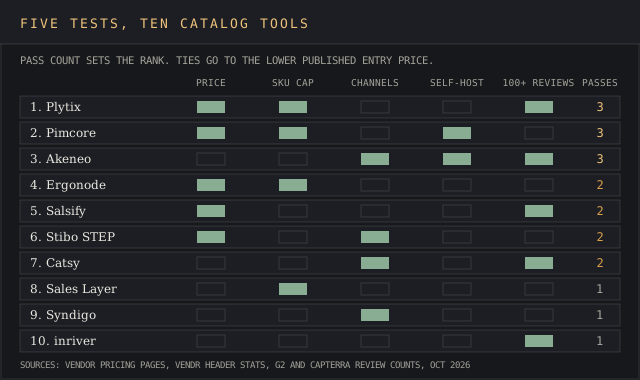
The most criteria any ranked tool passes. Plytix, Pimcore and Akeneo each reach three, and Sales Layer, Syndigo and inriver pass one apiece.
The 10 best catalog management software tools
Plytix
Best fit
Brands with up to a few thousand SKUs that need a priced plan and unlimited users from day one.
Plytix is cloud catalog management software built for small teams and priced by the size of their product catalogs. The Plytix pricing guide lists Standard at €0, Pro from €149 a month and Enterprise from €699 a month, each quoted at the 100-SKU starting tier, with prices rising as the SKU selector moves toward 25,000.
Every plan carries unlimited seats, which matters for marketing teams that share product details with agencies. Standard gets 2,000 API calls an hour; Enterprise gets 25,000.
Key features
- 500 AI credits a month on every plan for AI-powered product descriptions and translations
- Shopify, BigCommerce and Wayfair store connections as paid add-ons
- Feed Management add-on for syndication feeds to retailers and marketplaces
- Brand Portals and Product Data Sheets for sharing digital catalogs with resellers
- CDN traffic of 25 GB a month on Standard, up to 2 TB on Enterprise, for product images
Pricing
€0 Standard, €149 a month Pro and €699 a month Enterprise at 100 SKUs, per the Plytix knowledge base. Add-ons sit on top and are priced by SKU count, set with the SKU selector on the live pricing page.
Pros
- Lowest published paid entry price on this list
- Unlimited users on all three plans
- 446 reviews at 4.7 out of 5 on G2
Cons
- Each channel connector is a separate add-on, so a three-store setup adds three monthly fees
- SSO isn't available on Standard or Pro
- No self-hosted option
Data validation is the recurring complaint. A broadcast-media reviewer on Capterra wrote in March 2026:
"There are not enough checks and balances for my liking. I'd like to be able to make some fields mandetory for upload."
Capterra reviewer, broadcast media, 2 March 2026
Setup speed is the counterweight for teams that want to hit the ground running. An import-export reviewer on the same Capterra page wrote in July 2026 that "the system was set up in less then a month including the onboarding process and data imports."
Why it's ranked #1. Plytix, Pimcore and Akeneo each pass three tests, and Plytix wins the tie on the first criterion: a €149 monthly entry against Pimcore's $9,900 a year. Its 446 G2 reviews also clear the 100-review bar Pimcore's 50 miss.
Pimcore
Best fit
Companies with in-house PHP developers that want product catalog management, DAM and content in one self-hosted stack.
Pimcore is an open-core platform built on the Symfony framework, covering PIM, digital asset management and web content. The Pimcore pricing page lists Professional Edition at $9,900 a year and Enterprise Edition at $29,900 a year, both on-premises, with a free Community Edition and a custom-priced PaaS tier.
The page states no limits on products, assets or sites and no seat limits, so growing product catalogs don't change the license. Running more than four independent production instances requires a call to Pimcore. A team that picks Professional to cut corners gives up LTS and 24/7 support.
Key features
- Community Edition, free to download and run on local servers
- Enterprise Extensions, LTS and 24/7 support on Enterprise Edition
- E-commerce Framework and Customer Data Platform from Enterprise Edition up
- PaaS tier with hosting, auto-scaling and Boost Mode billed by the minute
- Built-in DAM for product images and video alongside product attributes
Pricing
$0 Community, $9,900 a year Professional, $29,900 a year Enterprise, PaaS on quote, all from Pimcore's pricing page.
Pros
- Published prices on two paid editions
- No caps on products, assets, sites or users
- On-premises and open-source deployment both documented
Cons
- Professional excludes 24/7 support and LTS
- 50 reviews on G2 and 8 ratings on TrustRadius, short of the 100-review bar
- Installation needs developer time
"Installation is but tedious for new and seasoned developer."
TrustRadius reviewer, engineering consultant, 21 September 2022
A program director on TrustRadius gave the case for it in February 2019: "Pimcore is fully opensource and based on leading Symfony, the leading PHP framework."
Why it's ranked #2. Pimcore ties Akeneo at three passes and wins on price, since it prints $9,900 a year and Akeneo prints no paid price. It trails Plytix on the same tie-break: $9,900 a year against €149 a month.
Akeneo
Best fit
Teams that want to start on a free open-source PIM and keep the option of a paid SaaS move.
Akeneo sells SaaS product catalog management and gives away a self-hosted Community Edition for product catalogs of any size. The Community Edition page calls it a "forever-free PIM" and states more than 80,000 downloads, a community of over 3,000 members and 100+ connectors and extensions in its marketplace.
The same page says over 500 customers run Akeneo, with named stories from Babolat and The Conran Shop. Support on the free edition runs through a community forum, so a team that drops the ball on an Elasticsearch upgrade fixes it without a vendor ticket.
Key features
- Community Edition on PHP, Symfony, MySQL and Elasticsearch
- 100+ community-built connectors and extensions
- Growth Package SaaS with cloud hosting and support
- Product Cloud for larger catalogs with partner-led implementations
- Attribute-level completeness scoring to flag incomplete records
Pricing
The Community Edition is free. The Growth Package and Product Cloud are sold on quote; Akeneo publishes no figure for either.
Pros
- $0 license for the self-hosted edition
- Largest stated connector marketplace among the open-source options here
- 248 reviews at 4.4 out of 5 on G2
Cons
- No published price for any paid edition
- 11 ratings at 7.4 out of 10 on TrustRadius
- Multi-tier approval workflows are thin for large organisations
A merchandise support manager at JD Group listed "Product approval & multi-tier workflow for larger organisations" as a con on TrustRadius in January 2023, and added that setup "has been somewhat tricky in a multi-company environment like ours." The same reviewer's pro: "It allows us to maintain a single source of truth for our product data."
Why it's ranked #3. Akeneo passes three tests, with 248 G2 reviews, 100+ connectors and a free self-hosted edition, one more than Ergonode's two. It trails Pimcore on the price tie-break, because Akeneo prints no paid price and Pimcore prints $9,900.
Ergonode
Best fit
Mid-market catalogs between 1,000 and 300,000 products that want a capped plan with a printed price.
Ergonode is a Polish catalog management software vendor that publishes both prices and caps for product catalogs. The Ergonode pricing page lists Free at €0 for up to 1,000 products and 2 users, Advance from €5,990 a year for 25,000 to 50,000 products and 20 users, and Scale from €19,990 a year for 300,000 products and 40 users.
Enterprise removes the product and user limits and goes to custom pricing. All plans bill annually and exclude VAT. Buyers who iron out the details of the unlabelled 25,000-versus-50,000 Advance cap before signing avoid a surprise upgrade.
Key features
- Free tier for 1,000 products and 2 users
- Apps Framework for building custom integrations
- Product caps printed on every tier
- Annual billing quoted with a monthly equivalent, €499 on Advance
Pricing
€0, €5,990 a year, €19,990 a year, then custom, from Ergonode's pricing page.
Pros
- Every tier states a product ceiling and a user ceiling
- A free plan large enough to test a real category
- 4.9 out of 5 from 9 reviews on Capterra UK
Cons
- The Advance tier shows "25.000/50.000" with no label for the two figures
- 32 reviews on G2 and 9 on Capterra, below the review bar
- No connector count published
"Setting up the first time requires a big design and architectural front-load."
Capterra UK reviewer, computer software, 9 January 2026
A consumer-goods reviewer on the same page wrote in October 2025 that "Ergonode has resolved our core problem of having an inefficient and inconsistent digital presence."
Why it's ranked #4. Ergonode prints a €5,990 entry against Salsify's $52,100 Vendr median, so it wins their two-pass tie on price. It trails Akeneo, which passes a third test with 248 G2 reviews.
Salsify
Best fit
CPG brands selling through large US retailers that need syndication and digital shelf analytics.
Salsify sells a product experience management suite for product catalogs syndicated to retailers: PIM, syndication, enhanced content, a GDSN data pool and digital shelf analytics. The Salsify platform page states users configured across 140 countries and cites Forrester naming it a PIM leader in Q4 2023.
A Nestlé USA testimonial on the homepage describes managing 48 brands and over 800 products online. Salsify also sells a supplier-side suite for retailers onboarding vendor content.
Key features
- Syndication Network for retailer and marketplace endpoints
- GDSN Data Pool for grocery and CPG data
- Intelligence Suite for AI-assisted content creation
- Digital Shelf Analytics on live product listings
- Catalog Sites for hosted digital catalogs
Pricing
Vendr's anonymised buyer data shows a $52,100 median a year, with a low of $21,467 and a high of $86,250. Salsify publishes no price.
Pros
- Syndication, PIM and shelf analytics from one vendor
- Vendr median on record, about 46% below Stibo's
- 129 reviews at 4.4 out of 5 on G2
Cons
- No published SKU cap or connector count
- Asset uploads lag on API connectors
- Support response times draw complaints
"API connectors sometimes fails, and in my experience usually takes a while for assets to be uploaded/updated"
TrustRadius reviewer, marketing, 10,001+ employees, 18 August 2023
A marketing manager reviewing the same day called it "the best syndication platform we've found in the market."
Why it's ranked #5. Salsify's $52,100 Vendr median sits below STEP's $97,391, which wins their two-pass tie on price. It loses to Ergonode on the same tie-break, because €5,990 is the lower entry.
Stibo Systems STEP
Best fit
Distributors and manufacturers managing millions of SKUs across product, supplier and location data.
Stibo Systems STEP is a master data platform with PIM as one of its uses. The STEP platform page states more than 100 prebuilt connectors and cites Ferguson managing more than 6 million products from 35,000 suppliers on it.
STEP runs as a multi-tenant, cloud-native service on Microsoft Azure. It fits an enterprise product catalog management project where product catalogs feed enterprise resource planning, ecommerce and print from one model.
Key features
- More than 100 prebuilt connectors
- Data modeling, quality, governance and compliance modules
- Supplier onboarding at Ferguson's 35,000-supplier scale
- Duplicate reduction of 90% cited in an Oney case study
- Azure-hosted SaaS deployment
Pricing
Vendr's anonymised buyer data puts the median contract at $97,391 a year, with a range of $26,213 to $99,832. Stibo publishes no price. At that median, the license takes the lion's share of a mid-market catalog budget.
Pros
- Documented scale at 6 million products
- 100+ connectors stated with a number
- Governance tooling for regulated product data
Cons
- Highest Vendr median on this list
- 4 reviews on Capterra UK
- No self-hosted option on the platform page
A retail reviewer on Capterra UK flagged a configuration gap in May 2018: "the number format for a currency field can not be configured." A November 2016 reviewer on the same page wrote, "I never knew it was possible to have every bit of data in one system."
Why it's ranked #6. STEP's $97,391 Vendr median gives it a price on record, which breaks its two-pass tie with Catsy. It trails Salsify, whose $52,100 median is the lower entry on the same tie-break.
Catsy
Best fit
Industrial suppliers and Shopify brands that want PIM and DAM sold as one product.
Catsy is a Chicago catalog management and digital asset management vendor focused on industrial product catalogs. The Catsy homepage shows 39 integration logos: 12 retailers including Home Depot and Walmart, 7 distributors including Fastenal and Ferguson, 7 ecommerce platforms, 10 ERPs and 3 CRMs.
Its pricing page sells Essential, Multi-Store and Enterprise Shopify packages with a free-trial request on Essential and no printed prices. Buyers who jump the gun on a demo before counting their SKUs get a quote they can't compare.
Key features
- Combined PIM and DAM for digital assets: images, videos, manuals and 3D files
- Retailer outputs for Home Depot, Lowe's, Menards and Wayfair
- ERP connections to Epicor Prophet 21, NetSuite and SAP
- Readiness scoring and audit history per product
- Self-serve portal for dealers
Pricing
Quote only. G2 reports an average discount of 9% from its reviewers.
Pros
- 151 reviews at 4.8 out of 5 on G2
- DAM included in the same contract as the PIM
- G2 reviewers report a 4-month average implementation
Cons
- No published price or SKU cap
- Integration setup is the recurring complaint
- No self-hosted option
A mid-market G2 reviewer wrote, "I wish the integration was initially a lot simpler, as it was difficult to use in the beginning." Another mid-market reviewer on the same page, read 16 October 2026, wrote that "Catsy integrates seamlessly with Shopify for features that Shopify itself won't support."
Why it's ranked #7. Catsy passes two tests with 151 G2 reviews and 39 named integrations, one more than Sales Layer's single pass. It trails STEP on the two-pass tie, because STEP has a $97,391 Vendr median on record and Catsy has no price.
Sales Layer
Best fit
B2B manufacturers who know their SKU count and user count before they talk to sales.
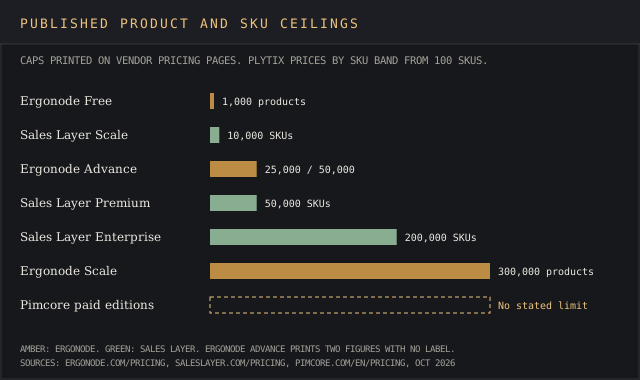
Sales Layer is a Spanish cloud catalog management system for B2B product catalogs that prints its limits and hides its prices. The Sales Layer pricing page caps Scale at 5 users, 10,000 SKUs and 1 language; Premium at 10 users, 50,000 SKUs and 5 languages; Enterprise at 35 users, 200,000 SKUs and 10 languages.
Every plan ends in a "Get a quote" button, and billing runs monthly or annually. A 10,001-SKU catalog is skating on thin ice with the Scale plan.
Key features
- Connectors for Amazon, Shopify, BigCommerce, Prestashop, Adobe Commerce and WooCommerce
- Import API and Bulk Export API
- REST Export API on request
- Language caps from 1 to 10 by plan for regional catalogs
Pricing
Quote only. The page states limits per plan and no currency figures.
Pros
- SKU, user and language caps printed for four tiers
- 4.7 out of 5 from 99 reviews on Capterra Belgium
- Six named ecommerce connectors
Cons
- No published price
- The Scale tier's 10,000-SKU cap forces an upgrade for mid-size catalogs
- One language on the entry plan
"Truly terrible customer support, and an inhuman lack of consideration of the circumstances."
Capterra reviewer, retail, 1 out of 5, 14 March 2022
The same page carries a September 2025 review from a machinery firm: "Sales Layer PIM has helped us organize our product catalog in a centralized and easy-to-update way."
Why it's ranked #8. Sales Layer prints SKU caps from 10,000 to 200,000, which outranks Syndigo's single pass on the third criterion. It trails Catsy, which passes two tests to Sales Layer's one.
Syndigo
Best fit
Food, grocery and consumer brands that need content validated against retailer rules before it ships.
Syndigo runs a network that moves product catalogs from brands to online retailers. The Syndigo homepage states 3,500+ retailers and 15,000+ brands in its network, 18,000+ companies as customers, nearly 4,000 retailer requirements used to validate data and more than 1 million data quality checks a day.
The suite covers MDM, PIM, syndication, rich media, GDSN and PowerReviews ratings. Its case studies cite a 350% conversion lift at MillerKnoll and a 60% improvement in operational efficiency at Victorinox.
Key features
- Network of 3,500+ retailers
- Validation against nearly 4,000 retailer requirements
- 1M+ daily data quality checks
- GDSN, Vendor Central and nutrition data modules
- PowerReviews for ratings and reviews
Pricing
Quote only. The homepage offers "Talk to Sales" and a demo.
Pros
- Largest stated retailer network on this list
- Retailer-rule validation checks data accuracy before syndication
- Covers grocery nutrition and in-store data
Cons
- No published price or Vendr median
- 11 reviews on Capterra Ireland
- Account management draws one-star reviews
"Syndigo is the worst company I have ever dealt with."
Capterra Ireland reviewer, medical devices, 18 July 2024
A consumer-goods reviewer on the same page wrote in February 2025 that "the software is relatively simple to use."
Why it's ranked #9. Syndigo's 3,500+ retailer network passes the channel test, an earlier criterion than the review test inriver passes. It trails Sales Layer, whose printed 10,000-to-200,000 SKU caps pass the second criterion.
inriver
Best fit
Manufacturers publishing product content in many languages, including print catalogs.
inriver is a Swedish product catalog management vendor whose customers publish product catalogs in print and online. The inriver homepage states 1,600+ brands, manufacturers and retailers as customers and a SKU range from 1,000 to over 1,000,000, and its modules include Inspire AI, Content Onboarding, Print & Publish and Digital Shelf Analytics.
Case studies carry the numbers. Prysmian scaled from 2,000 to 9,500 SKUs and cut catalog production time by 75%; Wolf Oil publishes across multiple languages, 15 of them, in 100 markets.
Key features
- Print & Publish for printed catalogs and data sheets
- Inspire AI for generated product copy
- Syndicate Advance for channel feeds
- Brand Store for distributor and reseller portals
Pricing
Quote only. A pricing-plans page is linked, with no figures on the homepage.
Pros
- 168 reviews at 4.2 out of 5 on G2, and 9.6 out of 10 from 13 TrustRadius ratings
- Print output built in
- Documented multi-language rollouts
Cons
- No published price, SKU cap per tier or connector count
- No rich text editor on product fields
- Complexity grows with SKU and category count
"What we struggle is that there's no richtext editor on inriver PIM and some of our product fields requires us to have it"
TrustRadius reviewer, product owner, 27 July 2026
The same reviewer praised "the ease of integration," and a 2021 strategist noted that "the challenge comes with the more SKUs and categories the company offers."
Why it's ranked #10. inriver passes one test, its 168 G2 reviews, and that's the last of the five criteria. Syndigo beats it with a stated 3,500-retailer network, which sits earlier in the order.
What catalog management software does
Catalog management software keeps one centralized product database and treats every storefront as an output across multiple channels. A product team edits a record once; the catalog system writes it to Shopify, Amazon, a distributor portal and a PDF data sheet. That's the single source of truth every vendor on this page sells, and it's where the operational efficiency claims come from.
Done right, catalog management software ensures one approved value per field reaches every channel.
Product catalog management covers five jobs. Collect product data from suppliers, ERP exports and spreadsheets. Organize it into a model with product attributes, variants and categories. Enrich it with product descriptions, technical specifications, product images and translations. Govern it with approvals and version control. Distribute it to sales channels in each channel's format.
Centralized product data improves data accuracy because one field has one owner. When product prices live in four spreadsheets, four people edit them, and the online store shows a different number from the marketplace. A catalog management system replaces that with one value and an audit trail. Catsy lists audit history per product; Syndigo runs more than 1 million data quality checks a day across its network.
Bulk editing is the product data feature buyers use first. Changing a material attribute on 4,000 SKUs by hand takes days of manual data entry; a filtered bulk update takes minutes, and workflow automation then routes the changed records to an approver before they publish.
Approval nips a bad value in the bud before any channel copies it. That approval step in product catalog management is where catalog accuracy is won or lost, which is why Akeneo's thin multi-tier workflow shows up in its reviews.
Digital asset management sits next to the product record. Pimcore, Catsy and Plytix store digital assets against each SKU, so a product page pulls the approved photo with the approved title. Salsify and Syndigo route rich media and other digital assets through their syndication networks, with no standalone DAM named on their pages.
Product catalog management software types and when each fits
Four deployment models cover the ten product catalog management tools. The choice sets the cost floor for your product catalogs before features enter the conversation.
- Open-source: Akeneo Community Edition and Pimcore Community Edition. Free to download, full code access for customization, hosting and upgrades on the buyer.
- On-premises commercial: Pimcore Professional at $9,900 a year and Enterprise at $29,900 a year. Installed on local servers with a vendor license and support.
- SaaS: Plytix, Ergonode, Sales Layer, Catsy, Salsify, Syndigo, inriver and Stibo STEP. The vendor runs the software and the infrastructure.
- Managed platform: Pimcore PaaS, priced on quote, with hosting, monitoring and auto-scaling run by the vendor.
Cloud-based catalog systems provide real-time updates and scale without a server project. Stibo runs STEP on Microsoft Azure, and Pimcore's PaaS adds auto-scaling and Boost Mode billed by the minute. Pimcore's PaaS comes closest to the best of both worlds, with open-core code and vendor-run hosting. The trade elsewhere is control: a SaaS buyer can't patch the code, and an open-source buyer can't phone a vendor at 2 a.m. on the free edition.
Pimcore also replaces some content management systems, because it serves web pages from the same records. Most other PIMs sit between two software systems, the ERP upstream and the storefront downstream, and Stibo frames STEP as master data management with product data management as one domain inside it.
A separate group of software solutions manages procurement catalogs: supplier price lists and punchout catalogs that employees buy from. Coupa and SAP Ariba sell those inside spend platforms, covered in the Coupa review, the SAP Ariba review and the procurement intelligence ranking. Data catalogs for warehouse tables are a third meaning, ranked under data intelligence tools.
Print catalogs, digital catalogs and eCatalogs
Catalogs come in three formats. Print catalogs are physical documents mailed to customers or handed out at trade shows. Digital catalogs are PDFs or flipbooks. eCatalogs are live, browsable pages on the internet, sometimes interactive catalogs with filters and order buttons.
Catalog software that serves print product catalogs needs layout output. inriver sells Print & Publish, and Prysmian cut catalog production time by 75% on it, per the inriver homepage. Salsify sells Catalog Sites for hosted digital catalogs. Plytix and Catsy generate product data sheets as PDFs. The rest push data to a layout tool or an ecommerce platform and stop there.
Catalog management pricing across the category
Entry prices on this page span from €0 to a $97,391 Vendr median, and the SKU count of your product catalogs drives most of the spread. Plytix starts at €149 a month at 100 SKUs and climbs as the catalog grows. Ergonode jumps from €5,990 a year at its Advance cap to €19,990 at 300,000 products. Sales Layer caps its Scale plan at 10,000 SKUs.
Ranked tools with no paid price on record: Akeneo, Catsy, Sales Layer, Syndigo and inriver. Salsify and Stibo print none either and carry a Vendr median.
Five vendors have no paid price on record. Catsy, Sales Layer, Syndigo and inriver sell on quote, and Akeneo's paid editions are quote-only, though its Community Edition costs $0. Salsify and Stibo print no price either; their Vendr medians of $52,100 and $97,391 come from anonymised buyer data.
The hidden costs are add-ons and services. Plytix charges separately for each store connection, Feed Management, Brand Portals and AI Unlimited. Pimcore's Professional Edition excludes 24/7 support and LTS. G2 reviewers put Catsy's average implementation at 4 months, and every month of implementation is a month of paid licence with product catalogs still in spreadsheets.
Common catalog management challenges
Data silos are the first problem in catalog management that every buyer names. Product details live in the ERP, marketing copy lives in a shared drive, and product images live on a designer's laptop. A catalog management system pulls those multiple systems into one record, which only works if someone owns the import mapping. Leave no stone unturned there: one unmapped ERP field empties a column across every imported record.
Manual processes cause most catalog errors. Copying existing data from an ERP export into a marketplace template introduces typos at every step, and manual data entry across multiple storefronts multiplies them. Catalog operations teams of two or three people feel this first.
Scale breaks spreadsheet-based product catalogs around the five-figure mark. Sales Layer's entry plan stops at 10,000 SKUs and Ergonode's free plan at 1,000 products, which tells you where vendors see the line. Prysmian went from 2,000 to 9,500 SKUs on inriver; that kind of growth is where a shared spreadsheet starts dropping rows.
Integration is the second-largest cost in product catalog management. Each of your sales channels wants its own product titles, attribute names and image sizes. Syndigo validates against nearly 4,000 retailer requirements; Plytix, Pimcore and Ergonode leave more of that mapping to the buyer.
Market trends push the same way. As retailers add attribute requirements, product catalogs with empty fields get suppressed in marketplace search, and the product data management work grows with every new channel.
SKUs behind one shirt sold in 6 sizes and 8 colors, each needing its own price and stock level.
Variants need structure. A shirt sold in 6 sizes and 8 colors is 48 SKUs, and each needs basic product details, product prices and inventory levels that match the parent record. Sales Layer reviewers complain about switching views from variant to product, a small gap that adds clicks across an entire catalog.
Incomplete product descriptions lead to returns, lost sales and a worse customer experience. Akeneo and Catsy both score record completeness, so a team can flag incomplete records before they publish. Regular audits against those scores keep data quality from drifting after launch, and they're cheaper than fixing product listings one retailer at a time.
Product catalogs and the customer experience
Shoppers make informed purchasing decisions from product details, and the customer experience on a product page is only as good as the record behind it. Online shopping removes the chance to pick up the item, so customer expectations rest on product images, technical specifications and product titles. Those fields decide customer satisfaction before the box arrives.
Returns are where customer satisfaction shows up as a number. A wrong dimension sent to 20 retailers produces returns at all 20, and the one-star reviews stay on each listing, which is how catalog errors reach brand reputation. Syndigo's MillerKnoll case study claims a 350% increase in conversion rate after content work, and its Victorinox study claims improved operational efficiency of 60%; both are vendor case studies, so read them as best cases.
Marketing teams and sales teams make informed decisions about which products to push from the same records. Retail businesses that also sell service offerings, such as installation or extended warranties, need product catalogs that hold non-physical SKUs. Social media platforms with shop tabs take product feeds in the same format marketplaces do, so one clean feed covers online selling on all of them.
Catalog management, inventory management and order management
Catalog tools hold what a product is; inventory management and order management systems hold how many exist and who bought them. Real-time inventory synchronization prevents overselling, but inventory levels usually sync from the ERP or the e-commerce platform. A PIM passes stock counts through when a connector supports it, and most of the ten tools leave stock with the ERP.
The same split applies to pricing. Dynamic pricing rules, purchase history and the ordering process live in commerce and pricing engines; see the price optimization tools ranking. For tools that tie stock to analytics, the inventory analytics software ranking covers managing inventory across locations. A catalog tool can still create product bundles as records and push them to an online store.
AI features in catalog management systems
Every vendor on this list sells AI-powered content generation. Plytix includes 500 AI credits a month on every plan; inriver sells Inspire AI; Salsify sells an Intelligence Suite, and its Kerry testimonial says a product was set up from scratch in one day. Syndigo sells AI GoPilots.
AI-driven catalog systems also pitch tailored product recommendations. Those run on the storefront, using purchase history and enriched product data from the PIM. The job of product catalogs is clean product attributes for the recommender to read; a buyer should zero in on which engine does the recommending and where it gets the data.
How to run a catalog management software evaluation
Run the evaluation on your own product catalogs. Export 500 real SKUs, including your worst records, and load them into the two free catalog software tiers on this page: Plytix Standard and Ergonode Free. That costs €0 and shows how each catalog system handles your attribute model, a drop in the bucket next to a wrong five-figure contract.
Ask each vendor to bring your team up to speed on a 500-SKU pilot. Then ask every quote-only catalog management vendor for the three numbers below, in writing. Sales Layer prints its SKU caps; the others should match it in the quote, so the buying committee makes informed decisions on cost per SKU.
- The SKU ceiling on the quoted plan
- The price per extra 10,000 SKUs
- The cost of each channel connector
Test one syndication end to end. Push the 500 SKUs to one marketplace or e-commerce platform and count rejected listings. Syndigo and Salsify sell retailer-rule validation for this step; everyone else hands you the rejection report. Picking the right catalog management software comes down to how many of those rejections the tool catches before they ship.
Check SEO output too, because product catalogs are search content. Product titles and descriptions generated in the PIM become the text search engines index, so test how each tool writes meta fields and how it handles duplicate copy across 48 variants.
Catalog management software FAQ
What is the best catalog management software?
Plytix ranks first among the product catalog management software on this page, with a €149 monthly Pro entry, unlimited seats and 446 G2 reviews. Pimcore ranks second for teams that want to self-host with no product caps, and Akeneo third on 248 G2 reviews and a free edition.
What is catalog management?
Catalog management is the process of collecting, organizing, enriching and distributing product catalogs across sales channels from one source, usually inside a product catalog management system. Software automates the import, approval and syndication steps.
What are the three main types of catalogs?
Paper catalogs, digital catalogs such as PDFs, and eCatalogs published as live web pages. inriver's Print & Publish covers print; Salsify's Catalog Sites covers hosted digital catalogs.
What software can I use to create a product catalog?
Catalog software such as Plytix and Catsy generates product data sheets from PIM records, and inriver sells print output. For design-heavy paper catalogs, teams export PIM data into a layout tool.
Which product catalog management software is free?
Akeneo Community Edition and Pimcore Community Edition are free to self-host for product catalogs of any size. Plytix Standard costs €0 at 100 SKUs, and Ergonode Free costs €0 for up to 1,000 products.
Can ChatGPT create a catalog?
A chatbot can draft product descriptions from a spreadsheet. It doesn't store records, track versions or syndicate to marketplaces, so teams use the AI features inside a PIM, such as Plytix's 500 monthly credits.
Bottom line
Of the ten catalog management solutions ranked, Plytix is the pick for brands that want a priced plan, unlimited users and a free tier to test on. Pimcore suits teams with developers who want to self-host with no product caps at $9,900 a year, and Ergonode suits mid-market product catalogs that want a printed €5,990 entry and a 300,000-product ceiling.
Enterprise buyers face quote-led contracts. Stibo STEP handles millions of SKUs at a $97,391 Vendr median; Salsify and Syndigo win on retailer syndication for CPG brands. Akeneo, Catsy, Sales Layer and inriver sit between, and each needs its SKU ceiling for your product catalogs written into the quote.