Best CPG software in 2026: 10 tools ranked
 By Jan Suski. I go deep on every review, checking every number against its source and digging up details other coverage misses, a habit from six years of SEO and link building for tech companies. Bylines at Surfer, Brand24, and Senuto. How the scoring works.
· Prefer this source on Google
Quick comparison of the top CPG software solutions
Ten tools in ranked order, with the layer of the stack each one covers, the scale figure and entry price a buyer can check before a demo, and the buyer each fits.
| # | Tool | Layer | Scale figure on record | Entry price on record | Best fit |
|---|---|---|---|---|---|
| 1 | Salesforce Consumer Goods Cloud | CRM, retail execution, TPM | 7 of the top 10 CPG companies on Salesforce | $100 per user per month | Brands with field reps and key accounts |
| 2 | SPS Commerce | EDI, retailer data | 46,000+ subscribing customers | $18,900 Vendr median* | Suppliers shipping to large retailers on EDI |
| 3 | Oracle NetSuite | ERP | 44,000+ customers | $74,782 Vendr median* | Growing brands that want finance and inventory together |
| 4 | SAP S/4HANA | ERP | 4.3/5 from 358 Capterra reviews | $29,292 Vendr median* (all SAP) | Enterprise CPG organizations leaving ECC |
| 5 | Microsoft Dynamics 365 Business Central | ERP | 4.1/5 from 209 Capterra reviews | $80 per user per month | Small manufacturers on Microsoft 365 |
| 6 | Promomash | Trade promotion and deductions | 500 brands, $3B trade spend | Quote only, priced by brand size | Natural channel brands selling through UNFI and KeHE |
| 7 | Vividly | Trade promotion management | 150+ brands on full TPM | Quote only | Food and beverage brands moving trade off spreadsheets |
| 8 | Crisp | Retailer data connectors | 40+ data sources | Quote only, priced by volume | Brands pulling retailer and distributor sales data |
| 9 | Repsly | Retail execution | 4.4/5 from 134 Capterra reviews | Quote only, 12-month minimum | Merchandising teams and agencies |
| 10 | Deacom ERP | Process manufacturing ERP | 3.7/5 from 10 Capterra reviews | Quote only | Batch and formula manufacturers needing lot traceability |
* Vendr's anonymised buyer data. The SAP median covers every SAP product, so it's a floor for an S/4HANA program. Every other figure comes from the vendor's own site or its Capterra listing.
Where these figures come from
Customer counts, module names and list prices come from each vendor’s own pages, linked from its entry below and read in October 2026. Ratings and review counts are Capterra’s. Medians marked * are Vendr’s anonymised buyer data. Promomash, Vividly, Crisp, Repsly and Deacom publish no price, so their rows read Quote only.
Three adjacent jobs sit on their own pages. Syndicated consumer data from NielsenIQ and Circana is ranked under retail analytics software. Price-pack and trade optimization for large brands is under revenue growth management tools. Statistical demand forecasting is under demand forecasting software.
CPG software is the operating stack a consumer packaged goods brand runs on to get products to consumers: the ERP that books inventory and production, the CRM and retail execution app its field reps carry, the trade promotion management system that tracks deals and deductions, and the EDI and data layer that talks to retailers.
That's the sense the search results for this keyword use. Salesforce, Deacom and PDI rank on it, next to a listicle mixing NetSuite and Vividly.
This page ranks ten of those tools on five tests a buyer can run before a demo, and names the job each solution does for CPG operations and the technology team behind them. It's written for operations, finance and sales leaders at CPG companies that have outgrown spreadsheets and aren't yet ready for a suite that costs an arm and a leg. Shoppers never see any of this technology, but it decides what reaches consumers.
The timing is set by SAP. SAP's 2020 announcement ends mainstream maintenance for its older Business Suite 7 ERP at the end of 2027, with optional extended maintenance to the end of 2030. Every CPG organization still on ECC has that 2027 date to plan its next tech stack around, and has to bite the bullet on a migration budget.
Evaluation criteria for CPG software
Five criteria decide the shortlist, and the ranking below applies them in this order. Each one returns a yes, a no or a number from the vendor's own pages, Vendr's anonymised buyer data or a public review site. A tie on one criterion goes to the next.
1. A price on record
Does the vendor publish a list price, or does Vendr publish a median from real purchases? Either passes. "Contact sales" with nothing behind it fails, and five of these ten fail it.
2. CPG-specific modules named on the vendor's site
Count the modules built for consumer goods work: trade promotion management, retail execution, distributor management, deduction handling, retailer EDI and lot traceability. A general ERP page that names none of them scores zero, even if a partner sells an add-on.
3. A published scale figure
A customer count, brand count, connector count or transaction volume printed by the vendor. NetSuite's 44,000+ customers counts.
4. Public review footprint
The Capterra rating and review count. Ten reviews at 3.7 carry less weight than 2,080 at 4.2, and zero reviews means buyers are taking the vendor's word for it.
5. Contract terms in writing
Minimum commitment, onboarding fees and support plan cost stated on the pricing page. Repsly's 12-month minimum with annual upfront payment passes because it's printed. A term you learn at signature fails.
The 10 best CPG software tools, ranked
Salesforce Consumer Goods Cloud
Best fit
CPG brands with field reps, key account managers and a trade budget large enough to need claims and accruals tracked in one system.
Consumer Goods Cloud is Salesforce's industry edition for consumer packaged goods, covering customer planning, trade promotion management, retail execution and distributor management on one Consumer Goods data model. Salesforce says 7 of the top 10 CPG companies plan or execute on Salesforce, and names PepsiCo, L'Oréal, Molson Coors & Yeti as customers.
The same page cites a 29% increase in promotion ROI and a 32% increase in customer lifetime value from dynamic personalization, both footnoted to "Salesforce 2026 Customer Success Metrics", Salesforce's own customer survey. It also cites a Forrester study at 205% ROI. Nobody outside Salesforce audits those figures.
Key features
- Retail Execution with visit planning, inventory tracking and Salesforce Maps
- Trade Promotion Management with promotion planning, ROI reporting, claims, accruals and funds management
- Agentforce for Consumer Goods, with a Trade Promotion Management Agent and a Visit Assistant
- Distributor Management for brands selling through wholesalers
- Tableau Next and Slack Business+ bundled into the Core editions
Pricing
The pricing page lists Retail Execution Merchandiser at $100 per user per month and Consumer Goods Cloud Sales Core and Service Core at $275 per user per month, all billed annually. Trade Promotion Management and Customer Planning are quote only.
A Premier success plan is listed at 30% of net license fees while the Core listings say Premier is included, so get that line in writing. Advanced and Max editions sit above Core at unlisted prices. The 30-day trial needs no credit card.
Pros
- The only tool here that prices a CPG-specific module on its own page
- TPM, field execution and CRM share one data model, so sales data and promotion results sit on the same account record
- Salesforce says seven of the top ten CPG companies plan or execute on its platform
Cons
- TPM, the module most brands buy it for, is quote only
- Ten Sales Core seats cost $33,000 a year before TPM, implementation or AI credits
- Consumer Goods Cloud itself has zero reviews on Capterra and Gartner Peer Insights
A Capterra reviewer of Salesforce Sales Cloud, the CRM Consumer Goods Cloud is built on, wrote that "setup often requires admin support or third-party consultants" (Capterra UK, Computer Software, 31 August 2025). Budget for that partner from day one; a CRM this configurable is a jack of all trades until someone sets it up.
Why it's ranked #1. Both pass criterion 1, SPS Commerce on an $18,900 Vendr median and Salesforce on a printed $100 rate, and Salesforce's four named CPG modules beat SPS's three on criterion 2, the first test that separates them.
SPS Commerce
Best fit
Suppliers that sell to large retailers with strict EDI rules and pay chargebacks when a document arrives late or wrong.
SPS Commerce runs a retail EDI network. Its homepage lists 46,000+ subscribing customers, 400+ system integration partners, 33 million SKUs managed and 750 million transactions a year, with connections to over 100 ERP, WMS and other systems. That makes it the plumbing between a brand's ERP and its retailers' purchase orders, an always on connection that SPS uses to automate processes a clerk would otherwise key by hand.
Key features
- Fulfillment, the core EDI product
- EDI Testing and Certification for new retailer connections
- Assortment for retailer item data
- Revenue Recovery for retailer deductions
- Supply Chain Performance Suite with Visibility Management and Performance Management
Pricing
No list price. Vendr's anonymised buyer data shows a median of $18,900 a year, with a low of $3,060 and a high of $27,382.
Pros
- The largest published customer count on this list
- Pre-built retailer connections, so a new trading partner doesn't send you back to square one
- 4.2/5 from 527 Capterra UK reviews
Cons
- Billing errors come up in 2026 reviews
- Custom work is quoted as development
- Its scope ends at documents and scorecards, so planning needs a second tool
The praise and the complaint arrive in the same review. "SPS Commerce has excellent support and implementation teams," a chemicals-industry reviewer wrote, then added: "We've had issues on multiple occasions with billing inconsistencies" (Capterra UK, 25 June 2026). A food and beverage reviewer said "Some development quotes feel high when the request appears to align with standard EDI functionality".
Why it's ranked #2. Three CPG modules (retailer EDI, item data, deduction recovery) beat NetSuite's one on criterion 2, and an $18,900 median passes criterion 1, but Salesforce names four modules to its three.
Oracle NetSuite
Best fit
Growing brands that want finance, inventory management, purchase orders and ecommerce orders in one system.
NetSuite is Oracle's cloud ERP, and its homepage says 44,000+ customers run on it. It also ranks in our inventory analytics software list for its multi-location stock reporting.
Key features
- Lot and serial tracing, backward and forward, per NetSuite's inventory page
- A real-time view of inventory across all sales channels and locations
- Automated replenishment through dynamic reorder points that hold preferred inventory levels
- Demand-based planning from historical demand, sales forecasts and seasonality
- Financials and multi-subsidiary accounting in the same database
Pricing
NetSuite publishes no list price. Vendr's anonymised buyer data puts the median contract at $74,782 a year across 1,514 purchases, ranging from $7,166 to $298,606.
Pros
- 44,000+ customers, second only to SPS Commerce here
- 4.2/5 from 2,080 Capterra UK reviews, the deepest review footprint on the list
- One system for financial operations, inventory and order management
Cons
- Oracle's pages name zero TPM or store-visit modules
- Support response times draw repeated complaints
- Customization costs land on top of the license
"Customization and implementation may also require additional support, which can increase costs and timelines."
Capterra UK reviewer, Hospital & Health Care, 2 April 2026, NetSuite reviews
Slow tickets are par for the course on that page: three of the five reviews shown complain about support speed, and one wrote that "support tickets sometimes take a week to resolve, which slows our audit prep" (Financial Services, 27 September 2026).
Why it's ranked #3. Lot traceability gives it one CPG module where SAP's pages name none, and 44,000+ customers settle criterion 3, but SPS Commerce names three modules.
SAP S/4HANA
Best fit
Enterprise CPG organizations on SAP ECC that have to move before mainstream maintenance ends in 2027.
S/4HANA is SAP's current ERP, and SAP has committed to maintain it until the end of 2040. SAP's product page claims a 50% decrease in implementation cost and 40-60% quicker time-to-value for its packaged cloud route, both vendor figures, and says Gartner named SAP Cloud ERP a Leader in its October 2025 Magic Quadrant for product-centric enterprises.
Key features
- SAP Business Suite packages for finance, supply chain management, procurement, sales and service
- Cloud ERP Private as the hosted S/4HANA option
- SAP Integrated Business Planning as the planning layer (see our SAP IBP review)
- Joule AI assistant and SAP Business Data Cloud
Pricing
Price on request. Vendr's SAP page shows a $29,292 median across 55 deals, ranging from $11,660 to $347,035, but that figure covers every SAP product, so treat it as a floor for an S/4HANA program.
Pros
- Maintenance committed to 2040
- Gartner Leader placement in October 2025
- 4.3/5 from 358 Capterra reviews
Cons
- S/4HANA itself is priced on request
- Zero CPG solutions named on SAP's consumer products page
- Reviewers call it hard to learn
"The product pricing plans are quite expensive and not affordable to small businesses," a management consulting reviewer wrote in January 2025. A food production reviewer in November 2024 praised "the mass amount of data storage and customizable options to ensure procurement processes are running well" (Capterra, SAP S/4HANA reviews).
Why it's ranked #4. It ties Business Central on criteria 2 and 3, then wins criterion 4 with 358 reviews at 4.3 against 209 at 4.1, but NetSuite's lot tracing and 44,000 customers beat it.
Microsoft Dynamics 365 Business Central
Best fit
Small consumer packaged goods manufacturers already on Microsoft 365 that want production processes and accounting in one ERP.
Business Central is Microsoft's ERP for small and mid-size firms. Microsoft's pricing page puts manufacturing and service order management on the Premium plan only, so a CPG producer budgets Premium at $1,320 a user a year.
Key features
- Essentials plan for core ERP users
- Manufacturing and service order management on Premium
- Team Members seats for light users
- Copilot Studio agents billed by Copilot Credits
Pricing
Essentials is $80 per user per month and Premium $110, both billed yearly; Team Members seats are $8. The trial is free for 30 days. Vendr's Microsoft page still shows older $70 and $100 rates; Microsoft's own page is the one that binds.
Pros
- A published per-user price, one of only two on this list
- Ten Essentials users cost $9,600 a year at list
- Reporting draws praise from users
Cons
- Microsoft's pages name zero CPG-specific TPM or retail modules
- Results depend on the reseller who implements it
- Advanced reports often need extra tools
"Dynamics 365 Business Central offers strong reporting tools," a financial services reviewer wrote in April 2026. An automotive reviewer in January 2026 was blunter: "our implementation partner was poor" (Capterra UK, Business Central reviews).
Why it's ranked #5. An $80 list price beats every quote-only tool below on criterion 1, but 209 reviews at 4.1 lose the tiebreak to SAP's 358 at 4.3.
Promomash
Best fit
Natural and specialty brands selling through UNFI and KeHE that want deduction recovery run as a service.
Promomash sells its CPGenius platform plus managed services for trade, deductions and in-store demos. Its pricing page says it serves 500 brands, manages $3 billion in trade spend and has processed $600 million in deductions, and lists one dairy brand recovering $1.8 million in deductions in 15 months.
Key features
- CPGenius Trade for closed-loop trade planning and plan-versus-actual P&L
- CPGenius Deductions with AI-assisted coding and human review
- CPGenius Demos & Events for scheduling brand ambassadors who sample product to consumers in store
- A Retail Execution add-on for merchandising and store visits
- A discounted Crisp data subscription with up to three connectors
Pricing
Quote only. Trade plans are priced by annual revenue band, deductions by monthly invoice volume. A one-year commitment is required, a one-time onboarding fee may apply, and onboarding takes two to four months.
Pros
- 500 brands, the largest brand count among the TPM tools here
- Contract terms printed on the pricing page
- Managed deduction work for teams without a trade analyst
Cons
- One-year lock-in plus a possible onboarding fee
- Two to four months to go live
- Interface glitches reported under time pressure
"It also tracks trade spend and distribution deductions - overall we make more money back than we spend on Promomash."
Capterra Canada reviewer, Consumer Goods, 30 July 2021, Promomash reviews
A food and beverage reviewer in October 2023 reported that "there were areas that would be glitchy, at times, when I was in a hurry."
Why it's ranked #6. Three CPG modules (TPM, deductions, store visits) beat Vividly's two on criterion 2, but with no price on record it falls behind Business Central's $80.
Vividly
Best fit
Food and beverage brands that run trade promotions and deductions in spreadsheets and want software their own team operates.
Vividly is a trade promotion management platform. Its pricing page says 150+ brands run full TPM on it, that customers planned 300,000+ promotions in 2025 and reconciled 350,000+ deductions last year, and it claims 98% forecasting accuracy. Its homepage carries a 91% figure in an older banner, so ask which one applies to your category. Two accuracy figures on one vendor's site is a red flag worth one email.
Key features
- AI-driven trade calendar planning from historical performance data, with forecasts adjusted in real time
- Deduction management and automated disputes
- Cash application against retailer and distributor payments
- A foodservice module for GPO agreements and distribution contracts
- SOC 1 Type II and SOC 2 Type II reports
Pricing
Quote only. The pricing page lists typical customers at 500 to 25,000 promotions a year.
Pros
- 4.9/5 from 17 Capterra reviews
- Deductions and promotions in one tool
- Onboarding quoted from two weeks, so a team can hit the ground running
Cons
- Quote-only pricing
- Two different accuracy claims on its own site
- Setup guidance draws complaints
"Our team no longer has to chase down deduction backups from multiple distributor portals," a food production reviewer wrote in June 2024. A consumer goods reviewer the same month wanted "more 'best practices' advise upon set up" (Capterra Canada, Vividly reviews).
Why it's ranked #7. Two CPG modules (TPM, deductions) beat Crisp's one, and 150+ brands on full TPM is a real count, but Promomash names three modules and 500 brands.
Crisp
Best fit
Brands that need retailer and distributor sales data, inventory and voids pulled from several portals into one feed.
Crisp connects retailer and distributor portals to a brand's data warehouse or BI tool, running an always-on connector to each portal so the brand sees what consumers bought. Its pricing page lists 40+ data sources and 13 destinations, and its homepage cites Nestlé reporting on 1,500+ SKUs in real time and Mars, Kraft Heinz and Kimberly-Clark among its customers.
Key features
- 40+ retailer and distributor data sources, 13 destinations
- Customer, Central, Category and Commercial desks for CPG teams
- Native apps on Databricks, Snowflake and Google Cloud
- ISO 27001, ISO 27017 and SOC 2
Pricing
Quote only, set by a brand's monthly points of distribution and ecommerce transactions.
Pros
- Closes the gap between shipments and what consumers bought at the shelf
- Bundled through Promomash at a discount
- Security certifications published
Cons
- 2 Capterra reviews
- Connector coverage still leaves gaps
- Distributor groupings can misstate chain-level numbers
"System relies on UNFI and KeHE data grouping to present INFRA and NCG business which is inaccurate."
Capterra Canada reviewer, Consumer Goods, 24 June 2024, Crisp reviews
The same reviewer's pro: "UNFI and KeHE data harmonized, easy to monitor inventory and voids." A second reviewer said "they don't have as many connections as we would like."
Why it's ranked #8. It ties Repsly and Deacom at one CPG module, then wins criterion 3 with 40+ published data sources where both print no scale figure, but Vividly names two modules.
Repsly
Best fit
CPG brands, and merchandising agencies serving clients, running merchandisers who audit shelves, log photos and close voids.
Repsly is a field app for merchandising teams. Repsly says its customers see 8% average growth in their first year and 22% more visits per rep, figures it footnotes to a sample of its top 10 customers, along with 180% more voids closed, the figure closest to on-shelf availability. That's a vendor sample of ten.
Key features
- Scheduling, workday tracking and a real-time activities feed
- Forms, photo gallery and product catalog
- ShelfScan image recognition of the shelf consumers see, sold in three AI tiers
- Territory Advisor and Insights Dashboards on the Scale plan
- API access on every plan
Pricing
The pricing page shows Core, Scale and Flex plans with no dollar figures and states that "All contracts require a 12-month minimum commitment with annual upfront payment." There's no free trial.
Pros
- Built for one job, store visits
- 4.4/5 from 134 Capterra UK reviews
- Contract terms in writing
Cons
- Quote-only pricing, and proofs of concept are the only way to test it
- Offline mode and sync draw complaints
- GPS tracking drains phone batteries, per one reviewer
"What I liked most about Repsly was the real-time visibility into field activity across our national retail footprint."
Capterra UK reviewer, Consumer Goods, 21 July 2025, Repsly reviews
A retail reviewer two weeks later named the weak spot: "Limited offline functionality and occasional syncing delays affect field data accuracy and user experience."
Why it's ranked #9. It ties Deacom on criteria 1 to 3, then wins criterion 4 with 134 reviews at 4.4 against Deacom's 10 at 3.7, but Crisp prints 40+ data sources.
Deacom ERP
Best fit
Batch and formula manufacturers making food, beverage and household goods for consumers that need lot traceability and quality control from formulation to shipment.
Deacom is a process manufacturing ERP owned by ECI Software Solutions. ECI's CPG page says it offers end-to-end supply chain visibility, planning and automated status updates, and its product page cites $500,000+ in annual savings at Van Drunen Farms from ending manual relabeling.
Key features
- Single-database ERP, so lot traceability runs from formula to shipment
- Formulation tracked by lot, expiry date and supplier
- Enforced quality checks with shop-floor test data
- Automated regulatory documentation and audit deadline alerts
Pricing
Quote only.
Pros
- Built for process manufacturing and compliance regulations
- One database across production processes and accounting
- A flat implementation fee, per one reviewer
Cons
- Quote-only pricing and zero published customer counts
- 3.7/5 from 10 Capterra reviews, the lowest here
- Custom reports need SQL
"It was inexpensive and the implementation cost was a flat rate," a food production reviewer wrote in December 2024, in the same review that said "The implementation team fluctuated and was disorganized" (Capterra Canada, Deacom reviews).
Why it's ranked #10. It loses the criterion 4 tiebreak to Repsly, 10 reviews at 3.7 against 134 at 4.4, and with no price or scale figure there's no entry below it to beat.
What CPG software does
CPG software manages supply chains and customer relationships for companies in the CPG industry that sell high-turnover products to consumers through retailers they don't control. The volume is the defining trait of these operations: the SPS Commerce network alone carries 750 million transactions a year. One case of product can pass through a distributor, a co-packer's supply chain, a retailer EDI feed, a promotion and a deduction claim before the brand sees cash.
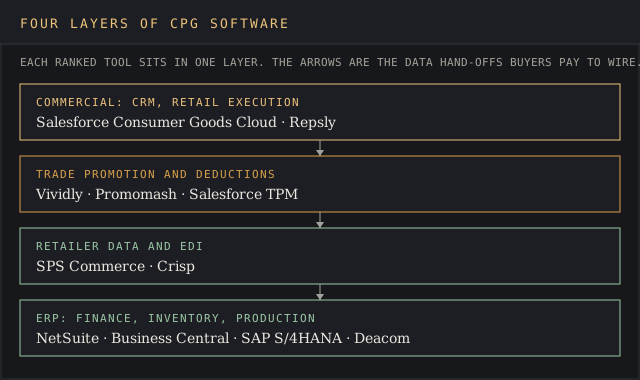
That's why the technology comes in layers. The ERP holds inventory, production planning and finance. The commercial layer holds accounts, store visits and promotions. The data layer pulls retailer sales data back so the brand can see what sold. Every hand-off between layers is a place to lose money in day-to-day operations and a place where technology vendors overlap, so integration with existing ERP and CRM systems is the first question to ask any vendor on this list.
Inventory, demand forecasting and waste
Real-time inventory management across multiple locations is table stakes for an ERP in this industry. NetSuite tracks stock across every channel with lot tracing; Deacom tracks lots by expiry date.
Both keep production processes and inventory in the same database, which a company's mock recall tests. Recalls start with consumers, so the trace has to run from shelf back to supplier lot.
Forecasting what consumers will buy cuts stockouts and overstocking, and overstocking raises storage costs and, for food brands, write-offs on expired lots. The planning module is where brands optimize safety stock.
NetSuite's demand-based planning uses historical demand, sales forecasts and seasonality. Statistical forecasting at enterprise scale sits in planning tools like SAP IBP and Kinaxis, covered in the supply chain intelligence ranking.
Product development is the other end: Infor, whose food and beverage suite bundles PLM with ERP, says customers report 30% faster time to market for new products. Aligning production with demand from consumers is where CPG software reduces waste and lowers costs, and where supply chain planning processes earn their license.
Trade promotion management and trade spend
Trade spend is where CPG margins leak, and where profitable growth gets decided. Brands use these tools to optimize the trade calendar, optimize promotion depth by retailer and claw back invalid deductions, the work Promomash and Vividly both sell.
Trade promotion management software plans each deal, forecasts lift among consumers, tracks the financial performance of every promotion and matches the retailer deduction to the promotion that caused it. Vividly, Promomash and Salesforce TPM all report promotion ROI. Promomash's own case studies show deduction recoveries of $733,000 to $1.8 million at single brands over 15 months.
A deduction with no matching promotion gets written off or eats analyst hours. Finding its backup across distributor portals is a needle in a haystack, which is the exact complaint Vividly's June 2024 reviewer said the tool removed.
Retail execution and on-shelf availability
Retail execution tools monitor in-store compliance and product visibility, the last step before consumers pick a product off the shelf.
Field reps log shelf photos, out-of-stocks consumers would hit, and display checks in Repsly or Salesforce's merchandiser app, and managers see those audits in a dashboard. Repsly sells ShelfScan image recognition as an add-on in three tiers, so photo audits come at a separate price.
CPG operations and digital transformation
Digital transformation in the CPG industry mostly means replacing spreadsheets and email with software, one layer at a time. A CPG company running complex supply chains through co-manufacturers, distributors and retailers keeps its data in four places, and each tool above owns one of them.
The commercial operations layer (Salesforce, Repsly) manages accounts and stores. Its job is to optimize where reps spend each day and manage the store list efficiently. The supply chain layer (NetSuite, SAP, Business Central, Deacom) manages inventory levels, production processes and quality control. SPS Commerce and Crisp carry data between the two and the retailers.
Operational efficiencies come from automation of steps a person does by hand today. SPS Commerce sends purchase order, invoice and ship notice documents without rekeying. Vividly automates deduction matching and cash application. Deacom automates regulatory compliance documents and audit deadline alerts. Each automation replaces a manual step with a logged one, which is what an auditor asks for anyway.
The digital tools pay back through operational efficiency: fewer analyst hours per deduction, fewer chargebacks per shipment, and fewer manual processes per invoice. Efficiency here is measured in hours, and so is growth in back-office capacity, so ask each vendor for the hours a named customer saved.
Consumer data reaches most of these tools secondhand, after consumers have already bought. Salesforce's 32% customer lifetime value figure comes from personalized experiences for brands selling direct to consumers; brands that sell only through retailers see consumers through retailer sales data in Crisp or panel data on the retail analytics page. Market share figures come from that panel data too.
Every vendor in the CPG industry markets powerful analytics tools. The test is which actionable insights a dashboard produces from your own data in a two-week pilot. A promotion report that shows lift with consumers by retailer and week gives a brand a competitive edge in its next category review with a buyer.
Where each solution fits CPG operations
- Finance and production planning: NetSuite, Business Central, SAP S/4HANA or Deacom
- Retailer orders and compliance with retailer data requirements: SPS Commerce
- Trade spend and deductions: Promomash, Vividly or Salesforce TPM
- Store visits and customer experience at the shelf: Repsly or Salesforce
- Retailer data on consumers' purchases: Crisp, the one data solution here
CPG software pricing and total cost of ownership
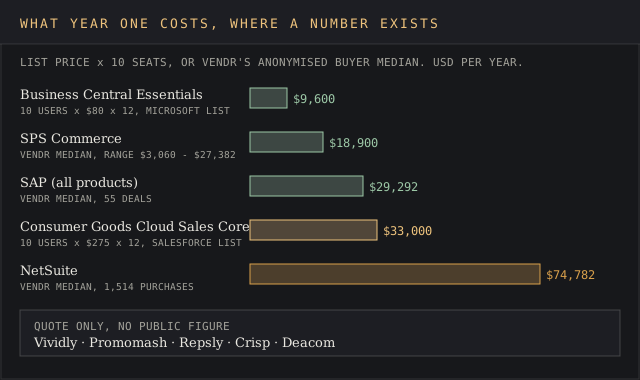
Pricing is the least transparent part of this industry, and each company quotes it differently. Five of the ten tools publish no price at all. Where a figure exists, year one runs from $9,600 for ten Business Central Essentials seats at list to a $74,782 NetSuite median, and Vendr's Infor median sits at $270,421 a year for the enterprise tier above that.
License cost is the smaller half. Evaluate total cost of ownership including licensing, implementation, support plans and maintenance. Promomash charges a one-time onboarding fee and needs two to four months. Ask every vendor for a three-year number in writing, covering every solution and service line, because the devil's in the details of the renewal clause.
Salesforce lists its Premier success plan at 30% of net license fees, a support line that sits on top of the per-seat price.
How to choose CPG software for your business
Start from the layer that's costing the company money today. A brand writing off deductions needs TPM first. A brand failing retailer EDI scorecards needs SPS Commerce first. A brand closing its books in a spreadsheet needs an ERP first. Buying all four layers in one year from one integrator puts all your eggs in one basket.
Then run the test that matters for each layer, using your own processes and data. Ask the ERP vendor to load 50 of your SKUs with real lot numbers and run a mock recall. Ask the TPM vendor to match last quarter's 20 largest deductions. Ask the field app vendor for a two-week pilot with five reps. Request software demos to see functionality in action, score them on a vendor evaluation scorecard, with two real processes run end to end.
Check scalability against your revenue growth plan, too, since the investment is sized for year three. Ask which solution tier a second factory or legal entity triggers, and get the efficiency gains a named company of your size reached. Business Central prices per seat in public; SAP and NetSuite quote each deal, so a second legal entity or factory changes each bill differently.
CPG software FAQ
What does CPG stand for?
Consumer packaged goods: products sold to consumers in packaging and used up fast, such as food, beverages, cleaning products and toiletries. The UK and Europe call the same category fast moving consumer goods.
What is CPG software?
CPG software solutions are applications built for the operations of a consumer packaged goods company: ERP, CRM and field execution, trade promotion management, EDI and retailer data. Together they feed data driven decisions on pricing, production and promotions, and let each company manage stock, compliance and retailer relationships efficiently.
What software is used for supply chain management in CPG?
An ERP such as NetSuite or SAP S/4HANA handles inventory and production, an EDI network such as SPS Commerce handles retailer orders, and a planning tool forecasts consumers' demand. Warehouse management systems add real-time tracking of stock levels inside the building.
What are the top 3 ERP systems for CPG companies?
On this ranking: NetSuite, SAP S/4HANA and Business Central, in that order, with Deacom for process manufacturers.
Bottom line
In a nutshell, Salesforce Consumer Goods Cloud wins for CPG brands with field sales and key accounts, because it prices its merchandiser module at $100 a user and runs TPM on the same record. SPS Commerce is the pick the moment a large retailer sends its EDI requirements. NetSuite is the ERP for growing brands, at a $74,782 median.
SAP S/4HANA is the enterprise move for ECC shops facing 2027, and Business Central is the cheapest published ERP here at $80 a user.
For trade spend, Promomash suits brands that want deductions handled as a service and Vividly suits teams that want to run the software themselves. Crisp, Repsly and Deacom each solve one job: data on what consumers bought, shelf audits and lot traceability. Profitable growth for CPG brands comes from fixing the layer that leaks first, then adding the next.