Affiliate marketing statistics 2026: spend, market size and partner data
 By Jan Suski. I go deep on every review, checking every number against its source and digging up details other coverage misses, a habit from six years of SEO and link building for tech companies. Bylines at Brand24 and Senuto. How the scoring works.
US advertisers will spend $13.81 billion on affiliate marketing in 2026, up 11.3% from $12.42 billion in 2025, according to a September 2025 eMarketer forecast. The same forecast credits the channel with $241.03 billion in US ecommerce sales in 2026. eMarketer's February 2026 forecast puts US retail ecommerce growth at 6.7%, so affiliate marketing spending is growing faster than the ecommerce sales affiliate marketing feeds.
This report gathers the latest affiliate marketing statistics from the bodies that publish them: eMarketer, the Performance Marketing Association, the UK's APMA, impact.com's platform data, Cognitive Market Research, Grand View Research and Datanyze. Every one of these affiliate marketing industry statistics links to its publisher on first use.
It's written for brands setting an affiliate marketing program budget, for affiliate publishers sizing their exposure to Google, for affiliate marketers comparing income data and for anyone who has seen four different figures quoted for one year. The devil's in the details here. One house puts the 2025 US affiliate market at $2.92 billion, and eMarketer puts 2025 US affiliate marketing spending at $12.42 billion.
The numbers Affiliate spend, market size and partner data, checked 17 November 2026
US affiliate marketing investment grew 49.8% between 2021 and 2024, and eMarketer expects another 11.3% in 2026.
The 2025 estimates for the global platform layer alone run from $16.16 billion to $22.58 billion, a $6.42 billion spread.
Three in four brands in impact.com's survey get between 11% and 30% of total revenue from affiliate programs.
I'll write a 2,500+ word report on the slice you name, every figure linked to its source. Yours to publish, from $200.
Affiliate marketing growth statistics for the US
eMarketer's series puts US affiliate spend at $10.72 billion in 2024, the first year above $10 billion. eMarketer tracks affiliate as ad spending, alongside the other paid channels in its forecasts. Its September 2025 forecast adds $1.70 billion for 2025 and another $1.39 billion for 2026, landing at $13.81 billion. That's $3.09 billion of new spending by US advertisers in two years, and the series reaches $15.80 billion by 2028, 47.4% above 2024.
The Performance Marketing Association's 2025 industry study, researched by London Research and published on 18 June 2025, counts higher. It puts US investment in the affiliate marketing industry at $13.62 billion in 2024, up 49.8% from $9.1 billion in 2021. That's a 14.42% compound growth rate. The PMA says affiliate investment grew at double the US ecommerce growth rate from 2021 to 2024.
Its study links that investment to $113 billion in US ecommerce sales, or 9.4% of all US ecommerce sales. For companies running affiliate programs, the PMA estimates affiliate marketing accounts for 15% to 20% of sales.
eMarketer and the PMA imply different returns per dollar. eMarketer's 2026 numbers work out to $17.45 of ecommerce sales per $1 of affiliate spend. The PMA's 2024 numbers work out to $8.30. Each publisher defines attributed sales its own way, and the $9.15 gap between those ratios is the size of that definitional difference.
Why the published affiliate marketing market size estimates diverge
Global figures for the affiliate marketing market come from research houses that sell the full report and publish a headline number for free. They size different things. Some count an affiliate market, some count the platform market for tracking and partner software, and the free pages don't publish the method behind either.
| Publisher | Market as defined | Base value | Forecast |
|---|---|---|---|
| Cognitive Market Research | Global affiliate market | $18.44 billion (2025) | $35.43 billion by 2033, 8.5% CAGR |
| Grand View Research | Global affiliate marketing platform market | $22.58 billion (2025) | $35.70 billion by 2033, 5.9% CAGR |
| The Business Research Company | Global affiliate marketing platform market | $20.22 billion (2025) | $22.1 billion in 2026, 9.3% growth |
| 360iResearch | Global affiliate marketing platform market | $16.16 billion (2025) | $48.92 billion by 2032, 17.14% CAGR |
| eMarketer | US affiliate marketing spend | $12.42 billion (2025) | $13.81 billion in 2026 |
| Cognitive Market Research | US affiliate market | $2.92 billion (2025) | Not split out on the free page |
| Performance Marketing Association | US affiliate investment | $13.62 billion (2024) | No forecast published |
Copy these lines into an email, fill them in and send. I reply with scope and a price within 2 to 3 business days.
Open the emailSources: Cognitive Market Research, data updated September 2026; Grand View Research, February 2026; The Business Research Company, May 2026; 360iResearch.
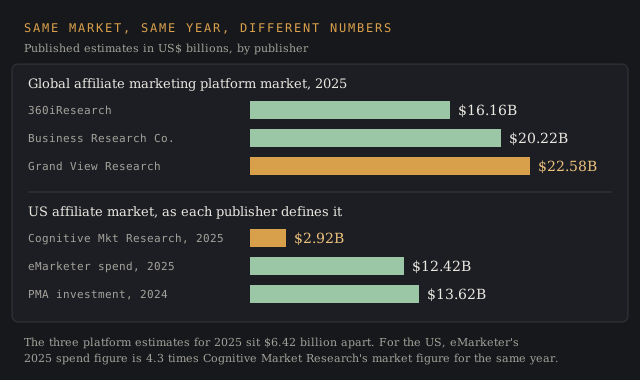
The platform estimates sit $6.42 billion apart for the same year, so Grand View Research's figure is 40% above 360iResearch's. Their growth assumptions spread wider still, from a 5.9% CAGR to 17.14%. Pick the house and you pick the story.
US estimates are further apart. Cognitive Market Research puts the US at $2,918.52 million in 2025, 15.82% of its global total. eMarketer's $12.42 billion of US affiliate spend for the same year is 4.3 times larger. The two figures can't describe the same quantity, and the free summary of the smaller figure gives no definition to reconcile them.
Research houses revise themselves too, and that's par for the course. eMarketer's August 2025 forecast put 2026 US spend at $13.20 billion, and the September 2025 forecast raised it to $13.81 billion, a $610 million change in a month. Cognitive Market Research's page carries two editions at once. Its FAQ gives a 2024 size of $18,512.2 million at an 8.00% CAGR with Europe growing fastest, and the report body names Africa as the fastest-growing region at a 12.492% CAGR.
Treat any single global affiliate marketing industry number as one house's model, and check it against a second house before quoting it, the basic step of data triangulation. Same forecast year, same market name, and the answer still moves by billions. The global affiliate marketing industry figure you quote should always carry its publisher's name.
Affiliate marketing statistics by region
Cognitive Market Research's 2025 split puts Asia Pacific first at $6.35 billion, or 34.44% of the global affiliate market. Europe follows at $4.60 billion (24.92%), then North America at $3.68 billion (19.96%). The US alone accounts for $2.92 billion, 79% of the North American figure, and Asia Pacific is more than twice the size of the US in this model.
The UK publishes its own count. The APMA's third State of the Affiliate Nation report, built from data supplied straight from the horse's mouth by 11 affiliate networks, found UK brands invested £1.8 billion in affiliate and partner marketing in 2025, up 7.3%. That spend generated £20.7 billion in revenue, an ROI of 15X, rising to 19X in travel and retail.
Affiliate marketing statistics by partner type
Loyalty and rewards partners take the lion's share of consumer spending through affiliate links. impact.com's first half 2026 shopping report covers 2,319 same-store North American retail brands and compares January to June 2026 with the same period in 2025, split across seven partner types.
| Partner type | Share of clicks | Share of transactions | Share of consumer spend |
|---|---|---|---|
| Loyalty and rewards | 15% (from 14%) | 55% (from 48%) | 54% (from 51%) |
| Network partners | 50% (from 44%) | 20% (from 19%) | 20% (from 17%) |
| Content review | 17% (flat) | 9% (from 10%) | 12% (flat) |
| Technology solutions | 7% (from 10%) | 5% (from 4%) | 5% (flat) |
| Voucher and coupon | 3% (from 6%) | 5% (from 9%) | 5% (from 11%) |
| Social media influencers | 4% (from 6%) | 4% (from 5%) | 3% (flat) |
| Media arbitrage | 3% (flat) | 1% (from 3%) | 1% (flat) |
- The partner types, networks or vertical to cover
- Regions, years and segments
- Where it runs: blog, white-label, gated or lead magnet
- Whose byline goes on it
- Deadline
- 2,500+ words, human-written
- Every figure linked to its source
- Yours to publish, under your name or none
- Hosting here for +$200, with your sponsored links
Network partners drove half of all clicks on affiliate links and a fifth of consumer spend. Voucher and coupon partners fell from 11% of spend to 5%. Content publishers and review sites held 12% of consumer spend with 17% of clicks, and media arbitrage's 1% is a drop in the bucket.
impact.com's report also shows transactions down and order values up. Transactions fell 7% and conversion rate fell 12%, while average order value rose 16%, from $111 to $130. Commission payments on affiliate links climbed 14%, commission rates rose 5%, and commissions grew to 90% of total brand spending, up from 86%.
Awin's network data moves another way for coupons. Discount and coupon publishers took 42.4% of US affiliate revenues in the first half of 2025, up from 39.7% in the same period a year earlier, per eMarketer's summary of Awin data. The creator economy's share of Awin network revenue rose from 15.9% to 19.5%, and 50.1% of sales from email publishers included a coupon.
Two networks, two partner bases and two different years, so affiliate marketing trends needn't move in the same direction.
Email marketing publishers lean on codes, and creators are the growth line. The creator economy feeds affiliate programs through codes and tracked links, and our creator economy statistics and influencer marketing statistics track the sponsorship side of that work.
The PMA also tracks where US budgets go by publisher type, per its June 2025 data cited by eMarketer. Cash back and rewards publishers took 35% of 2024 spend, content publishers 16%, and technology partners about 7%, up from 5% in 2021. Affiliate publishers on the content side are the group most exposed to search.
Affiliate marketing statistics by sector and return on ad spend
Retail's share of US affiliate spend fell from 76% in 2021 to 63% in 2024, per the PMA study. Financial services rose from 12% to 15%, travel from 5% to 9%, and telecommunications from 3% to 7%. Retail still holds most of the budget, and the share it lost moved to financial services, travel and telecom.
The PMA's return on ad spend figures name the most profitable niches. Travel returned $19 per $1 invested and retail $11. Inside retail, department stores reached $21 per $1, office supplies $20 and automotive parts $19. Travel's affiliate activity returns $8 more per dollar than the retail average, which tracks with travel's share of spend nearly doubling.
Holiday weeks concentrate affiliate marketing revenue. Awin's network saw fashion advertiser revenue grow over 30% on Black Friday 2024, with affiliate commissions up as much as 26% across the weekend, according to Awin's own reporting. Our Black Friday statistics report covers the wider sales picture for that week.
Affiliate marketing statistics on brand budgets
impact.com's Global State of Affiliate Marketing 2025 surveyed 818 marketers, 284 publishers and 421 content creators across eight countries in mid-2025. 74% of brands generate 11% to 30% of total revenue from affiliate marketing, and 14% generate more than 30%.
impact.com surveyed 818 marketers in eight countries and found 74% of brands generate 11% to 30% of total revenue from affiliate marketing.
Brands making 11% to 30% of revenue from affiliate
Source: impact.come.g. affiliate share of revenue in your vertical
Source: linked, checked, datedThe same survey found 74% of brands increased affiliate investment in the past year because other channels became more expensive. The most common program goal, named by 45% of brands in the full report, is to boost sales. Shares vary widely. 30% of brands allocate 10% to 20% of their marketing budget to affiliate, 38% allocate 21% to 30%, 20% allocate 31% to 50%, and 6% put more than half of it there, per InPublishing's report on the study.
The creator economy is the rising investment line for affiliate marketing. 59% of brands plan to allocate at least a quarter of their affiliate budget to creator partnerships. Buyers typically need three to four exposures to a creator before they purchase, per an eMarketer and impact.com survey, and 44% of B2C marketers in HubSpot's 2025 State of Marketing Report had their greatest success with micro-influencers.
In impact.com's sample, the most developed affiliate marketing program runs a partner mix of three to four partner types at once. Beyond creator partnerships, brands' partnership programs put money into search and media arbitrage (40%), loyalty and rewards (38%), content and reviews (34%), commerce (33%) and email (28%), per SBC News.
Senior marketers rate affiliate marketing highly. Nine in ten senior marketers in the UK, US, France and Germany called affiliate effective or highly effective in Awin and Forrester's 2024 survey, with Germany at 99%, per the same Awin roundup. Customers referred through affiliate links showed 21% higher average order values and a 21% higher repurchase rate. Awin uses those two figures to argue that affiliate partners acquire customers who spend 21% more per order.
AI, search and the affiliate channel's future
AI use in affiliate marketing is close to universal. impact.com found 97% of brands and 96% of creators already use AI in their partnership programs, and AI-driven content creation is now standard kit for affiliate marketers. Authority Hacker's 2024 survey of over 2,000 affiliate marketers found over 79% used AI in some capacity, per Awin's roundup.
Search is affiliate marketing's exposed flank. 69% of publishers in the PMA's survey said they were concerned their traffic and revenue would be negatively affected by recent Google actions, including search algorithm updates and AI Overviews. 54% were confident about the future of their affiliate business, a reading on the channel's future from the people most exposed to it, and 52% planned to experiment with new forms of promotion.
The damage shows up in single sites. Wirecutter's Google search visibility fell over 60% between May and August 2025, per a GSQi analysis cited by eMarketer. Affiliate marketers who drive traffic from Google, the primary traffic source for content sites, have put all their eggs in one basket and carry the risk of each of those search algorithm updates directly, and our Google search statistics and AI traffic report track how referral clicks are shifting.
AI assistants still lean on affiliate marketing content. Almost 70% of the sites cited in ChatGPT's mentions of the eyewear brand Zenni came from affiliate content, pages built around an affiliate link, per eMarketer, and 54% of consumers in a July 2025 Wildfire Systems survey used generative AI for price comparison.
Content marketing that earns a citation in those answers now sits inside the affiliate strategy, alongside the channels tracked in content marketing statistics and email marketing statistics.
Attribution, cookies and measurement
Last click attribution is losing its grip on affiliate programs. 94% of brands in impact.com's survey are experimenting with or planning to adopt alternative attribution models within a year.
Measuring affiliate marketing inside the wider mix lags behind. In an eMarketer and Rakuten Rewards survey, 27.3% of marketers fold affiliate into a general performance bucket in their media mix models and 14.8% leave it out entirely. 43.2% don't feed affiliate data into planning, or do so only after budgets are set.
In most programs running last click attribution, the coupon partner that touches a sale at checkout gets credit for the content partner who sent the buyer, and those models don't correct for it.
Tracking itself got a reprieve. Google said in April 2025 that it would keep third party cookies in Chrome and drop its planned standalone cookie prompt, according to eMarketer. Affiliate tracking that depends on third party cookies keeps working in Chrome. The jury's still out on which attribution model replaces last click once brands finish testing.
Affiliate marketing fraud statistics
CHEQ's May 2022 study found 17% of traffic from affiliate programs was fake, up from close to 10% in 2020. CHEQ put losses across the affiliate industry at $3.4 billion in 2022, against $1.4 billion in 2020, on the basis that the industry had grown from $15 billion to over $20 billion.
The schemes CHEQ named were botnets, click farms, cookie stuffing, and transaction and chargeback fraud. Cookie stuffing flies under the radar. It drops an affiliate link's tracking cookie without a real click, so the affiliate earns commission on a sale it didn't drive. The $3.4 billion figure is four years old and is still the most quoted affiliate marketing fraud estimate in 2026, a red flag for brands and affiliate marketers budgeting fraud prevention from it.
Affiliate marketing statistics on networks and the largest affiliate program
Amazon Associates is the largest affiliate program by installed base. Datanyze detects it on 44,034 websites, a 45.31% share of the affiliate network category it tracks. The next-largest affiliate network in its list holds 6.57%.
Datanyze counts sites carrying its affiliate link code, so the figure measures adoption by site owners and says nothing about commission revenue. Amazon Associates links a publisher to every brand's products sold on Amazon at once, and our Amazon statistics report covers the retailer's wider business.
Affiliate marketing statistics on what affiliate marketers earn
Most affiliate marketers earn modest sums from affiliate marketing. In Influencer Marketing Hub's Affiliate Marketing Benchmark Report 2022, 57.55% of respondents earned under $10,000 a year from affiliate work. 16.21% earned $10,000 to $50,000, 5.15% earned $50,000 to $100,000, 7.94% earned $100,000 to $150,000, and the 3.78% who hit the jackpot earned over $150,000.
Persistence is part of affiliate marketing income too. Authority Hacker's survey of 2,270 affiliate marketers found 31.3% of those earning six figures a year had considered giving up at some point.
Delivered for your site and your byline. Hosting here is optional.
Frequently asked questions
What percentage of affiliate marketers are successful?
If success means a full-time income from affiliate marketing, a little over one in nine affiliate marketers. Influencer Marketing Hub's benchmark survey found 11.72% of affiliate marketers earned over $100,000 a year, while 57.55% earned under $10,000.
What is the 80/20 rule in affiliate marketing?
It's the rule of thumb that a small group of partners drives most of the sales in affiliate programs. impact.com's first half 2026 data fits it closely, with loyalty and rewards partners producing 54% of consumer spend through affiliate links from 15% of clicks.
Can you make $10,000 a month with affiliate marketing?
Some affiliate marketers do. $10,000 a month is $120,000 a year, and Influencer Marketing Hub found 3.78% of respondents above $150,000 and another 7.94% between $100,000 and $150,000. It's a long shot for a new site, and most affiliate marketers never get there.
Is affiliate marketing still relevant in 2026?
US affiliate spend is forecast to grow 11.3% in 2026 against 6.7% for US retail ecommerce, per eMarketer. In the UK, the APMA counted 7.3% growth in affiliate marketing in 2025, and 74% of brands in impact.com's survey raised affiliate investment in the past year.
Bottom line
US affiliate marketing spending is heading for $13.81 billion in 2026 and outgrowing retail ecommerce. For a budget line or a business case, use eMarketer's spend series or the PMA's investment count, and name which one you used, since they sit $2.90 billion apart for 2024, at $10.72 billion and $13.62 billion.
Global sizes for the affiliate marketing industry are research-house models with different definitions, and the platform estimates alone span $6.42 billion. Read the latest affiliate marketing statistics with the publisher attached. Inside affiliate programs, loyalty partners take most of the spend, the creator economy takes a growing share, and Google exposure is the risk affiliate publishers name most often.
Affiliate networks, partner agencies and brand teams use reports like this one in pitch decks and client briefs.
A report on your topic for a blog page, gated content or a lead magnet.
Written for your client and published under their brand, with my name left off.
Your report on marketintelligencetools.com, with 2 to 3 CTAs carrying your sponsored links.
Default terms: the report is yours to publish, and I keep the right to republish it on this site behind a gate, outside Google's index.
Who sized the affiliate channel, and when each count was taken
Spend and forecasts: emarketer.com (September 2025 and August 2025 forecasts, February 2026 retail ecommerce forecast, April 2025 cookie report, Awin data for the first half of 2025), thepma.org (PMA and London Research industry study, 18 June 2025) and inpublishing.co.uk (APMA State of the Affiliate Nation, 2025).
Market size: cognitivemarketresearch.com (data updated September 2026), researchandmarkets.com (Grand View Research, February 2026; The Business Research Company, May 2026) and giiresearch.com (360iResearch).
Partners, budgets and fraud: impact.com (first half 2026 shopping report; Global State of Affiliate Marketing 2025), martechseries.com, sbcnews.co.uk (10 November 2025), awin.com, prnewswire.com (CHEQ, May 2022), datanyze.com, influencermarketinghub.com (Affiliate Marketing Benchmark Report 2022) and authorityhacker.com.
Every figure was checked against its source on 17 November 2026. None of the four research houses publishes the method behind its free headline figure, and the most quoted fraud estimate still dates from 2022.