AI in education statistics 2026: how students and teachers use AI, survey by survey
 By Jan Suski. I go deep on every review, checking every number against its source and digging up details other coverage misses, a habit from six years of SEO and link building for tech companies. Bylines at Brand24 and Senuto. How the scoring works.
The numbers AI use in schools and universities, checked 19 November 2026
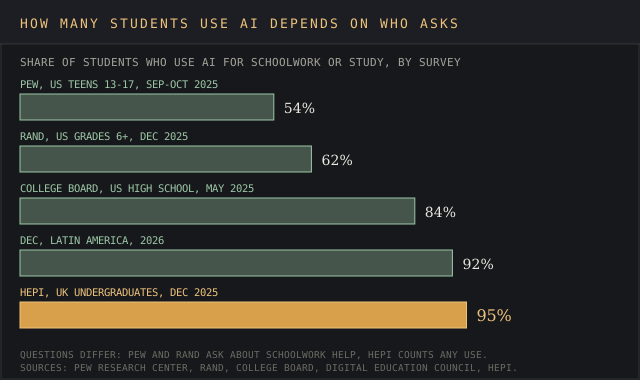
Student AI use runs from 54% to 95% depending on the survey, because each one asks a different question of a different group.
RAND's homework figure rose 14 points in seven months, from 48% to 62%.
Teachers who use AI weekly get back 5.9 hours a week, and only 19% of teachers work at a school with an AI policy, per Gallup.
I'll write a 2,500+ word report on the education market you name, with survey data, test results and market estimates linked to their sources. Yours to publish, from $200.
95% of UK undergraduates now use AI in some form, and 94% use generative AI on assessed work, according to the HEPI Student Generative AI Survey 2026. In the US, 54% of teens aged 13 to 17 use AI chatbots for schoolwork, per Pew Research Center, and RAND found 62% of students in grade 6 and up use AI for homework help.
This report collects the AI in education statistics that trace to a named publisher: student surveys from Pew Research Center, RAND, College Board, HEPI and the Digital Education Council; teacher surveys from Gallup, the OECD and IBM; test results from PISA 2025; and market size from two research houses.
Artificial intelligence reached classrooms within three years of ChatGPT's release in late 2022, and the education sector is still measuring the effect. This report is written for school and university leaders setting AI policies, teachers deciding how to integrate AI into lessons, edtech buyers, and anyone who has seen "92% of students use AI" quoted with no survey behind it. The surveys disagree, sometimes by 40 points, and the reasons get their own section.
How many students use AI in 2026
Every survey of students published since 2025 finds a majority using AI tools, and the share keeps rising. AI usage among college students and high school students has grown fastest since generative AI arrived in late 2022. The spread between surveys is the first thing to understand before quoting any of them:
Copy these lines into an email, fill them in and send. I reply with scope and a price within 2 to 3 business days.
Open the emailHigh school and middle school students
Pew Research Center surveyed 1,458 US teens and their parents from 25 September to 9 October 2025. Its How Teens Use and View AI report, published in February 2026, found:
- 54% of teens use AI chatbots to help with schoolwork
- 44% use AI for some of their schoolwork and 10% rely on it for most or all of it
- 57% use AI to search for information, and 42% to summarize an article, book or video
- About 3 in 10 teens use AI daily
Pew's earlier question about ChatGPT alone shows the climb: 13% of teens used ChatGPT for schoolwork in 2023 and 26% in 2024, as reported by TechCrunch. Teens rated using it for research acceptable (54%) far more often than for essays (18%).
RAND's American Youth Panel tracks middle school students and older. The share using AI for homework help rose from 48% in May 2025 to 62% in December 2025, in a December sample of 1,214 young people aged 12 to 29. That's a quick climb for seven months, and middle school students are part of it. Younger children use it too: nearly a third of parents of children 0 to 8 say their child has used AI for school-related learning, per our Generation Alpha statistics.
College Board's surveys of high school students show higher numbers: 79% used generative AI for schoolwork in January 2025 and 84% in May 2025, with 69% using ChatGPT specifically, per its October 2025 release. About half of high school students use AI tools to brainstorm, edit essays or find sources.
Microsoft's 2025 AI in Education report found 93% of US students had used AI at least once or twice for school, with 42% using it weekly and 30% using AI daily, per Campus Technology. The share who had never used AI dropped 20 points in a year.
College and university students
Use of AI in higher education is close to universal in the surveys that measure it, among college students and university students alike. HEPI's 2026 survey, run by Savanta with 1,054 full-time UK undergraduates in December 2025, puts AI use at 95%. The same series recorded 66% in 2024 and 92% in 2025, so university students went from a two-thirds majority to near saturation in two years.
The Digital Education Council reaches similar numbers outside the UK. Its 2024 Global AI Student Survey of 3,839 students in 16 countries found 86% using AI in their studies. The Digital Education Council's Latin America survey from 2026 puts use at 92%, with 67% using AI daily or weekly and ChatGPT used by 88% of frequent users.
Chegg's 2025 Global Student Survey of 11,706 college students in 15 countries found 80% had used generative AI for their studies, per a Campbell University summary of higher education surveys. Stanford's 2026 AI Index adds a cross-country view: generative AI use among university students rose in every one of the 15 countries it charted between 2023 and 2025, from 67% in the US and UK to 95% in Indonesia, per the AI Index education chapter.
For the wider picture of how people use AI outside school, our AI statistics report covers adult and workplace adoption.
What students use AI for
Explaining concepts tops the list of AI uses in higher education, and generative AI tools have become a study partner for most college students. HEPI's 2026 survey breaks down how UK undergraduates use AI on assessed work:
- 61% use AI for explaining concepts
- 49% use it to summarize articles
- 40% use it to suggest research ideas
- 39% use it to structure their thoughts
- 12% include AI-generated text directly in assessed work, up from 8% in 2025 and 3% in 2024
- Explaining concepts is also the top use HEPI recorded in 2025, ahead of summarizing
The last line is the one that worries observers of the HEPI data: AI-generated text pasted into written assignments quadrupled in two years. Most students use AI as a study aid, and the share pasting its text into graded work has grown every year.
US teens follow the same order. In Pew Research Center's survey, research and information search lead, math help comes next, and editing writing trails. College Board found about half of high school students use AI tools to brainstorm, edit or revise essays, and find sources.
AI tools students and teachers use
ChatGPT dominates student AI tool use in every survey that names products. College Board found 69% of US high school students used ChatGPT for schoolwork in May 2025. The Digital Education Council's Latin America survey found ChatGPT used by 88% of frequent student users, followed by Google Gemini, NotebookLM, Claude and Grok. Pew Research Center named ChatGPT the most popular AI chatbot among US teens, per NBC News.
Our chatbot statistics report covers chatbot use outside school, and our Claude users report covers one of the tools students name.
The AI tools in classrooms fall into four groups:
- General AI chatbots and AI assistants such as ChatGPT, Gemini, Copilot and Claude, which students use for explaining concepts, summarizing and drafting
- Lesson planning tools for teachers, which generate worksheets, quizzes and differentiated materials
- Adaptive learning platforms that adjust practice to each student's answers, the category Grand View expects to drive the AI in education market
- AI detection and grading tools that flag AI-generated text or give feedback on written assignments
AI tool use by teachers runs lighter than by students. Gallup found about 3 in 10 teachers use AI tools weekly, against 42% of US students in Microsoft's 2025 survey. Teachers at schools with an AI policy are more likely to have used AI tools, per Gallup, so AI tool adoption by schools shapes teacher use.
Student attitudes toward AI in education
Student attitudes are more divided than student usage. College Board found half of high school students neither agree nor disagree that AI's benefits outweigh its risks, with about a quarter agreeing and a quarter disagreeing. Pew Research Center found 15% of teens believe AI will affect them negatively and 17% are unsure, per Education Week. Our Gen Z statistics report covers the same generation's wider technology habits.
University students lean more positive. The Digital Education Council's Latin America survey found 68% hold a largely positive view of AI in education, and HEPI's 2025 survey found 67% of UK undergraduates think using AI is essential. HEPI's 2026 data shows the split on the student learning experience: 20% say AI makes them feel lonelier and 21% less lonely.
Students also report that AI can enhance student learning when it explains a concept a second way, and harm it when it does the work for them. RAND's 67% critical-thinking figure and HEPI's 61% explaining-concepts figure come from the same students, and both hold at once.
AI use compared across students, teachers, leaders and parents
Microsoft's 2026 survey asked the same questions of every group in the education sector, which makes it the cleanest comparison of AI usage by role:
| Group | Have used AI for school | Say their AI use rose in the past year |
|---|---|---|
| Students (13 and up) | 92% | 65% |
| Education leaders | 92% | 78% |
| Educators | 88% | 76% |
- The age groups, countries or tools to compare
- Regions, years and segments
- Where it runs: blog, white-label, gated or lead magnet
- Whose byline goes on it
- Deadline
- 2,500+ words, human-written
- Every figure linked to its source
- Yours to publish, under your name or none
- Hosting here for +$200, with your sponsored links
Parents trail all three. RAND found 72% of US parents used AI for work or personal tasks in 2026, and IBM found 28% of parents think AI doesn't belong in K-12 education at all right now. Microsoft also found 58% of education leaders say their schools are implementing or scaling AI, per its 2026 release.
The comparison shows that AI adoption is broad across every role inside schools and universities. The gap sits between use and preparation: students use AI tools most, and in HEPI's and the Digital Education Council's surveys most of them say they lack the training to use AI effectively.
How schools integrate AI: from bans to AI integration
Schools have moved from blocking AI tools to deciding how to integrate AI into teaching. College Board's principals survey found 55% of schools haven't blocked students or teachers from generative AI tools on the school network, and 45% have at least some restrictions. More than 85% of administrators said learning to use AI tools is valuable to a high school education.
Parents are warming to it too. Nearly 6 in 10 parents in College Board's survey agree it's better for students to use generative AI for schoolwork than not to. IBM found 51% of parents say clearer guidelines would most raise their confidence, and 48% want more transparency about classroom AI use.
AI integration in higher education runs through educational institutions' learning platforms and assessment design. HEPI found two-thirds of undergraduates say assessment changed in response to the use of AI, with some exams made harder to resist AI and others built around it. AI's role in a course now gets set by the course, the department and the institution in turn, which is why students in the same university report different rules.
The US Department of Education's 2023 report, Artificial Intelligence and the Future of Teaching and Learning, puts humans in the loop at the top of its recommendations, with teachers setting goals and AI handling routine work.
Getting AI policy right takes time, and schools that start early get ahead of the curve. Gallup's 26% larger time saving at schools with AI policies is the clearest return on that work in the AI in education statistics so far.
How teachers and educators use AI
The use of artificial intelligence by teachers trails student use, and the gap is closing as AI tools reach the education sector's staff rooms. Gallup and the Walton Family Foundation surveyed 2,232 US public school teachers for Teaching for Tomorrow, published in June 2025:
- 60% of teachers used an AI tool for their work in the 2024-25 school year
- 66% of high school teachers and 69% of early-career teachers did
- About 3 in 10 teachers use AI weekly
- Weekly users save 5.9 hours a week, about six weeks over a 37.4-week school year
- Monthly users save 2.9 hours a week
- 28% of teachers still oppose AI tools in the classroom
Teachers use AI tools to create worksheets, modify student materials and make tests, per The 74. Lesson planning tools and grading student work are the core time-savers, and the time goes back into instruction and student support.
IBM's study with Morning Consult, fielded in July 2026 with 1,019 K-12 education professionals and 1,029 parents, shows how far classroom AI tool use has spread since. Per IBM's September 2026 release:
- 76% of middle school educators say AI is used in their classroom at least weekly
- 73% of high school educators say the same, and 45% of high school teachers report daily or almost daily use
- 45% of elementary educators report weekly use, so younger students see less of it
- Only 20% of K-12 educators have had extensive AI training
Globally, the OECD's Teaching and Learning International Survey (TALIS) 2024 collected answers from 280,000 educators in 55 education systems. On average across the OECD, 36% of lower secondary teachers reported using AI in their work, per the TALIS 2024 country notes. Singapore and the United Arab Emirates led at around 75%.
The OECD's TALIS 2024 survey of 280,000 educators found 36% of lower secondary teachers used AI in their work, with Singapore and the UAE near 75%.
Lower secondary teachers using AI in their work, OECD average
Source: OECD TALIS 2024e.g. teacher AI use in the countries you sell to
Source: linked, checked, datedMicrosoft's 2026 AI in Education report puts educator AI use at 88%, with 76% of educators saying their AI use for school rose over the past year. Microsoft's figure sits well above Gallup's 60% and TALIS's 36%, and the three surveys differ in country mix, timing and who was sampled.
AI in higher education: faculty, leaders and institutions
Faculty AI adoption in higher education lags students by a wide margin. The Digital Education Council's 2025 Global AI Faculty Survey of 1,681 faculty at 52 institutions in 28 countries found 61% had used AI in teaching, and 88% of those used it minimally, per the Campbell summary. Only 17% rated their AI literacy as advanced or expert.
Higher education leaders see the same gap in AI in higher education adoption. In the AAC&U and Elon University survey of 337 higher education leaders, 62% estimated that fewer than half of their faculty use AI tools, 59% said recent graduates were unprepared for AI-skilled work, and 59% reported more cheating.
A Metropolitan State University of Denver faculty survey found 42% believe AI can save time and raise efficiency if used ethically. Ellucian's survey of faculty and administrators at more than 330 higher education institutions surveyed in the US and Canada found 93% expect to expand AI use over two years.
Institutional support trails student use. In HEPI's 2026 survey, 37% of undergraduates agreed their institution encourages AI use and 36% disagreed, and only 38% said they are provided with AI tools. Two-thirds of students say assessment has changed in response to AI.
Microsoft's 2025 report cited an IDC study finding 86% of education organizations use generative AI, the highest rate of any industry, per the Microsoft Education blog. Readiness lags behind that adoption, as the HEPI and IBM training figures below show.
Why AI in education statistics disagree
The same question, "how many students use AI?", gets answers from 54% to 95%. Four things drive the spread:
| Survey | Who was asked | What counted | Result |
|---|---|---|---|
| Pew Research Center, fall 2025 | 1,458 US teens aged 13 to 17 | Using AI chatbots for schoolwork | 54% |
| RAND, December 2025 | 1,214 US youth, grade 6 and up | Using AI for homework help | 62% |
| College Board, May 2025 | US high school students | Using generative AI for schoolwork | 84% |
| Digital Education Council, 2026 | Latin American university students | Using AI in studies | 92% |
| HEPI, December 2025 | 1,054 UK full-time undergraduates | Using AI in at least one way | 95% |
- Age. University students use AI more than high school students, and high school students more than middle school students. Pew's sample starts at 13, and HEPI's covers only undergraduates.
- Wording. "Any use" captures a student who asked a chatbot one question. "Use for schoolwork" or "homework help" excludes everything else.
- Timing. RAND's own series moved 14 points in seven months. A survey from early 2025 and one from early 2026 are measuring different years.
- Sampling. Pew and RAND use national probability panels, HEPI and IBM commission online panels from Savanta and Morning Consult, and Chegg and Microsoft are companies that sell AI-powered tools. Our guide to sampling bias covers why the panel matters.
The wording effect is the biggest. Our guide to response bias covers how a question's framing moves a survey result, and AI use is a textbook case. The upshot: a headline "92% of students use AI" and a headline "54% of teens use AI for schoolwork" can both be right.
AI policies, AI training and AI literacy
School AI policies trail the use of AI by students. College Board's principals survey found:
- About 40% of schools don't allow student generative AI use
- About 20% allow it with no policy
- About 13% encourage it in all classes
- 16% leave the decision to individual teachers, and 12% to departments or grade levels
Gallup found only 19% of teachers work at a school with a policy on AI tools, and teachers at those schools save 26% more time from AI. Policy is a lever: schools that write AI policies get more out of the tools.
AI training is the other gap. IBM found 20% of K-12 educators have had extensive AI training, and 42% cite a lack of training or professional development as the top barrier to teaching AI literacy. HEPI's 2025 survey found 67% of undergraduates think using AI is essential, while 36% had received AI skills training from their institution.
AI education itself is spreading. PISA 2025 found about 6 in 10 students across OECD countries had been asked in school to assess the quality of AI-generated information. IBM found 59% of educators think AI literacy should be required or offered as an elective, against 40% of parents.
Students feel the gap. The Digital Education Council's 2024 survey found 58% of students felt they lacked sufficient AI knowledge and skills, and 48% felt unprepared for an AI-enabled workplace. In its 2026 Latin America survey, 73% expect to use AI in their future jobs.
Academic integrity, critical thinking and cheating
Academic integrity is the concern that comes up in every survey, in schools and in AI in higher education alike. The numbers:
- RAND: 67% of students agreed in December 2025 that the more students use AI for schoolwork, the more it harms their critical thinking, up more than 10 points in ten months
- Pew Research Center: about 6 in 10 teens say students at their school use AI chatbots to cheat at least somewhat often, per Entrepreneur
- OECD TALIS 2024: 72% of teachers believe AI lets students misrepresent their work, per Education International
- IBM: teachers' top concerns are student dependency on AI (52%) and cheating or plagiarism (47%)
- Tecnológico de Monterrey: 55% of students believe AI could hurt academic integrity
Students admit the line is blurry. RAND found most students did not consider their school-related uses of AI to be cheating, apart from getting homework answers. Older students were more likely to worry about being accused of using AI to cheat.
Critical thinking is the other side of the same coin. The Digital Education Council's Latin America survey found 65% of students worry about shallow learning and reduced critical thinking. More female than male students in RAND's panel believe AI harms critical thinking.
Does AI improve student outcomes?
The best evidence on AI's impact on student learning so far comes from PISA 2025, which tested more than 760,000 students in 91 countries and economies. The OECD's results found:
- 46% of students in OECD countries use AI chatbots weekly or more to help them learn
- In several schoolwork scenarios, non-AI users outperform AI users by around 20 points, about one year of schooling
- Weekly users of AI for general purposes perform similarly to non-users
- Opportunities to learn AI skills at school are more common among advantaged students
The relationship isn't simple. Students who used AI moderately, from about once a month to once or twice a week, recorded higher average science scores than both rare and near-daily users, per Fortune's reading of the PISA data. The OECD cautions that the pattern may reflect who adopts AI more than what AI does.
Smaller studies point to gains where AI is built into the course. Macquarie University reported exam scores up nearly 10% after introducing an AI-powered study chatbot, per Microsoft. Adaptive learning platforms, which adjust practice to each student, are the other route schools are testing, and the jury's still out on how well gains like these hold at scale.
For academic performance, the honest reading is that AI helps student outcomes when it's used to learn and hurts when it's used to skip the learning. That pattern matches what students say about AI usage, and it gives schools a concrete target: teach students to use AI tools effectively before trying to improve student outcomes with more AI.
On the teacher side, the outcome evidence is clearer. Gallup's 5.9 hours a week is time that can go back into student engagement and human interaction with students.
Who uses AI more: income, parents and access
AI usage follows income. RAND's November 2026 report, based on about 1,000 parents and 1,800 teens, found:
- Parent AI use rose from 54% in 2025 to 72% in 2026
- 84% of parents in families earning $150,000 or more use AI, against 63% under $50,000
- 57% of teens in higher-income families use AI for homework, against 43% in lower-income families; in 2025 both were at 39%
- 63% of teens whose parents use AI frequently use it for homework, against 40% whose parents never do
The same pattern shows up abroad. HEPI found students from higher social grades more likely to use some AI tools, and PISA found AI learning opportunities concentrated among advantaged students. Without deliberate access, AI adoption in schools risks widening existing gaps in student outcomes.
K-12 vs higher education: AI statistics by level
The use of AI rises with age, and so do the stakes for academic integrity. Laid side by side, the surveys sort into three levels:
| Level | Student AI use | Teacher or faculty AI use | Source |
|---|---|---|---|
| Elementary | n/a | 45% of educators report weekly classroom use | IBM, July 2026 |
| Middle and high school | 54% to 84%, depending on the question | 60% of US teachers used AI in 2024-25; 73% to 76% report weekly classroom use | Pew Research Center, RAND, College Board, Gallup, IBM |
| Higher education | 80% to 95% | 61% of faculty used AI in teaching | HEPI, Digital Education Council, Chegg |
High school students reported higher use than middle school students in the surveys that split them by grade. Science teachers and math teachers see it in problem sets: over 40% of teens use AI for help with math problems, per Pew Research Center's survey.
AI in higher education carries the most academic integrity weight in the HEPI data, where 12% of undergraduates put AI-generated text into assessed work. Higher education institutions report the widest range of AI policies, from bans on AI-generated text in assessed work to courses that require students to use AI and document how.
What the AI in education statistics leave out
The surveys measure the use of AI well and its effects poorly, and the use of AI in assessed work least of all. Four gaps stand out:
- Depth of use. "Used AI" covers one chatbot question and a semester of AI-written essays alike. Only HEPI tracks AI-generated text in assessed work over time.
- Learning effects. PISA 2025 is the first large data set to link AI usage to test scores, and the OECD warns its results may reflect who adopts AI more than what AI does to student learning.
- Teacher time. Gallup's 5.9 hours is self-reported. No study has timed teachers before and after AI technologies arrived in their workflow.
- Human interaction. None of the surveys measures how much student engagement with teachers and classmates changes when AI systems answer questions first.
That's why the same AI education data can support headlines in both directions.
Artificial intelligence in schools is measured mostly by surveys of attitudes and self-reported use. Until there are more studies of artificial intelligence and learning like PISA's, every claim that AI improves or harms student outcomes rests on thin evidence. For anyone weighing the figures, our AI adoption statistics report shows how the same survey problems show up outside the education sector.
Artificial intelligence in education: what comes next
Three trends in the data point to where AI in education goes from here. First, use keeps rising: RAND's 14-point climb in seven months and HEPI's jump from 66% to 95% in two years show no plateau yet. Second, schools are moving from bans to AI integration, with AI education and AI literacy entering curricula. Third, academic integrity rules are shifting from detection to assessment design.
Classroom AI compared with earlier education technology has a short track record: three school years of data since late 2022. The open question in the AI in education statistics is the one PISA started to answer: which uses of AI help students learn, and which only help them finish.
AI in education market size
Two research houses size the market for artificial intelligence and AI tools in schools and universities, and they differ on both size and pace:
- Grand View Research: $8.3 billion in 2025, $11.4 billion in 2026, $57.2 billion by 2033 at a 25.9% CAGR. North America holds 37.5%, solutions about 70% of revenue, and higher education the largest end-use share.
- Precedence Research: $9.58 billion in 2026, about $136.79 billion by 2035 at a 34.52% CAGR. Higher education holds roughly 45% of demand and cloud about 60% of revenue.
The 2026 estimates sit within $2 billion of each other. The forecasts diverge because Precedence projects two more years at a faster rate. Grand View names Amazon Web Services, IBM, Microsoft, Google, Pearson, Carnegie Learning, DreamBox Learning and Anthology among key companies, and expects corporate training to grow fastest.
For the online learning side of the education sector, our online learning statistics report covers the platforms and enrollment numbers behind it.
Data privacy, bias and AI ethics
Concerns about AI systems and AI technologies in schools center on privacy, fairness and dependence on the AI tools built on them:
- Ellucian: 59% of faculty and administrators are concerned about data security and privacy, and 49% about bias in AI models
- Digital Education Council, Latin America 2026: 56% of students worry about privacy and 56% about the fairness of AI evaluating their work
- Chegg: 53% of student AI users worry about incorrect information
- IBM: 77% of parents want input on how AI is used in their child's classroom, and only 20% say they understand the AI guidance their child receives
- IBM: 28% of parents and 12% of educators say AI doesn't belong in K-12 education at this time
Students support AI feedback more than AI grades. Half of the Digital Education Council's Latin American respondents back teachers using AI for feedback, and they are more cautious about AI grading. AI ethics courses and clear data privacy rules are where schools can address these concerns directly.
Delivered for your site and your byline. Hosting here is optional.
Frequently asked questions
What percentage of students use AI in 2026?
Between 54% and 95%, depending on the survey. Pew Research Center found 54% of US teens use AI chatbots for schoolwork; HEPI found 95% of UK undergraduates use AI in some form.
What percentage of university students are using AI?
About nine in ten, so AI in higher education is close to universal. HEPI puts it at 95% in the UK, the Digital Education Council at 92% in Latin America and 86% globally in 2024, and Chegg at 80% across 15 countries.
Is it common for students to use AI?
Yes. Just over half of US teens use AI tools such as ChatGPT for schoolwork, and 84% of US high school students used generative AI for schoolwork in College Board's May 2025 survey.
How is AI changing education in 2026?
Assessment is the biggest change across the education sector: two-thirds of UK undergraduates say assessment has changed in response to AI. Teachers who use AI weekly save 5.9 hours a week, and schools are writing AI policies, though only 19% of US teachers work at a school with one.
What are 5 disadvantages of AI in education?
The surveys point to five: harm to critical thinking (67% of students in RAND's panel), cheating, inaccurate information, data privacy risks and unequal access by income.
Can teachers tell if you use ChatGPT?
Sometimes. AI detection tools produce both false positives and false negatives. RAND found older students more likely to believe teachers check homework for AI use, and HEPI's students report assessments changing in response to AI.
How effective is AI in education?
It depends on use. PISA 2025 found moderate users scoring higher in science than rare or near-daily users, and non-users outperforming users in some schoolwork scenarios by about a year of schooling.
Will AI replace teachers in 2050?
The surveys point toward AI as a teacher's assistant. Teachers use AI to save time on preparation and grading, half of the Digital Education Council's Latin American students back AI-assisted feedback while staying cautious about AI grading, and 77% of parents in IBM's survey want a say in classroom AI use.
How many people in school use AI?
Most of them. Across the surveys, a majority of middle school, high school and university students use AI, along with 60% of US public school teachers.
Bottom line
Students have adopted AI tools faster than their schools. 95% of UK undergraduates, 84% of US high school students and 54% of US teens use AI in some form, and each figure measures something different. Quote any of them with the survey, the age group and the date attached.
Teachers are catching up, with 60% using AI and weekly users saving 5.9 hours a week. The open questions are policy, training and learning: only 19% of teachers have an AI policy at their school, 20% have had extensive training, and PISA's data says the way students use AI tools shapes the results.
Edtech vendors, publishers and school networks use reports like this one in sales decks and board briefs.
A report on your topic for a blog page, gated content or a lead magnet.
Written for your client and published under their brand, with my name left off.
Your report on marketintelligencetools.com, with 2 to 3 CTAs carrying your sponsored links.
Default terms: the report is yours to publish, and I keep the right to republish it on this site behind a gate, outside Google's index.
The surveys behind each AI in education figure, and the outcome data still missing
Students: hepi.ac.uk (Student Generative AI Survey 2026, 1,054 UK undergraduates, December 2025; 2025 edition), pewresearch.org (How Teens Use and View AI, 1,458 teens, 25 September to 9 October 2025), rand.org (American Youth Panel report RR-A4742-1, March 2026, and the parents and income report, 12 November 2026), newsroom.collegeboard.org (6 October 2025).
Higher education: digitaleducationcouncil.com (Latin America survey, 2026) and the Campbell University summary of the DEC, Chegg, Ellucian, AAC&U and MSU Denver surveys at sites.campbell.edu.
Teachers and schools: news.gallup.com (Teaching for Tomorrow, 2,232 teachers, June 2025), newsroom.ibm.com (Morning Consult survey, July 2026), oecd.org (TALIS 2024 country notes; PISA 2025 Results Volume I, September 2026), ei-ie.org, news.microsoft.com and microsoft.com (AI in Education reports, 2025 and 2026), campustechnology.com and ed.gov (2023 AI report).
Market size: grandviewresearch.com (May 2026, updated June 2026) and precedenceresearch.com (updated 8 October 2026). Every figure was checked on 19 November 2026.
No survey here measures learning outcomes for the same students before and after they started using AI, and no national statistics office yet publishes AI use in schools. Every figure is a survey answer, a test-score correlation or a market estimate, and the page names which.