Generation Alpha statistics 2026: 2 billion kids, 3.6 hours of screens a day
 By Jan Suski. I go deep on every review, checking every number against its source and digging up details other coverage misses, a habit from six years of SEO and link building for tech companies. Bylines at Brand24 and Senuto. How the scoring works.
The numbers Generation Alpha worldwide and in the US, checked 20 November 2026
One in four people alive is Gen Alpha, so the cohort is the largest generation by headcount while still too young to earn most of its spending money.
97% of kids claim purchase independence while 60% say an adult pays, so Gen Alpha's spending power runs through its parents' wallets.
Fewer than a third of US fourth graders read at the Proficient level, so the most connected generation is also the one with the weakest recent reading scores.
I'll write a 2,500+ word report on the audience you name, with population tables, child surveys and platform data linked to their sources. Yours to publish, from $200.
About 2.0 billion people aged 0 to 14 were alive in 2024, the birth years most researchers assign to Generation Alpha, out of a global population of 8.16 billion, per the UN's World Population Prospects 2024. That's roughly 24.5% of humanity by our division. Gen Alpha kids aged 7 to 14 spend an average of 3.6 hours a day on recreational screens, and 97% say they decide what to buy on their own at least some of the time, per PwC's March 2026 survey.
This page collects Generation Alpha statistics that trace to a named publisher: population and definitions, diversity, screen time, social media usage, gaming, spending power, Generation Alpha education, health and future work. Each figure links to the survey or agency behind it, with sample size and date where published.
It's written for marketers, product teams, educators and parents who need numbers they can quote. The figures matter because the oldest Gen Alphas turned 16 in 2026, and within the next decade this cohort moves from influencing household budgets to holding its own.
Who counts as Generation Alpha
Generation Alpha has no official birth-year range, and the definitions in use differ by three years at the start:
| Publisher | Gen Alpha birth years | Gen Z birth years |
|---|---|---|
| McCrindle | 2010 to 2024 | 1995 to 2009 |
| Annie E. Casey Foundation | 2013 to present | 1997 to 2012 |
| PwC survey sample | Ages 7 to 14 in 2026 | n/a |
| GWI Kids sample | Ages 8 to 15 | n/a |
Mark McCrindle, the Australian social researcher who coined the name, ends the cohort in 2024 and calls the people born from 2025 to 2039 Generation Beta, the next generation. On McCrindle's split, Gen Alpha are the children of millennials (his Generation Y, born 1980 to 1994) and often the younger siblings of Gen Z.
The name borrows from scientific nomenclature. After the 2005 Atlantic hurricane season used up the normal list of storm names and moved to the Greek alphabet for the first time, McCrindle followed X, Y and Z with Alpha. In McCrindle's words the name marks the start of something new and is not a return to the old, a reading he gave as the first cohort was being born.
Gen Alpha population: how many there are
The Gen Alpha population is the largest generation in history on McCrindle's count. More than 2.8 million babies arrive each week, and when the last cohort arrived at the end of 2024 it numbered almost 2 billion. The UN figure for ages 0 to 14 in 2024, 2.0 billion of 8.16 billion, puts it at about 24.5% of the global population, our own division from the UN totals.
In the US the count depends on the start year:
- Nearly 39 million children born 2013 or later, in 2023 data, with more than 4 million each in California and Texas (Annie E. Casey Foundation)
- 3,628,934 US births in 2024, the last Gen Alpha birth year on McCrindle's definition, up 1% from 3,596,017 in 2023 (CDC National Center for Health Statistics)
- 51 million or more, a figure circulating in statistics roundups, which adds the 2010 to 2012 birth years and doesn't trace to a federal table we could find
So a share of the US population quoted for Gen Alpha can differ by more than 10 million people with no error on either side. Name the definition before you quote the number, or the devil's in the details will catch you out.
Generation Alpha is growing up in a world with fewer children. US births in 2023 were 17% below their 2007 high, per CDC, and the UN projects people aged 65 and over will outnumber those under 18 by the late 2070s. That makes Gen Alpha the largest generation by headcount and among the last large cohorts in developed countries.
A majority-minority generation
American children of the 2013-and-later cohort form the first generation in which white children are a minority. The Annie E. Casey Foundation's 2023 breakdown of US Gen Alpha:
- White: 48%, against 50% of Gen Z, 54% of millennials, 59% of Gen X and 71% of baby boomers
- Latino: 27%
- Black: 16%
- Asian American or Pacific Islander: 7%
- Two or more races: 6%
- American Indian or Alaska Native: 2%
The same data shows 24% of 2023 births were to foreign-born mothers, up from 22% in 2013, and 37% of Gen Alpha kids lived in low-income families in 2023. Those figures shape how this generation sees the world differently from previous generations, and how brands will need to market to Generation Alpha as it ages.
Screen time and the digital world
Gen Alpha meets screens at a young age and hits the ground running. Generation Alpha's habits start at an early age, before most children can read. Common Sense Media's 2025 census of children aged 0 to 8, released 26 February 2025, found:
- About 2.5 hours of screen time a day across ages 0 to 8, steady on earlier surveys
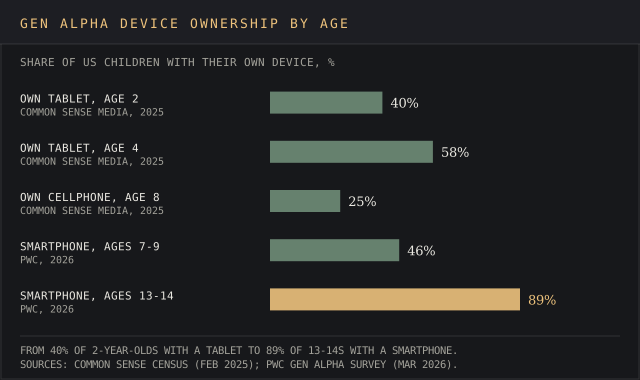
- 40% of 2-year-olds and 58% of 4-year-olds have their own tablet
- 25% of 8-year-olds have their own cellphone, and 51% of children 0 to 8 have a mobile device of their own
- About one in five use mobile devices for emotional regulation, mealtimes or falling asleep
- Children in lower-income homes spend about 3 hours 48 minutes a day with screens, against 1 hour 52 minutes in higher-income homes
By the tween years, devices are near-universal. PwC's survey of 1,004 children aged 7 to 14 and 1,009 parents, fielded 29 January to 13 February 2026, found 70% own a tablet, 72% use smartphones regularly, and smartphone ownership climbs from 46% at ages 7 to 9 to 89% at ages 13 to 14. Average recreational screen time across the sample was 3.6 hours a day. Morning Consult's May 2026 report found smartphones already reach half of Gen Alpha children aged 0 to 3.
Copy these lines into an email, fill them in and send. I reply with scope and a price within 2 to 3 business days.
Open the emailExcessive screen time is the worry many parents name. In Springtide Research Institute's 2024 survey of 13-year-olds, nearly half agreed they're "addicted" to their phone, the clearest self-reported sign of screen addiction in this age group. PwC found 36% of kids abandoned an app because of screen time limits or adult intervention.
Every cloud has a silver lining, and the counter-trend is real. GWI found 40% of 12- to 15-year-olds take deliberate breaks from their devices, physical toys on wishlists up 16% since 2023, and kids saying they play board games a lot up 8%. Gen Alpha splits time between a digital world and an offline life more than the headlines suggest.
Social media usage, YouTube and streaming services
YouTube takes the lion's share of attention and is the default screen for kids today. PwC found 68% of Gen Alpha watch YouTube regularly, 54% use gaming platforms and 49% use streaming services. Short-form video grows with age:
- TikTok regular use: 21% at ages 7 to 9, 46% at ages 13 to 14 (PwC)
- Parents co-view YouTube with their children 62% of the time, but TikTok only 17% (Common Sense Media)
- Nearly all 13-year-olds are on social media, and more than half must ask permission to use apps or sites (Springtide)
Gen Alpha watches more than it posts. In GWI's Gen Alpha report, built on more than 20,000 surveys of internet users aged 8 to 15 across 18 markets, 1 in 10 teens said they post everything they do, and 2 in 5 felt able to post what they think. Australia's under-16 social media ban now gives researchers a live test of offline childhood.
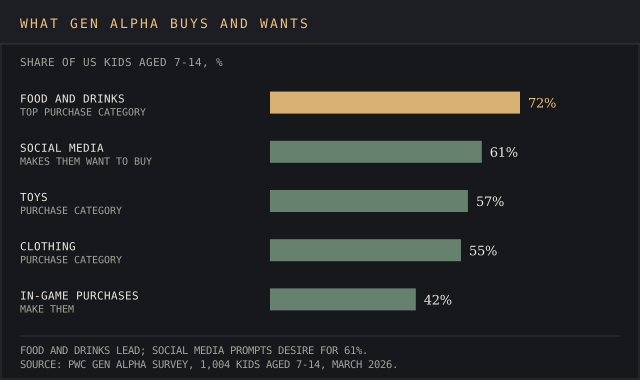
Social media usage drives Gen Alpha buying. PwC found 61% of Gen Alpha say social media makes them want to buy things, ahead of friends (56%), in-store browsing (53%) and TV ads (48%). Even among 7- to 9-year-olds the figure is 57%. For more on platform scale, see our YouTube statistics and TikTok statistics.
Gen Alpha gamers
Gaming is the main social space for Generation Alpha. GWI found 77% of 8- to 11-year-olds play video games, and Roblox use among its sample rose from 26% in 2021 to 51%. Gen Alpha gamers want to make things: 38% of gamers aged 12 to 15 like games with building or creating elements.
Money follows Gen Alpha play. PwC's Gen Alpha respondents reported:
- 53% buy digital apps or one-time downloads
- 42% make in game purchases
- 34% buy subscriptions or passes
GWI adds that over a quarter of 8- to 11-year-old gamers spend pocket money on virtual items, and Common Sense Media found time spent gaming among children 0 to 8 up 65% since 2020. Multiplayer party games such as Mario Party grew 11% since 2021, a sign Gen Alpha gamers play video games together. Our video game industry statistics page covers the wider market.
Generation Alpha consumer statistics: spending power and the purchase journey
Gen Alpha's spending power is mostly borrowed, because money doesn't grow on trees at age nine. PwC found 60% of 7- to 14-year-olds say an adult pays for them, 49% use cash, 16% use digital wallets, 14% gift cards and 12% a bank or debit card. Digital wallet use rises from 12% at ages 7 to 9 to 23% at ages 13 to 14.
Want a purchase driver chart like this for your own category? Send the product and the age group.
Email a briefGeneration Alpha does earn. 86% of kids and 79% of parents say kids earn their own money, and 38% get more than $20 in a typical week, rising to 51% at ages 13 to 14. Chores (65%) lead the sources, followed by rewards for grades, sports or hobbies (50%).
How Gen Alpha choose what to buy follows a clear purchase journey:
- Want: 61% are prompted by social media, and 61% add items to wish lists
- Ask: 47% ask immediately in stores, 44% when browsing online
- Negotiate: 44% bargain, and 43% repeat requests before asking directly
- Buy: 52% add items to shared carts for parental review
Top purchase categories are food and drinks (72%), toys (57%) and clothing (55%). On clothing, 97% of kids report some influence and 55% "a lot", and about 94% of parents agree. On skincare and beauty, 81% of kids claim influence against 61% of parents who see it, a 20-point gap parents feel in the beauty aisle.
Parents also underestimate independent ordering. 24% of kids say they order through shopping apps or websites on their own, against parents' estimate of 19%. On food delivery apps the gap is 25% against 14%. Pocket money is rising in most markets: GWI found it up at least 10% over four years in 9 of 14 markets, and UK kids get 25% more than in 2021, though US and Chinese kids receive less than a few years ago.
The long-run purchasing power is large. McCrindle projects Gen Alpha's economic footprint will exceed $5.46 trillion by 2029. A widely quoted $28 billion figure for current direct spending power, attributed to Numerator, has no public release we could trace.
Gen Alpha parents
Gen Alpha parents are mostly millennials, and millennial parents run the household as a negotiation in which kids increasingly call the shots. PwC's parent sample shows how closely they track their kids' spending. Parents keep an eye on screens: GWI found parental controls have risen steadily since 2021, and kids whose parents talk to them about privacy are 10% more likely to say they know how to stay safe online than kids whose parents only use controls.
Many parents use screens as tools. Common Sense found 75% of parents excited about their children learning through digital media, and one in five children use devices to calm down, eat or fall asleep. Market research on this cohort mostly reaches kids through their parents, which is why the PwC study paired 1,009 parents with its child sample, and why Morning Consult surveyed 1,018 parents of children 0 to 12.
75% of parents are excited about their children learning through digital media, per Common Sense Media.
Parents excited about children learning through digital media
Source: Common Sense Mediae.g. parent attitudes in the categories you sell to
Source: linked, checked, datedGeneration Alpha education
Reading is the elephant in the room. The oldest Gen Alphas were in early grade school when COVID-19 closed classrooms, and remote learning hit them in their earliest years of reading. The 2024 National Assessment of Educational Progress, released 29 January 2025, found:
- 31% of fourth graders at or above Proficient in reading, and about 40% below Basic, the largest share since 2002
- Nearly 40% of fourth graders at Proficient or above in math, with nearly a quarter below Basic
- Fourth-grade reading scores 5 points below 2019
The Annie E. Casey Foundation reports fourth-grade reading proficiency of 30% in 2024, down from 32% in 2022, and chronic absenteeism among fourth graders of 31%, down from 36% in 2022. The roundup claim that 69% of fourth graders aren't proficient in reading matches the 31% NAEP figure.
AI is already one of the educational aids in daily use. Nearly a third of parents in Common Sense's census say their child has used AI for school-related learning, and Morning Consult found a third of kids used an AI chatbot for homework in the past 90 days. PwC found 38% of 13- to 14-year-olds use AI tools for fun, and GWI found about 1 in 4 teens used an AI tool in the last week.
Predictions that more than half of Generation Alpha will earn a university degree circulate widely but look like pie in the sky: they trace to no published projection we could find. GWI found US teens valuing a university degree fell 24% among medium-income households, so the trend may run the other way. Our online learning statistics cover the digital classroom.
Health, wellbeing and mental health
The Annie E. Casey Foundation's data shows strain on Generation Alpha's mental health and physical health:
- Childhood anxiety or depression, ages 3 to 17: 13% in 2022 to 2023, up from 9% in 2016 to 2017
- 45% of children 6 to 11 were bullied, picked on or excluded in the past year
- 35% of 6- to 11-year-olds overweight or obese, and only 26% physically active for 60 minutes a day
- One in six parents report their Gen Alpha child has been cyberbullied
Among 13-year-olds in Springtide's survey, about 4 in 10 felt lonely at least sometimes over four weeks, and about half felt worried or anxious. Climate change weighs on young people too: six in 10 worry about it at least sometimes, and nearly half expect their lives to differ from their parents' because of it. Time spent playing sports and outdoors lags the screen hours; the 26% activity figure is the clearest marker.
How Generation Alpha sees the world differently
Generation Alpha statistics describe a cohort that does things differently from other generations at the same age, mostly because the tools arrived first. Generation Alpha is the first generation in which a majority of children aged 0 to 8 have a mobile device of their own, on Common Sense Media's 51% figure. Previous generations met mobile phones as teenagers; the youngest generation met tablets in the crib.
Four differences show up across the surveys:
- Screens before reading: 62% of US households with young children have a tablet "before most kids can read," per Morning Consult, and many children use devices to fall asleep.
- Gaming as a social network: Gen Alpha choose gaming platforms as a place to meet friends, and 54% use them regularly, against TikTok use of 21% to 46% depending on age.
- Commerce from the start: one in four orders online without a parent, and parents and other adults in the household underestimate it by 5 points.
- Diversity as the default: a majority-minority cohort in the US, with 24% of births to foreign-born mothers.
Generation Alpha also inherits global generations' worries early. Six in 10 13-year-olds worry about climate change, and about 4 in 10 of the youngest generation's oldest members report feeling lonely at least sometimes.
The new generation after it, Generation Beta, starts with people born from 2025, so Gen Alpha members will be its older siblings, and within the time period McCrindle assigns to Generation Beta, 2025 to 2039, the oldest Gen Alphas will start becoming its parents.
For marketers, the read is simple enough to be easier said than done. Generation Alpha decides wants early, persuades millennial parents to pay, and will reach adulthood between 2028 and 2042 on McCrindle's dates, our own addition of 18 years. People born in 2010 are already 16; people born in 2024 enter school around 2029.
Gen Alpha population by region
Most of the Gen Alpha population lives outside developed countries. The UN projects the populations of 63 countries and areas, including China, Germany, Japan and Russia, have already peaked, while sub-Saharan Africa's population is projected to more than double by 2050.
That means a rising share of Generation Alpha is born in sub-Saharan Africa, a point that global market research on the cohort tends to miss. PwC, Common Sense Media and Morning Consult survey US families, and GWI's 18 markets include only one in Africa, South Africa.
Careers, life expectancy and the global workforce
Generation Alpha's ambitions split by gender. GWI found 54% of girls believe girls can do any job they want, against 37% of boys who believe the same about themselves. 14% of adults in GWI's Zeitgeist survey fear the job market will fail Gen Alpha.
Generation Alpha should live longer than other generations. Average life expectancy at birth reached 73.3 years globally in 2024 and is projected to reach 77.4 years by 2054, per the UN, and McCrindle notes many members of Gen Alpha will live to see the 22nd century. A child born in 2024 who reaches the projected average would live to around 2100.
The time Gen Alpha enters the global workforce is already here for the oldest members, who can take part-time jobs at 16 in the US. Claims that Gen Alpha will make up 19% of the workforce by 2035, or that two thirds will work in jobs that don't exist yet, trace to no source we could verify, so they aren't used here.
Gen Alpha vs Gen Z
| Measure | Gen Z | Gen Alpha | Source |
|---|---|---|---|
| Birth years | 1997 to 2012 | 2013 to present | Annie E. Casey Foundation |
| Share white (US) | 50% | 48% | Annie E. Casey Foundation |
| Own device by age 4 | Smartphones arrived in their teens | 58% own a tablet | Common Sense Media |
Gen Z grew up as smartphones arrived; Generation Alpha was born into them, and the generation gap shows most in how early the devices arrived. Among Generation Alpha toddlers, 40% have their own tablet at age 2. Gen Z's numbers are in our Gen Z statistics report.
Delivered for your site and your byline. Hosting here is optional.
Frequently asked questions
Is Gen Z smarter or Gen Alpha?
No test compares the two at the same age on equal terms. NAEP shows fourth-grade reading proficiency at 31% in 2024, five points down on 2019 average scores, so Gen Alpha's early reading results trail those of Gen Z at the same grade.
Will Gen Alpha live to 100?
Most won't. Global average life expectancy is 73.3 years and projected at 77.4 by 2054 (UN). Many Gen Alpha members will live into the 22nd century, McCrindle notes, which means reaching their mid-70s to 90.
Is being Gen Alpha rare?
No. About one in four people alive, 2.0 billion of 8.16 billion in 2024, falls in the Gen Alpha birth years, which makes it the largest generation.
What is Gen Alpha most known for?
Early device use and gaming: 58% own a tablet by age 4, 68% watch YouTube regularly and Roblox use in GWI's sample doubled to 51% since 2021.
What does Gen Alpha struggle with the most?
Reading and mental health. About 40% of fourth graders read below NAEP Basic, and childhood anxiety or depression rose from 9% to 13% between 2016 and 2023.
Bottom line
Gen Alpha is the largest generation, about 2 billion people and a quarter of humanity, and the first in the US with a white minority. Kids today in this cohort spend 3.6 hours a day on screens by age 7 to 14, and 61% say social media makes them want to buy.
The numbers that matter most for planning are the definitional ones: a 2010 or 2013 start year changes the US count by millions. For spending, treat Gen Alpha as an influencer of parents' budgets, with McCrindle's $5.46 trillion 2029 footprint as the longer view.
Toy brands, edtech companies and kids' media firms publish reports like this one as lead magnets and client briefs.
A report on your topic for a blog page, gated content or a lead magnet.
Written for your client and published under their brand, with my name left off.
Your report on marketintelligencetools.com, with 2 to 3 CTAs carrying your sponsored links.
Default terms: the report is yours to publish, and I keep the right to republish it on this site behind a gate, outside Google's index.
The population tables, child surveys and test scores behind each Gen Alpha figure, and the headcount no agency publishes
Population and government sources: population.un.org (World Population Prospects 2024), aecf.org (Annie E. Casey Foundation, 2023 data), nagb.gov (NAEP 2024 results release, January 2025) and cdc.gov (National Center for Health Statistics data brief 535).
Research and survey sources: mccrindle.com.au (Generation Alpha defined, updated May 2026), pwc.com (Gen Alpha survey, March 2026), commonsensemedia.org (2025 census of children aged 0 to 8) and gwi.com (Gen Alpha report).
All figures checked 20 November 2026. National statistics offices track births by year, so no agency publishes a Generation Alpha headcount, and every population figure on this page is an age-band count.