Fashion industry statistics 2026: market size, resale, trade and emissions
 By Jan Suski. I go deep on every review, checking every number against its source and digging up details other coverage misses, a habit from six years of SEO and link building for tech companies. Bylines at Brand24 and Senuto. How the scoring works.
The global apparel and footwear market was worth $1.8 trillion in 2025, according to Euromonitor International, and the market research provider expects growth below 1% a year through 2030. Online channels took 32.4% of those sales. Secondhand clothing is the fastest-growing slice, at about 10% of global apparel spend.
This report collects fashion industry statistics from the bodies that publish them: Euromonitor, Statista, the Business of Fashion and McKinsey survey, ThredUp and GlobalData, Textile Exchange, the World Trade Organization, the US Bureau of Labor Statistics, Brand Finance and Interbrand. Each figure links to its publisher on first use.
It's written for brands, retailers and analysts who need a number they can defend. Where publishers disagree, and on fashion's market size, brand values and carbon footprint they disagree by billions or by whole percentage points, both figures sit side by side with what each one counts. On a $1.8 trillion market, a forecast that's off by one percentage point misstates a year's growth by about $18 billion.
The numbers Apparel, footwear, resale and trade, checked 17 November 2026
The apparel market is growing by low single digits while secondhand grows at about 9% a year.
Market size figures from Statista and Euromonitor differ in scope, apparel alone against apparel and footwear.
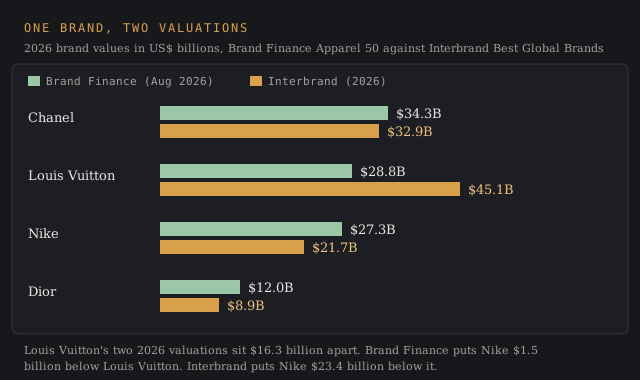
Two brand rankings published three months apart value Louis Vuitton $16.3 billion apart.
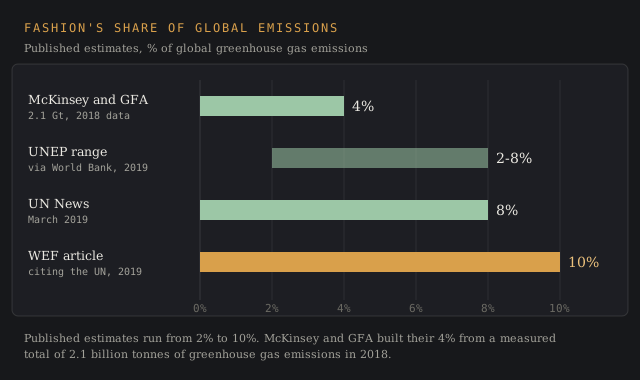
Estimates of fashion's share of global emissions run from 2% to 10%.
Brands, retailers and resale platforms quote market numbers in every deck. Send the category or the country and I'll source a version you own.
Global apparel market size
Statista, a second market research provider, has an apparel market outlook that puts global apparel revenue at $1.92 trillion in 2026, up 2.7%. The market is expected to grow 2.62% a year from 2026 to 2031. That works out to $243.15 of apparel per person in 2026, and about 95% of sales go to non-luxury brands.
Euromonitor International's worldwide apparel and footwear market size is $1.8 trillion for 2025. Its March 2026 release says the market is expected to grow below 1% a year through 2030 for the combined apparel market, with sportswear the faster segment at a 2% CAGR.
Volume tells the same slow story. Statista counts 24.1 pieces of apparel per person in 2026 and expects volume growth of 1.0% in 2027, reaching 203.2 billion pieces in 2031. The global fashion industry produces garments by the tens of billions, and garments produced annually keep rising in a market that grows about 1% in volume.
Statista's model uses GDP per capita, consumer spending per capita, internet penetration and population as forecast drivers. So apparel forecasts move with GDP per capita forecasts, and a downgrade to GDP per capita in a large market moves the global apparel market number with it.
Why fashion market size estimates diverge
The two headline market size numbers look close and measure different things. Statista's $1.92 trillion covers apparel alone for 2026. Euromonitor's $1.8 trillion covers apparel and footwear together for 2025. So Statista's apparel-only figure sits above Euromonitor's figure that includes shoes. Comparing scopes before comparing totals is the first step in data triangulation.
| Publisher | Scope | Market size | Growth outlook |
|---|---|---|---|
| Statista Market Insights | Global apparel | $1.92 trillion (2026) | 2.62% a year, 2026 to 2031 |
| Euromonitor International | Global apparel and footwear | $1.8 trillion (2025) | Below 1% a year to 2030 |
| Business of Fashion and McKinsey | Fashion industry global revenue | Not published as a dollar figure | Low single-digit growth in 2026 |
| ThredUp and GlobalData | Global secondhand apparel | $257 billion (2025) | About 9% a year to $393 billion in 2030 |
| Meticulous Research | Global apparel resale | $241 billion (2025) | 8.8% a year to $615.93 billion in 2036 |
Copy these lines into an email, fill them in and send. I reply with scope and a price within 2 to 3 business days.
Open the emailThe growth outlooks spread wider than the sizes. Statista's 2.62% and Euromonitor's sub-1% describe nearly the same fashion market and the same apparel industry over nearly the same window, and the gap between them compounds to tens of billions of dollars by 2030. Read every fashion market forecast with its scope attached, because the devil's in the details.
Resale market size estimates show the same problem at a smaller scale. ThredUp and GlobalData put the 2025 global secondhand apparel market at $257 billion. Meticulous Research puts global apparel resale at $241 billion for the same year, $16 billion lower.
Online and offline share of fashion retail sales worldwide
Online shopping took 32.4% of fashion retail sales worldwide in 2025, per Euromonitor's apparel and footwear data. Applied to its $1.8 trillion total, that's about $583 billion of online sales and about $1.2 trillion through physical stores, which still hold the lion's share at 67.6% of total fashion retail sales. That retail sales percentage puts about one dollar in three with shoppers purchasing apparel online.
That online and offline share shapes where global fashion retail spending goes. Our ecommerce statistics report covers global online retail sales and global ecommerce sales across every category, including the online shopping habits behind them. On Euromonitor's numbers, the online apparel market holds a third of overall fashion retail sales. Statista tracks the e-commerce fashion industry in a separate e-commerce market report, with its own fashion e-commerce segments.
For the online fashion retail forecast, Euromonitor's sub-1% growth for the whole market caps what online sales can add without taking share from stores. The retail industry statistics report tracks total global retail sales and store counts, and the retail market intelligence platform guide covers the tools that track retail sales worldwide by channel.
Apparel industry statistics for the US
The US leads the world's apparel retail market. Statista puts US apparel revenue at $373 billion in 2026, and Statista's analysts say Greater China is close to overtaking it among the largest apparel retail markets, a race worth keeping an eye on.
Household spending shows where the money goes. In 2023 the average US household spent $655 on apparel for women aged 16 and over, $406 on apparel for men, $96 for boys and $87 for girls, per the Bureau of Labor Statistics. Women's footwear took $208 and men's $147. The women's apparel market is the largest single line in the household clothing budget, 61% bigger than men's.
Apparel industry prices have barely moved in 30 years. The BLS consumer price index for apparel stood at 133.4 in 1994 and 131.5 in 2024, while the index for all items reached 313.7. Over those 30 years apparel prices stayed flat while the all-items index kept climbing, so clothing got cheaper in real terms, the backdrop for apparel consumer purchasing habits since the mid-1990s.
Clothing industry employment for designers is flat. The BLS counts about 32,700 fashion designer jobs in 2025, with a median annual wage of $80,960 in May 2025 and 0% projected growth to 2035. 36% are self-employed and 7% work in apparel manufacturing.
Footwear market growth and sportswear
Sportswear is the bright spot in apparel and footwear. Euromonitor says the global sportswear market is expected to grow at a 2% CAGR from 2025 to 2030, about double the growth rate it expects for apparel and footwear overall.
The buyers explain the footwear market growth. 31% of fitness enthusiasts plan to raise spending on clothing and footwear, against 24% of global consumers, and 35% of all consumers plan to spend more on health and wellness, per Euromonitor's 2025 Voice of the Consumer survey.
Footwear is tracked inside these combined numbers more often than on its own, and a free headline figure for footwear markets worldwide is a needle in a haystack. In the US, footwear took $355 of household spending in 2023 across men and women, per the BLS figures above.
Global apparel production and fibre use
Global fibre production reached a record 132 million tonnes in 2024, up from 125 million tonnes in 2023, per Textile Exchange's Materials Market Report 2025. Polyester production rose to 78 million tonnes, 59% of the total, and cotton slipped to a 19% share at 24.5 million tonnes.
Recycled polyester grew from 8.9 million to 9.3 million tonnes, but its share of polyester fell from 12.5% to 12% because virgin output grew faster. Against 132 million tonnes of total fibre, 9.3 million tonnes of recycled polyester is a drop in the bucket. Global apparel production keeps setting records on virgin synthetic fibre, and global apparel consumption follows it.
The fashion industry statistics on waste come from older work. The Ellen MacArthur Foundation's 2017 report found the equivalent of one garbage truck of textiles is landfilled or burned every second, and less than 1% of material used to produce clothing is recycled into new clothing, per FashionUnited's report on its launch. It put the value lost to clothing that's barely worn and rarely recycled at $500 billion a year.
Global apparel trade and the international fashion market
China's share of world clothing exports fell to 29.6% in 2024, the lowest level since 2010, according to World Trade Organization data compiled by Sheng Lu at the University of Delaware. Its share of world textile exports rose to 43.3% from 41.5% in 2023, so China ships more fabric to the countries that now sew the garments, a shift that stays under the radar in headline export figures.
The garment industry's export trade nearly doubled in two decades. Knitted garment exports rose from $145.2 billion in 2006 to $289.1 billion in 2025, and woven garment exports from $158.5 billion to $257.7 billion, per the International Cotton Advisory Committee's August 2026 Observer. Total textile and clothing industry exports grew from about $560 billion to $914 billion between 2006 and 2025.
The international fashion industry and the international fashion market run on that trade, and tariffs top the list of hurdles fashion executives name for 2026. For sourcing data, see our supply chain market intelligence guide.
Leading clothing companies and brand value
The top 50 apparel brands lost 4% of combined brand value in 2026, falling to $350.9 billion, per Brand Finance's Apparel 50 2026. Chanel kept first place at $34.3 billion, down 9%, ahead of Louis Vuitton at $28.8 billion and Nike at $27.3 billion. French brands hold $120.7 billion of the total, and the US has the most entries at 12 brands worth $68.8 billion.
Interbrand's 2026 ranking, reported by FashionUnited, values the same global fashion companies differently. Hermès leads the fashion brands at $45.2 billion, up 10.6%, with Louis Vuitton at $45.1 billion, down 6.9%. Nike fell 35.5% to $21.7 billion, and the Italian luxury brand Gucci fell 30.7% to $8.1 billion.
Want a brand-value chart like this for the labels in your category? Send the brand list.
Email a briefEach house uses its own valuation method, so brand value figures don't carry across rankings, and disagreement of this size is par for the course. Brand Finance has Nike $1.5 billion behind Louis Vuitton. Interbrand has it $23.4 billion behind. Dior is $12 billion in one and $8.9 billion in the other. Read between the lines and the two houses agree only on direction for Dior, down in both.
The best performing fashion brand in Interbrand's list was Uniqlo, up 16.2% to $20.5 billion, followed by Zara at $21.6 billion, up 11.2%. Dior is the strongest apparel brand in Brand Finance's index, with a Brand Strength Index score of 91.5 out of 100, even after its value fell 31% to $12 billion.
For the leading clothing companies worldwide, the clothing industry's two biggest rankings even disagree on direction. Chanel rose 8.1% in Interbrand's list and fell 9% in Brand Finance's.
Secondhand apparel market
The global secondhand apparel market grew about 13% in 2025 to $257 billion, roughly 10% of global apparel spend, per ThredUp's 2026 Resale Report, built with GlobalData on a survey of 3,268 US consumers and input from 50 brands. The resale market is expected to reach $393 billion by 2030 at about 9% a year, double the pace of the overall apparel market.
ThredUp expects the US secondhand market to reach $78.8 billion by 2030, according to its April 2026 release. 59% of US consumers bought secondhand apparel in 2025, up seven points in three years, per Retail TouchPoints' report on the study.
McKinsey and the Business of Fashion forecast secondhand fashion and luxury to grow two to three times faster than firsthand through 2027. Resale is the one line in the fashion sector where every forecaster points the same way.
Fashion industry emissions, water and waste
The fashion industry's carbon footprint depends on who you ask. McKinsey and the Global Fashion Agenda's Fashion on Climate report measured 2.1 billion tonnes of greenhouse gas emissions in 2018, about 4% of the global total, with 70% from upstream materials production and processing.
- The category, region or brand set to cover
- Regions, years and segments
- Where it runs: blog, white-label, gated or lead magnet
- Whose byline goes on it
- Deadline
- 2,500+ words, human-written
- Every figure linked to its source
- Yours to publish, under your name or none
- Hosting here for +$200, with your sponsored links
UN News reported in March 2019 that clothing and footwear production accounts for 8% of global greenhouse gas emissions. The World Bank, citing UNEP, gave a range of 2% to 8% the same year. A 2019 World Economic Forum article citing the UN put it at around 10%. The WEF article publishes no calculation behind its 10%, and the jury's still out on a single agreed number.
Water figures carry the same caveat. The UN Alliance for Sustainable Fashion credits the industry with 20% of global wastewater, per the UNCCD's summary. The World Bank's 2019 feature put one pair of jeans at 3,781 litres of water and 33.4 kilograms of carbon equivalent, citing UNEP.
Global fashion industry outlook for 2026
Across the global apparel market, fashion executives are gloomier than a year ago. 46% of respondents in The State of Fashion 2026, published by the Business of Fashion and McKinsey on 17 November 2025, expect conditions to worsen in 2026, up from 39%. 25% expect improvement, up from 20%, and the report projects low single-digit growth.
Tariffs are the top-cited hurdle. 36% of executives call North America unpromising, double the previous year's share, while the share calling China unpromising fell from 41% to 28%. 26% of fashion executives expect to bite the bullet on price increases above 5%, against 18% in luxury.
Shoppers are squeezed too, and worldwide consumer spending on clothing reflects it. 71% of global consumers are concerned about rising everyday costs, per Euromonitor's Voice of the Consumer: Lifestyles 2025 survey, and US consumer confidence hit its lowest level since May 2020 in April 2025, per McKinsey. More than 35% of executives already use generative AI for customer service, image creation and copywriting.
The fashion and apparel industry matters to the world economy at scale, and the fashion and clothing industry employs more than 300 million people along its value chain, from cotton farms to the garment industry's factories. Sustainable Energy for All's 2025 report puts fashion at about 2% of global GDP and gives that 300 million figure. Related consumer data sits in our Gen Z statistics and beauty statistics reports.
Delivered for your site and your byline. Hosting here is optional.
Frequently asked questions
Is the fashion industry growing or declining?
Growing slowly. Statista expects apparel revenue to rise 2.7% in 2026, and Euromonitor expects apparel and footwear to grow below 1% a year through 2030. Secondhand apparel is growing at about 9% a year, per ThredUp and GlobalData.
Is the fashion industry struggling?
Sentiment and brand values are falling. 46% of executives expect worse conditions in 2026, and Brand Finance's top 50 apparel brands lost 4% of combined brand value this year.
What is the 3-3-3 rule of fashion?
It's a capsule-wardrobe styling rule. You pick three tops, three bottoms and three pairs of shoes, and build every outfit from those nine pieces. It grew out of minimalist wardrobe challenges such as Courtney Carver's Project 333.
Is fashion the most polluting industry?
Published estimates put fashion at 2% to 10% of global greenhouse gas emissions. The best-documented figure, from McKinsey and the Global Fashion Agenda, is 4%, or 2.1 billion tonnes in 2018, about the combined annual emissions of France, Germany and the United Kingdom, per the report.
What is the unhealthiest fabric to wear?
This report covers fibre volumes, so it can't rank fabrics by health risk. The fibre people wear most is polyester, 59% of global fibre production in 2024, per Textile Exchange.
What are the current issues in the fashion industry?
Tariffs, weak consumer confidence, falling brand values and waste. Executives name tariffs as their top hurdle for 2026, 71% of consumers worry about everyday costs, and less than 1% of clothing material is recycled into new clothing.
Bottom line
The global apparel market is worth about $1.8 trillion to $1.92 trillion depending on scope and year, and it's growing by low single digits at best. Online takes about a third of sales, and resale takes about a tenth of apparel spend while growing several times faster. The clothing industry's growth now sits mostly in resale and sportswear.
Most of the fashion market's contested numbers, from market size to brand value to emissions, come from houses with different definitions. Quote them with the publisher and the scope attached, and treat the 10% emissions figure and any single brand valuation with care. To size a segment of your own, start from our market sizing template.
Apparel brands, resale platforms and retail agencies use reports like this one in pitch decks and client briefs.
A report on your topic for a blog page, gated content or a lead magnet.
Written for your client and published under their brand, with my name left off.
Your report on marketintelligencetools.com, with 2 to 3 CTAs carrying your sponsored links.
Default terms: the report is yours to publish, and I keep the right to republish it on this site behind a gate, outside Google's index.
The houses, trade bodies and surveys behind each fashion figure
Market size and sales: euromonitor.com (March 2026 release; Voice of the Consumer: Lifestyles 2025), statista.com (apparel market outlook), mckinsey.com (The State of Fashion 2026, 17 November 2025), thredup.com (2026 Resale Report and April 2026 release), retailtouchpoints.com and meticulousresearch.com.
Production, trade and the US: textileexchange.org (Materials Market Report 2025), shenglufashion.com (WTO data, 10 October 2025), icac.org (August 2026 Observer) and bls.gov (2025 apparel data and occupational outlook).
Brands and emissions: brandfinance.com (Apparel 50 2026), fashionunited.uk (Interbrand 2026), fashionunited.com (Ellen MacArthur Foundation launch, 2017), mckinsey.com (Fashion on Climate), news.un.org (March 2019), worldbank.org (23 September 2019), weforum.org (2019), unccd.int and seforall.org (2025).
Every figure was checked against its source on 17 November 2026. None of these publishers gives a free headline figure for the global footwear market on its own, and the 10% emissions share circulates with no published calculation behind it.