Gym statistics 2026: 81 million US members and a $47.1 billion industry
 By Jan Suski. I go deep on every review, checking every number against its source and digging up details other coverage misses, a habit from six years of SEO and link building for tech companies. Bylines at Brand24 and Senuto. How the scoring works.
81 million Americans held gym memberships in 2025, 26.1% of everyone aged six and older and an all-time high, according to the Health & Fitness Association's 2026 consumer report. Those members and another 19 million-plus pay-as-you-go users made about 7 billion gym visits, more than in the pre pandemic peak of 2019.
This report pulls together the gym membership statistics, gym statistics and fitness apps data that matter to gym owners, investors and anyone sizing the fitness industry: how many people hold gym memberships, who they are, how often they go, what they pay, how many members quit, and how big the fitness market is in the US, Europe and worldwide. Every figure links to the trade body, regulator, company filing or research house that published it.
Fitness industry statistics are a dime a dozen online, and many recycle one blog's numbers through ten others. Where the published estimates disagree, and for global fitness market size they disagree by up to $29 billion, the table names each house and its figure so a reader can see the spread.
The numbers Gym memberships, visits and revenue, checked 17 November 2026
One American in four belongs to a gym, yet fewer than half of adults meet the aerobic guideline, so the gap between gym members and the inactive majority is where the fitness industry's growth sits.
Retention of 66.4% means the typical club replaces about a third of its members every year before it grows at all.
Revenue is outpacing heads: HFA's 2026 operator survey found median revenue up 10.7% against net membership up 6.9%.
I'll write a 2,500+ word report on the fitness market you name, every figure linked to its trade body or filing like this page. Yours to publish, from $200.
US gym membership statistics: 81 million members in 2025
US gym membership hit 81 million in 2025, up 5.2% from 77 million gym memberships in 2024. HFA counts members aged six and older across gyms, health clubs and studios, and its survey of about 18,000 US residents a year runs with Sports Marketing Surveys USA under the Physical Activity Council.
| Year | Members | Penetration, ages 6+ | Total facility users |
|---|---|---|---|
| 2024 | 77 million | 25% | nearly 96 million |
| 2025 | 81 million | 26.1% | 100 million+ |
US fitness facility members and users (HFA)
The industry came back with flying colors: membership grew 20% between 2019 and 2024, per HFA's 2024 consumer report, which puts 2025's count about a quarter above the pre pandemic base. Total facility users, which add day passes and guest visits to paying members, crossed 100 million for the first time, about 33.5% of the population.
Studios held the most gym memberships of any facility type in 2024, at 23.1 million, ahead of fitness-only gyms at 22.2 million, so boutique studios and their class-based model hold a larger share of US gym memberships than fitness-only gyms do.
Only 4.6% of gym members didn't use their gym memberships at all in 2025, a record low and down from around 10% a few years earlier. The image of the gym as a place that profits from people who never show up doesn't match HFA's survey data anymore.
Gym memberships now against the pre pandemic baseline
The 2020 closures sent clubs back to square one, and gym memberships have since more than recovered, as these gym membership statistics show. The pre pandemic comparison HFA publishes runs from 2019 to 2024, and on almost every line the fitness industry is bigger, with one exception: how often each member goes.
| Measure | 2019 | 2024 | 2025 |
|---|---|---|---|
| Gym memberships (index, 2019 = 100) | 100 | 120 | 126 |
| Average member visits per week | 2.1 | 1.5 | n/a |
| Total facility users | n/a | nearly 96 million | 100 million+ |
| Members who never used their gym membership | n/a | around 10% | 4.6% |
Copy these lines into an email, fill them in and send. I reply with scope and a price within 2 to 3 business days.
Open the emailUS gym membership statistics, 2019 against 2024 and 2025 (HFA)
The index row uses HFA's reported 20% growth from 2019 to 2024 and the 5.2% rise in 2025. More gym memberships at a lower visit rate per member is the trade the US fitness industry made after 2020: more members, each visiting less often on average, and a total number of gym visits that still went past the old record.
That shape matters for gym owners planning floor space. A club with more gym members who each visit 1.5 times a week fills its peak hours differently from one with fewer members at 2.1 visits, and HFA's tracker shows visits per visitor up only 1.1% in 2025, so the extra traffic came from more gym goers.
Gym member demographics: who holds gym memberships by age, sex and income
Gen Z holds gym memberships at the highest rate of any age group. HFA puts penetration among 18- to 24-year-olds at 35.5%, against 26.1% for the whole population, and members aged 65 and older were the fastest-growing cohort in 2025, up 8.6%.
That growth at the older end shows up in IBISWorld's US industry report too, which makes senior fitness a planning line: it flags the aging population and healthcare costs as a long-run support for fitness club revenue, with baby boomers a central market.
HFA's 2024 report described the typical member as trending "younger, more male, less affluent, and more ethnically diverse." It doesn't publish a sex split for 2025, so the share of female gym members isn't in its headline data; the CDC's activity numbers below show the gap that sits behind it.
| Group | Share meeting guidelines |
|---|---|
| All adults | 47.2% |
| Men | 52.3% |
| Women | 42.4% |
| Ages 18 to 34 | 54.0% |
| Ages 65 and older | 38.4% |
| Family income 400%+ of poverty level | 56.5% |
| Family income under 100% of poverty level | 35.4% |
| Bachelor's degree or higher | 58.5% |
US adults meeting federal aerobic activity guidelines in leisure time, 2024 (CDC NCHS Data Brief 555)
The CDC data brief, published April 7, 2026 from the 2024 National Health Interview Survey, shows activity tracking income and education closely. Adults with a bachelor's degree meet the guideline at 58.5%, against 32.3% for those without a high school diploma.
People with gym memberships are far more active than the rest. HFA found 49.4% of members meet or beat the federal aerobic guideline, against 24.5% of non-users, and only 4.7% of members report no physical activity in a typical week, against 33.1% of non-users. Gen Z's share of that membership is covered in more depth in our Gen Z statistics report.
Gym attendance and gym usage statistics
Gym attendance gets measured three ways, and gym owners use all three to plan around gym memberships: HFA's member survey, HFA's traffic tracker and Placer.ai's chain-level data.
The fitness industry is on a roll: gym attendance set a record in 2025, and gym goers came back 1.1% more often per month than in 2024. Foot traffic at US commercial fitness facilities averaged more than 184,000 visits per location, up 4.2% from 2024, per HFA's Fitness Industry Traffic Tracker. Q4 2025 was the 19th consecutive quarter of visit growth.
The tracker runs on anonymized gym traffic data from nearly 11,000 US fitness facilities, analyzed with Sports Marketing Surveys USA and powered by Placer.ai. Its read on gym usage per person is quieter: average monthly visits per visitor rose 1.1% in 2025. Growth came from more people going, while each person went only a little more often.
- 7 billion: estimated US facility visits in 2025, above the 2019 pre pandemic peak (HFA).
- 1.5 visits a week: average member attendance in 2024, down from 2.1 in 2019 (HFA).
- 4.2 visits a month: how often the average gym visitor returned in 2025, against 2.5 for coffee shops and 2.4 for grocery, per Placer.ai via Chain Store Age.
- 6.7%: Planet Fitness visit growth in Q3 2026, per Placer.ai.
That visit frequency shows up in shopping-center data. Fitness led every tenant category Placer.ai measured on return visits in 2025, while apparel visits fell nearly 25% between 2019 and 2025 in the same data.
Clubs that want members to maintain consistent attendance build schedules around group classes and bring-a-friend passes for gym friends; HFA's benchmarking tracks program offerings next to retention.
Gym traffic data by chain and quarter
Chain-level gym traffic data from Placer.ai shows where the visits went. Planet Fitness visits grew 10.1% year over year in Q2 2025, with average visits per location up 6.2%, per Placer.ai's Q2 2025 recap; Life Time's Q2 2025 visits were 0.6% below the year before, with visits per location down 1.5%.
The budget chain kept that pace into the winter: its visits rose 8.9% in Q4 2025, per Placer.ai, and every month of 2026 through September was up on 2025. Premium clubs grow revenue through price and services; budget gyms grow it through gym visits and club count.
The weekly pattern has also changed. Placer.ai found weekly gym visits in Q1 2025 kept climbing through the whole quarter, unlike previous years, per Athletech News' summary.
Annual gym sign ups and the January spike
In gyms the early bird catches the worm, and January still drives annual gym sign ups. Placer.ai measured US fitness visits in January 2025 at 21.2% above December 2024, a slightly smaller jump than January 2024's 23.4% over the month before.
Member sign ups bunch in the first quarter, when new gym members arrive in the largest numbers of the year. The largest budget chain saw its gym memberships flat at 21.5 million from March through September 2026, so its 4% year-over-year growth came from new member sign ups outside that window.
Gyms that hit the ground running in January face a familiar trade-off. For gym owners, half your new members arriving in a single season is both a risk and a cash-flow cushion. The risk is that annual new members who joined on a resolution can leave by spring; the cushion is the enrollment fees and first-month membership fees booked in January.
Gym membership costs, gym fees and the average monthly fee
What gym memberships cost depends on the segment, and the range runs from $15 to well over $200 a month; premium dues cost an arm and a leg next to a budget card. Planet Fitness keeps its Classic Card at $15 a month and plans "highly targeted regional Black Card price increases" in Q2 2027, per its Q3 2026 earnings call. Black Card members made up about 68% of its base in Q3 2026, up 1.6 points in a year.
At the premium end, Life Time's average monthly dues were $244 in Q3 2026, up about 11.9% year over year, and average revenue per center membership was $1,016 for the quarter, up 12%, per Life Time's Q3 2026 call. That's roughly 16 times the budget Classic rate for a club with pools, spas and childcare.
| Operator | Segment | Price point | Source |
|---|---|---|---|
| Planet Fitness | Budget gyms (HVLP) | $15 a month, Classic Card | Q3 2026 earnings call |
| Life Time | Premium athletic club | $244 average monthly dues | Life Time Q3 2026 call |
Published gym membership price points by segment, 2026
Membership fees are the bulk of income at health clubs and fitness clubs, and boutique studios sell monthly gym memberships alongside class packs. HFA's 2025 Fitness Industry Benchmarking Report found dues made up 76.5% of revenue, with 23.5% from non-dues sources such as personal training, wellness and other services, per SGB's summary of the report. Median revenue per club was $2.0 million across respondents and close to $3.0 million for US companies.
Price increases on gym memberships are doing more of the work than member growth, and revenue growth is outpacing membership growth across the global fitness industry. In HFA's 2026 Global Report, operators lifted median revenue 10.7% in 2025 while net membership grew 6.9%, per Health Club Management; the survey covered 244 companies running nearly 27,000 facilities. For now, operators have their cake and eat it too: more members and higher prices.
Budget gyms pull the volume and premium facilities pull the dollars. The HVLP leader's 2,962 clubs carry 21.5 million gym memberships, about 7,260 per club, while Life Time's 196 centers carry 858,747 center memberships, about 4,380 per center, at 16 times the entry price. Boutique and premium facilities pull members who pay for amenities; the HVLP model counts on volume.
Gym retention: how many gym memberships end and why gym members cancel
US clubs kept 66.4% of their members on average in 2024, per HFA's 2025 benchmarking report. A third of gym memberships ending each year, as members quit and are replaced, means a typical gym has to sign up new members equal to a third of its roster just to stand still, a vicious cycle of marketing spend that never stops.
Monthly attrition puts the same problem in a smaller unit. The largest US chain reported an average monthly attrition rate of 3.6% for Q3 2026, par for the course by its own description: "broadly consistent with historical range and recent trends," per its earnings call transcript. Peloton's average net monthly churn on connected fitness subscriptions was 2.2% in the quarter to June 2026, up from 1.8% a year earlier.
| Measure | Figure | Period | Published by |
|---|---|---|---|
| Average annual member retention, US clubs | 66.4% | 2024 | HFA |
| Net membership growth, US clubs | 5.5% | 2024 | HFA |
| Planet Fitness average monthly attrition | 3.6% | Q3 2026 | Company earnings call |
| Peloton net monthly connected fitness churn | 2.2% | Q4 FY2026 | Peloton |
| Members who never used their membership | 4.6% | 2025 | HFA |
Published retention and churn figures
Usage is the clearest signal in the published gym membership statistics of why gym members cancel. HFA's share of members who never used their gym memberships fell to 4.6% in 2025 while visits per location rose 4.2%, and over the same period US gym memberships grew 5.2%: fewer idle members and more total members.
Cancellation rules are the other variable. The FTC's "click-to-cancel" rule, which covered health and fitness memberships among other recurring plans, was dead in the water by July 8, 2025, when the Eighth Circuit vacated it six days before it took effect, per Greenberg Traurig. More than half the states have automatic-renewal laws, and many are as strict as the vacated rule.
Our customer retention statistics put gym churn next to subscription businesses in other sectors.
Fitness industry revenue: how big the US gym industry is
US gym industry revenue reached $47.1 billion in 2026, IBISWorld's fitness industry revenue figure for the US fitness industry, up 1.8% that year and 3.7% a year compounded since 2021, per IBISWorld's July 2026 industry report. IBISWorld counts 107,878 businesses in the category in 2026, up 1.3% from 2025, and names Life Time as the largest company in a low-concentration market.
That count is far above the 55,300 fitness facilities HFA tallies, because IBISWorld's NAICS 71394 code takes in every fitness and recreational sports center. IBISWorld's February 2026 edition put industry employment at 812,000.
- Life Time: $2,995.3 million revenue in 2025 and guidance of $3,380 million to $3,390 million for 2026, per its Q3 2026 release.
- Planet Fitness: $360.0 million of company revenue and $1.3 billion of system-wide sales in Q3 2026, per its Q3 2026 release.
- Peloton: $2,446.0 million revenue in fiscal 2026 and its first full-year net profit, $63.2 million.
Fitness industry growth shows up in deal values too, with two budget gyms each valued at $1.5 billion or more. HFA's 2026 Global Report notes EōS Fitness was acquired for a reported $1.5 billion including debt, and Crunch Fitness was recapitalized at a valuation above $1.5 billion, per HFA's market trends summary.
Profit margins back that up, and the industry is bringing home the bacon. HFA's benchmarking found a median EBITDA margin of 23.6% in 2024, with two-thirds of clubs in positive territory.
Global fitness market size: why the estimates disagree
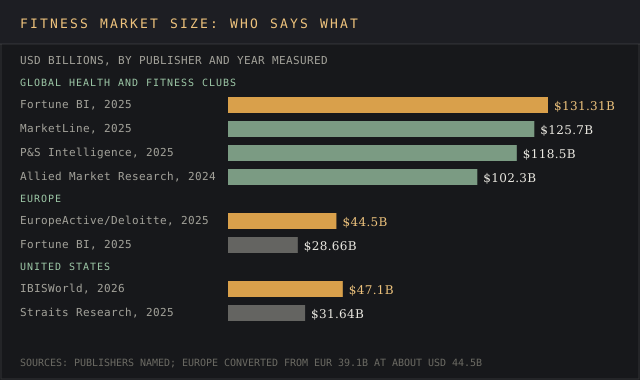
Four research houses put the 2024 or 2025 global fitness market between $102.3 billion and $131.31 billion, and each global fitness market report uses its own scope for the global gym industry. The devil's in the details: that $29 billion spread comes from definitions: what counts as a club, if personal training and spa revenue are in, and which countries are modeled.
| Publisher | Year measured | Market size | Forecast |
|---|---|---|---|
| Fortune Business Insights | 2025 | $131.31 billion | $298.16 billion by 2034 |
| MarketLine via ResearchAndMarkets | 2025 | $125.7 billion | 5.2% CAGR 2020 to 2025 |
| P&S Intelligence | 2025 | $118.5 billion | $210.7 billion by 2032 |
| Allied Market Research | 2024 | $102.3 billion | $234.8 billion by 2034 |
Published estimates of the global health and fitness club market
Regional numbers split wider still. Fortune Business Insights sizes Europe at $28.66 billion for 2025. EuropeActive and Deloitte, who survey operators market by market, put European revenue at €39.1 billion, about $44.5 billion, for the same year. That's a 55% gap on the same continent in the same year.
America's figures split the same way. IBISWorld's $47.1 billion for 2026 covers NAICS 71394; Straits Research puts the US health and fitness club market at $31.64 billion for 2025. Fortune Business Insights' North America figure, $56.33 billion, covers the whole continent.
Need the market-size estimates compared for your own region? Send the region and the segment.
Email a briefBritain shows the same problem with two careful sources. For 2025, ukactive's report with Grant Thornton counted 5,842 clubs, 12.2 million gym members and £6.5 billion revenue; Leisure DB counted 7,463 clubs, 12.1 million gym members and a £7.29 billion market value, per Health Club Management's side-by-side. On members the two are on the same page, within 100,000; on clubs they differ by 1,621.
The rule of thumb from these gaps: member counts from trade bodies are the most comparable gym statistics across sources, and revenue figures from research-house models are the least. Any global fitness market report figure needs its definition checked before it goes into a plan.
Global gym membership trends: Europe, the UK and the rest
Europe added 4.1 million net gym memberships in 2025, taking the total from 71.4 million to 75.5 million, up 5.8%, per EuropeActive's release of the European Health & Fitness Market Report 2026. Revenue rose 9.1% to €39.1 billion, and the sector added 1,965 net new clubs to reach 67,515, per SGI Europe.
EuropeActive's target is 100 million European members by 2030. At 2025's pace of about 4 million a year, the continent would reach roughly 95.5 million by the end of 2030, close but no cigar.
- Basic-Fit: 5.8 million gym memberships and €1.4 billion in revenue, Europe's largest operator (Athletech News).
- PureGym: 2.1 million gym memberships and €750 million in revenue.
- RSG Group: 1.8 million gym memberships.
- David Lloyd Leisure: €1.1 billion revenue, second by revenue.
- Deals: 27 major mergers and acquisitions completed in Europe in 2025.
The UK is one of the continent's two largest markets by members. ukactive's UK Health & Fitness Market Report 2026 counted a record 12.2 million gym members over 16, an 18% penetration rate that has risen by about a point a year: 14.6% in 2022, 16.0% in 2023, 16.9% in 2024 and 18.0% in 2025. Visits rose 10% to 679 million.
America is still the bigger fitness market by a distance. At 26.1% penetration among those aged six and older, against the UK's 18% of over-16s, the two aren't measured on the same base, but the 81 million US gym memberships are more than six times the UK's count.
Globally, HFA's 2025 Global Report, covering nearly 30 countries, found memberships up 6% in 2024, revenue up an average of 8% and the number of fitness facilities up nearly 4%, per HFA's summary. Its 2026 edition found operators expecting more of the same: more than 70% expect revenue to rise by more than 5% in 2026.
How many gyms, health clubs and fitness facilities there are
How many gyms the US has depends on who's counting and what counts as a gym. HFA's 2026 Global Report puts US fitness facilities at more than 55,300 locations; IBISWorld counts 107,878 businesses under NAICS 71394, which also takes in recreational sports centers and one-person studios.
| Scope | Count | Year | Published by |
|---|---|---|---|
| US fitness facility locations | 55,300+ | 2025 | HFA |
| US gym, health and fitness club businesses | 107,878 | 2026 | IBISWorld |
| Planet Fitness clubs, system-wide | 2,962 | Sep 2026 | Company release |
| Anytime Fitness locations, worldwide | 5,267 | 2024 | HFA Global Report 2025 |
| Life Time centers | 196 | Sep 2026 | Life Time |
| European health clubs | 67,515 | 2025 | EuropeActive and Deloitte |
| UK health clubs | 5,842 | 2025 | ukactive and Grant Thornton |
- The segment, region or club format to cover
- Regions, years and segments
- Where it runs: blog, white-label, gated or lead magnet
- Whose byline goes on it
- Deadline
- 2,500+ words, human-written
- Every figure linked to its source
- Yours to publish, under your name or none
- Hosting here for +$200, with your sponsored links
Gym and fitness center counts by source
The typical gym among HFA's fitness facilities handled more than 184,000 visits in 2025, about 504 a day across a 365-day year. At that volume a fitness center wears out equipment fast, and replacement sales lifted the largest franchisor's equipment line in 2026 even as new-club placements fell.
Health clubs and fitness facilities keep opening, and each new club has to win new members from the 74% of Americans outside a gym or from a rival. IBISWorld's business count has grown 2.1% a year on average from 2021 to 2026, and Europe added 1,965 net new clubs in 2025 alone. Our retail real estate market report covers what that demand does to shopping-center leasing.
Largest gym chains by gym memberships
Planet Fitness is the largest gym chain in the US by a wide margin. It finished Q3 2026 with about 21.5 million gym memberships across 2,962 clubs, after opening 33 new clubs in the quarter and raising its 2026 opening target to about 190 to 195.
| Operator | Members or subscriptions | Locations | Period | Source |
|---|---|---|---|---|
| Planet Fitness | 21.5 million | 2,962 | Sep 2026 | Company release |
| Basic-Fit | 5.8 million | n/a in source | 2025 | EuropeActive/Deloitte |
| Anytime Fitness | 4.2 million | 5,267 | 2024 | HFA Global Report 2025 |
| Crunch Fitness | 2.6 million | 458 | 2024 | HFA Global Report 2025 |
| Peloton | 2.553 million paid connected fitness subscriptions | online | Jun 2026 | Peloton |
| PureGym | 2.1 million | n/a in source | 2025 | EuropeActive/Deloitte |
| Life Time | 858,747 center memberships | 196 | Sep 2026 | Life Time |
Gym and fitness operators by members (latest published figures)
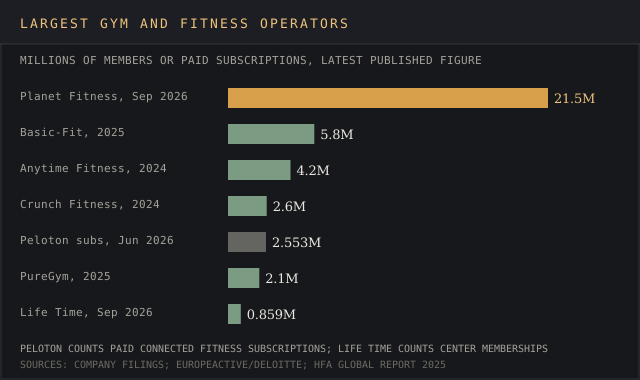
The Anytime Fitness and Crunch figures come from the HFA Global Report's brand rankings as reported by Sports Management. Anytime Fitness runs more locations than the HVLP leader with about a fifth of the gym members, on a small-box, 24-hour franchise model.
HFA's 2026 Global Report ranks the US segments this way: Planet Fitness leads high-volume, low-price, with Crunch Fitness, EōS Fitness and Chuze Fitness expanding; Life Time leads premium, followed by Equinox and The Bay Club Company; Anytime Fitness and LA Fitness anchor the mid-market; and Xponential Fitness leads studios on system-wide sales, per HFA's US country snapshot.
Life Time's number of center memberships rose 2.2% in the year to September 2026, per its 8-K filing, while revenue rose 14.2% to $893.5 million. That's the premium playbook in a nutshell: few new members, much more per member.
Boutique fitness studios, group classes and what members do
Boutique fitness studios lead on unit growth: in HFA's 2026 rankings, Club Pilates and HOTWORX led all US studio brands in new locations, and Xponential Fitness led on system-wide sales.
Boutique fitness studio memberships and big-box gyms now overlap, as the big boxes jump on the bandwagon. HFA's 2026 trends list names Planet Fitness, Snap Fitness, LA Fitness, Crunch Fitness and Amped Fitness as big-box brands adding Pilates, a format boutique studios built their business on, and the overlap puts boutique studios and budget gyms in the same group classes market.
What members do inside fitness clubs has shifted toward strength and away from cardio machines:
- Yoga: the most widely practiced activity, with 17.7 million facility members in 2025.
- Pickleball: up 21.3% to 7.6 million members; nearly two-thirds play weekly.
- Free weights: dumbbells, barbells and kettlebells have grown faster than any other equipment category since 2021.
- Cardio and HIIT: traditional high-intensity and stand-alone cardio formats are softening, per HFA.
Group exercise ties into retention, and operators keep adding class formats. Gym goers who book group classes have a fixed time and a known instructor, and the 2025 HFA benchmarking report tracks program offerings next to retention among its benchmarks.
The fitness equipment line follows member habits. The largest franchisor's equipment revenue rose 11.1% in Q3 2026 on replacement sales, while new-club equipment placements fell to 21 from 27, per Earnings Whispers.
Digital fitness, fitness apps and the connected fitness market
Health and fitness apps took a record $4.5 billion in in-app purchases in 2025, up 13%, while downloads rose 0.8% to 3.96 billion, according to Sensor Tower's State of Mobile 2026 analysis; Sensor Tower's category write-up credits AI features for much of the spending lift. That's fitness app revenue data from app stores alone, before web subscriptions.
The connected fitness market is shrinking at its best-known brand, and the pandemic hardware boom proved a flash in the pan. Peloton ended fiscal 2026 with 2.553 million paid connected fitness subscriptions, down 247,000 or 8.8%, and guides to 2.455 million to 2.475 million by June 2027, per its Q4 FY2026 release.
Peloton ended fiscal 2026 with 2.553 million paid connected fitness subscriptions, down 8.8%, per its Q4 FY2026 release.
Fall in Peloton paid connected fitness subscriptions, fiscal 2026
Source: Pelotone.g. boutique studio growth in the UK
Source: linked, checked, datedPeloton's total members, across hardware and app, fell 8% to 5.5 million, and paid app subscriptions fell 9% to 503,000, a drop in the bucket next to 81 million gym memberships, per Pelobuddy's breakdown of the results. Even so, subscription revenue rose 7% to $437 million in the quarter after a price increase, and the company booked its first full-year profit.
Digital fitness platforms and gyms share members more than they compete for them. Gym visits rose 4.2% in 2025 while Peloton subscriptions fell 8.8%: the pandemic swing toward home equipment has reversed, and fitness apps now sit next to gym memberships.
Fitness apps' downloads tell a slower story than their spending on digital fitness. Sensor Tower counted 3.6 billion health and fitness app downloads in 2024, up 6%, with the gyms and fitness subgenre accounting for seven of the top 10 apps by global downloads, per its State of Mobile 2025 write-up. Growth in 2025 then slowed to 0.8%, so fitness apps now grow by charging existing users more.
HFA lists AI integration and wearable fitness trackers among its 2026 market trends, which puts digital fitness inside the club's own offer. The digital fitness business that works in 2026 sits on top of a club, with fitness apps logging the workouts members do between gym visits.
Digital fitness also travels through partnerships. Peloton launched a content licensing deal with Spotify in April 2026, putting its classes in front of Spotify Premium members in most of Spotify's markets, per Peloton's Q3 FY2026 release. For people with gym memberships, digital fitness is a supplement on the days they don't go; for clubs, it's a retention tool between gym visits.
Personal training and fitness jobs
The US had 370,100 fitness trainer and instructor jobs in 2024, and the Bureau of Labor Statistics projects 12% growth to 2034, adding 44,100 jobs, per the BLS Occupational Outlook Handbook. That's four times the 3% projected for all occupations.
The median personal trainer or instructor earned $46,180 in May 2024, $22.20 an hour, below the $49,500 median for all occupations. A personal trainer on that wage costs a fitness business about as much as 16 Life Time members pay in a year of dues at $244 a month.
One-on-one coaching is the biggest non-dues revenue line at many clubs. Life Time named Dynamic Personal Training as a main driver of its in-center growth in Q3 2026, and HFA's benchmarking puts all non-dues revenue, coaching included, at 23.5% of club revenue.
Non-dues revenue at fitness facilities comes from a short list of services, and the published figures tie each to a source:
- Coaching: Life Time's Dynamic Personal Training grew at double digits in Q3 2026, per its earnings call.
- Recovery: 79% of facilities in HFA's benchmarking research offered recovery amenities, and the largest budget chain expects about 500 clubs to carry its Black Card Spa recovery add-ons.
- Spa and wellness: Life Time's LifeSpa also grew at double digits in the quarter.
- Classes: boutique studios charge for group classes directly; big-box gyms fold them into gym memberships.
For gym owners weighing where to add revenue, the split matters more than the total: the 76.5% from membership fees is predictable, while the 23.5% from services depends on how many gym members a club converts from access to coaching.
GLP-1 drugs, healthcare and the health and fitness sector
Weight-loss drugs have turned into a selling point for health clubs. HFA's 2026 Global Report lists GLP-1 partnerships among its market trends and cites research estimating that pairing GLP-1 treatment with exercise could save up to $28 billion in avoided costs over 10 years, a return of nearly 1,600% over 30 years, per HFA's US country snapshot.
The same snapshot puts US consumers' planned fitness spending for 2026 at an estimated $60 billion. HFA's own consumer data already shows free weights growing faster than any other equipment category since 2021, and the clubs selling GLP-1 programs are selling into a member base already moving toward strength work and fitness goals beyond weight.
The health and fitness sector's case to insurers and employers rests on the CDC's numbers. If fewer than half of adults meet the aerobic guideline and about a quarter meet the full standard, every fitness center that moves a member from the second group into the first has a claim on healthcare budgets, and HFA takes that case to Washington at its annual Fly-In and Advocacy Summit.
Physical activity statistics behind gym demand
About three in four US adults don't meet the full federal activity guidelines. In 2020, only 24.2% of adults met both the aerobic and muscle-strengthening guidelines, 22.7% met only the aerobic one, 6.8% met only the strength one and 46.3% met neither, per CDC Data Brief 443.
The aerobic number alone was 47.2% in 2024. The guideline is at least 150 minutes a week of moderate-intensity activity or 75 minutes of vigorous activity, plus muscle-strengthening work at least twice a week for the full standard.
That gap is the fitness sector's addressable market. HFA's 81 million gym memberships equal 26.1% of the population aged six and up, which leaves about three in four Americans outside a gym, and HFA's activity data shows members are twice as likely as non-users to hit their fitness goals on the federal measure.
Gym membership statistics for gym owners: what the numbers mean in practice
For a fitness business, the gym membership statistics above turn into three planning numbers: how many members leave, how many new members it takes to replace them, and how much each member pays beyond membership fees. Worked through for a hypothetical 3,000-member club, the HFA and chain benchmarks look like this.
- Annual losses at 66.4% retention: about 1,008 of 3,000 gym memberships end in a year.
- Monthly losses at 3.6% attrition: about 108 members a month, the rate the largest budget chain reported for Q3 2026.
- New member sign ups to grow 5.5%: about 1,173 new members a year, the 1,008 replacements plus 165 net adds, to match HFA's 2024 net growth.
- Non-dues share at 23.5%: on HFA's $2.0 million median club revenue, about $470,000 from coaching, wellness and services.
A stitch in time saves nine, and the arithmetic shows why operators in HFA's surveys put retention before acquisition. A typical gym that lifts retention from 66.4% to 70% keeps about 108 more gym memberships a year at 3,000 members, roughly a full month of new members, and a fitness business that keeps them spends less to replace gym memberships.
Operators are planning for more gym memberships and more new members anyway. In HFA's 2026 Global Report survey, more than 70% of operators expected revenue to rise by more than 5% in 2026, 57.7% expected EBITDA to do so, and 45.8% expected membership growth above 5%. HFA also found 79% of responding facilities offered recovery amenities, a sign of where fitness clubs are spending to keep members.
For new gym owners, the HVLP and premium chains set the price bands at either end, and the boutique studios fill the middle with class packs. A $15 Classic Card and $244 average dues mark the two ends of the published price range for any independent fitness center, and the 2,962 HVLP-leader clubs make the low end a crowded place to compete on price alone.
Gym industry outlook, 2026 to 2030
The published forecasts all point up, but the jury's still out on speed. They're one house's definition each, so the direction is more useful than any single number.
- US gym industry: IBISWorld projects revenue to keep growing over the five years to 2031 from $47.1 billion in 2026.
- Global health and fitness club market: Fortune Business Insights forecasts 9.66% a year from 2026 to 2034, to $298.16 billion.
- Europe: EuropeActive targets 100 million members by 2030, from 75.5 million in 2025.
- Jobs: the BLS projects 12% growth in fitness trainer and instructor jobs from 2024 to 2034.
- Largest US chain: the HVLP leader raised its 2026 club-opening target to about 190 to 195 and its revenue growth target to about 8%.
- Connected fitness: Peloton guides to another 9.8% fall in paid subscriptions by June 2027.
The health and fitness sector's own operators are the most bullish voice, and the CDC's activity data is the case for them: fewer than half of US adults meet the aerobic guideline, so the pool of potential gym members is still larger than the pool of current ones.
Methodology and sources for these gym statistics
Every number on this page comes from a named publisher, and the type of publisher matters for how far to trust it. The gym membership statistics come from three trade bodies that survey members or operators directly: the Health & Fitness Association (formerly IHRSA) in the US, EuropeActive with Deloitte for Europe, and ukactive with Grant Thornton for the UK.
- Member counts and penetration: HFA's annual survey of about 18,000 US residents, run with Sports Marketing Surveys USA.
- Visits: HFA's Fitness Industry Traffic Tracker, built on Placer.ai location data from nearly 11,000 US facilities.
- Retention and margins: HFA's 2025 Fitness Industry Benchmarking Report, a survey of 175 operating companies.
- Company figures: earnings releases, calls and SEC filings from the largest budget chain, Life Time and Peloton.
- Market size: IBISWorld for the US; Fortune Business Insights, MarketLine, P&S Intelligence and Allied Market Research for global estimates.
- Activity levels: the CDC's National Health Interview Survey; jobs from the BLS.
Fitness industry statistics from research houses are model outputs; trade body counts are survey results. Where the two conflict, as they do on Europe's market size, this page shows both and names each fitness association or research house behind them.
Delivered for your site and your byline. Hosting here is optional.
Frequently asked questions
How many people have a gym membership?
81 million Americans held gym memberships in 2025, 26.1% of the population aged six and older, per HFA. Europe had 75.5 million gym members and the UK 12.2 million.
How much does the average gym membership cost?
It depends on the segment. Planet Fitness's Classic Card is $15 a month, while Life Time's average monthly fee across its dues was $244 in Q3 2026. HFA's benchmarking found membership fees supply 76.5% of club revenue.
What is the average gym retention rate?
66.4% a year at US clubs in 2024, per HFA. In monthly terms, the largest budget chain reported 3.6% average attrition in Q3 2026.
How big is the fitness industry?
The US gym, health and fitness club industry generated $47.1 billion in 2026, per IBISWorld. Global estimates for 2025 run from $118.5 billion to $131.31 billion depending on the research house, and Europe alone took €39.1 billion.
Is the fitness industry growing or shrinking?
Growing. US membership rose 5.2% in 2025 to 81 million, visits per location rose 4.2%, and European revenue rose 9.1%. The connected fitness niche is the exception: Peloton's paid subscriptions fell 8.8% in fiscal 2026.
Are gym memberships increasing or decreasing?
Increasing. HFA counted 77 million gym memberships in the US in 2024 and 81 million in 2025, with new members outnumbering cancellations by about 4 million, and Europe went from 71.4 million to 75.5 million. The largest chain was flat at 21.5 million for the middle two quarters of 2026, up about 4% year over year.
What percentage of people use their gym membership?
About 95%. HFA found only 4.6% of members didn't use their gym memberships at all in 2025, a figure that matters to gym owners pricing off-peak plans. Average attendance was about 1.5 visits a week in 2024, down from 2.1 in 2019.
Is it true that 75% of Americans don't exercise?
Close, on the strict measure. In 2020, 24.2% of US adults met both the aerobic and muscle-strengthening guidelines, so about 76% fell short of the full standard. On aerobic activity alone, 47.2% met the guideline in 2024, and 46.3% met neither guideline in 2020.
What are the main issues facing the fitness industry?
Churn, pricing and cancellation rules. Clubs keep 66.4% of members a year, budget chains compete at $15 a month, and more than half of US states have automatic-renewal laws even after the federal click-to-cancel rule was vacated in July 2025.
Is the fitness industry oversaturated?
The numbers don't show it yet. IBISWorld counts 107,878 US businesses in a low-concentration market, but penetration rose from 25% to 26.1% in a year and visits per location still grew 4.2%. The largest chain's flat membership through 2026 is the one sign of a ceiling in the budget segment.
What percentage of gyms are successful?
About two-thirds of clubs in HFA's 2025 benchmarking sample had positive EBITDA, and the median EBITDA margin was 23.6%. That sample is of established operators, so it doesn't cover the small studios that close before they report anything.
Bottom line
Gym memberships in the US reached 81 million in 2025, 26.1% of the population aged six and up, and visits per location rose for 19 straight quarters. Europe added 4.1 million members and the UK hit 18% penetration.
Keep an eye on price: the money is moving faster than the members. Operators' revenue grew about four points faster than membership in 2025, Life Time's dues rose 11.9% in a year, and the biggest budget chain plans regional Black Card increases in 2027. Retention of 66.4% is the constraint every operator still faces.
For sizing work, start from the gym membership statistics by HFA, EuropeActive and ukactive, which agree across sources, and treat any single global fitness market figure as one house's definition. The small business owners running most of the 107,878 US fitness businesses are covered in our small business statistics.
Gym software vendors, equipment makers and franchise consultants use reports like this one in pitches and franchisee briefs.
A report on your topic for a blog page, gated content or a lead magnet.
Written for your client and published under their brand, with my name left off.
Your report on marketintelligencetools.com, with 2 to 3 CTAs carrying your sponsored links.
Default terms: the report is yours to publish, and I keep the right to republish it on this site behind a gate, outside Google's index.
Where each gym figure comes from, and the numbers no trade body publishes
Membership, visit and retention figures come from the Health & Fitness Association: its 2024 and 2026 US consumer reports, its Fitness Industry Traffic Tracker built on Placer.ai data, its 2025 Fitness Industry Benchmarking Report and its 2025 and 2026 Global Reports. European figures are from EuropeActive and Deloitte's European Health & Fitness Market Report 2026, and UK figures from ukactive and Grant Thornton, with Leisure DB's for comparison.
Company figures come from Planet Fitness, Life Time and Peloton earnings releases, calls and SEC filings for 2025 and 2026. Market sizes are IBISWorld's for the US, with Fortune Business Insights, MarketLine, P&S Intelligence, Allied Market Research and Straits Research for global and regional estimates. Activity data is from CDC Data Briefs 443 and 555, and jobs data from the BLS. All were checked on 17 November 2026.
No source publishes a sex split of US gym members for 2025, an average monthly fee across all US gyms, or cancellation reasons from a representative sample.