Burnout stats 2026: 53% to 55% of U.S. workers report job burnout
 By Jan Suski. I go deep on every review, checking every number against its source and digging up details other coverage misses, a habit from six years of SEO and link building for tech companies. Bylines at Brand24 and Senuto. How the scoring works.
Just over half of American workers say their job has burned them out. A NAMI and Ipsos poll of 2,153 full-time employees, fielded January 27 to February 2, 2026, put the figure at 53%. Eagle Hill Consulting's November 2025 survey of more than 1,400 employees found 55%.
Doctors are the exception to the trend. The AMA recorded physician burnout at 41.9% in 2025, down from 48.2% in 2023.
This report collects burnout statistics from the bodies that measured them, and all the data comes from the publisher that ran each survey: Gallup, the World Health Organization, NAMI, SHRM, Eagle Hill, the AMA and RAND. It covers how common employee burnout is, who it hits, what causes it, what it costs and which kinds of support lower it. It's written for HR leaders, managers and people analysts who need numbers with a publisher and a date attached.
The numbers U.S. and global workplace burnout, checked 19 November 2026
Two surveys fielded in late 2025 and early 2026 put U.S. job burnout at 53% to 55%.
Gen Z reports burnout at 66%, against 37% for baby boomers.
Physician burnout fell to 41.9% in 2025, down from 48.2% in 2023.
HR tech vendors, benefits providers and consultancies quote burnout numbers in every pitch. Send the industry, the country or the job group and I'll source a version you own.
The two newest U.S. burnout statistics put workplace burnout at 53% and 55%, two points apart, so a figure in that range is the current baseline.
Gen Z employees report burnout at 66%, nearly twice the 37% rate among baby boomers in the same Eagle Hill survey.
Only 42% of burned-out workers tell their manager, so most employee burnout never reaches the person who sets the workload.
How common employee burnout is in 2026
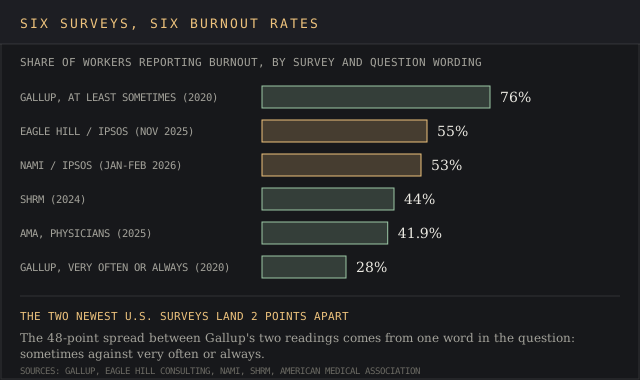
Six surveys published since 2020 put job burnout among U.S. workers between 28% and 76%, and the share of employees who experience burnout depends on the survey. The spread comes from who was asked and how the question was worded, and the table lists each survey with its sample and timing.
| Survey | Fielded | Sample | Burnout rate |
|---|---|---|---|
| NAMI and Ipsos, Workplace Mental Health Poll | Jan to Feb 2026 | 2,153 full-time employees | 53% |
| Eagle Hill Consulting Workforce Burnout Survey | Nov 2025 | 1,400+ U.S. employees | 55% |
| AMA Organizational Biopsy, physicians | Jan to Dec 2025 | About 19,000 physicians | 41.9% |
| SHRM Employee Mental Health research | 2024 | 1,405 U.S. employees | 44% |
| Gallup, at least sometimes | 2020 | U.S. employees | 76% |
| Gallup, top two frequency answers | 2020 | U.S. employees | 28% |
SHRM's 2024 numbers fill in what burnout feels like day to day. Of 1,405 employees, 44% felt burned out at work, 45% felt emotionally drained by their work and 51% felt used up at the end of the workday.
The NAMI poll adds the psychological side, and it shows how employees experience burnout outside the office. Among its respondents, 38% said their mental health suffered because of job demands, 39% felt so overwhelmed it was hard to do their job and 35% said their productivity suffered. Seven in 10 employees said they felt stressed about the state of the world outside work, and 41% of those uncomfortable discussing it at work named stigma as the barrier.
The employee engagement statistics report covers how employees experience burnout's twin, low engagement, in the same workforce, and burnout and engagement move together in most industries.
Why burnout rates differ between surveys
Gallup's own two readings sit 48 points apart. The 76% counts employees who feel burned out at least sometimes, and the 28% counts those who answered "very often" or "always." That one word in the question decides how bad burnout looks on a slide.
Copy these lines into an email, fill them in and send. I reply with scope and a price within 2 to 3 business days.
Open the emailThree variables move the number:
- Wording. Asking about burnout at least sometimes captures occasional bad weeks, and asking about frequent burnout captures the chronic cases.
- Population. NAMI surveyed full-time employees at companies with at least 100 staff, while the AMA surveyed physicians in 106 health systems.
- Timing. Eagle Hill fielded its survey in November, ahead of the year-end workload peak it warns employers about.
Employee surveys like these can't be averaged into one set of burnout statistics. Quote the burnout rate with its publisher, its question and its year, and compare like with like. Read between the lines of the question before quoting the answer.
How the World Health Organization classifies burnout
The World Health Organization classifies burnout in ICD-11 as an occupational phenomenon. It isn't classified as a medical condition, so occupational burnout is a work-related state and carries no medical diagnosis of its own.
WHO defines burnout syndrome as the result of chronic workplace stress that hasn't been successfully managed, with three dimensions:
- Feelings of energy depletion or emotional exhaustion
- Increased mental distance from one's job, or feelings of negativism or cynicism about it
- Reduced professional efficacy
The distinction matters for employers. Burnout is tied to the job by definition, so preventing burnout starts with workplace conditions and management practices, and a mental health condition such as depression or anxiety falls under a separate classification. WHO's fact sheet on work and mental disorders estimates 16% of working-age adults had a mental disorder in 2023.
Employee burnout by generation and gender
Workers under 30, Gen Z, report the highest burnout rates of any generation. Eagle Hill's 2025 survey breaks it down by age:
- Gen Z: 66%
- Millennials: 58%
- Gen X: 53%
- Baby boomers: 37%
Aflac's 2025-2026 WorkForces Report, reported by Insurance Business, found the same order, with 74% of Gen Z facing moderate or higher burnout against 66% of millennials. The same report found 51% of Gen Z employees couldn't pay $1,000 of unexpected medical costs, against 44% of all employees. The Gen Z statistics report covers the generation's pay, jobs and spending.
The occupational burnout gap by age runs the same way in both surveys. Employees 45 and older, Gen X and baby boomers, report lower burnout at 53% and 37%, and Gen X sits at the bottom on engagement, with Gallup's 2025 U.S. data putting Gen X at 29% engaged against 34% for baby boomers. The millennials statistics report covers the generation between them.
Women report burnout at higher rates than men. The 2022 Women in the Workplace study by McKinsey and LeanIn.Org found 43% of women leaders burned out against 31% of men at the same level, as the World Economic Forum reported. That same year, women leaders left their companies at the highest rate the study had recorded. The women in the workforce statistics report has the participation and pay data behind those numbers.
What causes workplace burnout
Gallup's burnout research is best known by its article title, "Employee Burnout: The Biggest Myth." The biggest myth, in Gallup's framing, is that long hours alone cause burnout. It ranked five contributing factors:
- Unfair treatment at work
- Unmanageable workload
- Unclear communication from managers
- Lack of manager support
- Unreasonable time pressure
Unfair treatment is the red flag Gallup ranks first, with workload second. Hours still count. Gallup found burnout risk rises once employees work more than 50 hours a week and climbs again past 60 hours, so employees who burn the candle at both ends carry the most risk even where treatment is fair.
Overtime patterns among nurses tell the same story. In a JAMA Network Open study of the 2018 national survey of registered nurses, those working over 40 hours a week had 3.28 times the odds of citing burnout as a reason for leaving, compared with nurses working under 20.
Eagle Hill's employees split the blame evenly, 50% on the work itself and 50% on the people side of work such as collaboration and team dynamics. Unclear expectations sit in both halves. Hours matter, though how employees experience burnout depends as much on the people around them as on the hours they log.
Caregiving responsibilities add load outside the job. NAMI found 61% of caregivers reported burnout against 49% of employees without caregiving duties.
Burnout among physicians, nurses and teachers
Physician burnout fell again in 2025, to 41.9%, from 43.2% in 2024 and 48.2% in 2023. The American Medical Association's figures come from nearly 19,000 physicians across 106 health systems, and job stress eased over the past year too, with nearly 43% reporting a great deal of it against 45.1% in 2024. Specialty gaps remain:
- Emergency medicine: 49.8%
- Urological surgery: 49.5%
- Hematology and oncology: 49.3%
- Obstetrics and gynecology: 45.7%
Nursing data is older and blunter, and it shows how registered nurses experience burnout as a reason to quit. Among nurses who left a job, 31.5% cited burnout, and 43.4% of those considering leaving named it too, according to the JAMA Network Open analysis published February 4, 2021.
Teachers carry more stress and work more hours than comparable professionals. RAND's 2024 survey found teachers working 53 hours a week, 15 of them outside their contracts, against 44 hours for similar working adults.
The pattern held in 2026. RAND's 2026 State of the American Teacher survey found 55% of K-12 public school teachers reported frequent job-related stress, against 34% of similar working adults. Female teachers sat at 59% and male teachers at 44%. On burnout itself, RAND's 2025 survey put teachers at 53%, 14 points above similar working adults, as The 74 reported.
RAND's 2026 survey found 55% of K-12 public school teachers reporting frequent job-related stress, against 34% of similar working adults, with female teachers at 59% and male teachers at 44%.
K-12 public school teachers reporting frequent job-related stress, 2026
Source: RANDe.g. stress rates for the job group you sell to
Source: linked, checked, datedManagers, individual contributors and burnout
When employees experience burnout, most stay silent with their managers, and managers see a fraction of it. Burnout stays under the radar in most teams. Only 42% have told their manager, and 42% of those who did say the manager took no action to reduce burnout, according to Eagle Hill. That leaves management with a partial view of the problem.
Gallup's research found all five burnout factors are shaped by how managers behave, which makes preventing burnout a management job. Unclear communication, lack of manager support, unreasonable time pressure and the fairness of work assignments are all set by managers.
Gallup's hybrid-work research points the same way. 48% of hybrid workers say their team hasn't discussed a plan for collaborating, and teams with a formal collaboration plan are 29% less likely to be burned out. Managers also decide who works more hours on the rota, which sets the burnout risk Gallup links to weeks past 50 hours.
Managers are burning out too. Gallup's State of the Global Workplace data shows manager engagement falling from 31% in 2022 to 22% in 2025, while individual contributors barely moved. Senior leaders reported daily stress at 46%, 7 points above individual contributors. Gallup's 2026 report found 79% of managers engaged in best-practice organizations, more than three times the global manager rate.
Manager support moves the numbers both ways. SHRM found employees with managers negatively affecting their mental health were far less likely to believe in the organization's mission, at 43% against 91%. Gallup puts managers behind at least 70% of the variance in team engagement scores. Without manager support, a burnout program at the organizational level has little to stand on, because the support employees feel day to day comes from managers.
Gallup also found higher engagement in organizations that adopted AI, 6 points above those that hadn't, with the biggest gains where managers actively support AI use.
The cost of employee burnout
Employee burnout shows up first in time off and job searches, and the emergency room figure ties workplace burnout to physical well-being. Gallup found employees who frequently experience burnout are 63% more likely to take a sick day, 23% more likely to visit the emergency room and 2.6 times as likely to be actively seeking a new job. The job search statistics report shows how long those searches take.
Turnover follows. SHRM found 45% of burned-out workers job searching against 16% of other workers, and Eagle Hill put burned-out employees at nearly three times as likely to plan to leave within a year. NAMI found 26% of employees had considered quitting because of work's impact on their mental health.
Engagement pays the other way. Gallup's Q12 meta-analysis found business units in the top quartile for engagement posted 23% higher profitability and 78% lower absenteeism.
Employee turnover is one line of the bill. Eagle Hill's respondents said burnout hurts their job performance (71%), their ability to serve customers (65%) and their attendance (56%).
At the national scale, poor mental health at work has a measurable price. WHO estimates 12 billion working days are lost every year to depression and anxiety, at a cost of $1 trillion in lost productivity. Gallup prices low global employee engagement at about $10 trillion, or 9% of global GDP, in its 2026 report. The same Gallup data puts 34% of employees worldwide in the thriving band of overall well-being.
Some employers measure the risk directly. People analytics platforms that track hours worked and attrition are compared in the workforce intelligence software ranking, and engineering teams survey developer burnout through the tools in the software engineering intelligence platforms ranking.
How employers reduce burnout
Workers have named the same fixes to reduce burnout since 2020. In Eagle Hill's surveys, employees asked for a four-day work week (69%), more flexibility (66%), a lower workload (63%) and working from home (56%), as Becker's reported in June 2024. A four-day week is easier said than done for a hospital or a call center, and flexibility and workload are the levers most employers can pull. Contact-center staffing figures are in the customer service statistics report.
Preventing burnout in hybrid teams comes down to agreed rules and support from managers, and the remote work statistics report has Gallup's full data on team charters and schedules.
SHRM found workers with a strong sense of belonging were 2.5 times less likely to feel burned out. Lower burnout follows the factors employers control, which are fair treatment, a workload set with the team and managers who give support. It doesn't matter how many resources a wellness program has if those three are missing.
The AMA's falling numbers show what a sustained workplace program to reduce burnout looks like. Health systems in its Organizational Biopsy measure job satisfaction, job stress, burnout, intent to leave and feeling valued every year, and 35 of them hold recognition in the AMA's Joy in Medicine program.
Job dissatisfaction runs lower than burnout among doctors, with 77% reporting job satisfaction in 2025, per Fierce Healthcare's coverage of the AMA data.
AI tools are the newest source of stress. In APA's 2026 Work in America survey of 2,009 workers, 48% worried that AI could make some or all of their job duties obsolete. Employers and managers rolling out AI tools can cut job burnout and support employees by setting clear expectations about which duties change, and the AI adoption statistics report tracks how fast that rollout is moving.
Delivered for your site and your byline. Hosting here is optional.
Frequently asked questions
Are burnout rates increasing?
For the general U.S. workforce, yes. Eagle Hill's survey published in June 2024 put burnout at 45%, and its November 2025 survey found 55%. Physician burnout fell over the same period, from 48.2% in 2023 to 41.9% in 2025.
Is Gen Z the most burnt out generation?
Gen Z reports the most burnout in both large 2025 surveys. Eagle Hill found 66% of Gen Z employees experiencing burnout, and Aflac found 74% facing moderate or higher burnout.
How common is employee burnout?
About half of U.S. workers report it. NAMI and Ipsos found 53% of full-time employees burned out because of their job in early 2026, and Eagle Hill found 55% in late 2025.
What job has the highest burnout rate?
Among physicians, emergency medicine had the highest rate in 2025 at 49.8%, per the AMA. Teachers report frequent job stress at 55%, against 34% of similar working adults.
What are the three dimensions of burnout?
WHO lists energy depletion or exhaustion, mental distance or cynicism about the job, and reduced professional efficacy.
Bottom line
Workplace burnout statistics put the rate at 53% to 55% of U.S. employees in the two newest surveys, with Gen Z at 66% and physicians down to 41.9%. Gallup's 76% and 28% come from one 2020 survey asked two ways, so quote the question with the number.
The causes in the data are unfair treatment, unmanageable workload and missing manager support, all of them management decisions, and the cost shows up in sick days, emergency room visits and job searches. Only 42% of burned-out workers tell their manager, which makes anonymous employee surveys the first place most companies will see the problem.
Lower burnout starts with the five factors Gallup ranked, and most of them sit with managers. Employers with limited resources can start there.
HR tech vendors, benefits providers and employers publish reports like this one as lead magnets and client briefs.
A report on your topic for a blog page, gated content or a lead magnet.
Written for your client and published under their brand, with my name left off.
Your report on marketintelligencetools.com, with 2 to 3 CTAs carrying your sponsored links.
Default terms: the report is yours to publish, and I keep the right to republish it on this site behind a gate, outside Google's index.
Where each burnout figure comes from, survey by survey
Surveys: nami.org (2026 Workplace Mental Health Poll), eaglehillconsulting.com (2025 workforce burnout survey), shrm.org (2024 employee mental health research), apa.org (2026 Work in America) and rand.org (June 2026 teacher survey).
Gallup: gallup.com (burnout research, State of the Global Workplace, U.S. engagement release of January 2026, hybrid-work guide, Q12 meta-analysis and manager research).
Health bodies and studies: who.int (ICD-11 burn-out entry, mental health at work fact sheet), ama-assn.org (2025 physician burnout), pmc.ncbi.nlm.nih.gov (JAMA Network Open study) and eurekalert.org.
Coverage: insurancebusinessmag.com, weforum.org, mckinsey.com (Women in the Workplace archive), the74million.org, beckershospitalreview.com (June 2024) and fiercehealthcare.com.
Every figure was checked against its source on 19 November 2026. Each survey defines burnout its own way, so each rate stays attached to its publisher.