SEOmonitor review: daily top-100 rank tracking, SEO forecasting and a €79 entry plan
 By Jan Suski. I go deep on every review, checking every number against its source and digging up details other coverage misses, a habit from six years of SEO and link building for tech companies. Bylines at Surfer, Brand24, and Senuto. How the scoring works.
Best for
SEO agencies tracking 3,000 to 20,000 keywords across several client websites, who pitch new business with traffic forecasts and want unlimited users, Google Analytics and Google Search Console data on every keyword row.
Not for
A single-site owner who needs more than 500 keywords or API access on the €79 plan, or a junior team that has to be productive in week one; G2 and Capterra reviewers call the interface daunting and easy to get lost in.
What it costs
€79 a month for 500 keywords on one website (Starter) or €299 a month for 3,000 keywords across unlimited websites (Pro), €49 per extra 1,000 keywords on Pro, €10 per website per month for each analytics connection, and 17% off for yearly prepayment.
- Starter
- €79/mo, 500 keywords, 1 website
- Pro
- €299/mo, 3,000 keywords, unlimited websites
- Extra 1,000 keywords
- €68 on Starter, €49 on Pro
- Analytics connection
- €10 per website per month on Pro
- Yearly billing
- 17% off, paid upfront
- Free trial
- 14 days, 1,000 keywords, no card
- Cancellation
- Any time; monthly refunds pro rata
- Depth
- Daily top 100, primary device
- Secondary device
- Weekly, Pro only
- Data ready
- By 8:00 AM, 99.9% SLA (vendor claim)
- Visibility
- 0% outside top 20 to 100% at #1
- Keyword folders
- Folders, groups, labels
- G2
- 4.7 from 30 reviews
- Capterra
- 4.5 from 8 reviews, customer service 4.9
- Founder and CEO
- Cosmin Negrescu
- Offices abroad
- United Kingdom and Turkey
- AI Overviews
- Daily mentions and citations
- AI models
- ChatGPT, Claude, Gemini, Perplexity, weekly
- Pro allowance
- 1,000 units, then €19 per 1,000
- Claude
- 5 units per keyword
AccuRanker
Not forAn agency whose pitch depends on revenue forecasts built from clients' GA4 data.
Semrush
Not forAn agency with eight account managers: their seats add $315 a month, against nothing on SEOmonitor.
Pairs well with SEOmonitor
SEOmonitor is an SEO monitoring tool built for agencies: Google rank tracking to position 100 every day, an SEO forecasting module that turns ranking targets into traffic and revenue projections, and keyword-level organic traffic pulled from Google Analytics 4 and Google Search Console, all in one account. Its pricing page pitches the Pro plan at "agencies, freelancers, and SEO teams managing multiple websites," and that's the focus of the whole account structure.
This SEOmonitor review covers what each plan costs from 500 to 20,000 keywords, how Visibility is calculated, what forecasting reads, how AI search is metered, what 38 G2 and Capterra reviewers say, and four alternatives.
It's written for agency owners and SEO leads comparing a dedicated SEO monitoring tool with the rank tracking tools inside the big suites. The timing matters. Older third-party reviews still quote a €49 starting price; the current rate card starts at €79, with Claude, ChatGPT, Gemini and Perplexity monitoring billed by the unit. Anyone renewing in 2027 gets a bill set by keyword count plus the AI models each client wants tracked.
What SEOmonitor does as an SEO monitoring tool
SEOmonitor splits the product into six modules on its features page: Rank Tracker, Keyword Research, SEO Forecast, Organic Traffic, Content Writer and Content Audit, plus an agency layer for SEO reports, the API and integrations. Rank tracking sits at the centre, and every other module reads the keywords a campaign tracks. Many features sit behind toggles on that page: four sections hide 30, 13, 10 and 5 extra items.
The design is agency math. A keyword counts once per campaign however many groups it sits in, seats and exports cost nothing extra on either plan, and Pro shares one keyword pool across an unlimited number of websites. An agency that signs a 12th client doesn't buy a 12th seat; it moves keywords inside the pool, and every account manager logs into the same account.
That makes it a monitoring tool for people who know the ropes. It expects you to create brand rules, target landing pages and groups of relevant competitors for each of your clients, and the payoff is a single tool where rankings, sessions, conversions & a forecast sit on the same keyword row. Starter and Pro carry different features beyond keyword volume, from the API to AI units.
Rank tracking and SEO monitoring: the daily top 100 on Google
Both plans track Google rankings daily to position 100 on the primary device, and Pro adds weekly monitoring on the secondary device, per the rate card. The features page adds a stored 100-result SERP per keyword, all SERP features and your presence in them, all-time best rankings on desktop and mobile, and raw result downloads for checking disputed rankings against live search results.
Monitoring timing is published. SEOmonitor's comparison hub says daily rankings are ready by 8:00 AM and that rank monitoring carries a 99.9% SLA. That's a vendor claim with no public status history beside it, so keep an eye on delivery times during the 14-day trial.
The monitoring layer is what the name refers to. The Page changes report links content edits to ranking changes, cannibalization reports flag drops caused by a landing page swap, Google core updates are annotated automatically, and you can create a target landing page per keyword so a wrong URL on the results page shows up as an issue.
Competitors get the same treatment. Suggested top competitors are sorted by Visibility, and group-level competitors pair site sections with the competitors you pick, so competitor monitoring runs per section.
Broken links and missing meta tags need crawl monitoring, and SEOmonitor's modules are built on rankings, pages and traffic, so a site audit such as the one in Ahrefs covers that layer. Google is the only one of the search engines the features page references; James F., a head of SEO, wrote on G2 in December 2017: "Working internationally, it'd be great if it supported Baidu, Yandex etc."
Keyword organisation runs three levels deep (folders, groups and labels), and AI grouping sorts thousands of keywords into categories. Keyword-gap analysis lists terms competitors rank for and you don't (analysis sorted by search volume), issue filters strip keywords that aren't relevant, and an Opportunity Score estimates traffic if a keyword reaches the top 3, which sorts the top keywords to push first.
Topic-wide Visibility gauges SEO demand across semantically related keywords. A G2 reviewer, a social media assistant at an enterprise, listed Topic Explorer and the Visibility Score as what they liked about the tool in April 2023.
How the Visibility metric is calculated
Of all its metrics, SEOmonitor's headline one is Visibility. Its documentation defines it as the sum of impressions divided by the sum of average search volume, where impressions equal an impression rate by rank times search volume. The rate falls from 100% at position 1 to 0% at position 20 and beyond, and only organic rankings count. Competitors get the same formula, so their Visibility compares like for like.
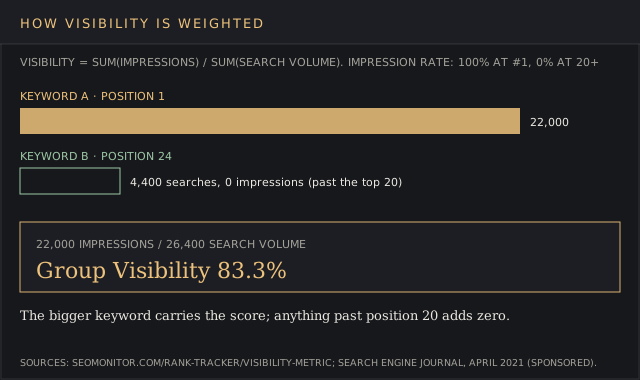
A 2021 sponsored post in Search Engine Journal, written by SEOmonitor, works an example: one keyword at position 1 with 22,000 monthly searches and one at position 24 with 4,400 give a group Visibility of 83.3%. The position-24 keyword adds zero because it sits past the cutoff.
Reviewers notice that cutoff. A Capterra head of marketing acquisition in entertainment, February 2023, lists this con: "Visibility metric only calculated using first 10 results". The current help article puts the cutoff at position 20 and points to Average Weighted Rank, a search-volume-weighted average position, for rankings deeper than that.
SEO forecasting: traffic, conversions and revenue
SEO forecasting is the module agencies buy SEOmonitor for. The forecast page lists the inputs: the campaign's keywords, their search volumes, the ranking targets you set, and actual non-brand organic traffic mapped to keywords, adjusted for year-over-year seasonality and for close variants so volume isn't counted twice.
Click-through in SEOmonitor's forecasting comes from SERP-adjusted CTR curves that change with the SERP features present, including AI Overviews. Mobile and desktop get separate volumes and CTR models, and you can override CTRs by position.
The output is monthly traffic and conversion projections, a revenue estimate through the Organic Traffic integration, and a Google Ads equivalent: what the same visits would cost as paid clicks. Scenarios are unlimited, so an SEO agency can create conservative and aggressive strategies and compare them, and a Chance Indicator grades each one Realistic, Ambitious or Too Ambitious from topical authority, current rankings and competition.
That answers the question a prospect asks before signing: how much revenue the work could add. The features page says a forecast takes 5 minutes to create and that the forecasting algorithms can be viewed and adjusted, which counts when clients' finance teams read between the lines of a pitch deck and want informed decisions on which scenario to fund.
Pitch use is the point. A Capterra reviewer, a digital marketing associate in IT services, March 2023, advises to "just check with the forecasting feature before reaching a new client".
"Forecasting is very strong, we've often found our results have been very accurate vs the estimates"
G2, Kevin G., founder at a small business, April 2024, comparing outcomes with what "we've estimated at a pitch stage from SEOMonitor forecasts." Source
The public forecast page leaves out the CTR table and the Chance Indicator's scoring formula. Check both inside the trial before forecasting numbers go into SEO reports for clients. Objective tracking then compares each forecast with real SEO performance month by month.
Organic traffic from Google Analytics and Google Search Console
Organic Traffic is the SEO module that turns rankings into sessions. Connect GA4 and Google Search Console and SEOmonitor's algorithm "distributes landing page traffic from Analytics into the specific keywords from Search Console," per its help center. Each keyword gets sessions, conversions and revenue; connect only Search Console and keywords get clicks. Those two help articles name GA4 and Search Console and no other sources.
Brand and non-brand traffic split on a brand rule set during campaign setup. Every keyword matching the rule is labeled brand automatically, and the rule can be edited, per the organic traffic overview. Non-branded traffic is the segment SEO work can move, so it's the one to zero in on, and it's the number forecasting starts from.
The full picture needs that traffic next to rankings, and traffic the model can't place on a keyword is labeled Unallocated, visible as its own line. The overview tabs (All, Brand, Non-Brand, Custom) carry five metrics: sessions, conversions or goals, bounce rate, conversion rate and revenue, at daily, weekly or monthly granularity.
The pricing page describes the "(not provided)" figure as a modeled allocation based on GA4 and Search Console data. That's par for the course for keyword-level traffic, and it means keyword-level conversion rate figures in client reports are estimates you defend with the method.
AI search monitoring: AI Overviews daily, four AI models weekly
SEOmonitor's AI search monitoring covers Google AI Overviews daily for mentions and citations, and ChatGPT, Claude, Gemini and Perplexity weekly, according to its AI search page. Its reports show how often a model names you, with what sentiment and against which competitors; if a model cites your pages and where they sit in its source list; and share of voice weighted by search demand.
Start narrow. The page advises agencies to focus on ChatGPT and AI Overviews, adding Claude, Gemini or Perplexity "when a client or a market calls for it."
Those metrics provide insights into where a client's brand appears in AI answers next to its Google rankings, without a second tool. Google AI Mode isn't among the engines named on that page, so Google AI Mode answers go unmonitored; AccuRanker's AccuLLM lists AI Mode next to AI Overviews, ChatGPT and Perplexity, per our AccuRanker review.
Metering is by the unit. One unit is one keyword tracked weekly on one model; ChatGPT, Gemini and Perplexity cost 1 unit per keyword and AI answers from Claude cost 5, per the pricing page. Pro includes 1,000 units and charges €19 per extra 1,000, so 1,000 keywords on Claude alone add €76 a month, the vendor's own example.
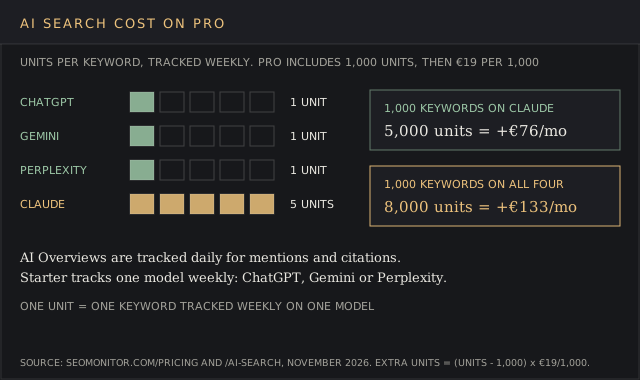
Run the same 1,000 keywords on all four models and the account uses 8,000 units, 7,000 above the allowance: €133 a month on top. Next to AccuLLM's separate subscription from $206 a month, €76 for Claude coverage is a drop in the bucket. One limit worth mentioning: Starter tracks one model weekly, and its FAQ lists ChatGPT, Gemini or Perplexity, leaving Claude out of AI visibility monitoring on the cheap plan.
New features ship fast, and reviewers credit it. Umut C., an SEO manager at an enterprise, wrote on G2 in March 2026: "Their integration of AI Overview (AIO) tracking was remarkably fast." Billing gets the opposite. Louis C., a senior web producer at an enterprise, scored SEOmonitor 3.5 on G2 in May 2026 and wrote of the AI tracking:
"these are a paid add-on, which feels unnecessary in today’s day and age"
G2, Louis C., senior web producer, enterprise, May 2026, adding "especially when other tools include similar capabilities without an additional cost." Source
SEOmonitor pricing in 2026
SEOmonitor publishes its full rate card on its pricing page, and the price scales with keyword volume. The page shows dollar and pound toggles, but every amount is in euros.
Starter steps from €79 for 500 keywords to €113 for 1,000, €181 for 2,000 and €249 for 3,000, the same focus on volume all the way up. At 3,000 keywords the Pro plan costs €299, so €50 a month buys unlimited websites, API access, weekly secondary-device monitoring, 1,000 AI units, the Agency Dashboard, data migration and onboarding. Starter covers one website, so an SEO agency with two clients is on Pro from day one.
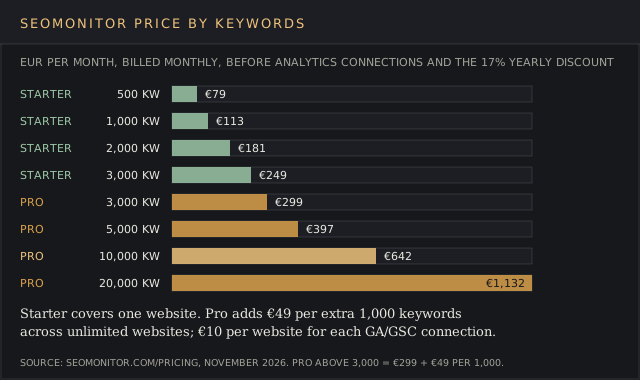
Normalized scenario: an agency tracking 10,000 keywords across 10 client websites, with analytics connected on each. Pro is €299 plus seven extra blocks of 1,000 at €49 (€343), so €642 a month, plus €100 for 10 connections at €10: €742 a month before the 17% yearly discount.
At the same €49 rate, 5,000 keywords cost €397 and 20,000 cost €1,132 before connections. AccuRanker's Expert plan covers 10,000 keywords at $764 a month on annual billing, per our AccuRanker pricing report.
Pro tiers run from 3,000 to 200,000 keywords within the selected account capacity, and no custom threshold is listed. For a wider view of how rank trackers price per keyword, the rank tracker pricing report sets the published plans side by side.
Hidden costs: analytics connections and AI monitoring units
Two lines push a Pro bill above the keyword math: analytics connections at €10 per website per month (Starter includes one GA/GSC set) and AI units at €19 per 1,000 above the allowance. Older reviews say SEOmonitor connects multiple analytics tools at no extra charge; on the current Pro plan each website's connection is a billed line.
Keyword counting has its own catch. A keyword counts once per campaign, but if you create another campaign or location for it, capacity is used again, so one term tracked in London and Dublin is two keywords. The devil's in the details, and this one is printed on the pricing page.
The same rule cuts the other way. A Capterra review from a project director in IT services, October 2020, notes: "If you remove keywords you no longer wish to track it will reduce your monthly bill."
Free trial, cancellation and refunds
The 14-day free trial needs no credit card and covers Google rankings and AI search monitoring on the first campaign, up to 1,000 keywords. Connecting GA4 and Search Console during the trial unlocks the Organic Traffic reports, which is where forecasting gets its baseline.
Monthly plans cancel at any time with pro-rata refunds. Yearly billing takes 17% off, paid upfront, with no locked-in contract; a yearly refund returns the unused portion after the months already used are recalculated at the standard monthly price. That's close to no strings attached, with one caveat the page states itself: a signed order form or negotiated agreement can override these terms.
Client reports, client access and the API
SEOmonitor can create reports three ways, per the features page: scheduled email reports with campaign overviews, read-only invites for clients to specific campaigns, and Looker Studio connectors plus a Google Sheets add-on. At a quick glance, the Agency Dashboard shows at-risk revenue and client health across clients, assigns account managers and deadlines, and lets you create alerts.
Branding on SEO reports is a custom logo. The help center even has a section titled Understanding SEO Performance for walking clients through the reports.
Looker Studio reports lag the app. One 2026 reviewer on G2 found AI visibility missing in the connector:
"The connectors to Looker Studio aren't quite up to date yet so not everything we can see in SEOmonitor can be seen reliably in Looker Studio such as AI visibility."
G2, Sarah T., small business, February 2026, in a five-star review titled "Intuitive, Reliable with Exceptional Support." Source
White-label reporting has drawn criticism. A G2 review from a digital marketing manager at a small business, April 2023, says "SEOMonitor is pretty costly." and "white-label reporting is unavailable, per my understanding of the tool." Agencies that want one dashboard of reports for clients across SEO, PPC and social add AgencyAnalytics on top.
The Content Writer can create articles in "under 15 minutes," with ideas to optimize pages tied to forecasted keywords. Content Audit flags overloaded pages, ones targeting too many keywords, as the next pages to optimize.
The API is one of the Pro features. The features page describes "unrestricted SEO API access" to create campaigns, manage keywords and read all metrics, plus MCP access for AI assistants; Starter has no API but keeps the MCP and Looker integrations.
What users praise and what they complain about
G2 lists SEOmonitor at 4.7 out of 5 from 30 reviews, and Capterra at 4.5 from 8, with customer service rated 4.9 and ease of use 4.4. The two sets agree on the strengths and the weak spots, and the weak spots look the same in reviews from 2017 and 2026. The detail and the update pace get credit: Martyn H.'s April 2026 G2 review is titled "Constant Innovation, Rich Reporting, and a Team That Goes Above and Beyond."
Support, forecasting and price per keyword
Support is the most consistent praise. A Capterra review from a marketing executive, May 2022: "Customer service is perfect, they are able to give you a lesson about the section of tool". On G2, a partner and industry lead SEO at a mid-market firm wrote in July 2024 that "The team at SEOmonitor handled the migration flawlessly, ensuring there were no disruptions to our workflow." Pro includes data migration, onboarding and training to get a new team up to speed.
Agencies like the per-keyword price. A helpful feature for calls with clients is Signals; David C., reviewing on G2 in March 2024 for a small business, wrote "Signals are soooooo good for client conversations and building trust." and "Rank tracking is super affordable in comparison to other tools". A Capterra SEO specialist in package delivery, February 2023, switched from Serpstat and gave the reason: "Price, SEOmonitor offered great value for money."
Interface, speed and the steep learning curve
The interface is the complaint in every year of reviews. Berian R., a digital marketing consultant, wrote on G2 in November 2017: "The interface can be challenging at times and powerful features are often hidden away." Chris C., an SEO specialist at an enterprise, on G2 in June 2023: "With so much information available, its easy to get lost, and its not the most accessible interface."
"fine for experienced users but for newbies or junior staff it can seem a bit daunting"
G2, Martyn H., head of insight, small business, April 2026, in a 4.5-star review that also says "The platform can be a bit overwhelming sometimes". Source
That's a hard start for a junior hire who has to hit the ground running on SEO clients. Keval D., on G2 in September 2023, puts it mildly: "It also has a little bit of a learning curve for utilizing SEOmonitor however the documentation is comprehensive to learn." The help center runs 13 sections, 44 articles in Rank Tracker alone.
Speed of the SEO monitoring tool is the second theme in reviews, from 2020 on Capterra to this G2 review:
"Can be slow and clunky sometimes (especially when trying to select which campaign to enter or uploading many keywords)"
G2, verified user, marketing and advertising, small business, October 2024, adding "but that seems to be something that effects more SEO keyword tracking tools." Source
Price is the third, and it lands hardest outside the eurozone. A Capterra marketing executive, May 2022: "It is so expensive, so if you are working in a non-europe country, it cost you too much." A euro-only rate card is a red flag for US agencies budgeting in dollars, since every invoice moves with the exchange rate.
Who builds SEOmonitor
SEOmonitor started inside an agency. Its about page says the agency was 5 years old when it narrowed its focus to SEO, and the company later opened offices outside its home country, in the United Kingdom and Turkey. Cosmin Negrescu is founder and CEO, per the 2021 Search Engine Journal post.
The about page lists a Customer Advisory Board of 9 members and a Best Innovation in Software win at the European Search Awards. The agency origin explains the tool's priorities: unlimited users, an Agency Dashboard for at-risk revenue, and forecasting built to win pitches.
SEOmonitor FAQ
What is SEO monitoring?
SEO monitoring is the daily monitoring of keyword rankings, organic traffic and site changes across search engines, with a flag when something moves: a ranking drop, a page swap, a core update, competitors climbing past you. Teams that monitor SEO for clients usually combine a rank tracking tool, Google Search Console and Google Analytics with a crawler for broken links, and set email alerts for the moves that need a response that day.
How much does SEOmonitor cost?
€79 a month for Starter (500 keywords, one website) or €299 for Pro (3,000 keywords, unlimited websites). How many keywords you track sets the bill, since users are unlimited on both plans and SEO reports for clients cost nothing extra.
Does SEOmonitor track AI answers?
Yes: Google AI Overviews daily and ChatGPT, Claude, Gemini and Perplexity weekly, measuring how often a brand appears in AI answers and which pages those AI answers cite. Pro meters it in units; Starter tracks one model.
Is SEO replaced by AI?
SEOmonitor's AI search page puts Google's share of the search market at about 90% as of mid-2026, citing CNBC, which is why it tracks AI citations next to Google rankings.
Which SEO tool is the most accurate?
It depends on what each tool measures. For rankings, SEOmonitor stores raw results and flags mobile-desktop disparities; keyword traffic is a modeled allocation of GA4 data; and Kevin G.'s G2 review reports forecasting results close to pitch estimates.
SEOmonitor alternatives: four tools compared
Four competitors cover the main reasons SEO agencies skip this monitoring tool: on-demand rank refreshes, an all-in-one suite, a backlink index, and a market-wide visibility index. Our competitive intelligence SEO tools ranking and the SEO tools pricing report cover the wider field.
AccuRanker: rank tracking with on-demand refreshes
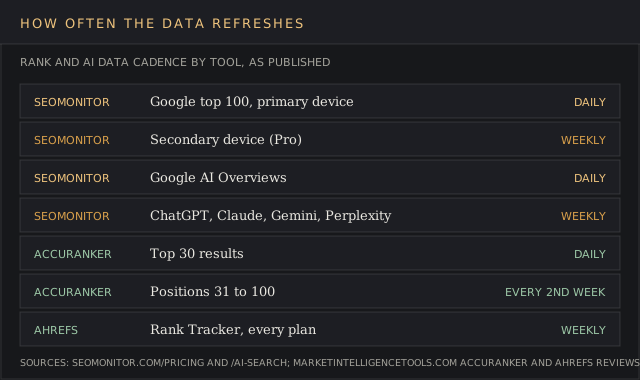
AccuRanker tracks Google and a handful of other search engines, with rankings in the top 30 daily and positions 31 to 100 every second week, per our AccuRanker review; SEOmonitor tracks all 100 rankings every day. AccuRanker wins for teams that want on-demand refreshes and a dollar rate card, from $224 a month for 2,000 keywords on annual billing. SEOmonitor wins where the pitch depends on revenue forecasting built from clients' own GA4 data.
Semrush: position tracking inside a 55-tool suite
Semrush runs $139 to $549 a month per single seat, plus $45 for each extra user, per our Semrush review and Semrush pricing report. Eight account managers on one Semrush plan add $315 a month in seats; on SEOmonitor they add nothing. Semrush is the jack of all trades of the group, and it wins for an SEO team that wants keyword research, backlinks, site audits, PPC and content tools in one login, with rankings in Position Tracking.
Ahrefs: backlinks and a weekly rank tracker
Ahrefs costs $29 for Starter, then $129 to $1,499 a month from Lite to Enterprise, and its Rank Tracker refreshes rankings weekly on every plan, per our Ahrefs review. It wins on backlinks and technical site audits; it loses for an SEO agency that sends clients reports on daily ranking changes. The Ahrefs vs Semrush comparison and the Ahrefs pricing report cover the suite choice.
SISTRIX: a visibility index built on DACH data
SISTRIX charges €119 to €799 a month, invoiced in euros, after a 2024 increase of 20% on three plans and 33% on Premium, per our SISTRIX review. Its Visibility Index rests on 18 years of German ranking history and measures any domain, while SEOmonitor's Visibility covers only the keywords you track.
SISTRIX wins for SEO agencies in Germany, Austria and Switzerland who pitch with market-wide index charts, and loses for anyone who wants revenue estimates, the job SEOmonitor's forecasting does. Plan detail is in the SISTRIX pricing report.
AgencyAnalytics pairs with SEOmonitor more than it competes: one Core plan at $20 per client per month billed annually, built as a cross-channel client reporting tool. Ten clients cost $200 a month for one dashboard across channels, per our review.
Verdict
SEOmonitor is a good tool for SEO agencies tracking 3,000 keywords and up across several client websites, who win business with forecasting, want daily top-100 rankings, and send clients reports built on GA4 and Search Console data. Unlimited users, a pooled keyword allowance, daily top-100 tracking and cancel-any-time billing make Pro at €299 a fair price point for that buyer, and support gets 4.9 on Capterra.
It isn't for a solo site owner who needs the API on a €79 account, a team that wants backlinks and a site audit in the same login, or a US agency that won't bite the bullet on a euro invoice. Semrush, Ahrefs or AccuRanker fit those buyers better, at the prices above.
It might suit an in-house SEO team with one large site, on two conditions: budget for €10 a month per analytics connection and for AI units if you track Claude, and plan training time, because reviews from 2017 to 2026 describe the same dense interface; Pro includes onboarding and training.