AI customer journey mapping in 2026: market estimates, adoption and limits
 By Jan Suski. I go deep on every review, checking every number against its source and digging up details other coverage misses, a habit from six years of SEO and link building for tech companies. Bylines at Surfer, Brand24, and Senuto. How the scoring works.
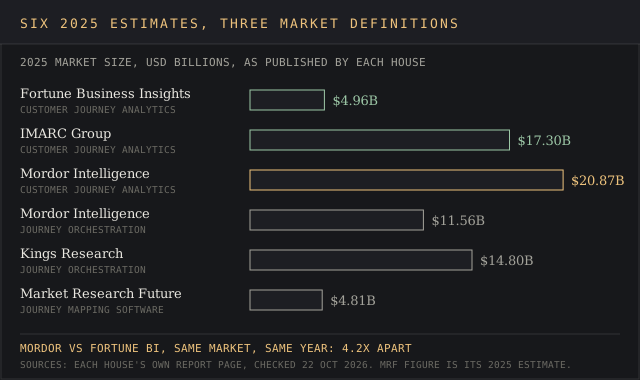
Seven research houses publish a size for the software companies use to map customer journeys and act on them. For one market and one year, 2025 customer journey analytics, their figures run from $4.96 billion at Fortune Business Insights to $20.87 billion at Mordor Intelligence.
Customers moved faster than the forecasts. Adobe counted a 693.4% year-on-year jump in generative AI referral traffic to US retail sites over the 2025 holidays. A Gartner survey of 3,566 customers in early 2026 found 87% want a route to a human agent whenever companies put GenAI in front of them.
This report covers the market sizes and why they disagree, the vendors and deals, published results from Bradesco, Verizon & Allstate, what customers report about AI touchpoints, and where AI-built journey maps go wrong, ending with a six-step build order. Practitioners from Heart of the Customer, Smaply, TheyDo and Nielsen Norman Group are quoted on the record.
The figures matter because they set budgets. A team that quotes the wrong house can overstate its market fourfold, and a team that automates journeys customers dislike pays in churn: 53% of customers in a Gartner survey said they'd consider switching over AI in service. It's written for CX, marketing and insights teams pricing a journey platform, chasing a competitive edge in retention, or deciding how far to trust a map a model drew.
The numbers AI customer journey mapping, seven research houses, checked 22 October 2026
Mordor's 2025 figure reads 4.2 times larger than Fortune Business Insights' for the same market, so every market-size citation needs the house's definition printed next to it.
AI-referred shoppers converted 31% better than other traffic, which puts the AI assistant on the customer journey as a new stage between the prompt and the first visit.
Only 24% of service leaders could show a positive return on AI, so an AI journey program still needs a pilot with a measured baseline before it gets a budget line.
CX vendors, agencies and analytics teams quote journey and AI adoption numbers in every pitch. Send the market or the platform set and I'll source a version you own.
How AI-powered mapping differs from a workshop journey map
A classic map of customer journeys comes out of workshops and interviews. A team lists the stages (awareness, consideration, purchase, retention), plots touchpoints and pain points from the customer's perspective, and the map stays fixed until someone redraws it. The free customer journey map template on this site follows that format.
AI-powered mapping reads all the data a company holds on customer journeys and keeps the map current. The customer data comes from CRM systems, web and app analytics, mobile apps, call transcripts, chat logs, reviews and survey verbatims, structured and unstructured data in one model. Five functions do the work:
- Clustering. Machine learning groups sessions into behavior patterns, including the loops, repeat visits and channel switches a linear stage model hides.
- Sentiment. Natural language processing gives a team the ability to read transcripts and verbatims at volume and score customer sentiment per touchpoint, so a pain point carries a measured tone across thousands of contacts.
- Prediction. Predictive analytics uses past behavior, purchase history and historical data to forecast customer needs and churn risk for each segment.
- Friction detection. Models flag friction points where drop-off or repeat contacts spike and suggest a fix to reduce friction, such as new support content or a shorter form.
- Triggers. The map turns into actions in real time: product recommendations, tailored recommendations by segment, AI-driven personalization that can personalize interactions across multiple channels, and routing between virtual assistants and human agents, the layer vendors sell as customer engagement.
AI makes the analysis step faster, and vendors of AI-powered mapping put large numbers on the saving. Insider One, which reports 1,500+ customers, says on its journey-mapping guide that "What once took weeks of manual work now happens in minutes."
Jochem van der Veer, co-founder and CEO of TheyDo, a journey management platform, set out where the AI models' job ends in a July 2025 CustomerThink interview:
"What LLMs are great at is understanding, labelling, tagging, grouping, clustering, and helping us see the patterns. But we still need human judgment, in the context of the business, to make a decision about what to do with those patterns."
Jochem van der Veer, co-founder and CEO, TheyDo
Market size estimates by research house
Eight estimates from seven houses cover three overlapping definitions of software for customer journeys. Each figure below comes from the house's own report page, checked on 22 October 2026.
| House | Market as defined | Base value | Forecast | CAGR |
|---|---|---|---|---|
| Fortune Business Insights (updated Oct 2026) | Customer journey analytics | $4.96B (2025) | $11.58B (2034) | 9.84% |
| IMARC Group (updated Jul 2026) | Customer journey analytics | $17.3B (2025) | $56.5B (2034) | 13.65% |
| Mordor Intelligence (updated Sep 2026) | Customer journey analytics, software plus services | $20.87B (2025) | $56.56B (2031) | 18.10% |
| Allied Market Research (Nov 2021) | Customer journey analytics | $8.29B (2020) | $46.68B (2030) | 18.8% |
| MarketsandMarkets (Mar 2021) | Customer journey analytics | $8.3B (2020) | $25.1B (2026) | 20.3% |
| Mordor Intelligence (updated Sep 2026) | Customer journey orchestration | $11.56B (2025) | $24.41B (2031) | 13.27% |
| Kings Research (updated Nov 2025) | Customer journey orchestration | $14.80B (2025) | $64.54B (2032) | 23.41% |
| Market Research Future (updated Oct 2026) | Customer journey mapping software | $4.81B (2025) | $19.67B (2035) | 15.12% |
Copy these lines into an email, fill them in and send. I reply with scope and a price within 2 to 3 business days.
Open the emailBase years differ by edition: Allied and MarketsandMarkets report 2020 values, the other six report 2025. Figures are each house's published estimate in US dollars.
Wider AI-in-CX definitions sit above all of these. Market.us puts the AI in customer experience market at $10.5 billion in 2023, rising to $76.7 billion by 2033. That customer experience definition counts chatbots, virtual assistants and contact-center AI technologies sold outside journey software.
Why the published estimates diverge by 4.2x
Scope explains most of the gap. Mordor defines the market as "every cloud or on-premise software solution, plus associated services" that tracks interactions across web, app, email, social, store and call-center touchpoints. Fortune Business Insights defines it as "the process of tracking and analyzing customer behavior," a definition built around the analysis process.
Edition dates do the rest. Allied and MarketsandMarkets published in 2021, before ChatGPT launched, and their pages still carry 2020 base years. Fortune's own 2023 edition valued the market at $3.85 billion for 2022, so its 2025 figure of $4.96 billion is consistent with its earlier line. IMARC's page gives a size and a scope list and leaves the definition to the buyer, who's left reading between the lines.
Growth rates split as widely as the base values. Customer journey analytics CAGRs run from 9.84% to 18.10%, and the two orchestration houses sit 2025 within $3.24 billion of each other, then diverge to 13.27% against 23.41% a year. A board deck should cite the house, the edition date and the scope line together. A lone market-size figure in a budget request is a red flag.
Vendors, analyst ratings and acquisitions
Gartner published its first Magic Quadrant for Customer Journey Analytics & Orchestration on 23 March 2026, and Adobe and CSG each announced a Leader placement. Forrester's Wave for customer journey management platforms in Q4 2025 named TheyDo a Leader, according to TheyDo's own release.
Money moved through the category since late 2023. The largest deals and scale markers, each straight from the horse's mouth in the company's own release or filing:
- Qualtrics signed to acquire Press Ganey Forsta for $6.75 billion, announced 6 October 2025.
- NEC agreed to buy CSG at $80.70 a share, a $2.9 billion enterprise value, on 29 October 2025. CSG owns the Kitewheel journey orchestration product.
- Adobe's Digital Experience segment, home of Journey Optimizer and Customer Journey Analytics, booked $5.86 billion in fiscal 2025, up 9%.
- Insider One raised a $500 million Series E led by General Atlantic in November 2024.
- Contentsquare, which closed its Heap deal in December 2023, says it serves more than 1.3 million websites.
- At the mapping-tool end, UXPressia cites 400,000 users and Smaply 200+ CX teams.
Medallia, taken private by Thoma Bravo for $6.4 billion in 2021, agreed to buy the orchestration vendor Thunderhead in January 2022. Our Medallia review and the Medallia vs Qualtrics comparison cover what those owners changed, and the customer experience intelligence rankings score ten platforms in the same buyer set.
What US buyers type into Google
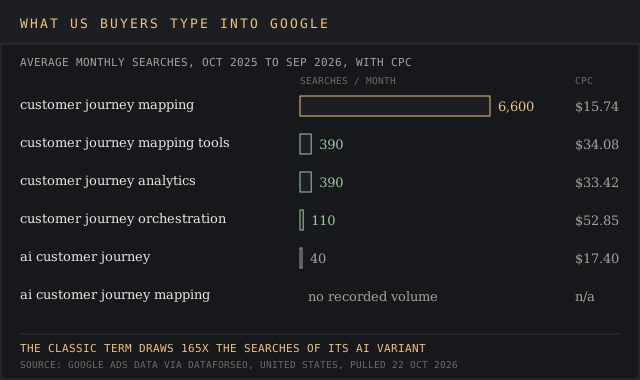
Buyers search the classic phrase and ignore the AI label. Google Ads data pulled through DataForSEO on 22 October 2026 shows 6,600 average monthly US searches for "customer journey mapping" and 40 for "ai customer journey", a 165-to-1 ratio. "ai customer journey mapping" returned no recorded volume at all.
Want a search-demand chart like this for your own keywords? Send the terms and the country.
Email a briefAdvertisers focus spend where purchase intent sits. A click on "customer journey orchestration" costs $52.85 against $15.74 for "customer journey mapping", a 3.4x premium for a term searched 110 times a month. Demand also runs on a calendar: "customer journey mapping" peaked at 9,900 searches in both October 2025 and March 2026 and fell to 4,400 through the summer months.
Google Ads reports "customer journey map" and "customer journey mapping" as one bucket, with identical monthly figures. The AI wording is in its early stages in search, living in vendor copy and analyst reports, and a page that ranks only for "AI journey mapping" is chasing a needle in a haystack. The efficient target for a content page stays the classic phrase.
How AI is transforming the customer journey itself
The impact of AI on customer journeys starts before a brand's own touchpoints. VML's Future Shopper 2025 study of 25,000+ shoppers in 16 countries, summarised under the title AI Reimagines the Customer Journey, found 68% of global consumers have used generative AI tools like ChatGPT. Bain puts the US share using generative AI for product research and comparison at 30% to 45%.
Traffic data shows where AI is transforming the path to purchase. Adobe Analytics, measured across more than 1 trillion online shopping visits to US retail sites, recorded the 693.4% jump in AI referrals for November and December 2025. Adobe Digital Insights reported AI-referred visitors converting 31% more than other traffic sources, 33% less likely to leave at once, and spending 45% more time on site.
Adobe Digital Insights found AI-referred retail visitors spent 45% more time on site and were 33% less likely to leave at once.
More time on site from AI-referred retail visitors
Source: Adobe Digital Insightse.g. AI referral traffic in your sector
Source: linked, checked, datedThe base is still a drop in the bucket. Bain found AI accounts for up to 25% of referral traffic for some retailers and under 1% of total traffic. Aaron Cheris, a partner in Bain's retail practice, called it "a major shift in retail discovery and loyalty since the rise of search engines." He added that these AI systems "are beginning to act independently across the shopping journey." Our AI traffic report tracks the same referral share across more sectors.
Service sits on the same curve. Gartner's July 2026 survey found customers are about three times more likely to use third-party GenAI tools than company-provided chatbots when resolving issues. A journey map built in 2023 starts at the brand's first touchpoint, after the ChatGPT session has already happened, and the chatbot statistics show how fast that row filled up.
BCG's Derek Rodenhausen told Think with Google in February 2025 that "Influence is the ability to meaningfully impact decisions by earning consumer attention." The same piece cites Google and Measure Protocol data showing US Android users cross over 130 mobile touchpoints a day.
BCG's research with Google, cited in the same piece, found almost one-fifth of companies qualify as AI leaders, with 60% higher revenue growth than their peers, the clearest business growth figure in the piece.
Published results from Bradesco, Verizon and Allstate
Three named cases of AI agents and assistants carry most of the published evidence on AI in customer experience. Bain's November 2025 article How Agentic AI Is Transforming Customer Experiences reports them:
- Bradesco. The Brazilian bank's generative AI chatbot resolves customer problems without human intervention in 90% of cases, serving millions of customers a day.
- Verizon. Generative AI predicts the reason behind 80% of incoming service-center calls and routes the caller to one of its human agents. Bain reports the AI reduces store visits and overall churn, and credits it with keeping an estimated 100,000 customers from leaving in 2024, the clearest customer loyalty number in the article.
- Allstate. AI drafts almost all claims emails, and Bain reports the models write more empathetic emails than many of Allstate's human representatives, who still check them for accuracy.
All three hand repetitive tasks to AI and send complex issues to people. IBM's own customer service guide states mature AI adopters reported 38% lower average inbound call handling time. Gartner predicts that by 2029 agentic AI will resolve 80% of common customer service issues without human intervention, cutting operational costs 30%. That's a cost efficiency forecast, and the jury's still out.
Leaders are spending on it now. Gartner's 2026 survey of 1,303 senior leaders at companies across industries found service and support put a median 12% of their 2025 budget into AI, the highest of ten business functions. An IBM Institute for Business Value survey of 2,000 executives and designers in 13 countries found 57% call generative AI the most disruptive force on how they'll design experiences. The AI adoption statistics page tracks the wider spend.
What customers say about AI touchpoints
Customer expectations of AI come with a condition attached. In Gartner's 2026 survey, 50% said interactions are easier when companies use GenAI, and 87% called an option to reach a human agent essential. Eric Keller, a senior director analyst at Gartner, put the design rule plainly: "Service leaders should not use GenAI as a mandatory first step for every issue."
The 2024 baseline was colder. A Gartner survey of 5,728 customers in December 2023 found 64% would prefer companies didn't use artificial intelligence in customer service, and 53% would consider switching to a competitor over it. Salesforce's survey of 15,015 consumers in 18 countries found nearly 75% want to know when they're dealing with AI agents, 45% are more likely to use one with a clear escalation path, and 72% trust companies less than they did a year earlier.
Failure rates are measured too. Qualtrics XM Institute surveyed 20,000+ consumers in 14 countries in Q3 2025 and found nearly one in five who used AI for customer service saw no benefit, about four times the failure rate of AI usage in general. Misuse of personal data was the top concern at 53%, up 8 points, and half worried AI would cut off human interaction with the company.
Isabelle Zdatny, head of thought leadership at the institute, said: "Too many companies are deploying AI to cut costs, not solve problems, and customers can tell the difference."
For a journey map, those numbers put the focus on three requirements. Every AI touchpoint needs a visible exit to a person and a disclosure line, and personalized experiences need a data-use policy a customer can read. The customer service statistics and customer experience statistics pages carry the customer satisfaction and switching data behind this.
Where AI-built journey maps go wrong
A map of customer journeys generated from a prompt carries invented detail. Jim Tincher, founder and CEO of Heart of the Customer, described the failure in a 2026 interview with The CX Lead:
"AI invents specificity. Small, plausible findings: a number in the right range, a quote that sounds right."
Jim Tincher, founder and CEO, Heart of the Customer
Tincher's working split keeps human expertise on the decisions: "AI on the data, humans when customers decide if they matter to you."
Nielsen Norman Group's Maria Rosala and Kate Moran wrote in a June 2024 analysis of synthetic users that "Synthetic users cannot replace the depth and empathy gained from studying and speaking with real people." Diana Villalobos, a CX and market researcher at Makeable, added a time limit in CustomerThink in August 2026: "A synthetic persona is frozen at the moment its data was captured."
Tool makers say the same. Marc Stickdorn, co-founder and CEO of Smaply, wrote on the Smaply blog in September 2025 that "AI suggestions are starting points, not finished products," and that AI "may also reinforce stereotypes." A map built from a model's guesses about a persona is pie in the sky until interviews and behavioral data back it.
Project risk sits on top of map risk. Gartner predicts over 40% of agentic AI projects will be canceled by the end of 2027 on cost, unclear value or weak risk controls, based on a January 2025 poll of 3,412 webinar attendees.
The same release estimates only about 130 of the thousands of vendors selling AI agents are real, which will send plenty of buyers back to the drawing board. Add the 24% of service leaders with a positive AI return, and a buyer who skips the pilot is putting all their eggs in one basket.
How to build an AI-assisted journey map
The order below puts research first and automation last, and each step leaves an artifact the next one checks.
- Set one business goal. Focus on a measurable target such as increasing customer satisfaction at onboarding or cutting churn in month two, and record the baseline before integrating AI, so the CX, marketing and data teams are on the same page.
- Interview real customers. Run interviews in each segment and draft the stages by hand from the customer's perspective. It's the least efficient step, and it produces the evidence the models are later checked against.
- Unify the customer data. Connect CRM systems, web analytics, mobile apps, contact-center transcripts and surveys, usually through a customer data platform. The CDP pricing report compares 15 vendors.
- Let the models find patterns. Use machine learning to understand customer behavior at scale, natural language processing for sentiment, and predictive analytics from predictive intelligence software for churn. Segment with behavioral market segmentation before analyzing customer behavior by path.
- Check every finding. Focus on tracing each friction point back to sessions, tickets or quotes. A finding with no source gets cut.
- Automate one trigger and measure it. Launch a single AI-powered action, such as product recommendations after a failed search or a hand-off rule for AI-powered chatbots, against a holdout group, tracking customer satisfaction and churn before changing wider business processes.
The customer analytics tools rankings compare the platforms for step 4, and sentiment analysis pricing covers 20 vendors' rates for the NLP layer. The customer intelligence guide explains how journey data feeds a wider customer experience strategy, and customer retention statistics put a value on each point of churn the map removes.
Delivered for your site and your byline. Hosting here is optional.
Frequently asked questions
How is AI-based journey mapping different from traditional journey mapping?
A traditional map comes from workshops and interviews and stays fixed until it's redrawn. An AI-assisted map reads CRM, analytics, transcripts and survey data continuously, forecasts customer needs, and updates stages, friction points and personalized experiences as behavior changes.
How does AI improve the customer journey mapping process?
It speeds up the analysis. Machine learning clusters paths, NLP reads thousands of verbatims, and predictive analytics flags churn risk by segment. TheyDo's Jochem van der Veer lists labelling, tagging, grouping and clustering as the model's strengths and keeps decision making with the customer experience team.
Can AI build a customer journey map on its own?
Generative AI can draft one from a prompt, and practitioners warn against shipping it. Jim Tincher of Heart of the Customer says "AI invents specificity," and Nielsen Norman Group says synthetic users can't replace research with real people.
What is the impact of AI on customer journeys?
It adds a stage before the first visit. VML found 68% of global consumers have used generative AI tools, Bain puts US use for product research at 30% to 45%, and Adobe recorded a 693.4% rise in AI referrals to US retail sites over the 2025 holidays.
Bottom line
The market for AI customer journey software is real and growing, and its size depends on who's counting: $4.96 billion or $20.87 billion for the same 2025 market, depending on the house and its definition. Gartner's first Magic Quadrant for the category in March 2026 and a $6.75 billion Qualtrics deal show where the vendors are placing bets.
On the customer side, AI assistants now sit at the front of customer journeys and send shoppers who convert 31% better, while 87% of customers still want a human within reach. The teams getting results, Bradesco, Verizon and Allstate among them, use AI on the data and on routine tasks and keep people on the decisions.
Verizon's 100,000 retained customers are the measurable version of happier customers. Build the map from interviews and behavioral data first, then let the models keep it current.
Journey platforms, CX agencies and analytics consultancies publish reports like this one as lead magnets and sales material.
A report on your topic for a blog page, gated content or a lead magnet.
Written for your client and published under their brand, with my name left off.
Your report on marketintelligencetools.com, with 2 to 3 CTAs carrying your sponsored links.
Default terms: the report is yours to publish, and I keep the right to republish it on this site behind a gate, outside Google's index.
Where each figure came from
Every market-size figure was read on the research house's own report page on 22 October 2026, and each source is linked where it's first cited.
Sources for the market-size sections, in order of first use, are fortunebusinessinsights.com, mordorintelligence.com, news.adobe.com, gartner.com, insiderone.com, customerthink.com, imarcgroup.com, alliedmarketresearch.com, marketsandmarkets.com, kingsresearch.com, marketresearchfuture.com and market.us.
The vendor, adoption, customer-survey and quote sections add globenewswire.com, business.adobe.com, businesswire.com, einpresswire.com, qualtrics.com, sec.gov, contentsquare.com, uxpressia.com, smaply.com, thomabravo.com, vml.com, bain.com, business.google.com, ibm.com, salesforce.com, thecxlead.com and nngroup.com.
Search volumes and cost-per-click figures are Google Ads data for the United States, pulled through DataForSEO on 22 October 2026 and covering October 2025 to September 2026.
Quotes are verbatim from the linked interview, blog post or press release, with each speaker's title as published there.